India
India  Mongolia
  Sweden
  Australia
Algorithmic Trading Platform Development Companies in India with relevant client projects include Softlabs Group and Infomaze. Softlabs is building a broker-connected platform for separate live-capital, paper, forward-testing and backtesting workflows. Infomaze describes custom trading software for an unnamed Indian stockbroking company, covering stock futures and options strategies, customer accounts and execution monitoring.
This guide compares software development partners, not investment managers, trading signals or ready-made bot subscriptions. The main questions are how strategy rules become orders, how the system handles failures and what evidence supports its readiness.
Live trading can cause financial loss. A working broker connection, paper-trading demonstration or backtest does not prove profitability or production readiness. This article covers software development, not investment advice.
Algorithmic trading developers at a glance
Use this list of Algorithmic Trading Platform Development Companies in India to compare documented engineering work. Keep project scope, delivery status and financial performance separate when assessing a provider.
| Company | Location | Relevant project | Project status and scope |
|---|---|---|---|
| 1. Softlabs Group | Mumbai, Maharashtra | Akshit: Fyers-connected platform with separate live-capital, paper, forward-testing and historical backtesting workflows. | In progress; not production-hardened. Includes application allocation checks and strategy lifecycle handling. |
| 2. Infomaze | Mysore, Karnataka | Unnamed Indian stockbroking company: custom futures/options strategy software and an administration interface. | Completed work described by Infomaze. The public account does not identify the client or establish independently verified deployment or returns. |
Algorithmic Trading Platform Development Companies in India: project experience
Look for a match to your required order flow, broker interface and operating model. A company may have relevant development experience without having built every research tool or operational control your platform needs.
Softlabs Group
Mumbai, Maharashtra, IndiaSoftlabs develops custom business software and automation. Its project for Akshit in India brings market data, strategy rules, order handling and recorded activity into one platform, with real-capital execution kept separate from simulation and research workflows.
Relevant project: multi-mode strategy platform for Akshit
The current build receives Fyers market-price updates, evaluates configured strategy conditions and checks application-level strategy and user allocations before eligible new buys. It stores order linkage and supports Created, Running, Paused, Stopped and Error lifecycle states.
The platform is in progress and not production-hardened. Live-capital mode can submit real orders, but that capability does not establish safe operation or a completed deployment. Monitoring, security, recovery, reconciliation and emergency-response controls still need production-level review and verification.
The multi-mode algorithmic trading case study explains the implementation. The walkthrough below separates its operating modes and current control limits.
Start with the broker, order flow and controls your platform needs.
Infomaze
Mysore, Karnataka, IndiaInfomaze documents a custom algorithmic trading project for an Indian stockbroking business. Its account focuses on implementing the client’s strategies and giving staff an administration interface to manage customers and review strategy execution.
Relevant project: an Indian stockbroking company
In its Custom Algo Trading Software case study, Infomaze describes developing multiple algorithms for stock futures and options. The administration interface lets the client explore strategies, create customer accounts and track execution outcomes. The account also describes allowing stakeholders to change strategies without returning to the developers for each change.
The client is unnamed, and the case does not disclose its broker integration or implementation stack. Ask Infomaze to demonstrate the relevant order flow, access controls and failure handling, and confirm which parts of the described system apply to your brief. The project account is not independent evidence of trading returns.
How we separate live orders from strategy testing
In progressWe are building the Akshit platform around four distinct workflows. The separation matters because evaluating a strategy, simulating an order and sending a real broker order are different operations with different risks.
Live-capital trading
This mode can send eligible buy and sell requests to the connected Fyers account. It uses real money and can create losses. Its existence does not mean the platform is production-ready.
Paper trading
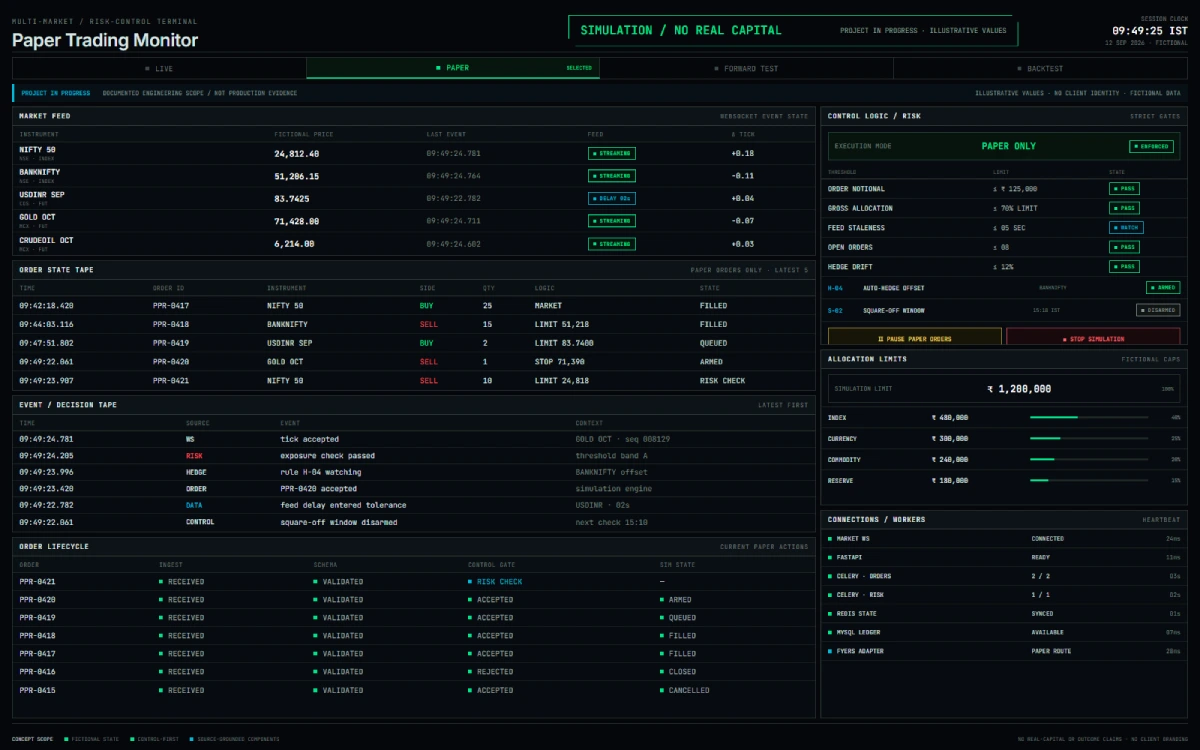
Paper mode simulates orders without sending real-capital orders to the broker. It supports checking strategy logic, allocation decisions and recorded order activity.
Forward testing
This workflow observes strategy behavior as new market data arrives. It remains separate from real-capital order submission and does not establish live execution quality or future results.
Historical backtesting
A separate engine applies strategy logic to historical data and stores simulated trades and statistics. Its outputs depend on the data and assumptions used, not just the strategy code.
From a price update to an order record
Fyers WebSocket updates feed the active grid strategy. The strategy checks its configured percentage conditions and application-level strategy and user allocations. In live-capital mode, an eligible request can reach the Fyers API. The platform stores the order and links it to the related trading record for lifecycle checks and later review.
The allocation checks can block an eligible new buy when the application’s available allocation is insufficient. They do not establish broker-account margin or cap financial loss. A percentage profit threshold can trigger a square-off request, while a drop threshold can block further buys; neither guarantees a price, a fill or protection from loss.
Pause and Stop are not emergency position closure
Pause stops further strategy processing but does not close open positions. Stop marks the strategy as stopped and pauses linked users; it is not a confirmed standalone panic control that closes every position. Monitoring integration, security hardening, recovery and order/position reconciliation remain unfinished production work.
For buyers assessing Algorithmic Trading Platform Development Companies in India, this distinction is worth testing directly: what stops processing, what cancels an order and what actually requests position closure. Those actions should not be treated as interchangeable.
Read the full Softlabs strategy-platform case study for the engineering scope and current limits. It reports no financial performance results.
Define strategy rules, broker access and platform ownership
Give Algorithmic Trading Platform Development Companies in India a written specification that can be tested. A request for an automated trading platform leaves too many choices open: instruments, data, order types, users and the actions allowed in each mode.
Strategy inputs and decisions
Specify data inputs, entry and exit rules, sizing, timing and what happens when information is missing. Provide example events with expected decisions, not just a chart of past results.
Broker and market-data scope
Name the broker accounts, permitted interfaces, instruments and order types. Confirm data rights, session handling and API limits with the relevant providers before fixing the integration scope.
Users and live-order permissions
Define who may create strategies, change allocations, access broker connections and enable live execution. Explain who owns each account and who handles operational incidents.
Testing assumptions and records
Define historical data, fees, slippage and simulated-fill assumptions. Specify the strategy version, inputs, order events and broker responses that must be stored for later investigation.
Test trading-platform failures before approving live use
When shortlisting the top Algorithmic Trading Platform Development Companies in India for your project, compare their failure tests as closely as their feature demonstrations. Ask each provider to show the same scenarios and explain what remains unverified.
- Keep simulation away from broker orders. Test that paper, forward-testing and backtest activity cannot submit live orders. Make mode changes and user authorization explicit.
- Handle rejected and partial orders. Check how the platform records broker responses and partial fills, and how those events affect remaining quantities and strategy state.
- Recover without duplicate submissions. Interrupt a connection or restart a worker during an order request. Verify the system checks broker state before deciding whether another submission is needed.
- Detect stale data and reconcile positions. Test feed delays, reconnects and mismatches between local records and broker records. Define when the application must stop new activity and alert an operator.
- Separate pause, cancel and close actions. Demonstrate their effects on pending orders and open positions. Test the emergency procedure separately rather than assuming a Stop button provides it.
- Define the operational handover. Agree access control, credential handling, monitoring, backups, recovery, source-code rights and support. Obtain the required broker, security, regulatory and production reviews for the intended deployment.
Ask for separate costs and milestones for data integration, strategy logic, research tools, execution controls, testing and production preparation. A first working demonstration is a useful milestone, not the final acceptance test.
Questions about algorithmic trading platform development
Which development company should we shortlist?
Do paper trading and backtesting prove a strategy will be profitable?
Can the platform connect to any broker?
Does stopping a strategy close all open positions?
Is the Softlabs platform ready for production use?
What do we need for a useful cost and timeline estimate?
Define the rules. Test the order flow.
Bring Softlabs your broker requirements, strategy logic and operating modes. Discuss a development scope with clear controls and acceptance tests, not a promise of trading returns.
Discuss my trading platform