PROJECT IN PROGRESS

Multi-Mode Algorithmic Trading Platform for Strategy Validation

INDIAAkshit

A custom platform is being built for Akshit to run and evaluate trading strategies across live-capital, paper, forward-testing and historical backtesting workflows.

The platform connects market-price data, strategy rules, order handling, capital controls and lifecycle management in one technical system. Its purpose is to support controlled strategy development and validation—not to promise trading results.

Discuss Your Platform Requirements
Illustrative multi-mode algorithmic trading platform with separate live-capital, paper, forward-testing and historical backtesting workflows
Fyers API v3
Broker integration
Operating workflows
Live capital, paper trading, forward testing and backtesting
Strategy execution and validation
Main use
Building / In Progress
Not production-hardened
Important: This project is still being built and is not production-hardened. Live-capital mode can place real orders through the connected broker account. Trading can result in financial loss. Paper trading, forward testing and backtesting do not prove future or live performance. This page is a technical project description, not investment advice.

Akshit

Capital Markets

Multi-Mode Algorithmic Trading Platform for Strategy Validation

Building / In Progress
Client location
India
Project type
Custom algorithmic trading software
Main use
Strategy execution and validation
Broker integration
Fyers API v3
Operating workflows
Live capital, paper trading, forward testing and backtesting
Production status
Not production-hardened
Client Objective

A Single Platform for Strategy Execution and Validation

Akshit needed a technical platform that could support different stages of algorithmic strategy work without treating every stage as the same.

The platform is being designed to:

  • receive live market-price updates;
  • evaluate strategy conditions on each relevant update;
  • place real orders when live-capital mode is intentionally active;
  • simulate orders when paper mode is active;
  • observe strategy behavior under live-forward conditions;
  • test strategy logic against historical data;
  • apply allocation and lifecycle controls;
  • store orders, trades and strategy statistics for review.

The project separates real-capital execution from simulation and research workflows. This separation helps users understand which actions can reach a broker and which actions remain inside the platform.

It does not remove trading, model, data, execution, broker, connectivity or implementation risk.

Why Four Workflows

Why Four Workflows Are Kept Separate

Strategy development is not one activity. Historical analysis, simulated execution, live-forward observation and real order placement have different purposes and different risks.

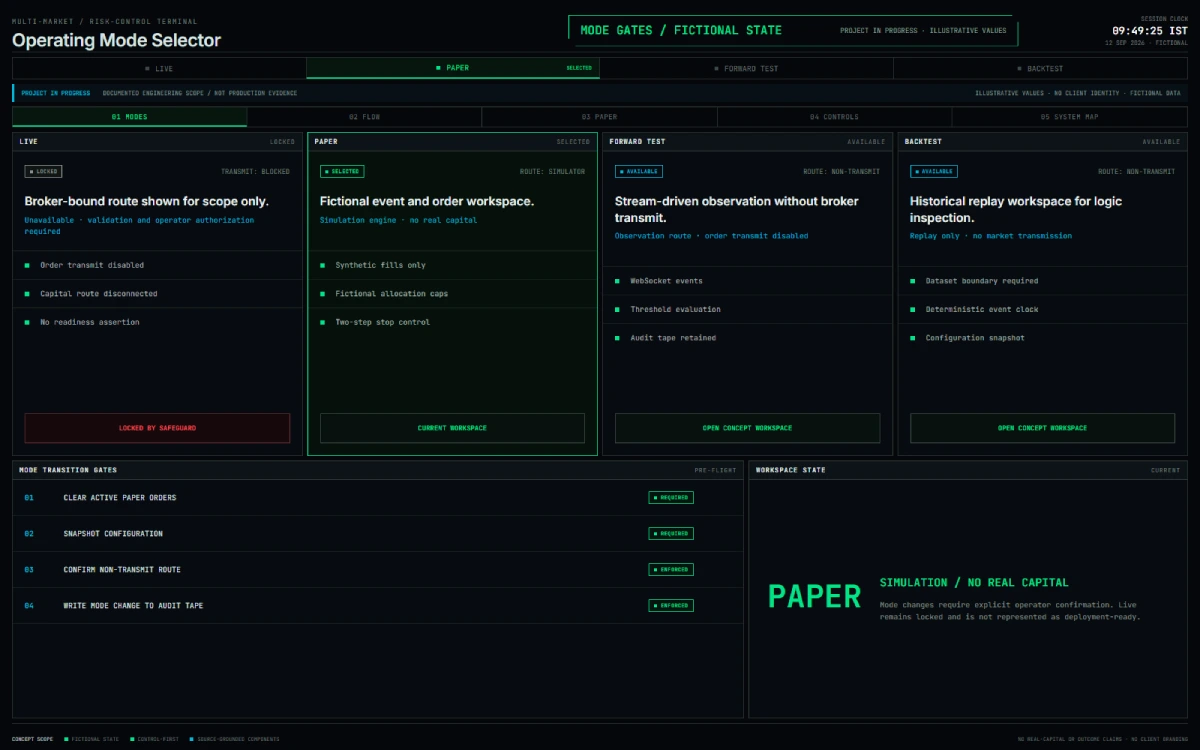
The platform therefore separates four workflows:

  1. Live-capital trading for real broker orders.
  2. Paper trading for simulated orders with no real-capital execution.
  3. Forward testing for observing strategy behavior with live-forward market conditions without treating the observations as proof of financial performance.
  4. Backtesting for applying strategy rules to historical data and storing simulated trades and statistics.

A strategy may behave differently across these workflows. Historical or simulated behavior does not guarantee live execution quality or future financial results.

Illustrative view of the platform’s four separate operating workflows
Illustrative view of the platform’s four separate operating workflows. Values are fictional. The project remains in progress.
Operating Modes

Four Modes for Different Stages of Strategy Work

01

Mode 01

Live-Capital Trading

Live-capital mode can send real buy and sell orders to the connected Fyers account.

Market-price updates are evaluated against the active strategy rules. When an eligible condition is met and the configured controls allow it, the platform can submit an order through the Fyers API.

Boundary: This mode uses real capital and can create financial losses. Its existence does not prove that the platform is publicly operating, adopted, profitable or production-ready.
02

Mode 02

Paper Trading

Paper mode simulates strategy orders without sending real-capital orders to the broker.

It supports checking application logic, order flow and recorded strategy behavior before choosing whether to use live-capital mode.

Boundary: Paper trading avoids real-capital exposure during that mode, but it does not reproduce every live-market condition. It does not prove future returns, fill quality, latency, slippage, liquidity or live performance.

03

Mode 03

Forward Testing

Forward testing observes strategy behavior using live-forward conditions while keeping the validation purpose separate from any claim of proven financial performance.

It is intended to help review how strategy rules respond as new market data arrives.

Boundary: Forward-test observations are not proof of future or live performance. They may differ from real execution because of market, data, timing, broker, model and implementation factors.

04

Mode 04

Backtesting

The separate backtest engine applies strategy logic to historical data and stores simulated trades and strategy statistics for review.

It helps inspect how the logic would have behaved under the historical data and assumptions used by the engine.

Boundary: Backtest outputs are hypothetical. They may be affected by data quality, assumptions, costs, liquidity, look-ahead bias, overfitting and implementation differences. They do not guarantee future or live results.

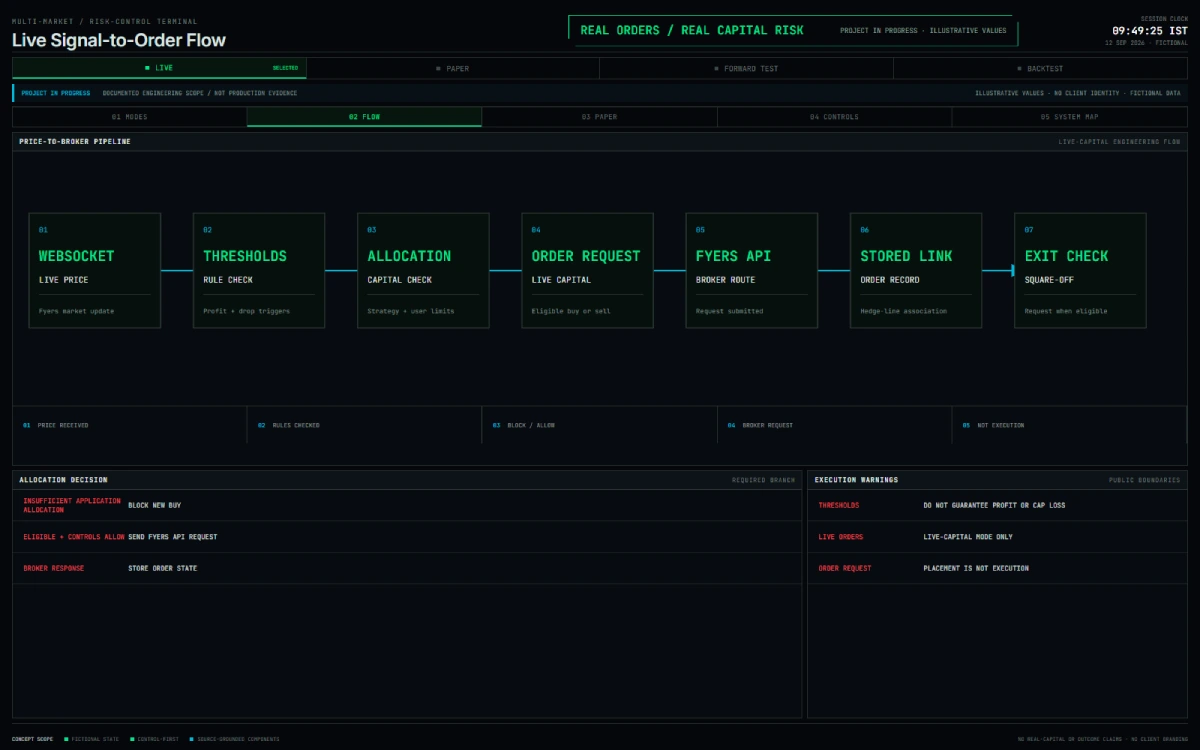
Signal-to-Order Workflow

How the Live Workflow Is Designed to Operate

Step 01

Live market-price updates

The Fyers WebSocket supplies live market-price updates.

Step 02

Active grid strategy

The active grid strategy receives each relevant price update.

Step 03

Profit threshold

The strategy checks its configured percentage-based profit threshold.

Step 04

Drop threshold

The strategy checks its configured percentage-based drop threshold.

Step 05

Strategy allocation

The platform checks the strategy’s total allocated fund limit.

Step 06

User allocation

The platform checks the linked user’s allocated fund limit.

Step 07

Insufficient allocation

If available allocation is insufficient, the platform blocks the new buy.

Step 08

Eligible order request

If the strategy condition is eligible and the controls allow it, the platform sends the required buy or sell order through the Fyers API.

Step 09

Stored order linkage

The platform stores the order and links it to the relevant hedge-line trading record.

Step 10

Lifecycle checks

The linked position remains available for lifecycle and exit-condition checks.

Step 11

Square-off request

When the configured exit condition is met, the platform can submit the square-off order.

Step 12

Recorded state

The order, trade and strategy state are recorded for later review.

Workflow Boundaries
  • A profit threshold is a strategy trigger. It does not guarantee that an order will fill at the threshold price or produce a profit.
  • A drop threshold can block further buys under the configured strategy rule. It does not cap losses and is not the same as a broker-side stop-loss order.
  • Square-off behavior depends on application state, market conditions, data, connectivity and broker response.
  • A linked hedge-line order provides order association. It does not guarantee a hedge, a fill or a reduction in financial risk.
  • Real orders are submitted only in the live-capital workflow.
  • Simulation and backtest orders must remain clearly labelled as non-live.
Illustrative signal-to-order sequence from live market data through rule checks, allocation checks, broker order handling and stored order linkage
Illustrative signal-to-order sequence from live market data through rule checks, allocation checks, broker order handling and stored order linkage. Values are fictional.
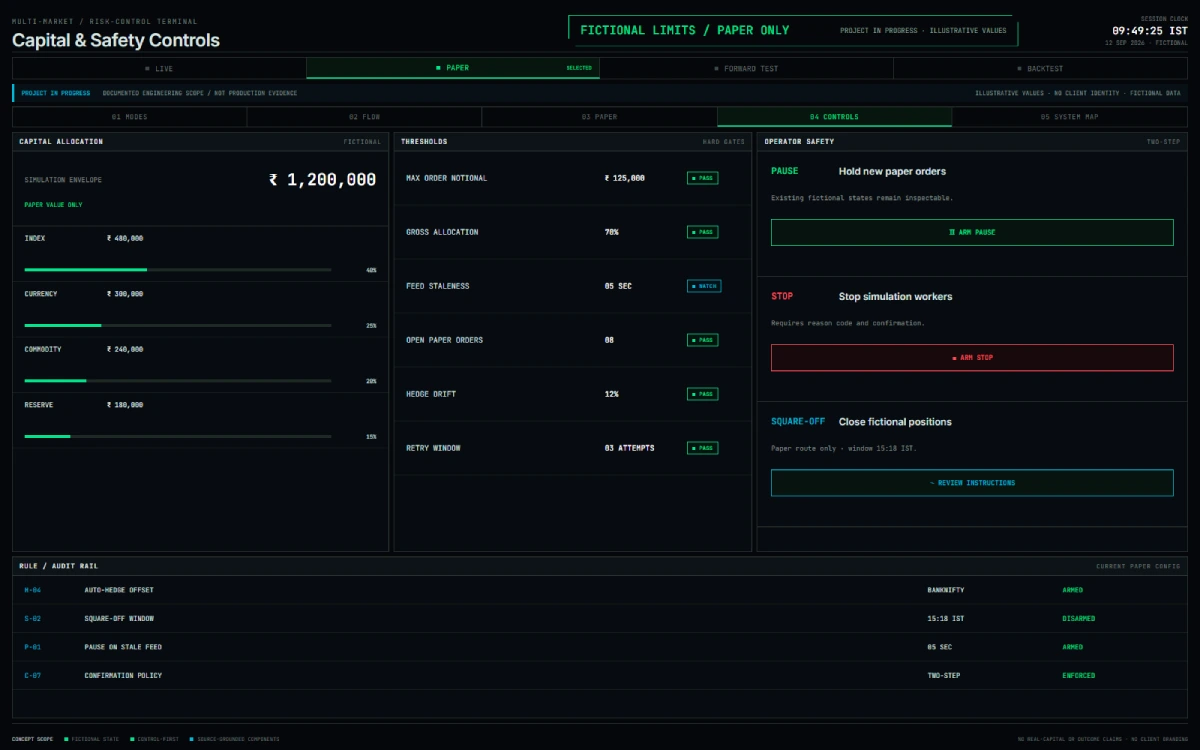
Implemented Controls

Implemented Strategy and Capital Controls

The current build includes the following controls.

Application-level allocation, threshold and lifecycle controls
Paper-Trading Monitor

Reviewing Simulated Strategy Activity

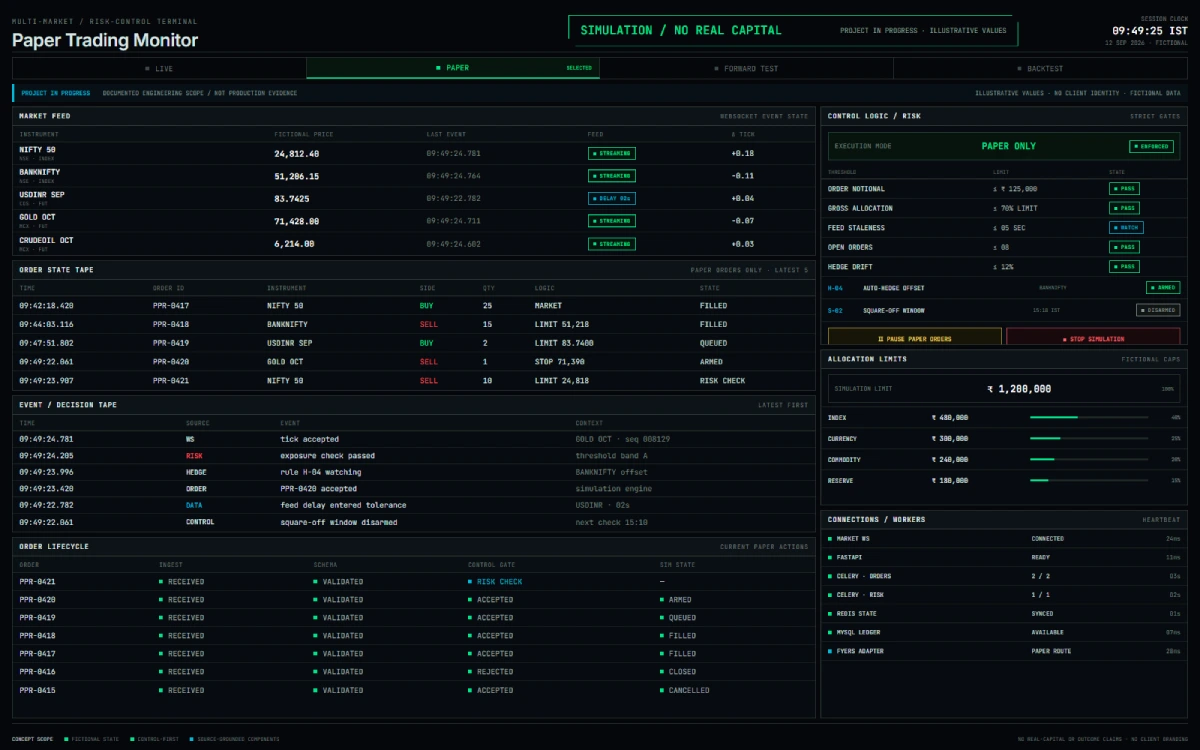
The paper-trading workflow is designed to show simulated orders, strategy state and recorded activity without submitting real-capital orders.

Simulation / No Real CapitalPaper-trading monitor with fictional values. Simulation / No Real Capital.
Paper-trading monitor with fictional values. Simulation / No Real Capital. The display is illustrative and does not show financial performance.

Paper-trading activity is simulated and does not submit real-capital orders.

Paper trading can help check:

  • whether strategy conditions are reached;
  • whether simulated orders follow the intended sequence;
  • whether allocation checks block ineligible actions;
  • whether records are linked correctly;
  • whether pause, stop and error states are represented correctly;
  • whether simulated activity is stored for review.

Paper trading does not validate future profitability or reproduce every live execution condition.

System Architecture

Architecture for Streaming, Automation and Stored Activity

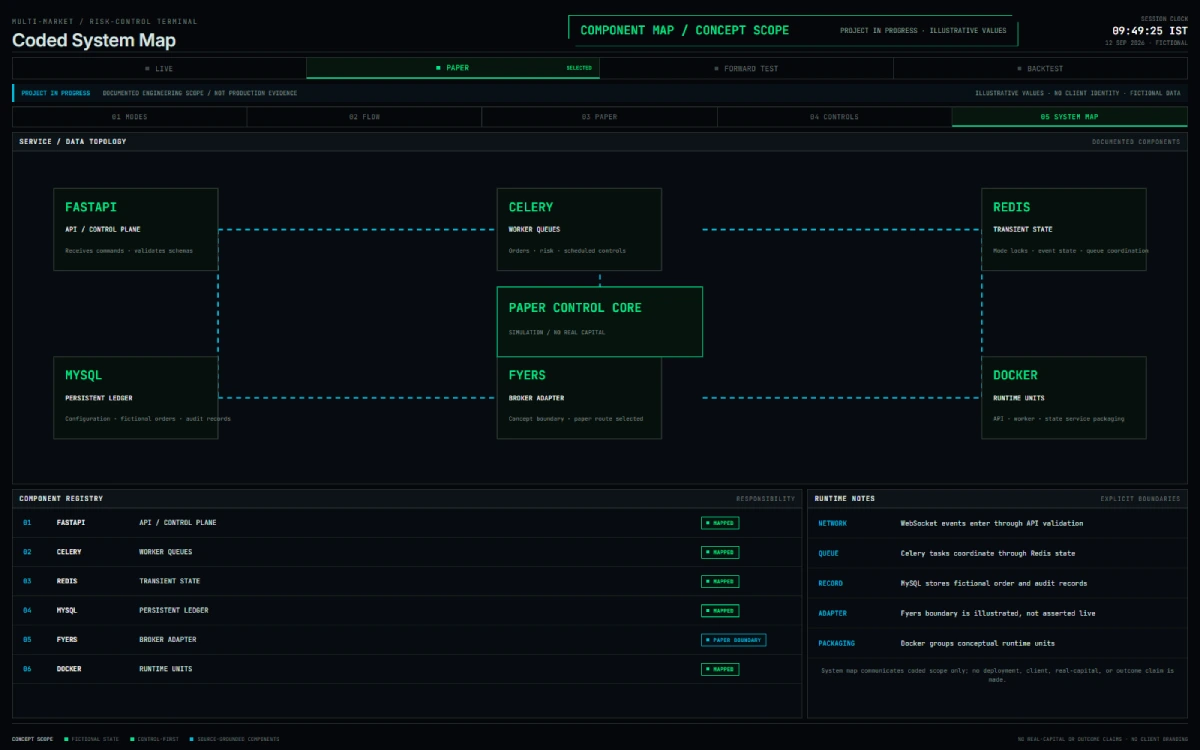
The platform combines real-time market data, API services, scheduled processes, background workers, broker connectivity and persistent storage.

01

Market Data and Broker Connection

Fyers API v3 supplies WebSocket price streams and REST broker communication. Only live-capital mode can submit real orders.

02

Application and Automation

FastAPI and Uvicorn handle strategy operations and lifecycle changes. APScheduler and Celery worker and beat processes support scheduled and background work; production must prevent duplicate execution.

03

Storage and Coordination

MySQL, SQLAlchemy 2.0 and Alembic manage records and schema changes. Redis supports queues and scheduling, but is not the only safeguard for live-order execution.

04

Deployment and Logging

Docker and Docker Compose support consistent setup. File and database logging are available, but active monitoring integration remains incomplete and production readiness is not implied.

Illustrative architecture showing market data, broker connectivity, API services, schedulers, workers, Redis, MySQL and logging
Illustrative architecture showing market data, broker connectivity, API services, schedulers, workers, Redis, MySQL and logging. No credentials, private endpoints or internal code details are shown.
Current Hardening Gaps

Current Production and Risk Boundaries

The platform is being built and is not production-hardened.

Current limitations include:

  • There is no confirmed standalone emergency panic control that immediately closes every position.
  • The normal stop action is not a panic close-all action.
  • Pausing a strategy does not close open positions.
  • Broker-side per-trade stop-loss bracket protection is not currently confirmed and was absent in older code.
  • The percentage drop threshold blocks further buys under the strategy rule; it does not cap losses.
  • The percentage profit threshold can trigger a square-off request; it does not guarantee a profit or execution price.
  • Monitoring integration remains incomplete.
  • Security hardening remains in progress.
  • Production deployment, operational resilience and recovery controls remain in progress.
  • Broker errors, rejected orders, partial fills, stale data, lost connectivity and service interruptions remain possible operational concerns.
  • Open-position reconciliation and recovery behavior require production-level verification.
  • Paper, forward and backtest workflows do not validate live-capital safety or financial performance.
  • A live-capital integration does not establish that the system is currently running publicly or being used at scale.

The platform is not production-ready. Security, monitoring, recovery, reconciliation, broker behavior and emergency operational controls require separate review and verification before production use.

What Is Being Validated

Technical Areas Under Validation

The project is validating whether the platform behaves as designed across its separate workflows.

Strategy Behavior

  • price updates reach the active strategy;
  • percentage conditions are evaluated as configured;
  • eligible and ineligible actions are separated;
  • allocation controls are checked before new buys;
  • exit conditions create the intended square-off request.

Order Flow

  • real orders are limited to live-capital mode;
  • simulated orders remain outside real-capital execution;
  • orders are stored and linked to the related trading record;
  • broker responses and order-state changes can be reviewed;
  • rejected and incomplete order paths are handled predictably.

Lifecycle Behavior

  • supported state changes work as intended;
  • invalid state changes are rejected;
  • pause prevents further strategy activity without claiming to close positions;
  • stop marks the strategy as stopped and pauses linked users;
  • error states remain visible for review.

Data and Automation

  • market-price streams are processed consistently;
  • scheduled and background tasks do not create unintended duplicate work;
  • strategy, order, trade and statistical records remain connected;
  • logs contain enough information for technical investigation;
  • database changes remain controlled.

Production Readiness Work

  • authentication and access controls;
  • secrets and environment management;
  • broker-session handling;
  • monitoring and alerting;
  • service recovery;
  • order and position reconciliation;
  • duplicate-order prevention;
  • operational runbooks;
  • deployment controls;
  • emergency-response procedures.

Validation checks technical behavior under defined test conditions. It does not approve a strategy’s financial performance and does not establish that the system is ready for unrestricted live-capital use.

Designed Control Coverage

Designed Control Coverage, Not Financial Results

No financial or performance results are reported in this case study.

The current build is designed to cover:

  • separation of live-capital and non-live workflows;
  • strategy-level allocation checks;
  • user-level allocation checks;
  • blocking new buys when application allocation is insufficient;
  • percentage-based exit-condition handling;
  • percentage-based blocking of further buys;
  • stored linkage between related trading orders;
  • controlled strategy lifecycle changes;
  • simulated paper-order monitoring;
  • live-forward strategy observation;
  • historical backtest trade and statistics storage;
  • background and scheduled strategy operations;
  • technical logging for review.

Performance limitations

The platform’s implemented controls and test workflows describe engineering scope only. They do not prove profitability, safety, production readiness or future trading performance.

The platform’s implemented controls and test workflows describe engineering scope only. They do not prove profitability, safety, production readiness or future trading performance.

In Progress

Core Features In Progress

01

Strategy Operation

Multi-Mode Operation

Separate workflows for live-capital trading, paper trading, forward testing and historical backtesting.

Real-Time Price Processing

Live price updates from the Fyers WebSocket can be evaluated by active strategy logic.

Grid Strategy Processing

The grid engine checks configured percentage thresholds on each relevant price update.

Forward Strategy Observation

Forward testing supports live-forward observation without treating the output as proof of performance.

02

Orders & Controls

Broker Order Integration

Live-capital mode can send eligible buy and sell requests through the Fyers REST API.

Capital Allocation Checks

Strategy and user allocation limits are checked before an eligible new buy.

Linked Order Records

Related orders can be connected to the relevant hedge-line trading record.

Exit-Condition Handling

Configured conditions can trigger a square-off request.

03

Simulation & Testing

Simulated Order Handling

Paper mode records simulated activity without submitting real-capital orders.

Historical Backtesting

A separate engine stores simulated historical trades and strategy statistics.

04

Lifecycle & Operations

Strategy Lifecycle Management

Created, Running, Paused, Stopped and Error states provide controlled lifecycle handling.

Background Automation

Scheduled jobs and worker processes support recurring and asynchronous operations.

Persistent Records

Strategy, order, trade and statistical information can be stored for technical review.

Technical Logging

File and database logs support investigation during development.

Also Fits

The Engineering Pattern May Also Fit

Subject to separate requirements, compliance review and production validation, the same engineering pattern may also fit:

  • 01broker-connected strategy research tools;
  • 02paper-trading applications;
  • 03forward-testing trading software;
  • 04historical strategy-analysis systems;
  • 05custom order-workflow platforms;
  • 06portfolio-rule monitoring tools;
  • 07capital-allocation control dashboards;
  • 08internal trading-operations software;
  • 09multi-strategy lifecycle management systems.

This list describes possible technical fit only. It is not an offer of investment advice and does not establish suitability for any person, strategy, broker, asset or market.

Technologies

Technologies Used

01
Application API
FastAPI
Uvicorn
02
Scheduling and Background Work
APScheduler
Celery worker
Celery beat
Redis
03
Broker Connectivity
Fyers API v3 WebSocket
Fyers API v3 REST
04
Data and Schema
MySQL
SQLAlchemy 2.0
Alembic
05
Deployment and Logging
Docker
Docker Compose
File logging
Database logging

Technology limitations

The listed technologies do not by themselves guarantee security, uptime, low latency, order execution, compliance, scalability, high availability or production readiness. Monitoring integration remains incomplete.

Planning a Custom Trading Strategy Platform?

Discuss the technical scope of a multi-mode platform for broker integration, paper trading, forward testing, backtesting, allocation controls and strategy lifecycle management.

Discuss Your Platform Requirements

Software development support does not include investment advice or a guarantee of trading results. Any live-capital deployment requires separate security, operational, broker, regulatory and production-readiness review.

FAQs

Frequently Asked Questions

What is a multi-mode algorithmic trading platform?

A multi-mode algorithmic trading platform separates real order execution from simulation and research workflows. This project includes live-capital trading, paper trading, forward testing and historical backtesting. Each workflow has a different purpose and risk boundary.

Does the platform place real trades?

Live-capital mode can send real buy and sell orders to a connected Fyers account. Paper trading, forward testing and backtesting must remain separate from real-capital order submission. The presence of live-capital capability does not prove public operation, adoption, profitability or production readiness.

What is the difference between paper trading, forward testing and backtesting?

Paper trading simulates order activity without real-capital execution. Forward testing observes strategy behavior as new market conditions occur. Backtesting applies strategy logic to historical data. None of these workflows proves future or live performance.

Do the profit and drop thresholds prevent losses?

No. The profit threshold can trigger a square-off request, but it does not guarantee a profit or execution price. The drop threshold can block further buys under the configured rule, but it does not close existing positions or cap losses.

Does pausing or stopping a strategy close every open position?

No. Pause does not close open positions. The stop action marks the strategy as stopped and pauses linked users, but it is not a standalone emergency panic control that immediately closes every position.

Is the platform production-ready?

No. The project is still being built and is not production-hardened. Monitoring integration, security hardening, operational recovery, reconciliation and emergency-control work require further review and verification before production use.

DMCA.com Protection Status  © Copyright 2003 - 2026 Softlabs Technologies & Development Pvt. Ltd. All Rights Reserved.