India
India  Mongolia
  Sweden
  Australia
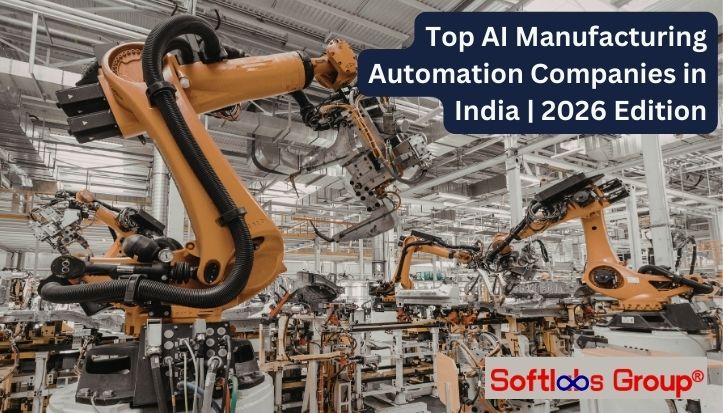
Manufacturers are no longer asking whether AI belongs on the factory floor. The harder question is which AI use case should come first, and which partner can make it work inside an existing plant without disrupting production. The best AI manufacturing automation companies in India are not just selling dashboards or pilots. They are helping manufacturers connect machines, cameras, sensors, MES, ERP, operators, and quality workflows into systems that improve real production outcomes.
This guide presents a practitioner-evaluated list of the top AI manufacturing automation companies in India for 2026, covering custom industrial AI software, AI-driven MES, computer vision quality inspection, predictive maintenance, autonomous mobile robots, IIoT platforms, production monitoring, and smart factory automation solutions. It is designed for plant heads, operations leaders, CTOs, and manufacturing business owners who need to shortlist the right type of partner, not just read another generic company list.
Simple definition: AI manufacturing automation means using machine learning, computer vision, robotics, IIoT data, and intelligent software workflows to improve factory operations such as quality inspection, predictive maintenance, production visibility, material movement, safety monitoring, inventory tracking, energy optimisation, and process scheduling.
Which AI Manufacturing Automation Solution Do You Actually Need?
The search term may be broad, but manufacturing problems are usually specific. Before choosing from AI manufacturing companies, map your operational problem to the right automation category. This prevents a common mistake: buying a platform when the real need is a custom integration, or buying robotics when the bottleneck is actually production visibility.
| Manufacturing problem | Better AI automation fit | What to check before buying |
|---|---|---|
| Defects escape manual inspection | Computer vision quality inspection or visual inspection AI | Camera angle, lighting, defect library, false-positive tuning, PLC or rejection-line integration |
| Machines fail without warning | Predictive maintenance AI using sensor, vibration, temperature, and power data | Data history, sensor reliability, maintenance workflow integration, alert ownership |
| Material movement delays production | AMRs, warehouse robotics, robotic sortation, or intralogistics automation | Floor layout, payload, traffic rules, charging plan, WMS/MES integration |
| No real-time production visibility | AI-driven MES, production dashboards, machine data integration, operator workflow systems | PLC/SCADA/MES/ERP access, data frequency, shift-level reporting, downtime taxonomy |
| Safety monitoring is manual | PPE detection, zone monitoring, unsafe behaviour detection, video analytics | Camera coverage, alert escalation, EHS workflow, incident reporting and evidence capture |
| Inventory counts are inaccurate | Computer vision inventory tracking, GPS/RFID integration, AI stock visibility systems | Object variability, yard layout, update frequency, ERP sync, exception handling |
| Production plans keep changing | AI production scheduling, constraint optimisation, demand and capacity planning | BOM accuracy, machine constraints, maintenance calendars, order priority rules |
Source context: Invest India has reported digital technologies rising from 20% of manufacturing expenditure in 2021 to a projected 40% by 2025. The practical 2026 priority is not only adoption, but scaling AI, IIoT, robotics, and computer vision into production workflows.
The Expanding Capabilities of AI in Manufacturing Automation
The market for AI manufacturing automation in India is maturing rapidly — and that maturity is producing specialisation rather than generalisation. The firms that are winning in 2026 are not offering broad “AI for manufacturing” platforms; they are solving specific, high-stakes problems with genuine domain depth. Understanding which capability area your business needs is the first step before any partner evaluation.
AI Manufacturing Automation vs Industrial Automation: What Is the Difference?
GSC data shows this page is also being tested for broader automation and factory automation searches. That makes sense, but the terms are not identical. A buyer comparing AI manufacturing automation companies in India should understand where classic industrial automation ends and where AI-led manufacturing intelligence begins.
| Term | What it usually means | Typical buyer question |
|---|---|---|
| Industrial automation | PLC, SCADA, control systems, robotics, sensors, machines, and electrical automation | How do we automate or control a repetitive industrial process? |
| Factory automation | Automation inside plant operations, assembly lines, material handling, inspection, packaging, and production workflows | How do we reduce manual dependency on the shop floor? |
| AI manufacturing automation | AI layer added to factory data, images, sensor streams, machines, dashboards, and workflows | How do we detect, predict, recommend, or act earlier using production data? |
| Smart manufacturing | Connected manufacturing systems using IIoT, MES, analytics, AI, dashboards, and digital workflows | How do we connect the factory into one intelligent operating system? |
AI-Powered Visual Inspection
The era of manual quality control is functionally over in 2026. AI-powered visual inspection systems — built on deep convolutional neural networks and edge computing hardware — now achieve near-perfect defect detection accuracy at speeds no human inspector can match. For sectors like automotive, semiconductor, and pharmaceuticals, where microscopic defects translate directly into safety risk and regulatory liability, this capability has moved from competitive advantage to operational requirement.
Autonomous Mobile Robots (AMRs)
Intralogistics — the movement of materials within a factory or warehouse — is being transformed by AMRs that navigate dynamically using sensors and real-time environment mapping rather than fixed tracks or infrastructure modifications. This adaptability makes them the dominant choice for brownfield facilities, where tearing out floors to install AGV rails is not commercially viable. The best Indian AMR firms have moved from pilot deployments to fleet-scale operations across automotive OEMs and e-commerce fulfilment networks in 2026.
Predictive Maintenance and Industrial IoT
The convergence of IIoT sensor networks and AI analytics is producing maintenance systems that predict equipment failures days or weeks before they occur — not by waiting for error codes but by recognising subtle pattern deviations in vibration, temperature, and power draw data. Understanding how AI agents operate in these environments is increasingly important for plant managers evaluating platforms, as the most advanced implementations use autonomous agents to not just flag anomalies but trigger maintenance workflows and parts procurement automatically.
Ready to explore 2026 AI solutions for manufacturing?
Explore Our AI ServicesWhy Trust This Report?
This guide is produced by Softlabs Group — founded in 2003, ISO 9001:2015 and ISO 27001 certified, with over two decades of custom AI and industrial software delivery experience across manufacturing, logistics, and regulated industries. Our insights are built on production delivery rather than market observation: we have built industrial IoT systems, MES integrations, computer vision platforms, and managed dedicated engineering teams for manufacturers across India, the UK, and the Middle East. That ground-level experience informs every evaluation on this list.
How We Selected India’s Top AI Manufacturing Automation Partners
Every firm on this list was evaluated against five criteria: a laser focus on manufacturing rather than generic AI delivery; verified, production-scale case studies with measurable industrial outcomes; genuine technical depth in robotics, IIoT, or computer vision; an agile firm size capable of a focused partnership model; and a strong India-based delivery presence. Firms that offer AI as a marketing label over an off-the-shelf toolchain did not make the cut.
Quick Buyer Shortlist: Which Company Fits Which Manufacturing Need?
The companies below do not solve the same problem. Some are best for custom industrial AI software, some for warehouse robotics, some for visual inspection, and some for IIoT infrastructure. Use this quick shortlist before reading the detailed profiles.
| Manufacturing need | Best-fit companies from this list | Why this fit makes sense |
|---|---|---|
| Custom industrial AI, MES/ERP integration, computer vision, and workflow intelligence | Softlabs Group | Best suited when the solution must be built around existing systems, legacy workflows, custom dashboards, and plant-specific constraints. |
| Warehouse robotics and material movement automation | Addverb, Ati Motors, Unbox Robotics, Peer Robotics | Useful when the primary bottleneck is intralogistics, sortation, kitting, picking, or movement of materials within facilities. |
| Visual inspection and defect detection | Lincode Labs, SwitchOn, Unseen Era | Relevant when the goal is to detect product defects, assembly errors, packaging issues, OCR/OCV errors, or surface abnormalities. |
| Robotic cells, welding, assembly, and industrial integration | DiFACTO Robotics | Works better when the buyer needs hard automation, robot programming, offline simulation, and multi-brand industrial robotics integration. |
| Cleanroom, floor management, and autonomous industrial cleaning | Peppermint Robotics | A strong fit for pharma, aviation, hospitals, and large industrial spaces where cleaning quality and manpower reduction matter. |
| SME-friendly automation with low setup complexity | Peer Robotics, Softlabs Group | Better when the buyer needs low-friction adoption, flexible integration, and avoids overcomplicated factory transformation projects. |
The Top 10 AI Manufacturing Automation Companies in India (2026)
Softlabs Group
Established 2003 | Lower Parel, Mumbai, MaharashtraSoftlabs Group occupies a distinctive position among AI manufacturing automation companies in India: they build the bespoke, deeply integrated industrial AI systems that off-the-shelf automation platforms cannot accommodate. Founded in 2003 and ISO 9001:2015 and ISO 27001 certified, they bring 23 years of enterprise software discipline to manufacturing environments where AI systems must communicate directly with PLCs, integrate cleanly with existing MES and ERP infrastructure, and operate reliably in conditions where downtime has a direct production cost. Their expertise spans computer vision for industrial compliance monitoring, AI-driven inventory intelligence, and autonomous logistics tracking — with a Govtech Award at the 2025 Aegis Graham Bell Awards recognising their credibility in high-stakes regulated deployments. For manufacturers who need AI that fits their operation rather than an operation reshaped to fit an AI product, Softlabs Group is the partner that delivers that level of customisation with production-grade reliability.
Key Manufacturing AI Services:
- Company Size51–200 employees
- Hourly Rate$30–$60 / hr
- LocationOffice 6A, Trade World D Wing, Lower Parel West, Mumbai, Maharashtra 400013
- Websitesoftlabsgroup.com
- Contact+91 7021649439 | business@softlabsgroup.com
- IndustriesManufacturing, Logistics, Healthcare, FinTech, Government, Real Estate, Energy, Education
- CertificationsISO 9001:2015 · ISO 27001 · GovTech Award at Graham Bell Awards 2025
- ServicesCustom AI/ML Development, Industrial IoT (IIoT), AI-Driven MES, Computer Vision, Predictive Maintenance, Big Data
- Tech StackPython (TensorFlow, PyTorch), OpenCV, Edge Computing (Nvidia Jetson), .NET, Java, AWS, Azure
- MES/ERP IntegrationCustom APIs for MES/ERP integration; PLC communication via Modbus and OPC-UA protocols
Softlabs in Action — Verified Case Studies
Addverb Technologies
Noida, Uttar PradeshAddverb Technologies is the scale player on this list — a 1,000–2,000 person robotics and warehouse automation firm that has moved from Indian manufacturing deployments to global supply chain operations across Asia and Europe. Their hardware-software portfolio spans Autonomous Mobile Robots, ASRS systems, and their proprietary Optimus WMS, making them a single-vendor solution for end-to-end warehouse intelligence. Their 2026 sorting swarm deployments for FMCG giants have redefined what throughput efficiency looks like in high-SKU fulfilment environments — and their backing from major industry investors reflects the commercial validation their technology has earned in production.
- Company Size1,000–2,000 employees
- LocationNoida, Uttar Pradesh
- Websiteaddverb.com
- IndustriesE-commerce, Retail, FMCG, Pharmaceuticals, 3PL, Automotive, Manufacturing
- ProductsAMRs, Sorting Robots (Zippy), ASRS (Multi-Pro), Optimus WMS
- Tech StackROS, Python, C++, AI/ML navigation, GCP, Docker, Kubernetes
Notable Case Studies
Lincode Labs
Bengaluru, KarnatakaLincode Labs has built one of the most focused value propositions in Indian manufacturing AI: a no-code visual inspection platform that delivers near-perfect defect detection accuracy without requiring onsite AI expertise to operate. Their LIVIS system is hardware-agnostic and designed to plug into existing machine vision infrastructure, which means manufacturers can upgrade inspection capability without replacing capital equipment. Their 2026 expansion into automotive and semiconductor lines — sectors where microscopic defects carry safety and liability consequences — validates their accuracy claims beyond marketing. The Centrepolis Best Manufacturing Technology 2024 award provides third-party credibility to underpin the commercial case.
- Company Size11–50 employees
- LocationBengaluru, Karnataka
- Websitelincode.ai
- AwardsBest Manufacturing Technology 2024, Centrepolis Accelerator
- IndustriesAutomotive, Semiconductor, Electronics, Aerospace, Food & Beverage
- ProductsLIVIS (Intelligent Visual Inspection), No-Code AI Platform, Assembly Verification
- Tech StackDeep Learning (CNNs), Computer Vision, Edge AI, Python, C++, Hardware Agnostic
Notable Case Studies
Ati Motors
Bengaluru, KarnatakaAti Motors has built a strong commercial position by solving the brownfield automation problem that most AMR vendors sidestep: deploying autonomous material movement in existing facilities without infrastructure modification. Their LiDAR-based Sherpa AMR range navigates dynamically using VSLAM — no floor markings, no QR codes, no facility renovation required. The deployment of 100+ robots for Hyundai in North America is the kind of reference that establishes credibility at automotive OEM scale, which is typically the most demanding and process-disciplined environment any AMR faces.
- Company Size201–500 employees
- LocationBengaluru, Karnataka
- Websiteatimotors.com
- IndustriesAutomotive, Logistics, Warehousing, General Manufacturing
- ProductsSherpa Tug, Sherpa Pivot, Sherpa Lifter, Robots-as-a-Service (RaaS)
- Tech Stack3D LiDAR, VSLAM Navigation, AI, ROS, C++, Python
Notable Case Studies
Peppermint Robotics
Pune, MaharashtraPeppermint Robotics occupies a niche that is easy to underestimate and commercially significant: autonomous floor management in manufacturing environments where cleanliness and sterility are operational requirements, not housekeeping. Based in Pune, their robotic scrubber-dryer and material tug platforms use AI-based navigation to operate in high-traffic factory floors, pharmaceutical cleanrooms, and aviation facilities without human guidance. The 50% manpower reduction at Bosch’s manufacturing facility is a commercially material outcome in an era of rising industrial labour costs — and their sterile pharma deployments demonstrate the regulatory compliance credibility that most robotics firms cannot claim.
- Company Size51–100 employees
- LocationPune, Maharashtra
- Websitepeppermintrobotics.com
- IndustriesManufacturing, Pharma, Healthcare, Commercial Real Estate, Aviation
- ProductsRobotic Scrubber Dryers (SD20, SD45, SD100), Robotic Tug (TUG1000), Peppermint OS
- Tech StackAI-based Navigation, LiDAR, 3D Depth Sensors, Cloud Analytics (AWS/Azure)
Notable Case Studies
SwitchOn
Bengaluru, KarnatakaSwitchOn has built a highly specific and commercially defensible position in the AI manufacturing automation market: edge-AI visual inspection fast enough and accurate enough for zero-defect production lines in precision manufacturing. Based in Bengaluru, their DeepInspect platform achieves sub-11-second inspection cycles and integrates directly with PLCs to route quality data into SCADA systems for immediate action — closing the loop between detection and operational response without human intermediaries. Their 100-micron defect detection for Denso Corporation is the technical benchmark that establishes their credibility in automotive-grade precision environments.
- Company Size25–50 employees
- LocationBengaluru, Karnataka
- Websiteswitchon.io
- IndustriesAutomotive, Pharmaceutical, Consumer Goods, Precision Manufacturing
- ProductsDeepInspect Inspection System, Quality-as-a-Service, Surface Defect Analysis
- Tech StackEdge AI (Nvidia), Deep Learning, Computer Vision, IIoT, PLC/SCADA integration
Notable Case Studies
Unbox Robotics
Pune, MaharashtraUnbox Robotics has tackled one of the most space-constrained problems in modern logistics: how to sort high volumes of parcels when floor space is expensive and scarce. Based in Pune, their vertical robotic sortation systems use swarm intelligence to achieve 99.9% sorting accuracy in urban fulfilment hubs where horizontal expansion is not an option. Their plug-and-play deployment model — no facility redesign required — means logistics operators can add sorting capacity without taking operations offline. For e-commerce and postal operators running multi-shift operations in cities where real estate costs compound against fulfilment economics, Unbox delivers the space-to-throughput ratio that conventional conveyor systems cannot match.
- Company Size51–200 employees
- LocationPune, Maharashtra
- Websiteunboxrobotics.com
- IndustriesE-commerce, Retail, Logistics, 3PL, Postal & Parcel Services
- ProductsVertical Robotic Parcel Sortation, Swarm Intelligence Platform, Order Consolidation
- Tech StackSwarm Intelligence, ROS, Python, Computer Vision
Notable Case Studies
Peer Robotics
Gurugram, HaryanaPeer Robotics has focused on the segment of the AMR market that is consistently underserved: SME manufacturers that need automation but lack the capital, floor space, or engineering bandwidth to implement complex robotic systems. Based in Gurugram, Haryana, their collaborative mobile robots learn directly from human movement — eliminating the traditional programming and integration overhead that makes automation inaccessible to smaller operations. No infrastructure changes, no specialist programming, rapid deployment: their model is designed to make the SME automation business case viable rather than aspirational. Their 2026 work in kitting and assembly material movement reflects the practical, no-complexity approach that the SME manufacturing sector actually needs.
- Company Size11–50 employees
- LocationGurugram, Haryana
- Websitepeerrobotics.ai
- IndustriesManufacturing, Warehousing, Automotive, Logistics
- ProductsCollaborative Mobile Robot Platforms (Peer 3000), Human-feedback learning systems
- Tech StackHuman-in-the-loop AI, LiDAR/Camera Fusion, Nvidia Jetson, ROS
Notable Case Studies
DiFACTO Robotics
Bengaluru, KarnatakaDiFACTO Robotics has successfully bridged the gap between hard industrial robotics integration and the AI-enhanced cognitive layer that 2026 manufacturing demands. Based in Bengaluru with 201–500 employees, they are a full robotic cell integrator for automotive and aerospace component manufacturing — welding, assembly, and material handling — with the offline simulation capability to commission robotic cells without production downtime. Their multi-brand programming competency across Fanuc and KUKA, combined with Rockwell PLC integration, means they can work inside whatever hardware environment a manufacturer already has rather than requiring a platform change as a prerequisite to automation.
- Company Size201–500 employees
- LocationBengaluru, Karnataka
- Websitedifacto.com
- IndustriesAutomotive, Aerospace, Construction Equipment, General Manufacturing
- ProductsRobotic Welding, Robotic Assembly, Standard Positioners, Dross Skimming Systems
- Tech StackMulti-brand programming (Fanuc, KUKA), PLC (Rockwell), Offline Simulation (RoboDK)
Notable Case Studies
Unseen Era Technologies
Pinjore, HaryanaUnseen Era closes this list as a veteran IIoT and industrial vision specialist that has been doing the unglamorous but commercially essential work of connecting factory machinery to intelligent data systems since 2010. ISO 9001:2015 and ISO 14001:2015 certified and based in Pinjore, Haryana, they deploy vision systems, flow wrap packaging AI, and IIoT energy management tools that turn equipment sensor streams into the data pipelines that predictive maintenance and operational analytics depend on. For FMCG, chemical, and pharma manufacturers where the constraint is not AI ambition but reliable, compliant data infrastructure, Unseen Era provides the foundational layer that makes the rest of the AI manufacturing stack possible.
- Company Size11–25 employees
- LocationPinjore, Haryana
- Websiteunseenera.com
- Contact+91-7206-86-5596 | info@unseenera.com
- CertificationsISO 9001:2015 · ISO 14001:2015
- IndustriesPharmaceuticals, Food & Beverage, Automotive, Chemical, FMCG, Cosmetics
- ProductsVision Systems (OCR/OCV), IIoT Energy Management, Flow Wrap Packaging AI
- Tech StackVision (HikRobot, FLIR), Banner Sensors, PLC Programming, SCADA/HMI
Notable Case Studies
What a Serious AI Manufacturing Automation Partner Should Deliver
The strongest AI automation partner is not the one with the flashiest demo. It is the one that can translate a factory problem into a working production system. When comparing AI manufacturing automation companies in India, look for these delivery components in the proposal.
When AI Manufacturing Automation May Not Work Yet
AI is useful only when the process, data, and ownership are ready. A good partner should be willing to tell you when a factory is not ready for full-scale AI automation yet. This is especially important for smart manufacturing automation solutions where poor foundations can turn a promising pilot into an expensive dashboard.
- Process data is missing or unreliable: If downtime, defects, machine states, or material movement are not recorded consistently, AI will struggle to produce trustworthy recommendations.
- Camera and sensor placement is poor: Computer vision quality inspection, PPE detection, and inventory tracking depend heavily on visibility, lighting, resolution, and occlusion control.
- The KPI owner is unclear: If no one owns defect reduction, downtime response, energy savings, or safety escalation, AI alerts will not change operations.
- There is no integration plan: A model that cannot connect with MES, ERP, SCADA, PLCs, or operator workflows remains isolated from production decisions.
- The team expects AI to fix broken processes: AI can detect, predict, and recommend. It cannot compensate for undefined SOPs, missing maintenance discipline, or unresolved production ownership.
- There is no maintenance budget: AI systems need monitoring, calibration, retraining, hardware support, and user feedback after go-live.
Frequently Asked Questions
What are AI manufacturing automation companies?
AI manufacturing automation companies build systems that use machine learning, computer vision, robotics, IIoT data, and intelligent software workflows to improve factory operations. Their work may include predictive maintenance, visual inspection, production monitoring, AI-driven MES, safety monitoring, inventory tracking, AMRs, and smart factory dashboards.
How is AI manufacturing automation different from normal factory automation?
Traditional factory automation usually focuses on controlling machines, lines, sensors, and repetitive workflows through PLCs, SCADA, robotics, and industrial systems. AI manufacturing automation adds intelligence on top of factory data so the system can detect defects, predict failures, recommend actions, classify exceptions, and improve decisions over time.
Which AI manufacturing use case should a factory start with?
Start with the use case where the business loss is clear and measurable. Common starting points are visual quality inspection, predictive maintenance for critical machines, PPE and safety monitoring, production visibility dashboards, inventory tracking, and material movement automation.
Can AI manufacturing automation work with existing MES, ERP, SCADA, and PLC systems?
Yes, but the integration effort depends on the age and accessibility of the systems. A serious AI automation partner should assess available APIs, database access, OPC-UA or Modbus communication, data frequency, and workflow ownership before promising integration.
What should manufacturers ask before hiring an AI automation company?
Ask what data is needed, how the model will be validated, whether the system works in your actual plant conditions, how alerts reach operators, what integrations are included, how performance will be monitored, and how the solution will scale beyond the first plant.
Partnering with an AI Manufacturing Automation Firm in 2026: Five Principles
Engaging any of the firms on this list requires a collaborative approach that goes beyond vendor procurement. Here is how to structure that engagement for maximum commercial return:
Define your Industry 5.0 problem first. The clearest signal of a weak AI manufacturing engagement is when a vendor leads with the technology rather than the outcome. Know your specific bottleneck — defect rate, downtime cost, labour dependency — before any conversation begins.
Start with a Proof of Concept. A time-boxed, narrow-scope POC validates technical fit before full capital commitment. The best firms welcome this; it reduces risk for both sides and produces the data needed to make an informed deployment decision.
Prioritise MES and ERP integration depth. Autonomous AI that doesn’t communicate with your operational systems creates a data silo rather than a solution. Ask specifically how the system connects to your MES, ERP, and SCADA infrastructure on day one.
Scrutinise data sovereignty and security protocols. Manufacturing data is commercially sensitive and, in regulated sectors, legally restricted. Verify ISO 27001 certification and Zero-Trust security architecture — particularly for IIoT deployments where sensor data flows continuously.
Plan for multi-site scalability from day one. A system that works brilliantly at one plant but cannot scale across a network compounds rather than solves operational complexity. Build the architecture for the fleet, even when starting with a single facility.
Worker safety automation is a critical sub-topic – see our dedicated guide to AI PPE detection development companies in India for the full safety AI market.
Conclusion: Building the Cognitive Manufacturing Operation
India has cultivated one of the world’s most capable ecosystems for AI manufacturing automation — spanning bespoke industrial AI software, autonomous robotics, precision vision inspection, and IIoT sensing infrastructure. The firms on this list are not experimenting with manufacturing AI; they are delivering it in live production environments where the cost of failure is measured in downtime, defect rates, and regulatory exposure. Choosing the right partner from this guide is the decision that determines whether your 2026 industrial transformation delivers commercial outcomes or produces another compelling proof of concept that never reaches the factory floor.
For a broader view of how India’s AI ecosystem is developing, or to explore the AI-driven Manufacturing Execution Systems that are redefining production intelligence, both resources are worth exploring alongside this guide. To understand how agentic AI is beginning to reshape manufacturing decision-making, the context is there when you are ready for it. For a broader view of the industrial automation partner landscape, our guide to AI industrial automation companies in India covers adjacent providers worth evaluating alongside this list.
Report compiled by Softlabs Editorial. Updated for 2026. Market and SERP context should be reviewed periodically as manufacturing AI demand evolves.
Ready to lead the 2026 industrial revolution?
Submit your project brief and talk to an AI manufacturing specialist today.
Submit Your Project Inquiry