In progress

Window Survey-to-Contract Automation for Energy Glazing

🇮🇪 IrelandConstruction, windows and glazing

Energy Glazing is working with The Digital Department and Softlabs on a window survey automation platform for its survey-to-contract workflow.

Tommy Trinder remains the pricing engine. The connected architecture is functional, while measurement-edit verification and the final production flow remain in progress.

Discuss a Similar Automation Project
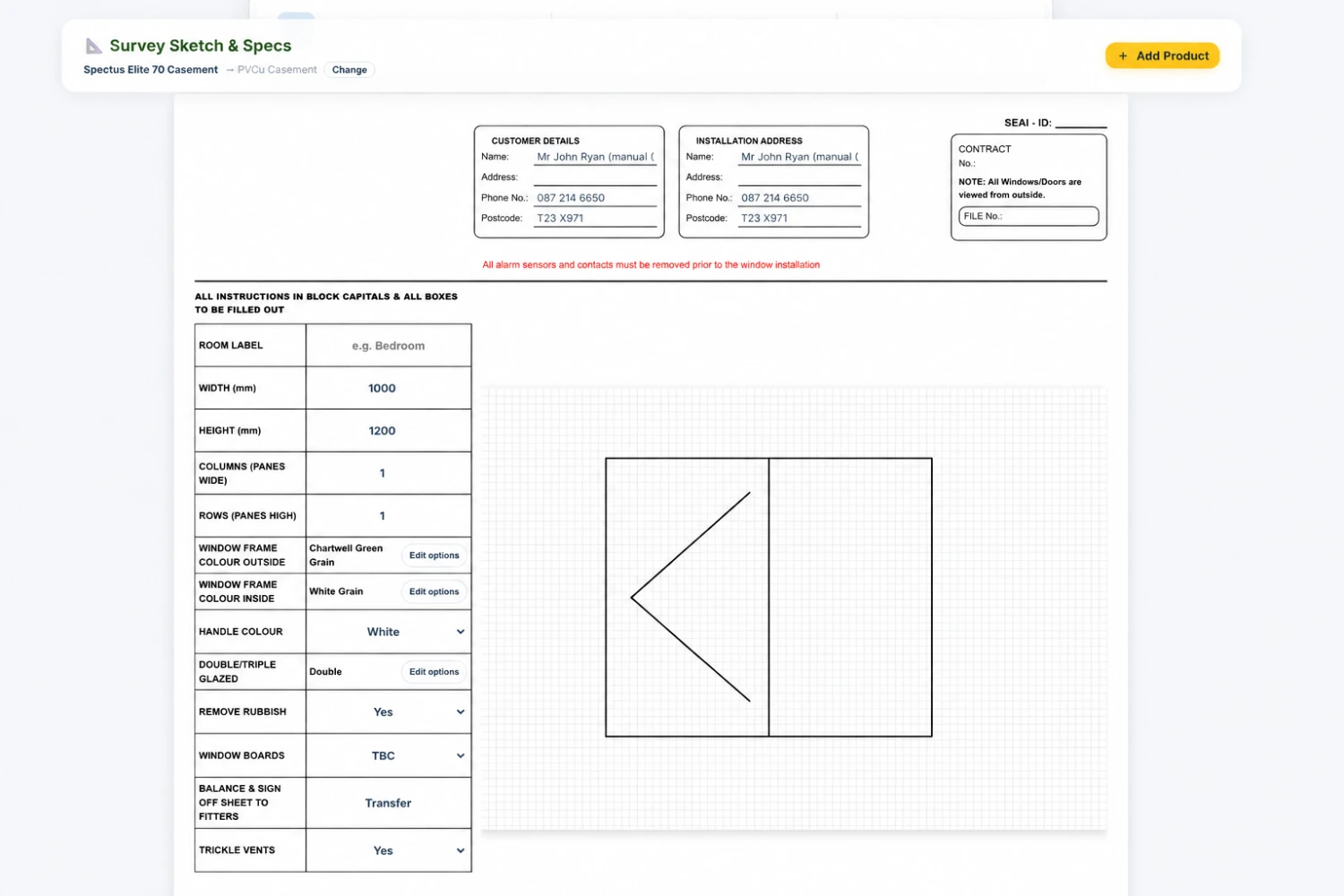
Team-supplied test-environment screenshot of the survey sketch and specification workspace.
Authentic product screenshot showing the survey sketch and specification workflow; test-environment data.

iPad survey captureCustomer details and free-hand sketches

Connected automationQueue-managed workflow state

Tommy TrinderExisting pricing engine

Implementation underwayCore architecture functional

Energy GlazingConstruction, windows and glazing

Window Survey and Quotation Workflow Automation

In progress

Country
Ireland
Delivery partner
The Digital Department
Partner lead
Alan Brogan, Managing Director
Partner location evidence
Cork, Ireland
Current stage
Connected architecture in implementation; core architecture functional
Third-party pricing engine
Tommy Trinder
Client context

Supporting Energy Glazing’s Survey-to-Quote Workflow

Energy Glazing operates in the Irish windows and glazing sector. Its sales representatives and surveyors use Tommy Trinder to configure windows and generate quotations.

The Digital Department, led by Managing Director Alan Brogan, is the delivery and agency partner for the project. The partner evidence places the business in Cork, Ireland.

Softlabs is building the capture, workflow and automation layer around the existing quotation process.

The project does not replace Tommy Trinder. It uses Tommy Trinder as the pricing engine while adding a structured path from an iPad survey sketch to a window drawing within the third-party system.

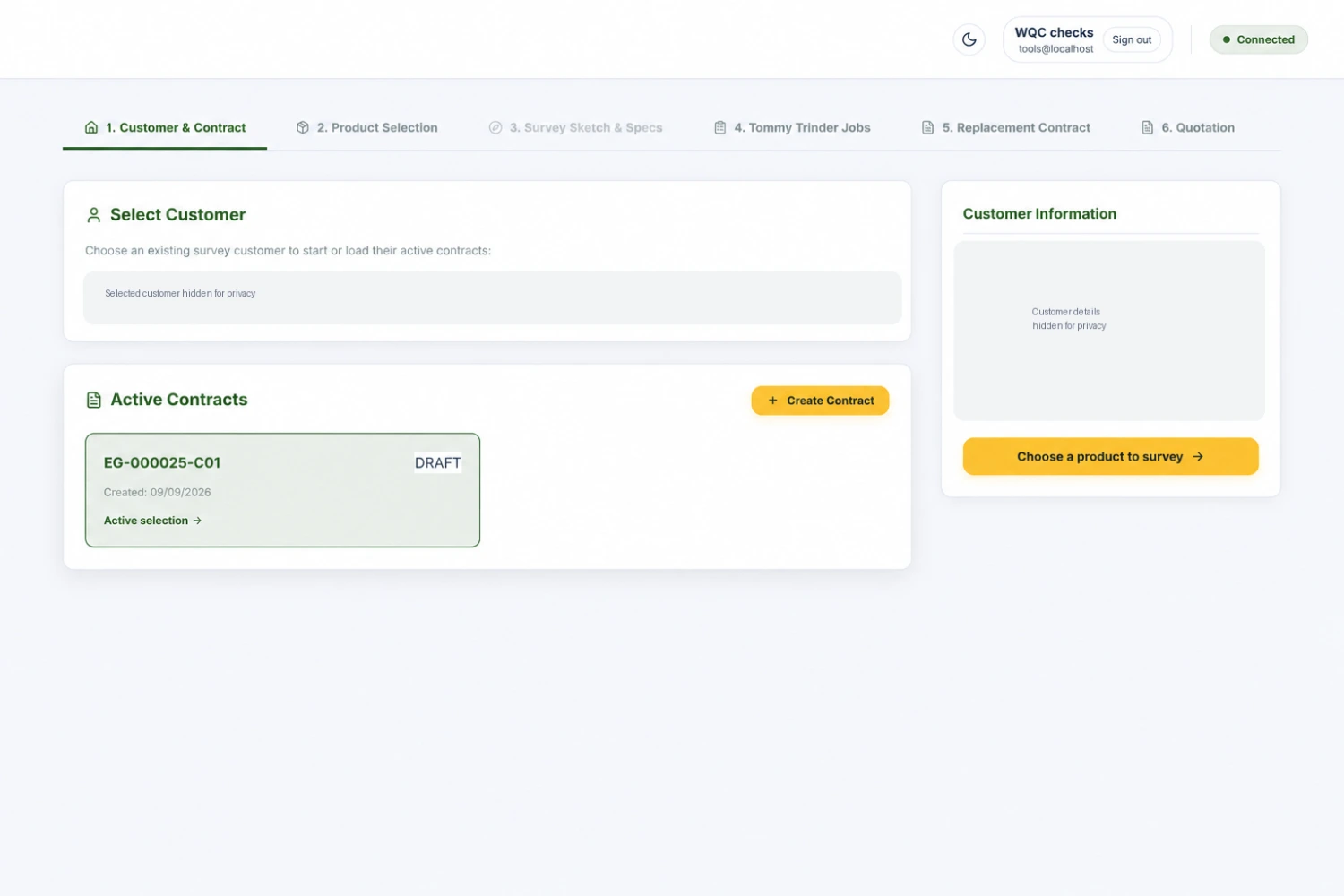
Energy Glazing customer and active-contract selection screen with identifying values hidden.
Authentic product screenshot showing customer and contract selection; identifying values hidden.
The need

The Need for Glazing Survey and Quotation Automation

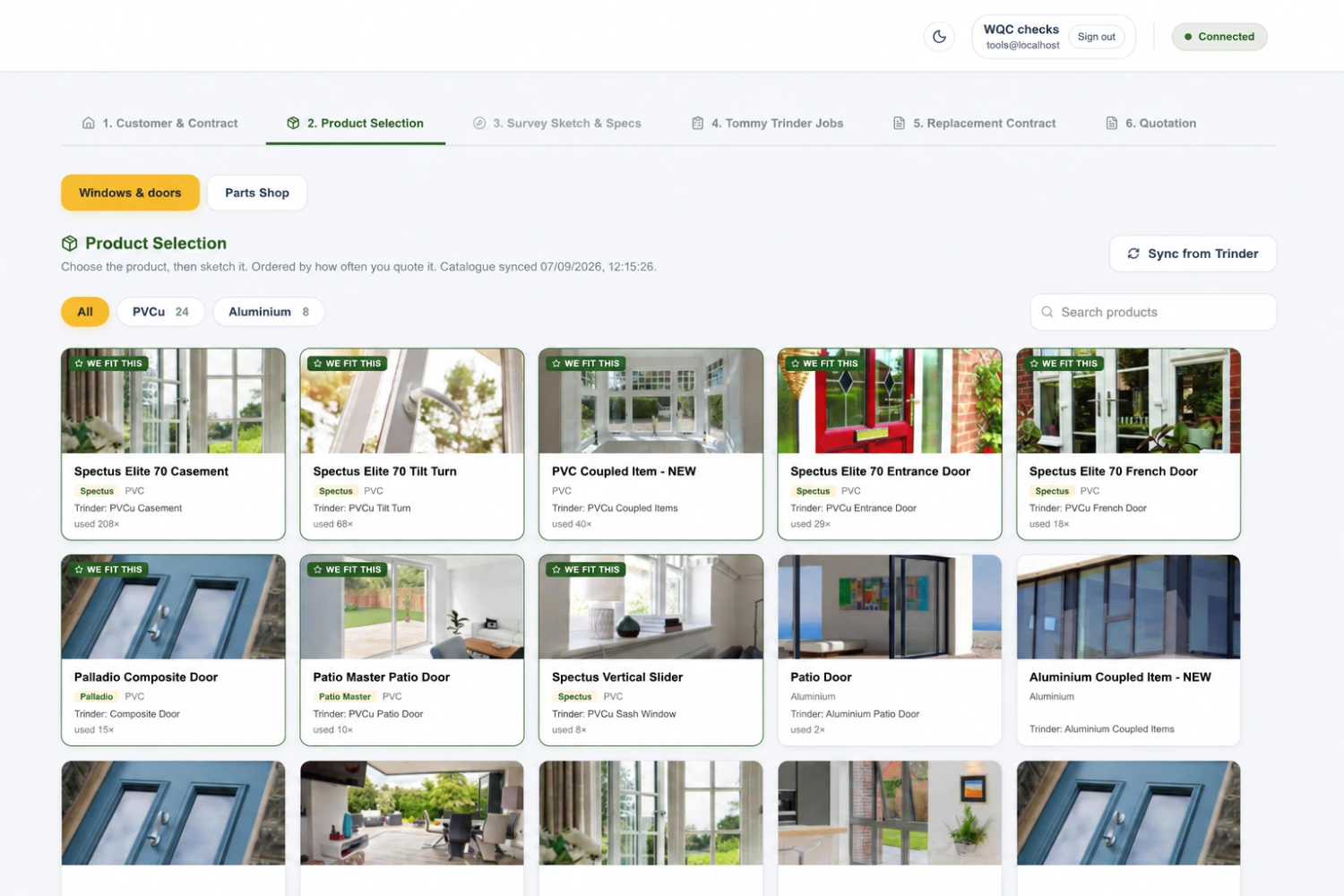
Product catalogue showing window, door and parts-shop choices in the survey-to-contract workflow.
Authentic product screenshot showing the product catalogue available to the survey-to-contract workflow.
01

Connect the physical survey

A surveyor needs to collect customer information and window measurements during a physical site survey, then turn that information into a configuration Tommy Trinder can use.

Physical measuring and other site work remain manual.
02

Create a structured digital path

  • Enter customer details on an iPad
  • Capture a free-hand window sketch
  • Start an automation job
  • Create job data and automation state
  • Create the customer profile in Tommy Trinder
  • Reproduce the surveyed window as a mathematical drawing
Discovery findings

What the Discovery and Feasibility Sprint Established

A Discovery and Feasibility Sprint proposal was dated 16 June 2026. The sprint was completed, and the recommended connected automation architecture moved into implementation.

Option A

V1 Platform

A five-module V1 platform was assessed during discovery.

Assessed but not selected
Option B

Full Browser Automation

The canvas visualiser is not exposed like a normal form, so standard browser automation could not reliably treat its drawing as form data.

Not viable as the complete solution
Selected approach

Connected Automation

A workflow orchestration engine manages queue items and state. A UI Automation Framework-based headless layer handles the mathematical window drawing.

Selected for implementation
What we are building

A Hybrid Window Survey Automation Platform

Softlabs is building a workflow that connects an iPad-based survey process with Tommy Trinder.

The surveyor records customer details and draws the window on the iPad. The C# WQC-App backend prepares XML job data and creates a workflow orchestration queue item. A UI Automation Framework-based headless automation engine retrieves the job through an API and completes the required interface steps.

Product-selection screen for a selected window or door item.
Authentic product screenshot showing product selection in the connected workflow.
How it works

How a Survey Becomes a Quotation and Contract

Step 01

Customer & Contract

The surveyor selects the customer and opens the correct contract for the installation address.

Step 02

Product Selection

The surveyor chooses a window, door or Parts Shop item from choices and defaults available in the Tommy Trinder catalogue.

Step 03

Survey Sketch & Specs

The surveyor draws one item, checks panes and opening direction, enters exact width and height, completes the specification and saves it. WQC does not guess measurements.

Step 04

Tommy Trinder Jobs

Actions include ADD, EDIT, GET QUOTATION, GET CONTRACT and SEND EMAIL. Jobs can show QUEUED, RUNNING, SUCCESS or FAILED.

Step 05

Replacement Contract

WQC builds the contract from survey information and Trinder data. Items can show the specification, survey sketch and drawing retrieved after GET CONTRACT runs.

Step 06

Quotation

WQC reads pricing from Tommy Trinder and stores quotation versions. The PDF exists only after the quote is finalised. Finalisation locks the quote and remains a human decision.

Technical boundary

Where the Automation Starts and Stops

A clear view of what the documented workflow includes and what the current case study does not claim.

01
Documented scope

Included in the workflow

  • iPad customer entry and free-hand sketch capture
  • Manual start of an automation job
  • XML creation and queue submission
  • Queue processing and API job retrieval
  • Tommy Trinder customer-profile creation
  • Mathematical window drawing
  • Tap-to-override for uncertain details
02
Current limits

Outside the current claims

  • Automatic physical surveying or site measurement
  • Replacement of Tommy Trinder
  • Autonomous interpretation without human review
  • A fully verified measurement-edit function
  • A completed production deployment
  • Hosting, security, compliance or database claims
  • Achieved business results or performance metrics
Functional now

What Is Functional in the Current Architecture

The core connected architecture is functional. This does not mean the complete production workflow has been finished or deployed.

  • Surveyor entry and sketch capture
  • Starting a workflow job
  • XML creation and queue submission
  • Queue processing
  • API job retrieval
  • Automated Tommy Trinder login
  • Customer-profile creation
  • Mathematical window drawing
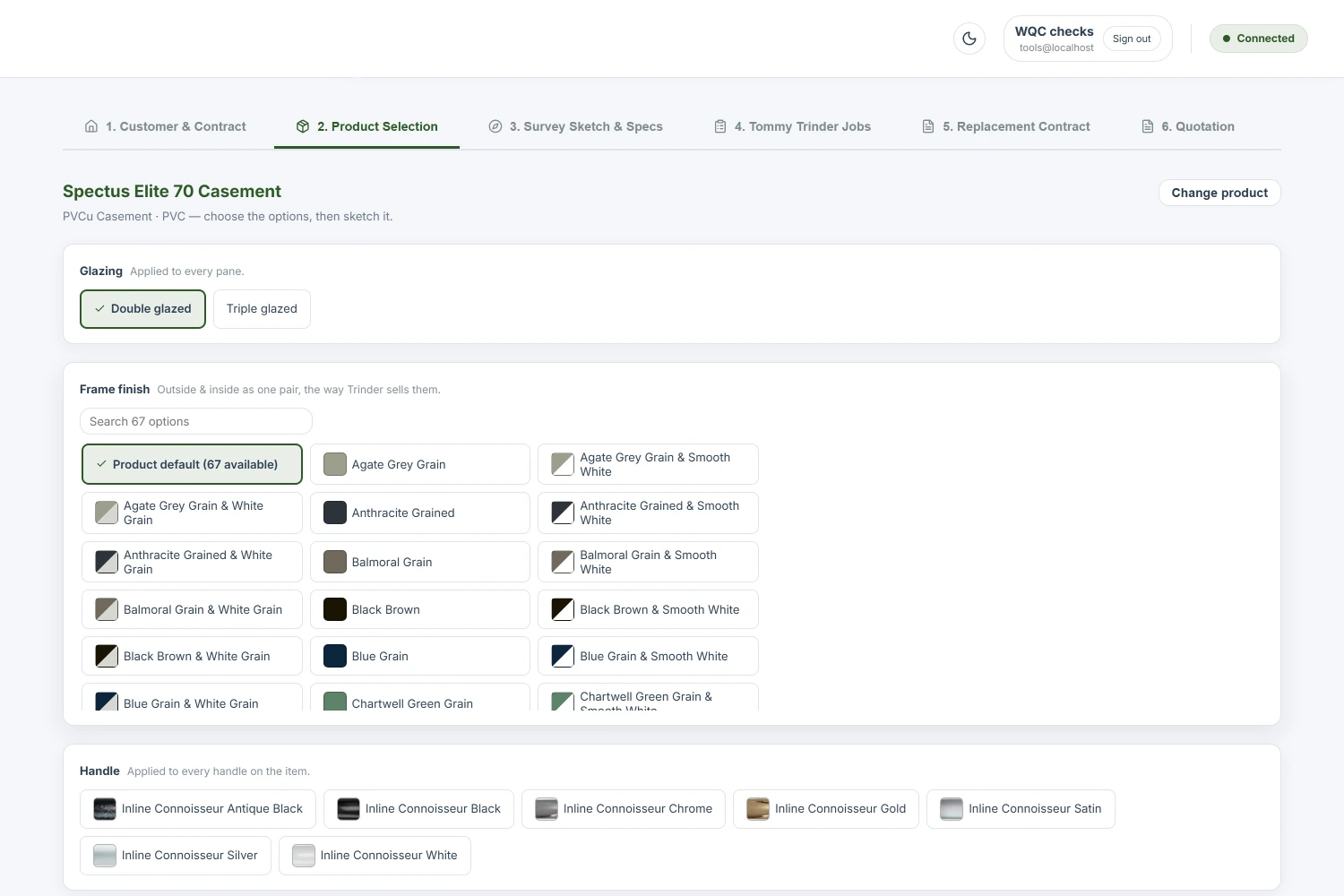
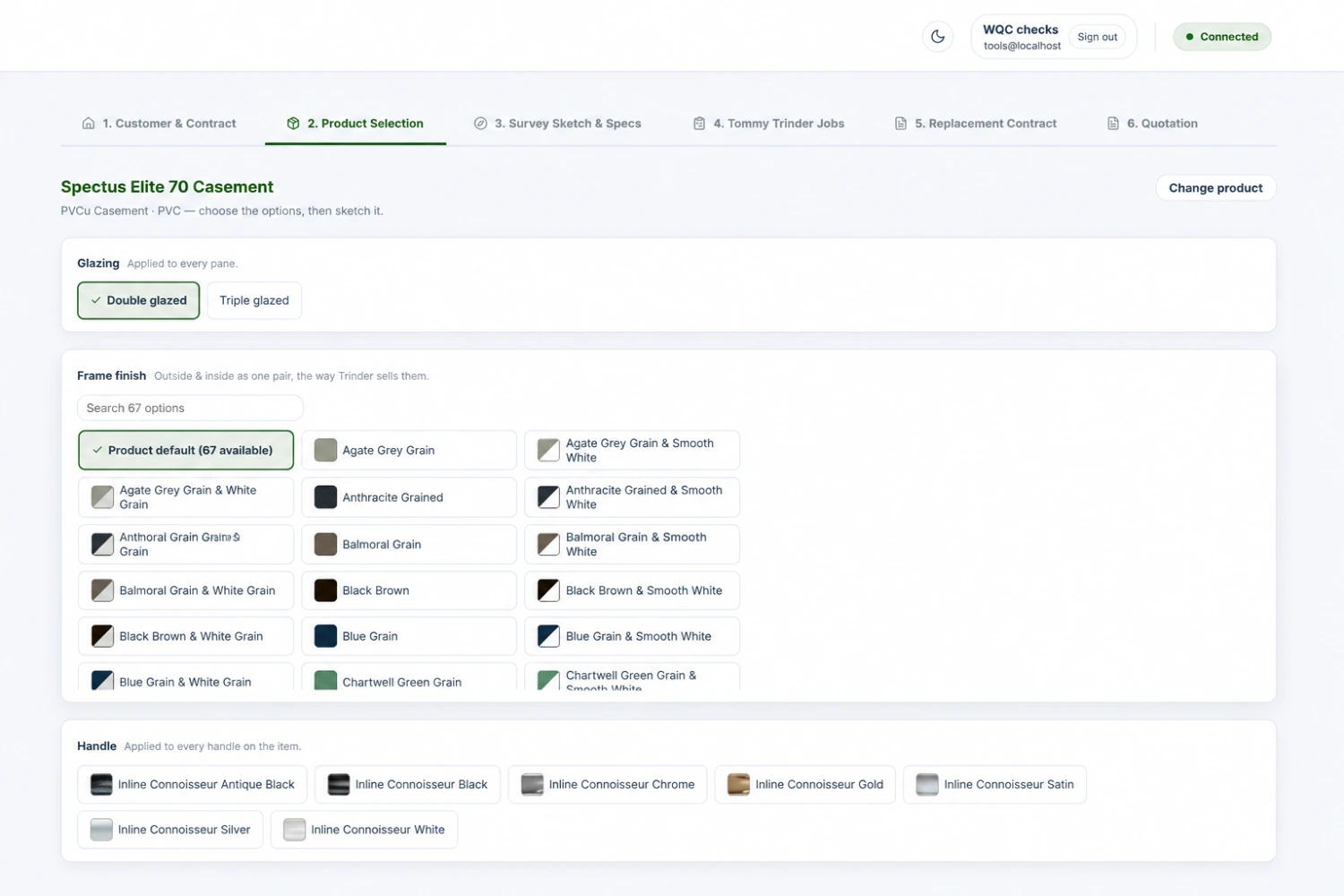
Product configuration screen with glazing, frame-finish and handle choices.
Authentic product screenshot showing detailed product options sourced for quotation preparation.
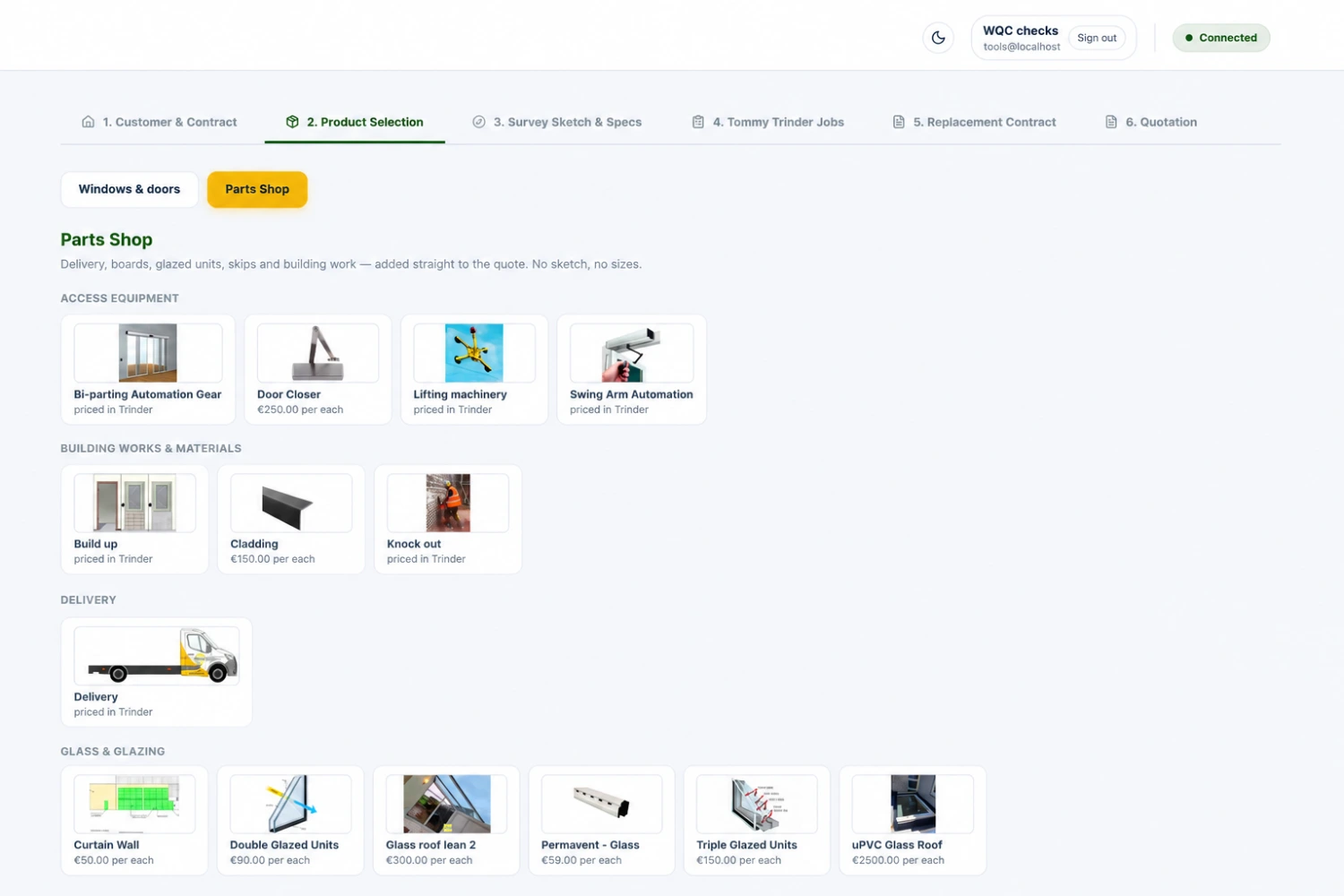
Parts Shop screen for adding product components to a quotation.
Authentic product screenshot showing Parts Shop items added directly to the quotation.
Work still in progress

Remaining Work in the Documented Flow

The core connected architecture is functional, but these two gates still need to be completed before the final production flow can be signed off.

01Human finalisation

Quotation PDF finalisation boundary

Retrieval has been tested successfully in live use, but depends on the quotation being finalised in Tommy Trinder. Finalisation locks the quote and remains a human decision.

02Pending verification

Complete measurement verification

Measurement editing passed one manual 1000 × 2000 mm door test. Automated read-back verification remains pending before full sign-off.

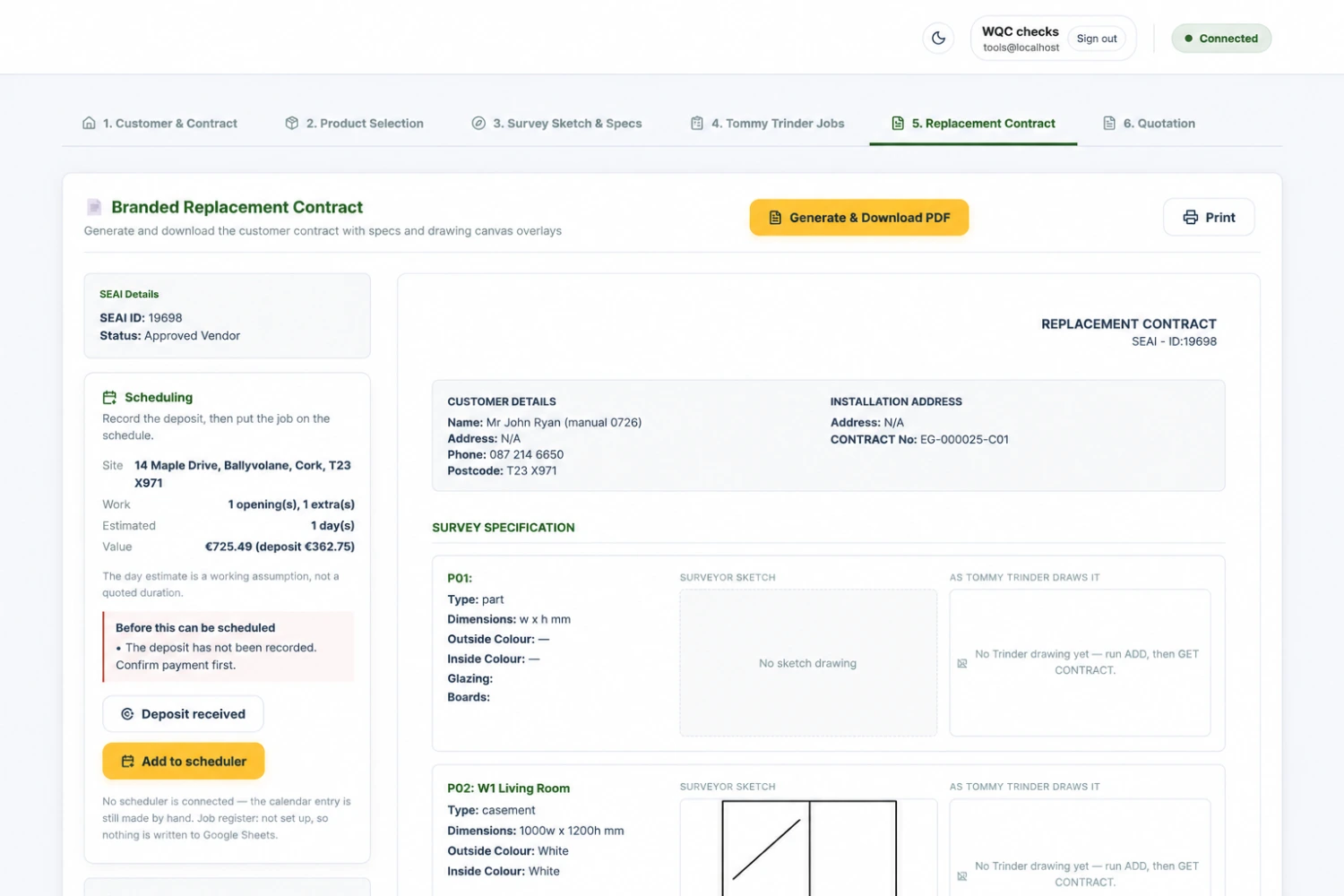
Replacement Contract section showing contract preparation within the application workflow.
Authentic product screenshot showing the replacement-contract stage; project in progress.

The final production flow remains incomplete until pending work and required validation are finished.

Designed operational value

What the Workflow Is Designed to Support

The platform is designed to create a more structured connection between site survey information and the Tommy Trinder quotation workflow.

01
Survey input

From the site

  • Consistent route from iPad survey entry to processing
  • Free-hand sketch to mathematical drawing
02
Workflow control

Through a controlled process

  • Controlled movement of job data through a queue
  • Human confirmation of uncertain details
03
Quotation output

Into the existing quotation tool

  • Reuse of Tommy Trinder as the pricing engine
  • Clearer visibility of workflow state
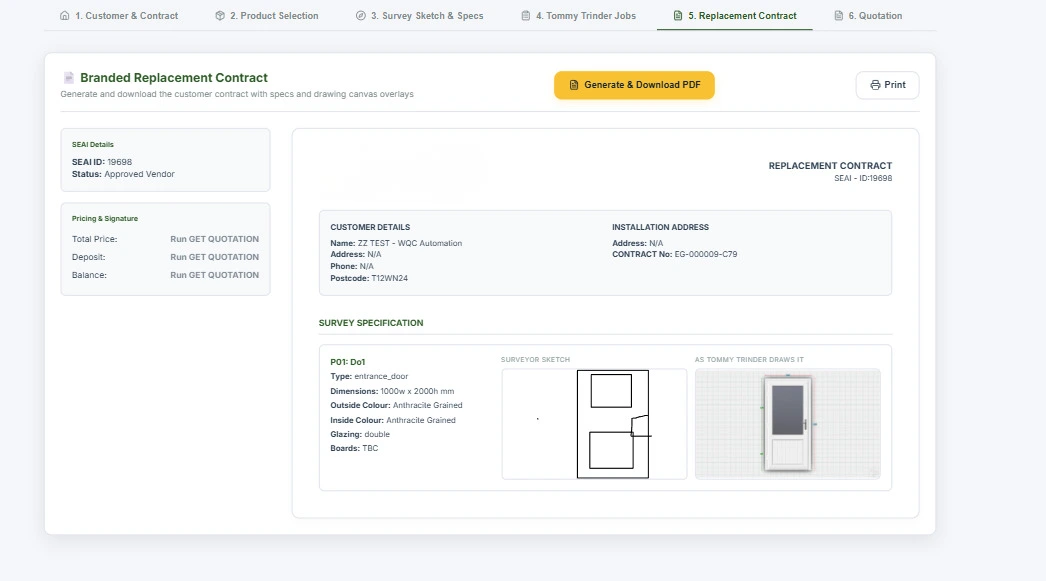
Replacement-contract preview with survey specification and Tommy Trinder drawing.
Authentic product screenshot showing a test replacement-contract preview generated from workflow data.

These are design goals, not reported business results. No documented figures are available for time savings, accuracy, quote volume or adoption.

Feature status

Automation Features In Progress

Capabilities are grouped by their documented status so implemented work, human controls and pending validation remain clearly separated.

01

Implemented within the current core flow

Five documented capabilities

iPad Survey Capture

Customer-detail entry and sketch capture.

Queue-Based Job Control

XML creation and queue submission.

Unattended Workflow Processing

Queue processing and API retrieval.

Tommy Trinder Customer Creation

Automated login and customer creation.

Mathematical Window Drawing

Validated information transferred to the canvas workflow.

02

Included in the documented workflow

Human-control capability

Tap-to-Override Selection

Human selection of uncertain hinges or opening directions.

03

Subject to quotation finalisation

Current technical boundary

Final Quotation PDF Retrieval

Technically working and tested in live use, subject to quotation finalisation.

04

Pending testing

Verification still required

Edit Measurement Function

One manual test passed; automated read-back verification remains pending.

Also fits

Similar Workflows This Architecture Could Support

  • Window and door survey workflows
  • Glazing sales-process automation
  • Fenestration configuration workflows
  • iPad-based field survey capture
  • Sketch-to-configuration processes
  • Queue-managed quotation preparation
  • Browser workflows with a canvas or visual designer
Technology

What Technologies Power the Workflow?

01

Survey capture

iPad survey interfaceEntry and sketch capture
02

Application & data

C# WQC-AppJob preparation and XML creation
XMLJob-data format
APIJob information retrieval
03

Orchestration

Workflow orchestration engineQueue and workflow-state management
04

Automation layer

UI Automation Framework-based headless engineQueue processing and interface automation
UI Automation FrameworkHeadless drawing translation
Headless browser automation layerBrowser control and mathematical network injection
05

Configuration & pricing

Tommy TrinderConfiguration and pricing engine
Have a similar workflow?

Need to Connect Field Surveys With Your Quotation Workflow?

Softlabs can assess how survey data, workflow automation and an existing pricing or configuration platform could work together without replacing the software your team already relies on.

Discuss Your Workflow
FAQs

Frequently Asked Questions

What is a window survey-to-contract automation platform?

Window survey automation software connects information collected during a window survey with the digital workflow used to configure products or prepare quotations. Here, the surveyor enters customer details and a free-hand sketch on an iPad, while automation prepares job data and creates a mathematical window drawing inside Tommy Trinder.

Does the Energy Glazing platform replace Tommy Trinder?

No. Tommy Trinder remains the third-party window configuration and pricing engine. Softlabs is building the survey capture, workflow and automation layer around it.

How does the iPad window sketch become a drawing in Tommy Trinder?

The C# WQC-App creates XML and places a runId in a workflow orchestration queue. A UI Automation Framework-based headless automation engine retrieves the job through an API and creates the customer in Tommy Trinder. The UI Automation Framework-based headless automation layer then translates the iPad sketch into a mathematical window drawing.

Why was a hybrid workflow orchestration and headless automation approach selected?

Full browser automation was assessed, but the Tommy Trinder visualiser uses a canvas rather than normal form data. The selected approach uses a workflow orchestration engine for queues and workflow state, while the headless layer handles mathematical window drawing.

Does the workflow use AI to recognise every hand-drawn detail?

The project evidence does not document an AI system or perfect handwriting recognition. When a hinge or opening direction is uncertain, Tap-to-override allows the surveyor to select the intended option.

Is the complete survey-to-contract workflow live?

No. The project is in progress. Its core connected automation architecture is functional, but the final production flow is not complete. Quotation-PDF retrieval is technically working, subject to quotation finalisation, and measurement editing has passed one manual test but still needs automated read-back verification before full sign-off.

DMCA.com Protection Status  © Copyright 2003 - 2026 Softlabs Technologies & Development Pvt. Ltd. All Rights Reserved.