



The platform owner. Admin users manage the overall platform, distributors, top-level configuration and platform-level access.
In progress
 India
Navtatva · Retail technology
India
Navtatva · Retail technology
Building a Multi-Tenant Retailer eCommerce Platform
India
Navtatva is developing a multi-distributor commerce platform that is designed to help offline retailers operate branded online stores on unique subdomains. The system connects platform administrators, distributors, retailers, their teams and customers while using FYND Commerce as the system of record for core commerce data and order fulfilment.
The core eCommerce and management modules have been implemented in a test environment. Multi-tenant architecture, payment integration and end-to-end operational flows are still being validated.

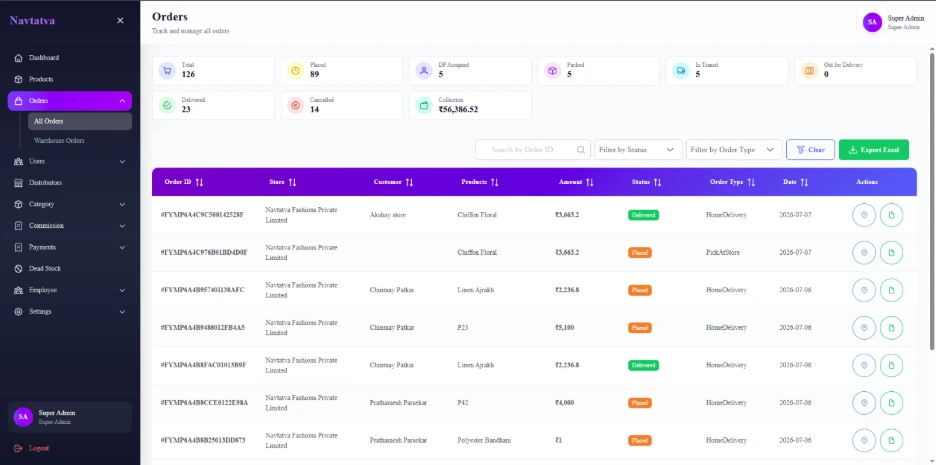
Project status: This platform has been implemented in a test environment and remains under development and validation. UAT is pending, no retailer or distributor has tested it yet, and the platform is not production-ready.
Navtatva
Distributor commerce
Multi-tenant retailer eCommerce platform
In progress — implemented in a test environment
- Industry
- Retail technology and distributor commerce
- Business model
- Admin → Distributor → Retailer → Customer
- Store model
- Branded retailer storefronts on unique subdomains
- Commerce system of record
- FYND Commerce
- Validation status
- UAT pending; retailer and distributor testing not started
Helping Offline Retailers Operate Branded Online Stores
Navtatva is being built to connect distributors and their retailer networks through one controlled digital-commerce system.
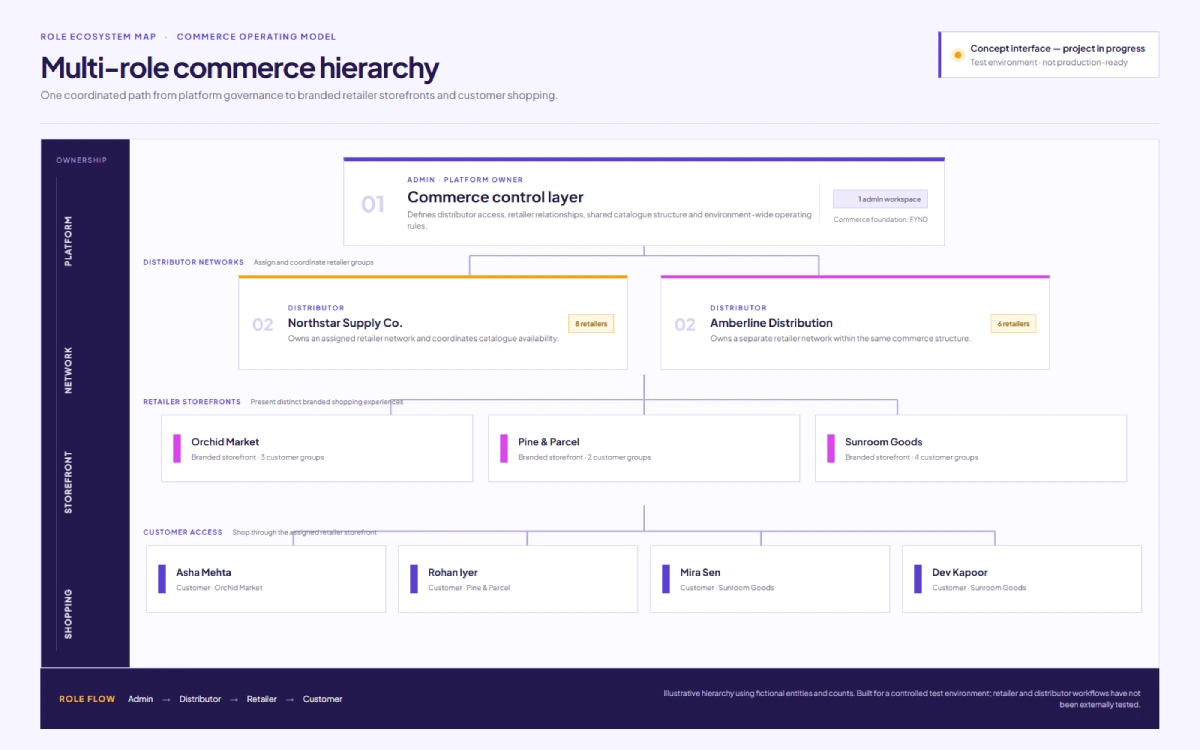
Each retailer belongs to one distributor and can operate a branded storefront on a unique subdomain. Distributors can onboard retailers and define which active FYND products are available to them. Retailers can then select approved products, publish them to their storefronts and manage the customer shopping experience.
The platform also needs role-based access for platform teams, distributors, retailers, managers and staff without losing control of tenant-level data or configuration.
What We Are Building
The cards use the same Birdi template interaction. Hover, focus or tap to read each area.
One Platform, Multiple Levels of Control
A distributor onboards and controls its retailer network. It selects products from the active FYND catalogue and defines which products retailers may use.
Each retailer belongs to exactly one distributor. A retailer can select only distributor-approved products, manage its storefront and CMS content, publish products and handle order fulfilment activities such as packing.
Managers and staff can be created under Admin, Distributor or Retailer organisations. Their access is controlled through configurable permissions appropriate to their parent organisation.
Customers browse a retailer’s storefront, select products, place orders and track order progress.
FYND Remains the Commerce System of Record
Product listing pages and product detail pages are intended to retrieve current commerce data through FYND APIs. Orders, status updates, shipment details and delivery information also move through FYND-connected workflows.
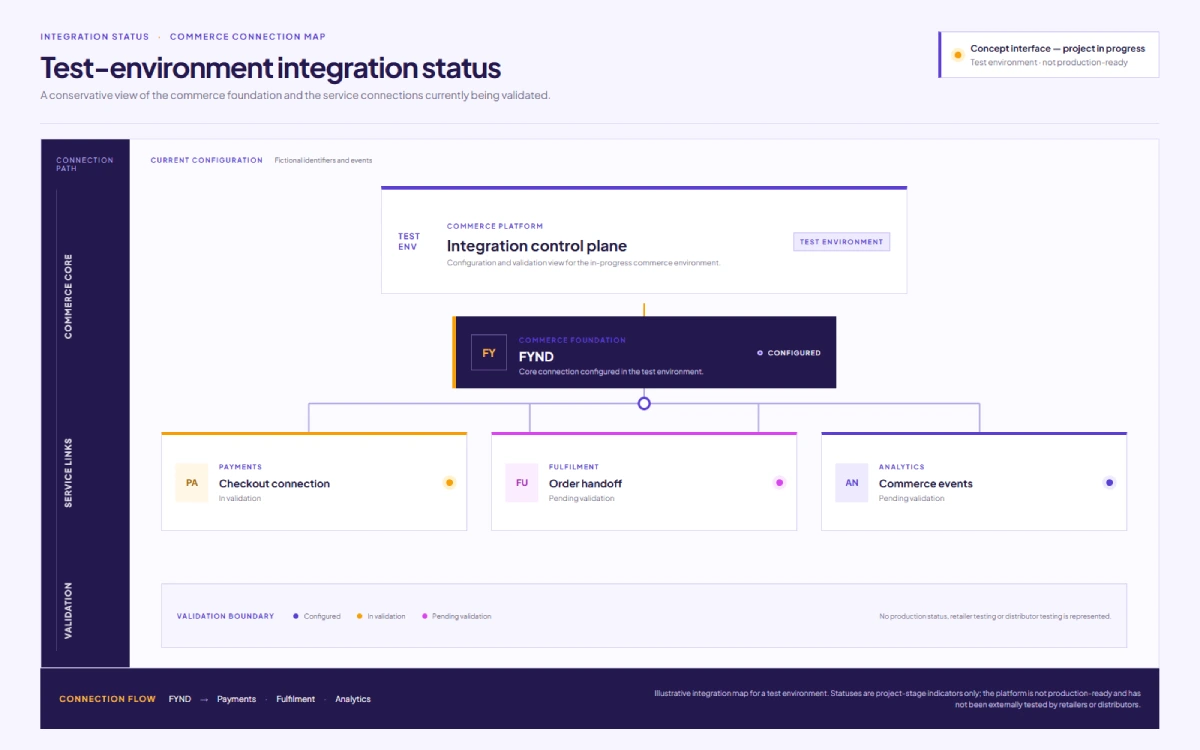
FYND Commerce is authoritative for
- products;
- categories;
- catalogue data;
- inventory;
- orders;
- order status;
- shipment information; and
- delivery information.
System-of-record boundary
Navtatva does not own a separate product-and-inventory commerce engine. Local storage may be used for caching, search, configuration or performance, but FYND remains authoritative for the underlying commerce records.
Navtatva owns or orchestrates
- the multi-tenant organisation model;
- distributor and retailer relationships;
- retailer storefront customisation;
- roles and permissions;
- payments and settlement workflows;
- analytics; and
- the customer-facing experience.
How the Documented Commerce Flow Works
The left illustration changes as you move through the documented flow. These steps remain under validation and do not represent production transactions.
Step
01
of 06
Step 01 · Documented flow
Catalogue data begins in FYND
FYND provides the active product, category, catalogue and inventory data.
Step 02 · Under validation
The distributor selects products
A distributor chooses products from the active FYND catalogue and makes approved products available to its retailers.
Step 03 · Under validation
The retailer selects and publishes
A retailer selects only distributor-approved products and publishes them to its branded storefront.
Step 04 · Under validation
The customer places an order
The customer browses the retailer store, adds products to the cart and proceeds through checkout.
Step 05 · Under validation
Payment or COD is recorded
For an online payment, Navtatva is intended to collect and orchestrate the payment. For cash on delivery, the retailer handles the COD path. Payment integration remains under validation.
Step 06 · Under validation
FYND supports fulfilment and tracking
The order passes through the FYND-connected order flow. The retailer packs the order, and the FYND delivery partner completes delivery. Order, shipment and delivery status are obtained through FYND.
Built Now in the Test Environment
Developer evidence identifies the following areas as implemented or actively integrated in the test environment:
- core eCommerce and catalogue functionality;
- distributor management;
- retailer management;
- product-management workflows;
- order-management workflows;
- user and authentication modules; and
- payment-related integration work.
Confirmed authentication direction
Email OTP with JWT-based sessions or access control. Documented role and permission modules support Admin, Distributor, Retailer, Manager and Staff access patterns.
These modules are not evidence of production readiness. End-to-end tenant behaviour, payment consistency, business prerequisites and user acceptance still require further testing.
Documented Scope Under Validation
The wider product documentation includes the following deliverables and requirements. Their completion remains unconfirmed:
Email OTP is identified in the current implementation. Mobile OTP remains a documented requirement; its implementation is not confirmed.
Current Engineering Challenge
The main engineering challenge is creating a reliable multi-tenant architecture while maintaining consistent payment and order behaviour.
Each distributor and retailer needs the correct data, users, permissions, catalogue choices and storefront configuration. A retailer must remain linked to exactly one distributor and must be able to select only products that distributor has approved.
The platform also needs dependable transitions between checkout, payment status, order creation in the FYND-connected workflow and later shipment or delivery updates. These flows are still being tested and refined.
The current work therefore focuses on:
No claim is made that tenant isolation is proven or that zero tenant leakage has been achieved.
QA Status: Needs Further Testing
All recorded figures are shown together so the current validation position is clear.
Total test cases
2,170
Passed
500
Failed
60
Pending
1,610
The 1,610 pending cases are recorded as blocked by unavailable product master data, configuration or other prerequisites. The QA verdict is Needs Further Testing .
Recorded test categories
Recorded test documentation marks smoke, integration, system, regression, API and database testing categories as complete. This recorded category status does not override the unresolved manual functional results. Unit testing is not confirmed.
Device and browser coverage
Testing records cover Google Chrome, Microsoft Edge and Brave on Windows 11. Responsive issues remain on tablet layouts. Android and iOS testing have not been completed.
Current release boundary
- Implemented in a test environment
- Not production-ready
- UAT pending
- No retailer has tested the platform
- No distributor has tested the platform
- Further functional testing and prerequisite data are required
Designed Operational Value — Not Achieved Results
If completed and validated, the platform is designed to support the people who move products from catalogue control to the customer journey.
Platform teams
Coordinate payments, configuration and customer experience across multiple tenants.
Distributors
Manage retailer networks and approved product access.
Retailers
Create branded online sales channels, select products without an independent master catalogue, and follow a connected order, packing and delivery workflow.
Customers
Browse retailer-specific stores on unique subdomains.
Operational teams
Manage access through organisation-aware roles.
These are intended operational benefits. They are not evidence of retailer adoption, transaction growth, revenue improvement or production performance.
Features In Progress
Every feature remains explicitly marked as in progress or under validation.
01
Tenancy
Organisation and storefront boundaries.
Multi-Tenant Organisation Model
Distributor, retailer and team structures with tenant-aware settings, users and permissions.
Retailer Subdomain Storefronts
Branded online stores that give each retailer a distinct customer-facing presence.
Distributor Catalogue Control
Distributor selection from active FYND products, followed by retailer access to approved products only.
Retailer Catalogue Management
Retailer-level product selection, publishing and storefront merchandising within distributor controls.
02
Commerce
Products, orders and payment paths.
FYND-Connected PLP and PDP
Product listing and detail experiences intended to retrieve live catalogue and inventory information through FYND APIs.
Order Management
Order handling connected to FYND order, shipment and delivery information.
Payment Orchestration
Online-payment and settlement-related workflows, with Razorpay documented in the stack and integration work still under validation.
Cash on Delivery
A documented checkout path in which COD is handled by the retailer.
03
Operations
Access, content, search and journeys.
Roles and Permissions
Admin, Distributor, Retailer, Manager and Staff roles with configurable permissions.
Storefront CMS
Retailer-controlled storefront content and customisation.
Search and Performance Support
Elasticsearch, Redis and caching components documented for search and performance-related needs.
Customer Experience
Shopping, checkout, notifications and order-tracking journeys that remain subject to functional and user validation.
This Platform Model Also Fits
The documented architecture may also be relevant to teams exploring:
- a retailer storefront platform;
- distributor retailer commerce software;
- subdomain eCommerce storefronts;
- a multi-store eCommerce development model;
- retailer catalogue management;
- a FYND commerce integration;
- a multi-tenant retail platform; or
- multi-distributor eCommerce software.
This is supporting solution context, not a claim that Navtatva already serves these markets in production.
Technologies and Documented Architecture
The architecture evidence documents these technologies and components. Their inclusion does not independently prove complete production deployment, production configuration or successful production integrations.
01
Application
Customer frontend
Next.js
Administration frontend
Next.js
Backend
Node.js and Express
Application interfaces
REST APIs
02
Data & commerce
Primary database
MySQL
Cache/performance
Redis
Search
Elasticsearch
Commerce system
FYND Commerce
Payment provider
Razorpay
Object storage
Amazon S3
03
Access & evidence
Authentication direction
Email OTP and JWT
Source control
Git
API documentation evidence
Swagger
Containerisation evidence
Docker and Docker Compose
04
Infrastructure
Hosting
Amazon Lightsail
Background processing evidence
Cron, queue and worker components
Web and network configuration evidence
Nginx, Certbot and UFW
Security Evidence Boundary
Cautious statements supported
- documented JWT-based authentication modules;
- documented role-based access control;
- validation and authentication middleware;
- environment-variable configuration fields; and
- recorded authentication and authorisation testing.
This evidence does not prove that every intended security control has been independently verified. It also does not establish security compliance, production security readiness or proven tenant isolation.
Claims not established
- zero tenant leakage;
- independent penetration testing;
- regulatory certification;
- broad security compliance;
- production-grade hardening; or
- complete verification of all security controls.
Start a conversation
Planning a Multi-Tenant Commerce Platform?
We help teams design and develop role-based commerce platforms, retailer storefront systems and API-connected eCommerce experiences.
Frequently Asked Questions
1. What is the Navtatva multi-tenant retailer eCommerce platform?
Navtatva is an in-progress multi-distributor commerce platform designed to help offline retailers operate branded online stores on unique subdomains. It connects platform administrators, distributors, retailers, their teams and customers while using FYND Commerce as the system of record for core commerce data.
2. How are distributors and retailers connected in the platform?
A distributor can onboard and control multiple retailers. Each retailer belongs to exactly one distributor. The distributor selects products from the active FYND catalogue, and the retailer can select and publish only the products that distributor has approved.
3. Does Navtatva maintain its own product and inventory database?
Navtatva is not intended to operate a separate authoritative product-and-inventory commerce engine. FYND remains the system of record for products, categories, catalogue, inventory, orders, shipment and delivery data. Navtatva may use caching, search indexes or performance-related storage without replacing FYND as the authoritative source.
4. What parts of the platform have been built?
Developer evidence identifies core eCommerce and catalogue functions, distributor and retailer management, product management, order management, user and authentication modules, and payment-related integration work as implemented or underway in the test environment. The platform is not production-ready, and the wider documented scope remains under validation.
5. What is the current testing status?
The manual functional test set contains 2,170 cases: 500 passed, 60 failed and 1,610 pending. The pending cases are recorded as blocked by unavailable product master data, configuration or other prerequisites. The QA verdict is Needs Further Testing . UAT is pending, and no retailer or distributor has tested the platform.
6. Is the Navtatva platform live in production?
No production-ready status has been established. The platform has been implemented in a test environment and remains under development and validation. Payment flows, multi-tenant behaviour, tablet responsiveness and other end-to-end scenarios require further testing. Android and iOS testing have not been completed.


