 India
India  Mongolia
  Sweden
  Australia
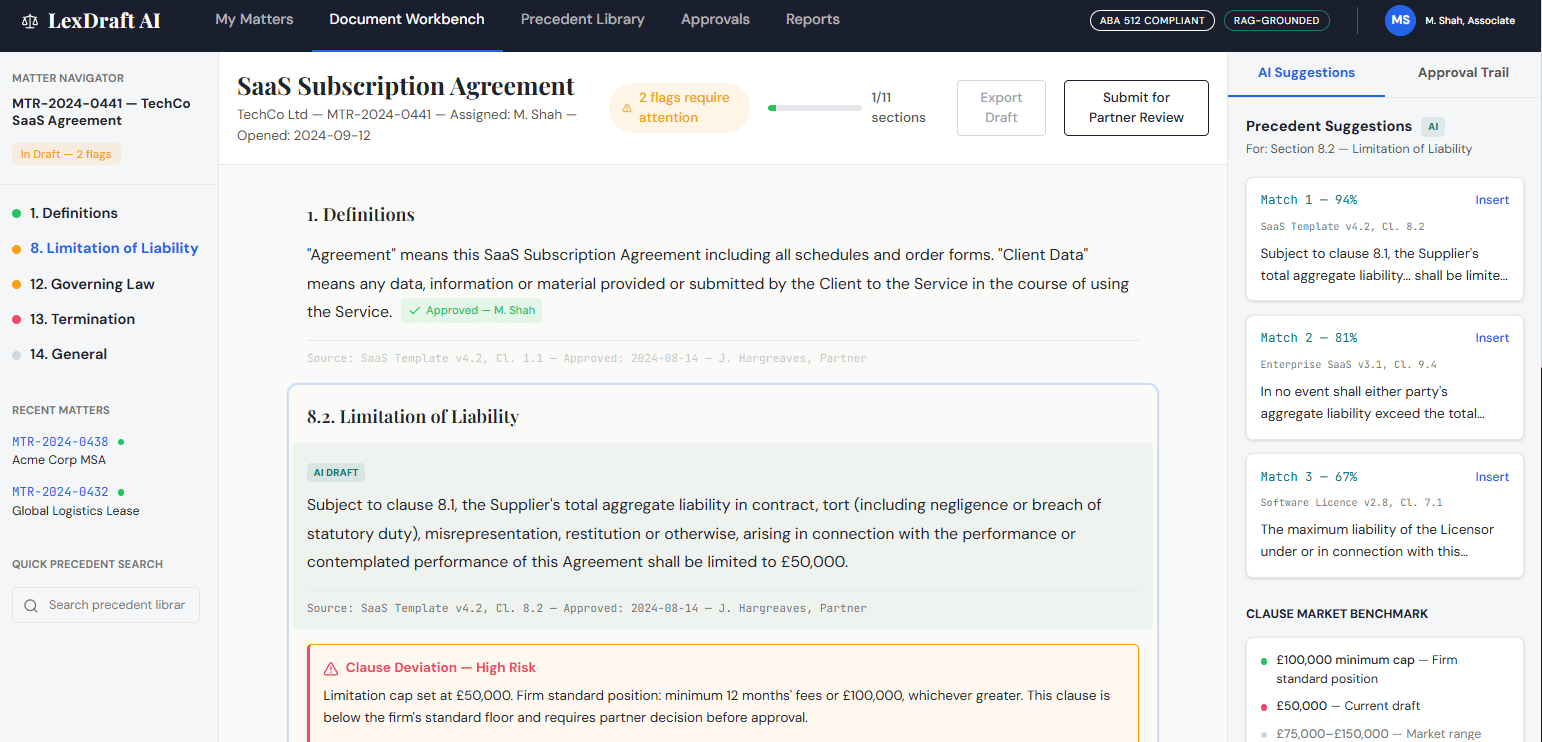
Executive Summary: The Drafting Burden That Keeps Growing
You are a senior associate at 11pm, reviewing a first draft from a junior that needs a full rewrite before the partner sees it tomorrow morning. Or you are in-house counsel, fielding a request for a straightforward commercial agreement – work that should take two hours but lands at the bottom of a queue that is already three days deep. Routine drafting consumes the legal profession at scale. An LLM legal writing AI solution changes that equation by acting as a retrieval-grounded, source-verifiable drafting copilot – one that produces structured first drafts, flags clause-level risks, reuses approved precedents, and hands every output back to a qualified lawyer for review and sign-off.
This is not a chatbot that generates plausible-sounding text. Purpose-built legal AI drafting workflows combine large language model reasoning with controlled document retrieval, citation verification, and mandatory human approval before anything leaves the firm. For legal teams under fee pressure, associate-hour scrutiny, and client demands for demonstrable efficiency, this solution addresses the highest-volume pain point in daily legal operations.
1. Why Does Routine Legal Drafting Keep Consuming Hours That Should Take Minutes?
Context: The Operational Reality of Legal Document Production
Legal document production sits at the intersection of two competing pressures: the professional obligation for precision and the commercial reality of finite associate hours. Law firms, in-house departments, and boutique practices all run the same loop – instructions arrive, a lawyer drafts, a senior lawyer rewrites, and a client waits. In practice, organisations deploying traditional workflows consistently find that the drafting loop consumes a disproportionate share of high-cost associate time on work that is structurally repetitive: standard NDAs, commercial agreements, board resolutions, advisory memos on well-trodden topics, and litigation support documents that follow established patterns matter after matter.
The scale of the inefficiency is real. Research cited by the American Bar Association confirms that 82% of firms using AI report greater productivity, with 65% saving up to five hours per week per lawyer. However, adoption of legal-specific AI remains uneven – firms that have not yet implemented a structured approach are leaving measurable capacity on the table.
Key Pain Points This AI Solution Addresses
- Lawyers spending too much time on routine document drafting: Associates and even senior lawyers regularly report that drafting standard agreements from scratch consumes hours that could be spent on analysis, strategy, or client work.
- High associate billing hours on repetitive legal work: Producing a 10-page brief or detailed advisory memo can require five to twenty hours of associate time. When the underlying legal framework is settled, much of that time reflects process inefficiency rather than legal complexity.
- Inconsistent contract language across different matters: Without a centralised way to reuse approved legal language, different associates draft the same clause type differently on every matter – creating risk and eroding client confidence in output quality.
- Outside counsel costs too high for standard work: In-house teams face mounting pressure to reduce outside counsel spend, particularly for high-frequency, lower-complexity work such as standard commercial agreements and routine compliance documents.
- Legal teams too slow to support the business: When business stakeholders wait days for a simple contract or advisory note, it signals that the legal function is a bottleneck rather than an enabler – damaging both relationships and deal velocity.
- First drafts from junior lawyers needing extensive rework: Partners and senior associates routinely spend as much time correcting junior drafts as they would have spent drafting the document themselves, eliminating the leverage the delegation was supposed to create.
- No centralised way to reuse approved legal language: Approved clauses, negotiated positions, and preferred formulations live in individual lawyers’ email archives and document folders rather than in a structured, searchable precedent library that the whole team can draw on.
Why Traditional Approaches Fall Short
Manual drafting workflows fail at scale not because lawyers lack skill, but because the process architecture itself creates compounding delays. When each document starts from a blank page or an outdated precedent, quality depends entirely on the individual drafter’s knowledge of what approved language exists and whether they remember to use it. A common pattern across real legal operations is that the institutional knowledge about clause preferences and negotiated positions lives in people’s heads rather than in structured systems – meaning every associate departure represents a knowledge loss event.
Template-based document automation addresses repetition but not reasoning. Standard template tools produce the right structure for simple, predictable documents but cannot adapt to new fact patterns, draft explanatory sections, or flag risk where a clause departs from market standard. The result is a gap between what automation can handle and what the legal team actually needs – a gap that falls back on associate time to fill.
Generic AI tools – using a general-purpose chatbot for legal drafting – create a different and more serious problem. They produce polished-sounding output without grounding in authoritative sources, firm precedent, or jurisdiction-specific requirements. Courts documented over 300 AI hallucination cases in filings by end of 2024, accelerating to over 700 by 2025. The fundamental problem is not the tool but the architecture: any drafting system that allows a language model to generate citations or legal authorities without real-time verification against authoritative sources is not a legal AI system – it is a liability.
2. What Is an LLM Legal Writing AI Solution and How Does It Differ From a Chatbot?
A purpose-built LLM legal writing AI solution is a structured legal drafting workflow, not a general conversational AI. The distinction matters enormously in practice. Where a generic chatbot generates text from its training data alone, a legal writing AI solution combines language model reasoning with controlled retrieval from approved sources – the firm’s own precedent library, playbook clauses, matter documents, and optionally licensed legal content – before generating a single word of output. Every suggested clause, every referenced authority, and every risk flag traces back to a verifiable source the lawyer can inspect.
The architecture is designed around one core principle: the AI acts as a drafting and analysis layer, not as a legal authority. It accelerates the production of first drafts, surfaces relevant precedent, identifies where a clause departs from the firm’s standard position, and structures the output for lawyer review and sign-off. The solution compresses the time from instruction to reviewable draft – without removing the human legal judgment that determines whether that draft is right for the specific matter and client.
Vision and Objectives
- Reduce first-draft production time for structured document types by a material margin – research from Harvard Law School’s Center on the Legal Profession documents AmLaw 100 pilots where AI compressed specific litigation drafting workflows from 16 hours to under 4 minutes – allowing associates to shift from routine drafting toward substantive legal analysis.
- Enforce consistent use of approved clause language across all matters, eliminating the variation that arises when different lawyers draft the same clause type from memory rather than from a governed precedent library.
- Surface clause-level risk automatically by flagging where a proposed contract departs from the firm’s standard position or from market practice benchmarks relevant to the document type.
- Enable in-house teams to handle a higher volume of standard work internally rather than routing it to outside counsel, reducing external spend on matters where the legal complexity does not justify the billing rate.
- Maintain a verifiable audit trail from source document through AI-assisted draft to approved final version, satisfying both internal governance requirements and professional responsibility obligations around AI use.
- Accelerate associate development by giving junior lawyers access to approved precedent language and clause-level guidance during drafting, reducing the rework burden on senior lawyers reviewing their work.
3. What Does This AI Solution Look Like in Practice?
In-House Counsel at a Mid-Size Technology Company
Your legal team of three handles every commercial agreement for a 400-person company, and the sales team wants a first draft of a new SaaS subscription agreement by tomorrow morning. Currently, that means pulling an old agreement from the shared drive, stripping out client-specific language manually, and hoping the base clauses are still current with the firm’s approved positions. With an LLM legal drafting platform, the in-house lawyer uploads the matter brief, selects the agreement type, and the system retrieves the most recent approved SaaS template plus relevant supplemental clauses from the precedent library. The draft arrives pre-structured, with source links for every clause section and flags on three provisions where the requester’s commercial terms depart from standard. The lawyer reviews, adjusts the flagged clauses, and approves the output in under two hours. The business gets its draft. The legal team does not work until midnight.
Mid-Size Law Firm Managing High-Volume Transactional Work
Every Monday, your transactional team receives a batch of routine commercial matters – supplier agreements, confidentiality arrangements, and licensing drafts – that associates must turn around in 48 hours while also progressing active deals. The bottleneck is not legal complexity; it is volume. An AI legal writing solution for mid-size law firms integrates directly into the firm’s document management system, pulling relevant precedent automatically when a new matter opens. Associates draft inside Microsoft Word with a sidebar showing applicable firm clauses, market comparison data for key provisions, and flagged deviations from the firm’s standard positions. What previously required a full associate day now requires two to three hours of focused review and adjustment. Partners spend their review time on genuine legal issues rather than correcting formatting, clause selection, and consistency errors.
Litigation Support Team Preparing Briefing Materials
Your litigation team is three weeks from a major hearing and needs to produce case summaries, chronologies, and supporting analysis for a document bundle that runs to four hundred pages. The associates assigned to the matter have never worked on this case type before and are spending more time orienting themselves in the file than actually drafting. A legal document automation tool configured for litigation support ingests the full case bundle, extracts key facts, dates, and parties, and produces a structured chronology and document summary. The AI flags which source documents support each factual claim and where the record contains gaps or inconsistencies. Associates review the structured output rather than rebuilding the factual record from scratch – cutting orientation time by approximately half and directing their attention to the analytical gaps that require actual legal judgment. The senior partner reviews a factually grounded first draft rather than a blank document.
Ready to explore what this solution looks like for your organisation?
Talk to Our AI Team4. How Does an LLM Legal Writing AI Solution Actually Work?
The architecture of a well-built legal writing AI solution reflects a deliberate separation between the AI’s drafting and reasoning functions and the authoritative sources those functions draw on. Rather than asking a language model to generate legal content from its training data alone, the system routes every generation task through a controlled retrieval layer first. This architecture directly addresses the hallucination risk that has led to sanctions in courts worldwide – because the model cannot cite what the retrieval layer has not first confirmed exists in the approved source corpus.
Data Acquisition: What the System Consumes
The system draws from three categories of input. First, the matter-level documents provided by the user: instructions, prior drafts, relevant correspondence, client-supplied facts, and any reference materials specific to the engagement. Second, the firm’s structured knowledge assets: approved contract templates, playbook clause libraries, negotiated precedents, standard positions on common commercial terms, and internal legal guidance documents. Third, where licensed access exists, structured legal content such as authoritative case databases, statutory compilations, and regulatory guidance – integrated via secure API connections that allow the system to retrieve verified authorities rather than generate them.
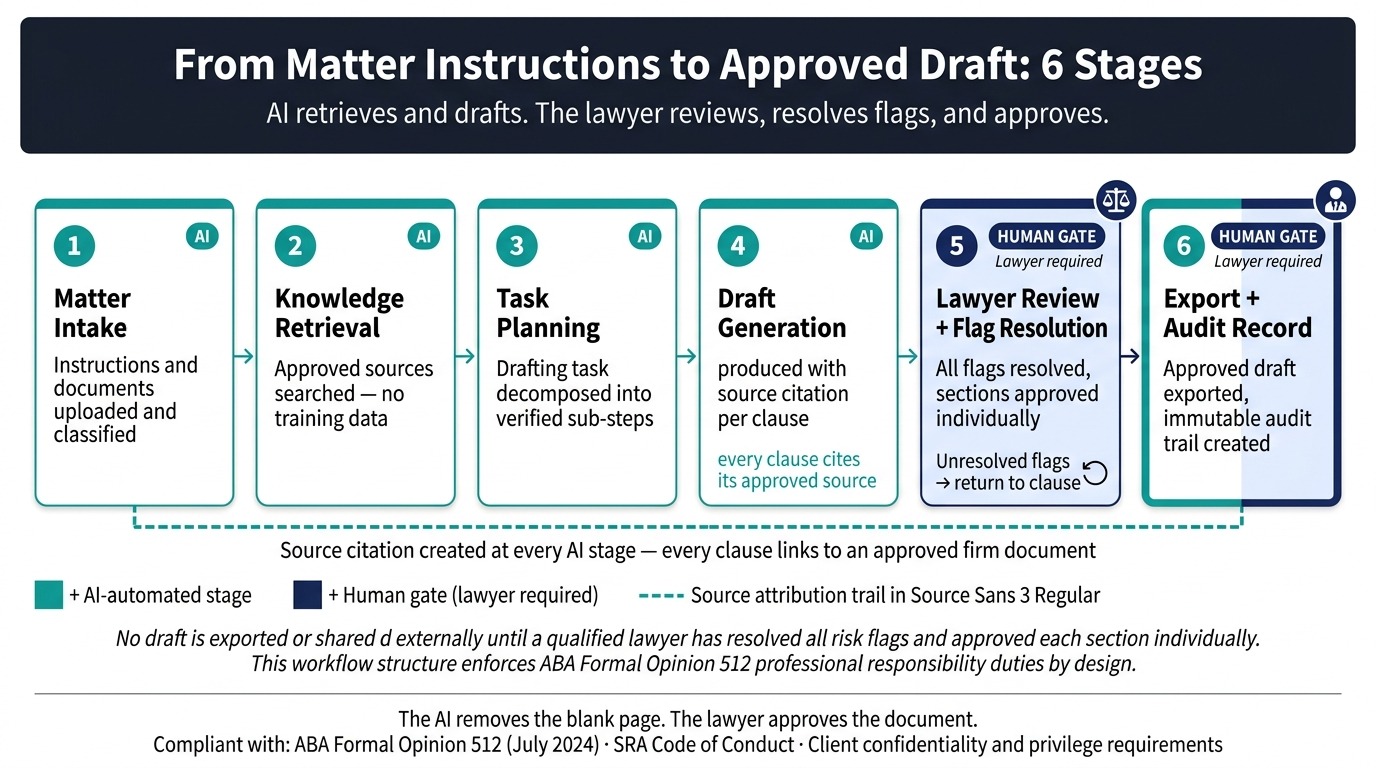
The AI Processing Pipeline
- Matter Intake and Task Classification: First, the user opens a matter and uploads the relevant inputs – a brief, instructions, a contract for review, or a prior draft. The system classifies the task type (first draft generation, contract review, memo production, litigation support document) and identifies which approved sources and templates are relevant to this document type and jurisdiction. This classification determines which retrieval pathways the system activates and which verification checks apply to the output.
- Knowledge Retrieval and Grounding: Next, the system searches only approved sources – the firm’s precedent library, uploaded matter documents, playbook clauses, and any licensed external legal content. Retrieval-Augmented Generation (RAG)An AI architecture that grounds language model outputs in retrieved documents rather than relying on training data alone, enabling source-verifiable responses ensures that every passage the drafting layer draws on comes from a document the system has retrieved and can link back to. Generic chatbot knowledge – the model’s training data – does not contribute to the draft. This is the architectural boundary that separates a legal AI drafting tool from a general-purpose AI assistant.
- Task Planning and Decomposition: Once the relevant sources are retrieved, the system breaks the drafting task into a structured plan rather than generating the entire document in a single model call. A contract review task, for instance, decomposes into: identify parties and governing terms, extract key commercial provisions, compare each provision against the playbook position, flag deviations, and generate a structured redline summary. This multi-step approach allows the system to apply different reasoning and verification steps to different parts of the document, rather than treating the whole task as a single generation problem.
- Draft Generation with Source Attribution: The system then generates each section of the draft with source passages attached. Every clause or paragraph the model produces is linked to the specific precedent, template section, or retrieved document that informed it. The output is not presented as authoritative text – it is presented as a draft grounded in specific approved sources, each of which the reviewing lawyer can inspect directly. Where the system cannot find an approved precedent to support a proposed clause, it flags the gap rather than generating ungrounded text.
- Verification and Risk Flagging: Before presenting the draft for review, the system runs a verification pass. For litigation documents, this includes checking that any case references resolve to actual retrieved authorities rather than generated text. For contract drafts, this includes comparing key provisions against the playbook and flagging where the draft departs from standard positions. Confidence scoringA numerical measure attached to AI-generated outputs indicating how strongly the retrieval layer supports the suggested text, used to prioritise human review effort assigns each section a reliability indicator, directing the reviewing lawyer’s attention toward the passages that require the most scrutiny.
- Output Preparation for Human Review: The system assembles the complete draft in the appropriate format – a Word document with tracked changes and comments for contract review work, a structured memo with cited sources for advisory work, or a summary with factual citations for litigation support. Every generated section carries a visible source link. Sections with low confidence scores or detected gaps are marked for mandatory lawyer review before the document can be approved for external use. The draft is a starting point, not a final product.
Human-in-the-Loop: Where Human Judgment Still Matters
What implementation experience reveals that theoretical explanations often miss is that the highest value in a legal AI drafting system comes not from eliminating human review but from redirecting it. The goal is to shift lawyer attention from low-value correction tasks – fixing formatting, selecting obvious clauses, locating precedents – toward the genuinely legal work: assessing whether the approved clause is right for this specific client, this specific counterparty, and this specific risk profile.
- All outputs require lawyer review before external use. No draft generated by the system goes to a client, court, or counterparty without a qualified lawyer reviewing and approving it. The system enforces this through a workflow step – documents in a “draft” state cannot be exported or shared until they carry an approval record.
- Flagged sections require explicit lawyer sign-off. Passages where the system detected a deviation from standard positions, a gap in source support, or a low confidence score are locked for explicit lawyer review – the reviewer must address each flag before the approval workflow completes.
- Novel legal questions bypass the drafting layer entirely. The system recognises when a query involves a question of first impression, an unsettled area of law, or a jurisdiction where the approved source corpus has insufficient coverage. In these cases, it escalates to the lawyer directly rather than generating a draft that may appear more authoritative than the underlying sources warrant.
- Citation verification is assisted, not automated. The system checks whether retrieved legal authorities exist in the approved corpus and links them in the output. However, the lawyer remains responsible for confirming that those authorities are current, good law, and actually support the proposition for which they are cited – a professional obligation that cannot be delegated to any tool.
- Client-specific judgment remains entirely with the lawyer. The AI drafts from approved standard positions. Whether a departure from that standard position is appropriate for a specific client relationship, deal context, or risk tolerance requires human legal judgment that the system flags for but does not resolve.
Output and Interaction: What the Lawyer Actually Sees
The primary working environment is Microsoft Word, where a sidebar integration surfaces approved clause suggestions, source links, and flagged deviations directly in the document the lawyer is editing. Lawyers do not need to switch applications, re-enter content, or learn a new interface – the AI assistance appears in the context where drafting already happens.
A web-based review dashboard provides matter-level oversight: a queue of documents awaiting review, status indicators for approval workflow progress, audit records showing which sources informed each section, and team-level activity reporting for legal operations managers. For in-house teams managing high-volume standard work, the dashboard gives legal ops visibility into throughput and turnaround time without requiring lawyers to produce manual status updates.
5. What Technologies Power an LLM Legal Writing AI Solution?
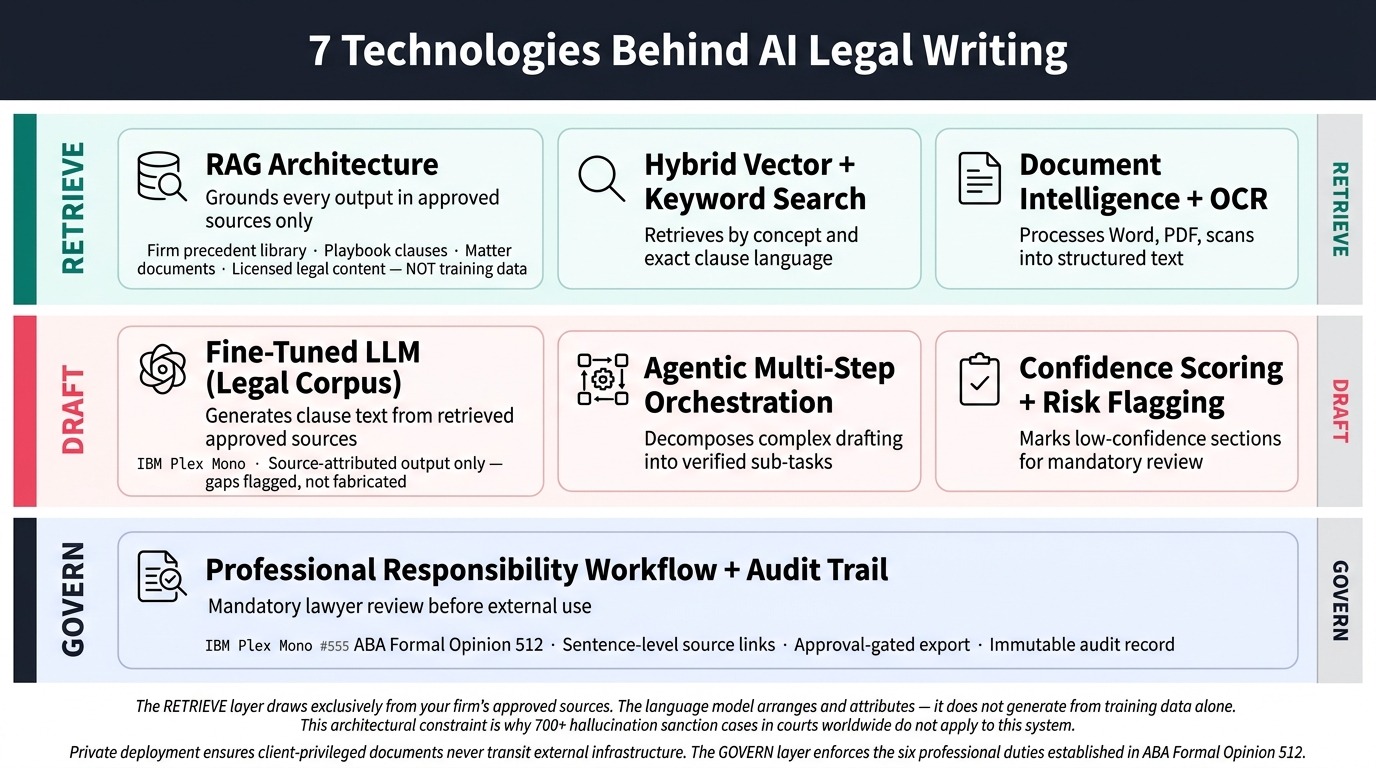
- Large Language Models (LLMs)Foundation AI models trained on large text corpora that generate coherent, contextually appropriate text – the drafting and reasoning engine at the centre of the solution: The core generation layer, responsible for producing draft text, summarising documents, identifying risk provisions, and structuring legal arguments. Modern legal AI systems typically use frontier-class models, selected for their reasoning capability on complex language tasks rather than for legal domain pre-training alone.
- Retrieval-Augmented Generation (RAG)Architecture that combines document retrieval with language model generation, grounding every output in retrieved source passages rather than relying on training data alone: The foundational architecture that separates a legal AI drafting tool from a generic chatbot. RAG ensures the model drafts from approved sources rather than from its parametric training data, making every output traceable to specific documents the system retrieved and can display to the reviewer.
- Hybrid Vector and Keyword SearchA retrieval approach combining semantic similarity search (vector) with exact-match keyword search, enabling legal documents to be retrieved by conceptual meaning as well as specific clause language or citation text: Legal retrieval requires both semantic understanding – finding a clause that addresses a concept even when the wording differs – and exact-match search for specific provision text, party names, or citation strings. Hybrid search combines both approaches for accurate, comprehensive precedent retrieval.
- Document Intelligence and OCROptical character recognition combined with document structure analysis, enabling the system to extract and process text from scanned PDFs, Word documents, and other legal file formats accurately: Legal inputs arrive in every format – scanned contracts, PDF court filings, DOCX drafts, email threads. Document intelligence pipelines normalise these inputs into structured text the retrieval and generation layers can process, preserving document structure and metadata throughout.
- Agentic Multi-Step OrchestrationAn AI system architecture where complex tasks are decomposed into sequential sub-tasks, each handled by specialised model calls or tool invocations, rather than processed in a single generation step: Complex legal tasks – a full contract review against a playbook, or a multi-issue litigation memo – require more than a single model call. Orchestration frameworks break these tasks into planned steps, routing each sub-task to the appropriate retrieval, reasoning, and verification components and assembling the result into a coherent whole.
- Enterprise Security and Tenant IsolationInfrastructure controls ensuring that each organisation’s documents, knowledge base, and AI outputs are completely separated from other organisations’ data, with encryption at rest and in transit: Legal data is privileged. The system must enforce strict separation between client matters, ensure that the firm’s precedent library is never exposed to other tenants, and maintain a complete audit trail of who accessed what and when – requirements that are non-negotiable for professional responsibility compliance and client confidentiality.
- Microsoft 365 and Document Management System IntegrationDirect API connections to Microsoft Word, Outlook, SharePoint, and specialist legal document management platforms such as iManage and NetDocuments, enabling AI assistance within the tools lawyers already use: Adoption in legal practice depends on reducing friction. Word-native integration means lawyers interact with AI assistance inside the document they are already editing rather than copying text in and out of a separate interface – the most consistently cited factor in successful legal AI deployment.
6. What Results Does an LLM Legal Writing AI Solution Deliver?
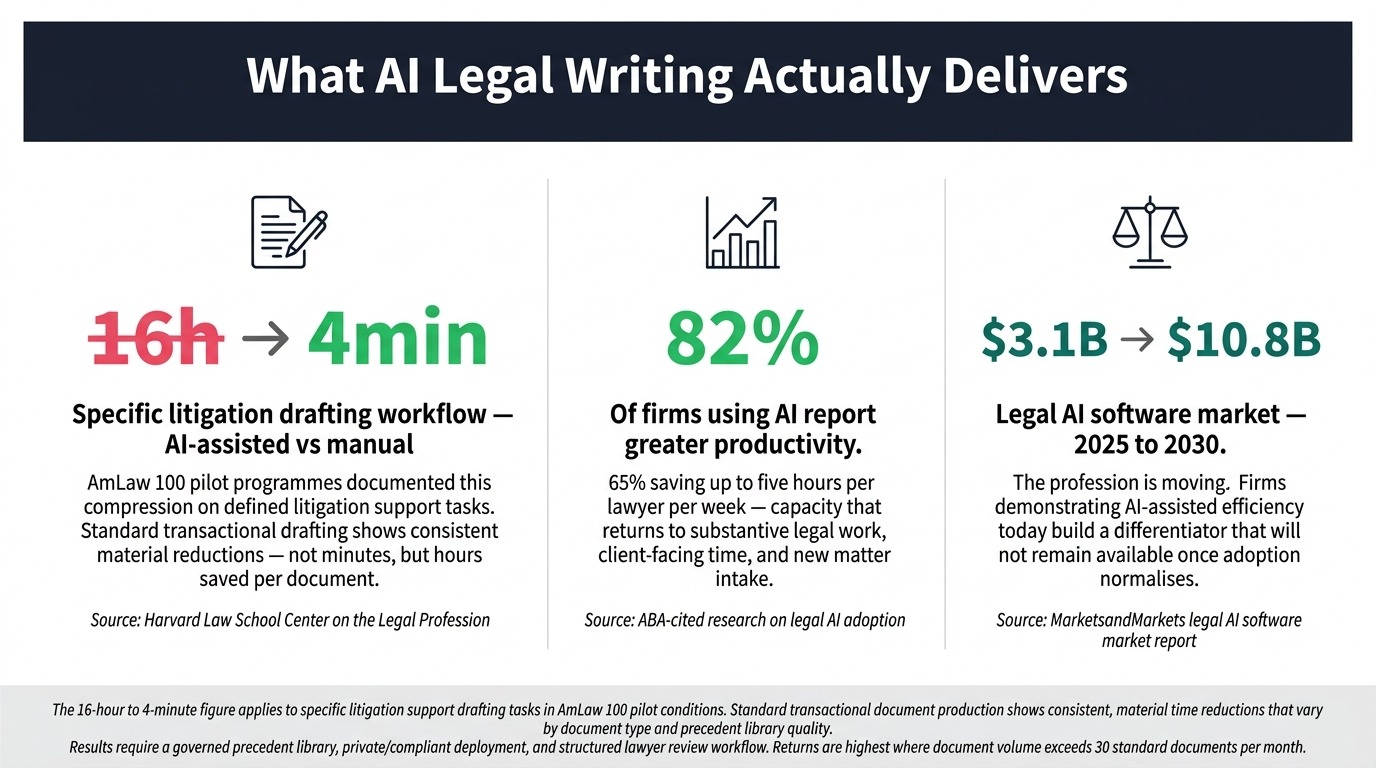
- Substantially faster first-draft production for standard document types. Harvard Law School’s Center on the Legal Profession documents AmLaw 100 pilots where AI-assisted drafting compressed certain litigation workflows from 16 hours to under 4 minutes. For standard transactional documents – NDAs, commercial agreements, advisory memos on settled areas of law – the reduction in associate time per document is consistently material, not marginal.
- Consistent use of approved clause language across all matters, because the retrieval layer surfaces the firm’s current standard position on every clause type rather than relying on individual lawyers to remember or locate it. Clause consistency reduces negotiation time and eliminates the risk exposure that comes from inadvertently using outdated or unapproved language.
- Earlier identification of high-risk contract provisions, because the system flags deviations from standard positions and market benchmarks during drafting rather than during partner review – compressing the review cycle and directing senior lawyer attention to genuine issues rather than routine correction.
- Reduced outside counsel spend for in-house teams on high-frequency, lower-complexity work. When standard commercial agreements and routine compliance documents can be produced efficiently internally, in-house teams can handle a higher proportion of the legal workload themselves – reserving outside counsel engagement for complex, high-stakes matters where specialist expertise justifies the cost.
- Higher associate leverage for partners and senior lawyers, because junior lawyer drafts arrive in better shape, grounded in approved precedent rather than constructed from memory. Partners spend review time on legal substance rather than on correcting clause selection and drafting errors.
- Improved precedent library discipline, because the system creates an incentive to maintain a governed, current precedent library – the better the firm’s structured knowledge assets, the better the AI-assisted drafts. Over time, the firm builds a compounding knowledge asset rather than relying on institutional knowledge stored in individual lawyers’ files.
- Demonstrable AI use for fee-conscious clients: Clients and procurement teams increasingly request evidence that their legal service providers use AI to deliver efficiency. A structured LLM legal writing AI solution provides an auditable record of AI-assisted work product production, supporting both compliance with client requirements and conversations about value-based or fixed-fee arrangements.
- Reduced compliance risk from unverified AI use, because the system’s architecture enforces source grounding and human review – directly addressing the professional responsibility concerns that ABA Formal Opinion 512 established and that courts have sanctioned lawyers for ignoring when using unstructured AI tools.
7. Is an LLM Legal Writing AI Solution Worth the Investment? The Business Case Framework
A structured LLM legal writing AI solution delivers measurable return across several key business metrics – the question for most legal teams is not whether the return exists but whether the implementation is scoped to capture it. Teams that have worked through this integration consistently find that the strongest ROI case comes from focusing the initial deployment on a defined set of high-frequency document types rather than attempting to cover all legal work at once.
The core metrics to measure before and after implementation are: first-draft production time for the targeted document types (measured in hours per document, tracked by matter type); associate revision cycles on first drafts before partner approval (fewer cycles indicate better baseline quality); outside counsel spend on the document categories the solution is designed to replace with internal production; and matter cycle time from instruction to approved final document for standard agreement types.
For a mid-size law firm or in-house legal team handling thirty or more standard documents per month across the targeted categories, the time-saving case is straightforward to model. The same Harvard Law School research that documented 16-hour workflows compressing to minutes confirms that lawyer productivity gains from AI-assisted drafting are both measurable and significant – at associate billing rates or in-house equivalent cost, even modest weekly time savings per lawyer produce material annual value across a team.
A realistic implementation timeline for a mid-size organisation – from initial scoping and precedent library preparation through to live deployment for the first use case – runs three to five months. The longest phase is typically precedent library curation: ensuring the approved templates and clause libraries the system will draw on are current, governed, and structured for retrieval. Organisations with strong existing knowledge management infrastructure move faster. Those rebuilding from scattered file-share precedents will need additional time upfront – but the library curation process itself delivers value independent of the AI layer.
The business case for acting now rather than waiting rests on two converging pressures: client expectations for AI-assisted efficiency are rising faster than most firms’ current adoption rate, and the legal AI software market is projected to grow from $3.11 billion in 2025 to $10.82 billion by 2030 according to MarketsandMarkets – signalling that the tools, the infrastructure, and the competitive pressure all move in one direction. The competitive differentiation from demonstrable AI capability is available to early movers today; it will not remain a differentiator once adoption normalises across the profession.
8. What Does Implementing an LLM Legal Writing AI Solution Actually Require?
- Precedent library preparation is the prerequisite, not the afterthought. The most frequently underestimated factor in live deployments of this type is the state of the firm’s existing knowledge assets. An AI legal drafting tool retrieves from what you give it. If the approved templates are outdated, the clause libraries are inconsistent, or the precedent structure is scattered across file shares and email archives, the system will surface low-quality material. Allocating time for precedent governance before go-live is not optional – it is the work that determines output quality.
- Confidentiality and data handling require explicit scoping decisions. Matters vary in sensitivity. A robust implementation requires a clear data classification framework: which matters may be used to enrich the retrieval corpus, which must be kept isolated even within the firm’s environment, and what external services – if any – the AI layer is permitted to call. Many enterprise buyers choose private LLM deployment to ensure client-privileged documents never transit external infrastructure.
- Professional responsibility compliance requires active governance, not passive trust. ABA Formal Opinion 512 (2024) establishes six duties for lawyers using AI: competence, confidentiality, communication, candor toward the tribunal, supervisory responsibility, and billing practices. Implementing the system requires establishing and documenting AI use policies, ensuring lawyers receive training on the tool’s capabilities and limitations, and building the human review workflow into the process architecture – not as an optional step but as a mandatory gate.
- Integration complexity depends heavily on the existing technology environment. Firms running modern document management systems with good API access can integrate Word-native assistance and matter-level retrieval in a manageable development cycle. Firms with legacy systems, mixed storage environments, or inconsistent document naming conventions will face additional scoping work before the integration functions cleanly.
- Jurisdiction and practice area coverage must be defined upfront. No legal AI drafting system covers all jurisdictions and all practice areas equally well. The implementation scope should define which document types and jurisdictions the system is authoritative for – and ensure the system clearly signals to users when they are working outside that scope rather than generating text as if the coverage were universal.
- Ongoing evaluation requires lawyer-in-the-loop feedback. Output quality improves over time only if the system captures feedback from reviewers – which clauses were accepted, which were revised, which were rejected, and why. Building a feedback mechanism into the review workflow from day one means the system learns from the firm’s actual standards rather than converging on a generic legal average.
- Change management is an implementation risk as significant as any technical factor. Lawyers with prior bad experiences with generic AI tools may approach the system sceptically. Introducing the solution as workflow compression rather than lawyer replacement, demonstrating early wins on the highest-friction document types, and involving senior lawyers in defining the approved clause library all reduce adoption friction significantly.
Where This Solution Has Real Limits
- Novel legal questions and matters of first impression are genuinely beyond what a retrieval-grounded drafting system handles reliably. When there is no settled precedent to retrieve, the system has no authoritative source to ground its output – and generating text as if settled authority existed would be precisely the hallucination problem the architecture is designed to prevent.
- Multi-jurisdiction complexity where a single document must satisfy requirements across several legal systems simultaneously requires careful scoping. The retrieval layer performs well when jurisdiction is clear and the approved corpus covers it – it does not reliably navigate jurisdiction selection itself.
- Citation verification assists but does not replace the lawyer’s KeyCite obligation. The system checks whether a retrieved authority exists in the approved corpus and links it. However, whether that authority is still good law, has been overruled, or has been limited by subsequent decisions requires current citator verification that the lawyer must perform.
- Output quality is bounded by the quality of the precedent library. If the firm’s approved templates contain errors, outdated provisions, or poor drafting, the AI-assisted draft will reproduce those problems at scale. Garbage in, garbage out applies here as clearly as in any data-dependent system.
9. Which Legal Teams Get the Most Value From This Solution?
The organisations that see the strongest return from an LLM legal writing AI solution share a common profile: they handle a high volume of structurally similar documents, they have capable lawyers who are currently underutilised on repetitive drafting work, and they face either external fee pressure from clients or internal cost pressure from the business demanding faster legal support. The solution delivers the most visible value where the gap between current drafting speed and what the team’s capacity can sustain is widest.
- Mid-size and large law firms managing high-volume transactional or commercial work across practice areas such as corporate, real estate, banking, and employment, where standard document production consumes significant associate time on every matter.
- In-house legal departments at companies with active commercial operations, where a small team fields a steady stream of requests for commercial agreements, supplier contracts, employment documents, and regulatory compliance support.
- Legal operations functions within large corporates that manage outside counsel relationships and want to reduce spend on routine document production by building more internal capability.
- Litigation support teams producing document chronologies, case summaries, expert-support materials, and briefing documents where the work is analytically structured but data-intensive.
This solution is particularly valuable if: your team spends more than 30% of its time on first-draft production for documents that follow consistent patterns; your outside counsel spend includes material fees for work your in-house team could handle with better tooling; your junior lawyers regularly produce first drafts that require partner-level rework; or your clients have started asking whether you use AI and what efficiency benefits they can expect from it.
10. Frequently Asked Questions About LLM Legal Writing AI Solutions
How is an LLM legal writing AI solution different from just using ChatGPT for legal drafting?
The core difference is architecture, not capability. A general-purpose tool like ChatGPT generates text from its training data alone – it cannot access your firm’s approved precedents, it has no visibility into your matter documents, and it cannot verify whether a cited case exists in any authoritative legal database. A purpose-built LLM legal writing AI solution uses retrieval-augmented generation to ground every output in approved sources – your firm’s precedent library, playbook clauses, and matter documents – before the language model generates a single word. Every suggested clause links back to a source the lawyer can inspect. This architectural difference is precisely what distinguishes a professionally responsible legal drafting tool from the generic chatbot use that has produced hundreds of sanctions cases in courts worldwide.
Can an LLM legal drafting platform actually reduce outside counsel spend for in-house teams?
For high-frequency, lower-complexity work – standard commercial agreements, NDAs, routine employment documents, compliance correspondence – a well-implemented LLM legal drafting platform enables in-house teams to produce more of this work internally rather than routing it externally. The economics are straightforward: if the AI-assisted drafting time for a standard commercial agreement drops from a half-day to two hours, an in-house team of three can handle significantly more volume without additional headcount. The reduction in outside counsel spend is most visible on document types where the legal complexity is genuinely routine – the solution does not replace outside counsel for complex, novel, or high-stakes matters where specialist expertise is the primary value.
What happens when the AI drafts a legal document incorrectly or cites a wrong authority?
In a properly architected legal AI writing solution, the system does not silently generate incorrect citations – it flags where source support is absent or weak rather than inventing it. Every output carries source links to the documents retrieved during generation, and passages where confidence is low are marked for mandatory lawyer review before the document can be approved. However, the system is not infallible: it is the lawyer’s professional responsibility to verify that cited authorities are current, applicable, and actually support the proposition for which they are cited. The solution reduces the risk of citation fabrication through architecture, but the professional obligation to check the work remains with the lawyer who approves the document for external use.
How long does it take to implement an LLM legal writing solution for a law firm or in-house team?
A realistic implementation timeline for a mid-size organisation runs three to five months from initial scoping to live deployment on the first use case. The technical build – system configuration, document management integration, Word plugin deployment, and security controls – typically runs six to ten weeks. The longer variable is precedent library preparation: ensuring the approved templates and clause libraries the system will retrieve from are current, governed, and consistently structured. Organisations with strong existing knowledge management infrastructure can compress this phase; those building from scattered precedents need additional upfront time. The payback period on time savings typically becomes visible within the first full quarter of live use on high-frequency document types.
Is an LLM-based legal writing platform compliant with ABA ethics rules and professional responsibility requirements?
ABA Formal Opinion 512 (July 2024) established that lawyers may use AI tools consistent with their existing professional obligations, including duties of competence, confidentiality, candor toward the tribunal, and supervisory responsibility. A well-designed LLM legal writing AI solution is built to support these obligations – with source-verifiable outputs, mandatory human review gates, audit trails, and data isolation controls – rather than to circumvent them. However, compliance is not a product feature; it is a governance outcome. Firms must establish AI use policies, train lawyers on the tool’s capabilities and limitations, and ensure that the human review workflow is actually followed rather than bypassed under time pressure. The tool provides the architecture for compliant use – the firm provides the discipline to use it that way consistently.
11. Build This Solution With Softlabs Group
Softlabs Group builds custom LLM legal writing AI solutions for law firms and in-house legal teams – grounded in your firm’s own precedent library, integrated into your document management and Microsoft 365 environment, and architected around the retrieval, verification, and human review workflow that professional responsibility requires. We do not deploy off-the-shelf tools and call it done. We scope the solution to your specific document types, jurisdictions, and knowledge assets – then build the retrieval layer, drafting pipeline, verification checks, and review workflow that make the system reliable in production rather than impressive only in demos. For organisations with strict data sovereignty requirements, we offer private LLM development to ensure client-privileged documents remain within your controlled environment throughout the entire workflow.
If your team is evaluating whether a structured legal AI drafting system is the right next step, the most useful conversation starts with your highest-friction document type – the one where associates spend the most time, partners do the most rework, and the business waits the longest. That is typically where the case is clearest and the implementation is most manageable. Our enterprise AI development team is experienced in legal workflow integration, document intelligence, and the security architecture that legal data requires. Start that conversation below.