 India
India  Mongolia
  Sweden
  Australia
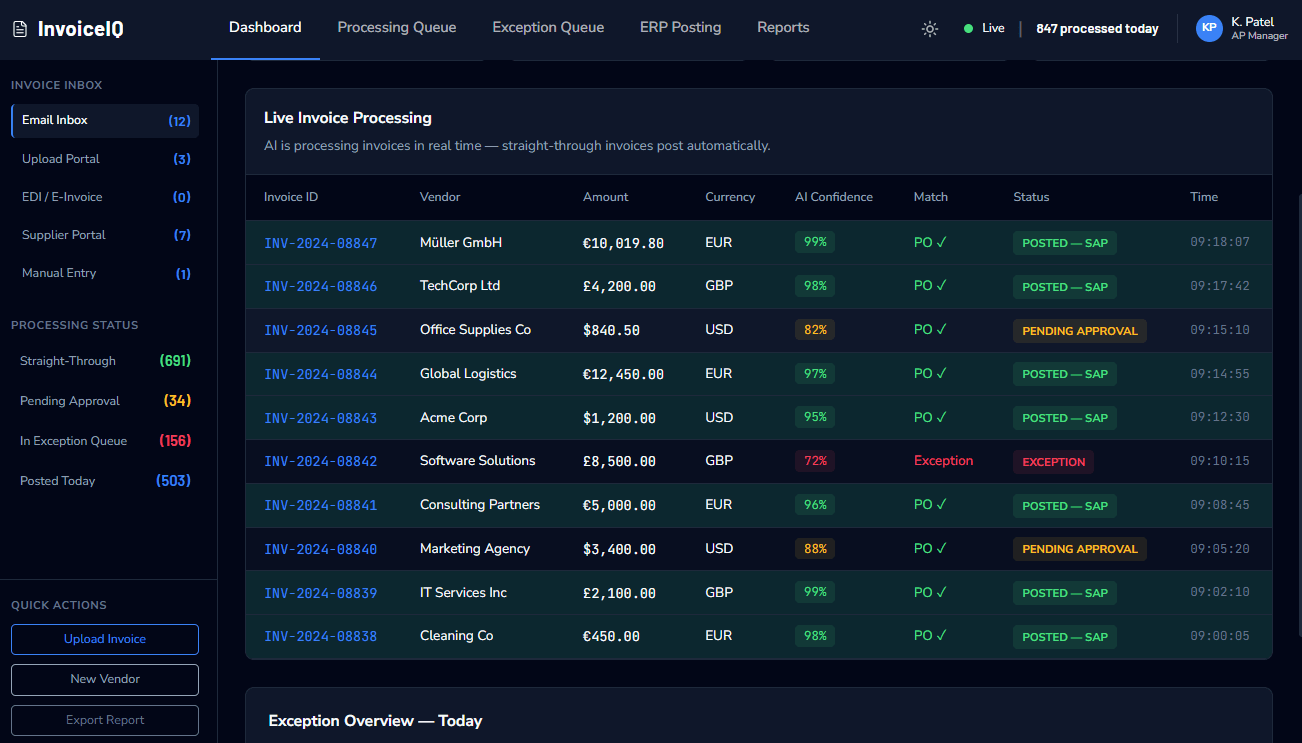
Executive Summary: The Hidden Cost Sitting Inside Every Unprocessed Invoice
Your AP team is skilled, experienced, and perpetually buried. Every month-end, the same invoices pile up – vendor emails, scanned PDFs, emailed attachments in five different formats – and the team manually keys data, chases approvals, and reconciles mismatches against purchase orders. The LLM invoice extraction and processing AI solution changes this fundamental workflow. By combining large language model (LLM)A deep learning AI model trained on vast text data, capable of understanding and reasoning about language in context rather than matching fixed patterns reasoning with optical character recognition (OCR)Technology that converts scanned images or PDFs into machine-readable text, forming the foundational read layer before AI interpretation, structured validation, and workflow automation, this solution turns invoice intake into a controlled, largely touchless process – routing clean invoices straight to your ERP and escalating exceptions with clear context for human review.
For finance teams handling hundreds or thousands of invoices monthly, the economics are stark. Manual processing costs organisations significantly more per invoice than an automated alternative – and the gap widens as volume grows. However, the real value is not just cost reduction. It is the speed, accuracy, and control that a well-built AI invoice automation solution delivers across approval cycles, compliance requirements, and payment accuracy. This page explains exactly how a production-grade LLM invoice extraction and processing AI solution works, what it takes to build one that survives real-world deployment, and where Softlabs Group fits into that picture.
Why Does Manual Invoice Processing Keep Getting More Expensive and Error-Prone?
Context: The Modern Accounts Payable Environment
Accounts payable sits at the intersection of supplier relationships, cash flow management, and financial compliance. Most mid-size and enterprise finance teams receive invoices across a mix of channels – email, supplier portals, physical scans, and increasingly through e-invoicing networks mandated by governments globally. Each invoice arrives in a different format, with different field labels, different tax structures, and different levels of scan quality. The AP team must extract, validate, match, route, and post every one – often under tight month-end deadlines and growing regulatory scrutiny.
In practice, organisations deploying manual or partially automated AP workflows typically encounter a compounding problem: volume increases faster than headcount, error rates compound with each manual step, and exception handling consumes the majority of AP staff time. The result is a function that is simultaneously critical to business operations and chronically under-resourced.
Key Pain Points This AI Invoice Automation Solution Addresses
- High cost per invoice from manual processing: Finance teams relying on manual data entry spend significantly more per invoice than automated alternatives, with costs including staff time, error correction, and delayed payment penalties all compounding the true figure.
- AP team overwhelmed at month-end: Invoice volume surges predictably – yet most teams cannot flex headcount to match, forcing overtime, prioritisation shortcuts, and missed payment windows.
- Invoice exceptions stalling approval workflows: A mismatched PO reference, a missing line-item total, or an unrecognised vendor name can freeze an invoice in a manual exception queue for days, damaging both supplier relationships and early-payment discount capture.
- Duplicate invoice payments going undetected: Manual review catches some duplicates, but vendors re-submitting invoices across channels or with minor reference number variations regularly slip through – resulting in overpayments that require costly recovery.
- Late payments damaging supplier relationships: Slow cycle times – often stretching to two weeks or more in manual environments – translate directly into late fees, strained vendor trust, and missed negotiating leverage on pricing and terms.
- No real-time visibility into outstanding invoices: Without a centralised processing layer, finance leadership cannot see the true liability position at any given moment, making cash flow forecasting unreliable.
- Manual data entry errors causing payment mistakes: Research consistently shows that invoices processed by hand carry error rates of 3-5%, with nearly four in ten invoices containing at least one discrepancy when manual review is the primary control mechanism.
Why Traditional Approaches Fall Short
Template-based OCR – the predecessor to modern AI invoice processing software – works acceptably when every vendor sends the same layout. The moment a supplier changes their invoice template, sends a hand-annotated PDF, or operates in a different currency or language, template-based rules break. Maintaining vendor-specific templates across a supplier base of dozens or hundreds becomes a full-time task that never quite keeps pace with real-world variation.
Rule-based automation fares similarly. Rules can enforce specific field formats and flag obvious mismatches, but they cannot interpret semantics. A system built on rules cannot recognise that “Summe,” “Total Due,” and “Gross Amount” all refer to the same invoice field across different vendor formats. Furthermore, traditional approaches generate high exception rates precisely at the moments they are most needed – during volume surges – because exceptions require manual resolution and the queue grows faster than the team can clear it.
The contrast with a well-built LLM invoice extraction and processing AI solution is meaningful. An AI invoice processing platform that combines OCR, LLM-based semantic interpretation, and deterministic validation handles format variation by understanding context – not by matching fixed patterns. However, the honest caveat is this: AI invoice processing software still depends on upstream data quality, structured exception handling, and clean ERP master data to deliver its full value. The technology is not magic; it is a sophisticated reasoning layer within a controlled workflow.
What Is an LLM Invoice Extraction and Processing AI Solution?
An LLM invoice extraction and processing AI solution is a hybrid finance automation system that reads invoices in any format – PDFs, scans, images, or structured e-invoice feeds – extracts key fields, validates the data against business rules and ERP master records, and routes clean invoices straight through to payment while escalating exceptions with clear context for human review.
The critical distinction from earlier approaches is that the LLM functions as a reasoning layer, not the entire system. It interprets messy field labels, normalises vendor-specific terminology, and maps extracted content into a clean target schema. Deterministic validation rules then verify totals, tax calculations, PO matches, and duplicate flags before anything moves forward. This layered architecture – read, reason, validate, route – is what makes a production-grade AI invoice data capture platform reliable at scale, not just impressive on sample PDFs.
Vision and Objectives
- Touchless processing for routine invoices: Clean, matched invoices move from receipt to ERP posting without human intervention, measured by the proportion of invoices processed with zero manual touchpoints.
- Controlled exception handling: Invoices that fail validation surface in a structured exception queue – classified by reason, assigned to the right owner, and resolved faster than email-chain escalation allows.
- Accurate PO and goods receipt matching: Two-way and three-way matching occurs automatically, with tolerance bands configured to the organisation’s risk appetite rather than requiring manual comparison.
- Duplicate and fraud prevention before payment: Deterministic duplicate detection and vendor master validation catch overpayment risks before they reach the payment run – not during post-payment reconciliation.
- Real-time AP visibility: Finance leadership sees outstanding liabilities, approval status, and exception volumes at any moment, enabling accurate cash flow management rather than end-of-period surprises.
- Audit-ready posting workflows: Every extraction, validation decision, and manual correction generates a timestamped audit trail, reducing compliance preparation time and supporting external audit requirements.
How Do Real Organisations Use LLM Invoice Extraction in Practice?
Scenario 1: Manufacturing Company with Multi-Supplier, Multi-Currency AP Volume
Your procurement team buys from 200+ suppliers across five countries, and invoice formats change every time a vendor updates their billing system – while your AP headcount has stayed flat for three years.
Manual processing requires a different template or parsing rule for each vendor layout, and maintaining those rules is a part-time job. Currency mismatches and missing PO references generate constant exception queues that consume AP staff’s day.
An LLM invoice extraction platform reads each invoice’s context rather than its layout. It normalises field labels across languages, maps line items to the correct GL codes, and cross-references each invoice against the relevant purchase order within seconds. Invoices that match post automatically; the few that do not surface in a structured exception queue with the mismatch reason clearly stated.
The outcome: AP cycle time drops from fourteen days to under three, and the team redirects time from data entry to supplier relationship management and discount capture.
Scenario 2: Shared Services Centre Handling AP for Multiple Business Units
You run AP for seven business units from a single shared services centre, and every unit has different approval hierarchies, GL coding conventions, and ERP posting requirements.
Each invoice must reach the right approver within the right business unit’s workflow – a routing problem that manual triage gets wrong often enough to create real compliance exposure. Month-end is a predictable crisis as volumes spike simultaneously across all units.
A configurable AI accounts payable solution ingests invoices centrally, identifies the correct business unit from header fields and vendor master data, applies the right routing rules per unit, and sends each invoice to the correct approval chain automatically. Exception volumes reduce because validation catches discrepancies before routing, not after.
The result: processing throughput increases substantially per FTE, and month-end no longer requires mandatory overtime to clear the queue.
Scenario 3: Fast-Growing E-Commerce Business Scaling Invoice Volume Beyond Team Capacity
Your invoice volume doubled last year and is on track to double again – but hiring two AP clerks for every doubling of volume is neither affordable nor sustainable.
Vendor invoices arrive by email in PDF format, as image attachments, and occasionally as handwritten credit notes from smaller suppliers. Traditional OCR fails on low-quality scans, and your current system flags nearly a quarter of all invoices as exceptions requiring manual review.
An intelligent invoice processing tool with OCR preprocessing and LLM-based field interpretation handles format variation without vendor-specific templates. Confidence scoring identifies low-certainty extractions before they reach validation, routing only genuinely ambiguous cases to human review rather than everything that falls outside a rigid rule set.
The outcome: the team processes three times the invoice volume without adding headcount, and the exception rate falls from over 20% to under 10% within the first quarter after deployment.
Ready to explore what this solution looks like for your organisation?
Talk to Our AI TeamHow Does an LLM Invoice Extraction and Processing AI Solution Actually Work?
A production-grade LLM invoice extraction and processing AI solution solves two distinct problems in sequence: first, converting pixels or PDF content into reliable text; second, converting that text into trusted, validated accounting data. Each problem requires a different layer of technology, and skipping either layer is what causes most demo systems to fail in production.
The architecture below reflects what teams that have worked through real invoice AI deployments consistently find is necessary – not a simplified ideal, but the actual modules required for a system that handles bad scans, non-standard vendors, missing PO references, and live ERP posting without breaking.
Data Acquisition: What the System Ingests
The system accepts invoices from multiple input channels simultaneously: AP email inboxes (monitored automatically), web upload portals, supplier-facing submission portals, ERP invoice queues, and structured e-invoicing network feeds. Each ingestion point captures the original file for traceability, logs receipt metadata – timestamp, source channel, initial vendor identification – and queues the document for processing. Supporting documentation such as purchase orders, goods receipt notes, and vendor master records from the ERP are also pulled at this stage to support downstream matching.
The AI Processing Pipeline
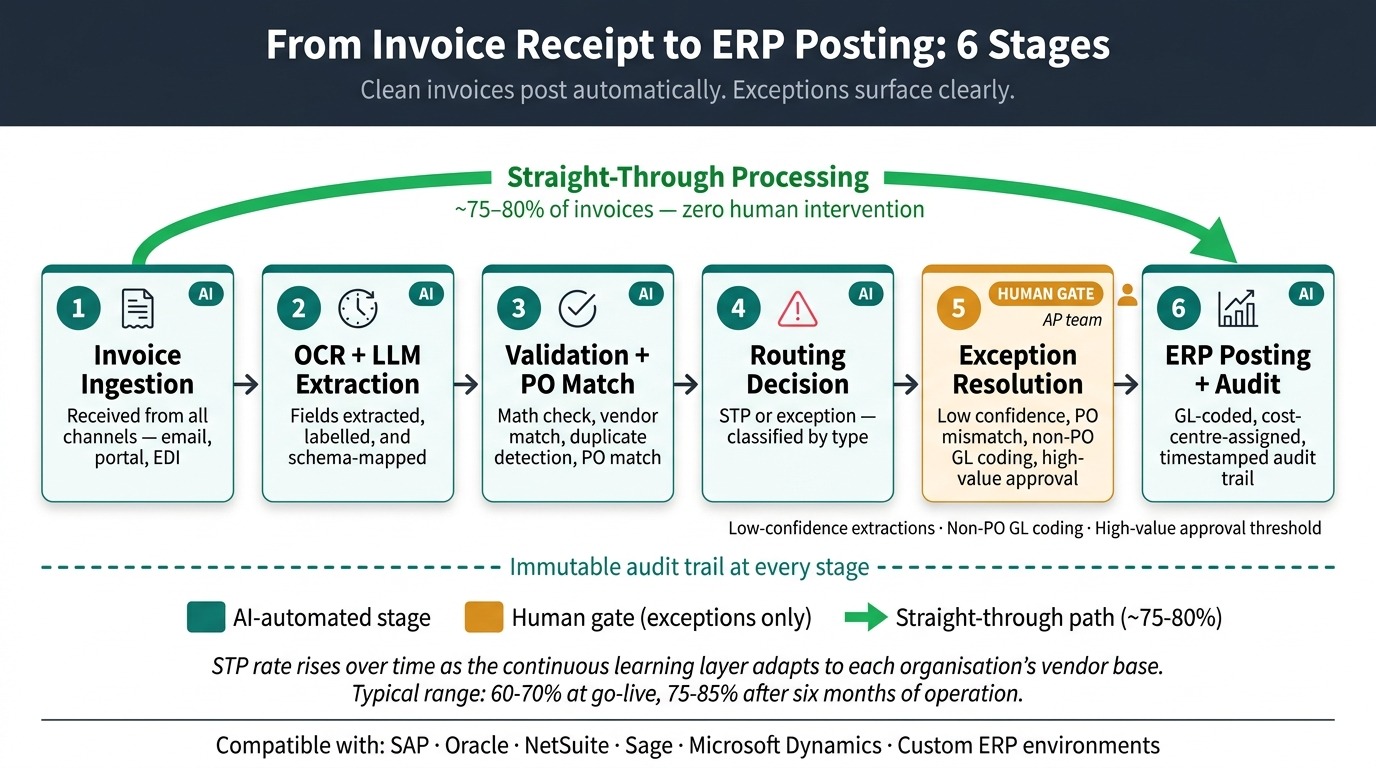
- Document Preprocessing and OCR Extraction: First, the system assesses each incoming document’s quality and format. For image-based PDFs and scans, a dedicated document AIAI models trained specifically on document layouts, tables, and visual structure – not just raw text – enabling accurate extraction from complex, multi-column invoice formats layer performs layout analysis and OCR to convert pixels into structured text. This step is handled by specialised document-understanding models rather than generic OCR alone, because line-item tables, merged cells, and multi-column layouts require spatial reasoning that standard character recognition does not provide. Digital PDFs bypass OCR and feed their text content directly to the next stage.
- LLM-Based Field Interpretation and Schema Mapping: Next, the LLM receives the extracted text and maps it to a clean target schema: vendor name, invoice number, invoice date, due date, currency, line-item descriptions, unit prices, quantities, subtotals, tax amounts, and total. Crucially, the LLM reasons about the meaning of field labels rather than matching fixed patterns – so “Betrag,” “Montant HT,” and “Taxable Value” all correctly map to the right schema field regardless of vendor or language. Each extracted field receives a confidence score. Low-confidence extractions are flagged for human review before validation runs, preventing confident wrong answers from reaching the control layer.
- Deterministic Validation and Business Rules Enforcement: Once extracted, the system runs every invoice through a rule-based validation layer that checks totals and tax calculations mathematically, cross-references the vendor name and registration number against the ERP vendor master, applies duplicate detection using invoice number, vendor ID, date, and amount combinations, and verifies any PO number reference against open purchase orders. This layer is deterministic – not probabilistic. It does not “think” about whether something is correct; it either passes or fails against defined rules. Teams that have worked through this integration consistently find that skipping or weakening this layer is the primary cause of post-payment errors that require costly recovery.
- Two-Way and Three-Way PO Matching: The system then attempts to match validated invoices against purchase orders and, where applicable, goods receipt or service confirmation records. Two-way matching verifies that the invoiced amounts align with the PO within a configurable tolerance band. Three-way matching additionally confirms that the goods or services have been received and accepted before releasing the invoice for payment. Matching completes in seconds; manual matching of the same invoice against paper PO records typically takes fifteen to thirty minutes. Invoices that match within tolerance proceed automatically; those that fall outside it join the exception queue with the specific mismatch identified.
- Intelligent Approval Routing: The system then routes each validated, matched invoice to the correct approver – determined by business unit, invoice amount, cost centre, vendor category, or any combination of configurable routing rules. Approval requests include the invoice, its extracted fields, the validation result, and the match confirmation, giving approvers everything needed to approve or query without chasing additional information. Straight-through processing (STP)The proportion of invoices that move from receipt to approved posting without any human intervention or manual correction – the primary efficiency metric for AP automation invoices bypass the approval step entirely under pre-defined criteria, such as recurring invoices from approved vendors within established price bands.
- ERP Posting and Continuous Learning: Approved invoices post directly to the connected ERP or accounting system with pre-mapped GL codes, cost centre assignments, and payment terms. The system records every posting in a complete audit trail. Every manual correction made by a human reviewer – whether correcting an extracted field, overriding a routing decision, or resolving a match exception – feeds back into vendor-specific rules and model confidence thresholds. As a result, accuracy and touchless rates improve over time as the system learns the specific patterns, formats, and quirks of each organisation’s supplier base.
Human-in-the-Loop: Where Human Judgment Still Matters
- Low-confidence field extractions: Any field where the LLM’s confidence score falls below the configured threshold surfaces in a structured review queue, allowing a human to confirm or correct before validation runs – preventing confident wrong answers from flowing downstream.
- Non-PO invoices requiring GL coding: Invoices without a purchase order reference – services, subscriptions, or emergency purchases – require a human to assign the correct GL code and cost centre, because this decision requires business context the system does not have.
- Exception resolution with vendor context: When an invoice fails validation or matching, a human reviewer resolves it with the specific mismatch clearly displayed. The reviewer’s decision – approve with override, reject, or query the vendor – is logged for audit and contributes to future rule refinement.
- Approval sign-off on high-value invoices: Invoices above a configured value threshold always require explicit human approval, regardless of how cleanly they validated and matched. This is a configurable control, not a system limitation.
- Vendor onboarding and master data maintenance: New vendors require human verification before the system trusts their invoice data at full confidence. This one-time verification step prevents vendor impersonation and ensures master data quality from the start.
Output and Interaction: What Users Actually See
Finance team members interact with the system primarily through an exception dashboard – a filtered view showing only invoices that require human attention, each with the specific reason for escalation clearly stated. Most invoices never appear in this view because they process touchlessly. The dashboard displays current AP liability, pending approvals by amount and ageing, exception volumes by category, and touchless processing rates over time.
Approvers receive notification emails or in-system alerts with the invoice and its extracted data pre-populated, requiring a single click to approve or a short text field to query. Finance leadership views real-time dashboards showing outstanding liability, average cycle times, early-payment discount windows, and duplicate detection statistics. ERP integration means posted invoice data appears in the accounting system immediately after approval – no re-keying, no batch upload delay.
What Technologies Power an LLM Invoice Extraction and Processing AI Solution?
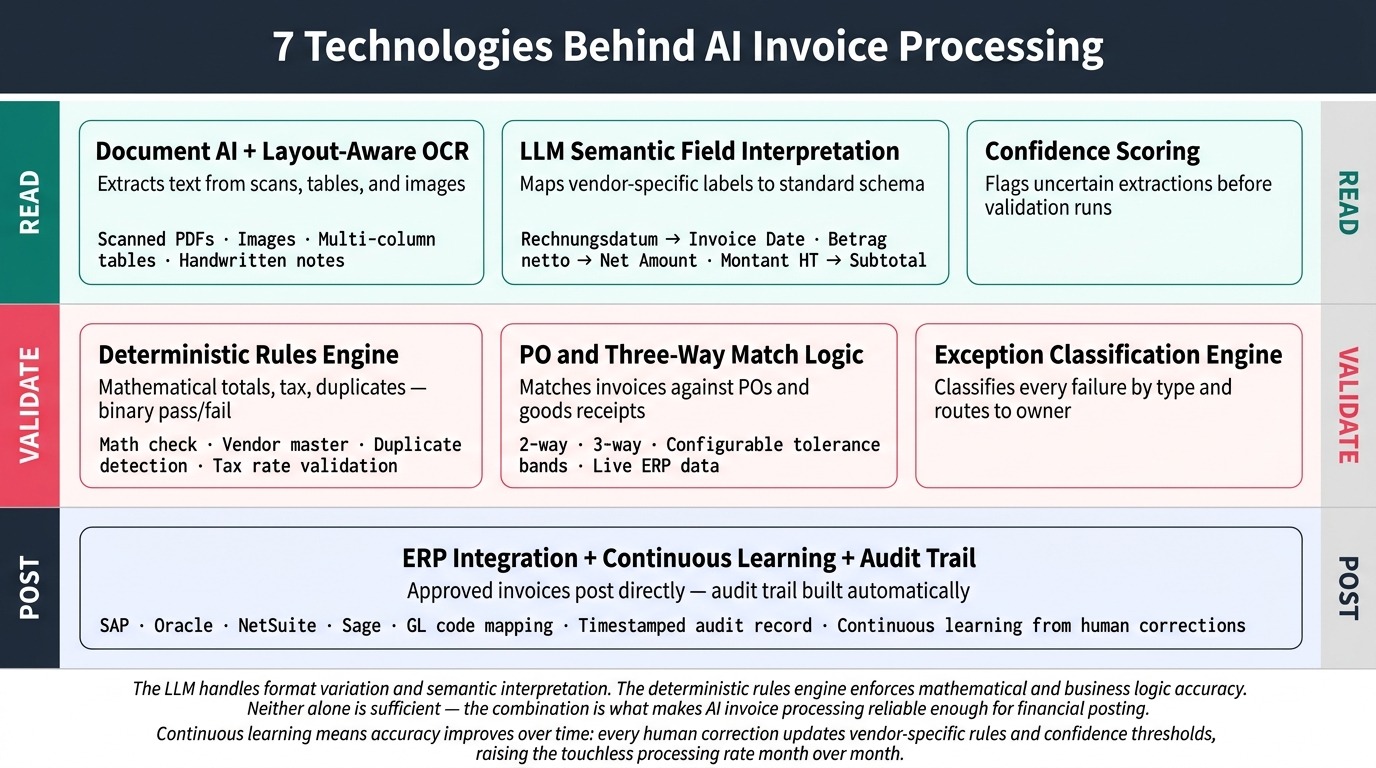
- Document AI and Layout-Aware OCRAI models trained on document visual structure – understanding tables, columns, headers, and spatial relationships between fields rather than treating a page as a flat block of text: Standard OCR converts pixels to characters; document AI understands the spatial relationship between those characters. For invoices with multi-column tables, merged cells, and varying header positions, layout awareness is what separates reliable line-item extraction from character-level guesswork.
- Large Language Models (LLMs) for Semantic InterpretationFoundation AI models that reason about text meaning in context, enabling them to normalise varied vendor terminology into a consistent schema without vendor-specific programming: LLMs handle the vocabulary variation problem that rules and templates cannot. They interpret that “Rechnungsdatum,” “Date de Facture,” and “Bill Date” all refer to the invoice date – and they do this across thousands of vendor formats without requiring manual template maintenance for each one.
- Confidence Scoring and Uncertainty QuantificationA mechanism by which each extracted field is assigned a probability estimate, enabling the system to route uncertain extractions for human review rather than passing them silently to validation: Without confidence scoring, a system that extracts a wrong value confidently is worse than one that admits uncertainty. Confidence-scored outputs allow the human-in-the-loop to focus attention only where the model is genuinely unsure.
- Deterministic Validation Rules Engine: This layer enforces mathematical correctness (do the line items sum to the stated total?), business logic (is this vendor approved?), and compliance checks (does the tax calculation match the applicable rate?) with binary pass/fail results. It is the trust layer – not probabilistic, not AI-based – and it is what makes the extracted data reliable enough to post to an ERP without manual review.
- PO Matching and Three-Way Match LogicAutomated comparison of invoice amounts and line items against purchase orders and goods receipt records, confirming that payment is owed for goods or services actually received: Matching logic runs against live ERP data, not static exports, so tolerance bands and PO statuses are always current. This prevents payment for undelivered goods and catches invoice inflation against open PO values.
- ERP and AP System Integration Layer: Pre-built connectors to common ERP and accounting platforms enable direct posting of approved invoices with mapped GL codes, cost centres, and payment terms. Integration quality determines whether automation actually eliminates re-keying or simply moves it to a different step in the process.
- Continuous Learning Feedback LoopA mechanism by which every human correction to an extracted field or routing decision updates vendor-specific rules and model confidence thresholds, improving accuracy over time without retraining from scratch: Every human correction teaches the system something about a specific vendor’s patterns. Systems that implement continuous learning improve touchless processing rates measurably over the first six to twelve months of operation – a pattern that static rule-based systems cannot replicate.
What Results Does an AI Invoice Automation Solution Deliver?
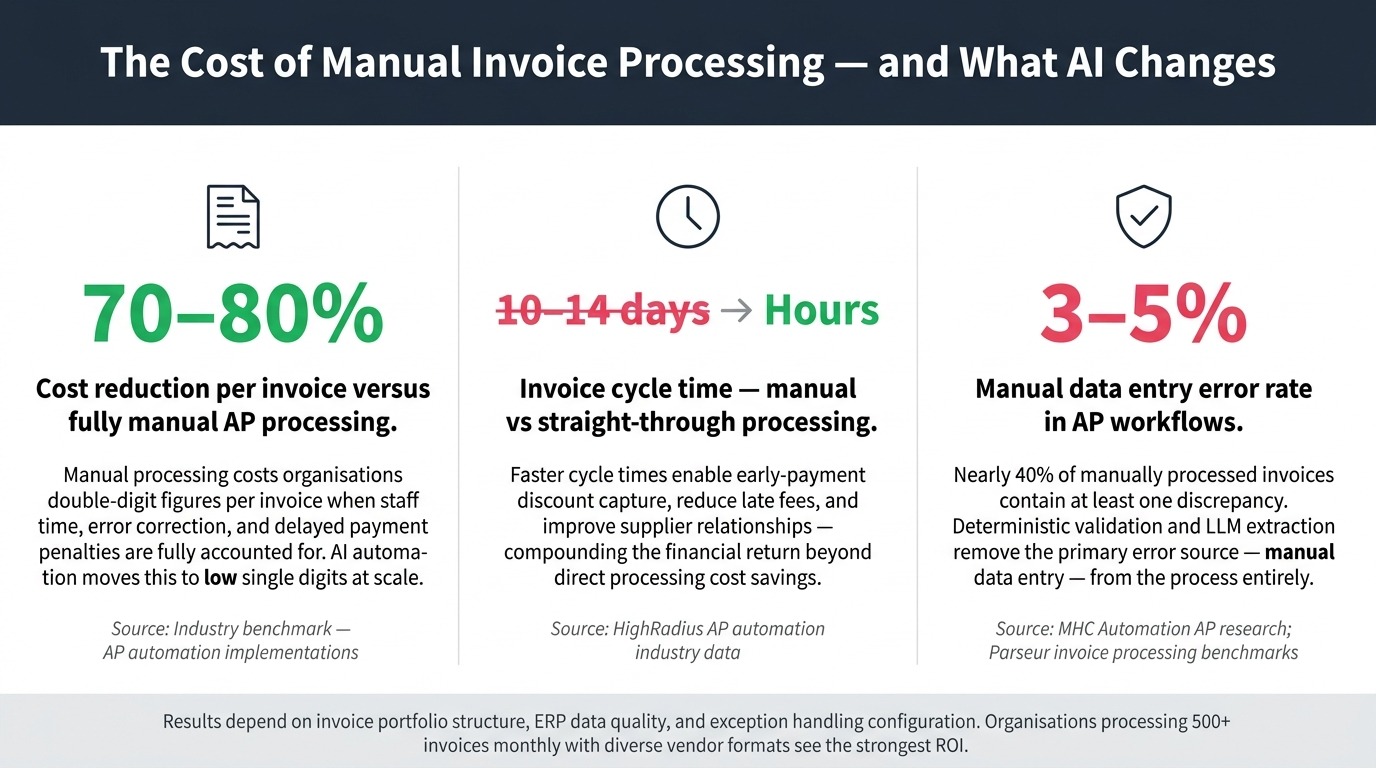
- Substantial reduction in cost per invoice: Automated AP processing software eliminates the manual labour cost of data entry, exception chasing, and duplicate recovery from the per-invoice figure – with well-implemented systems typically achieving cost reductions of 70-80% compared to fully manual workflows, moving from double-digit cost per invoice to low single-digit figures.
- Dramatically shorter invoice cycle times: Processing time for straight-through invoices drops from the industry average of ten to fourteen days for manual workflows to hours or less – enabling earlier payment, better discount capture, and improved supplier satisfaction.
- Lower error rates and fewer payment mistakes: Removing manual data entry from the process addresses the primary source of invoice errors. Deterministic validation catches mismatches that human review misses under time pressure, particularly during month-end volume surges.
- Higher early-payment discount capture: Faster cycle times mean finance teams can act on early-payment discount windows that manual processing cycles routinely miss. For organisations with significant spend, even modest improvement in discount capture generates material savings.
- Duplicate payment prevention before settlement: Automated duplicate detection running at the point of ingestion catches re-submitted invoices across channels – a risk that scales poorly under manual review as volume increases.
- Scalable AP capacity without proportional headcount growth: An AI invoice data capture platform processes higher volumes with the same team. As invoice volume grows with the business, the system scales without requiring additional data-entry headcount – redirecting AP staff toward exception resolution, supplier management, and strategic analysis instead.
- Real-time liability visibility for finance leadership: Centralised invoice processing generates a current view of outstanding AP liability at any moment – replacing the end-of-period reconciliation scramble with continuous, accurate cash flow insight.
- Audit-ready documentation for compliance: Every extraction decision, validation result, approval action, and posting event generates a timestamped, immutable audit trail – reducing compliance preparation effort and supporting regulatory requirements, including accelerating global e-invoicing mandates.
Is an LLM Invoice Extraction and Processing AI Solution Worth the Investment?
Yes – for organisations processing sufficient invoice volume with existing manual or partially automated workflows, the business case is typically strong and the payback period relatively short. However, the ROI depends on which metrics you measure and how honestly you baseline them. Below is a framework for building that case internally.
Key Metrics to Measure Before and After Implementation
- Cost per invoice processed: Baseline this by dividing total AP staff cost plus infrastructure cost by total invoices processed annually. Track how this changes as touchless processing rates increase and manual handling declines.
- Average invoice cycle time: Measure from receipt to approved posting. Compare pre-implementation averages against post-implementation for both straight-through and exception invoices separately.
- Touchless processing rate: The percentage of invoices that flow from receipt to ERP posting without any manual intervention. This metric rises over time as continuous learning improves vendor-specific accuracy – track it monthly for the first year.
- Exception rate by category: Track what proportion of invoices generate exceptions and why. A well-configured system should reduce overall exception rates, but more importantly it should make the remaining exceptions faster to resolve by surfacing the specific reason at the point of escalation.
- Early-payment discount capture rate: Compare the proportion of eligible discount windows captured before and after implementation. For organisations with significant supplier spend, this metric alone can represent substantial annual savings.
Realistic Implementation and Payback Timeline
A common pattern across real implementations of this solution is a phased ramp rather than an instant step-change. For a mid-size organisation processing several thousand invoices monthly, an initial implementation phase of eight to twelve weeks typically covers system configuration, ERP integration, vendor master data cleaning, and processing of a representative invoice sample for accuracy validation. The system goes live with a conservative confidence threshold – more invoices surface for human review initially – and the threshold tightens as accuracy improves over the following months.
Payback typically arrives within six to twelve months for organisations with meaningful manual processing volume, driven primarily by labour cost reduction and early-payment discount recapture. The business case for acting now rather than waiting strengthens each quarter as global e-invoicing mandates accelerate – organisations with an automated AP processing foundation adapt to new compliance requirements far faster than those still relying on manual workflows.
What Does Implementing an LLM Invoice Extraction and Processing AI Solution Actually Require?
- ERP and vendor master data quality: The most frequently underestimated factor in live AP automation deployments is the state of vendor master data. If vendor names, tax registration numbers, and payment terms in the ERP are inconsistent or incomplete, the matching layer generates false exceptions from day one. Cleaning vendor master data before implementation reduces the initial exception rate significantly and shortens the time to meaningful touchless processing.
- Invoice diversity assessment: Not all invoice portfolios automate equally. Organisations whose suppliers send consistent, well-structured digital invoices reach high touchless rates faster. Those with a large proportion of handwritten credit notes, scanned paper invoices, or non-PO service invoices require a longer ramp and more robust exception handling configuration.
- ERP integration complexity: Direct ERP integration with correct field mapping, GL code assignment, and cost centre routing is where most implementation time is spent. The quality of this integration determines whether approved invoice data posts cleanly or still requires manual intervention before reaching the ledger.
- Process design before automation: Automating a poorly defined approval workflow produces a faster version of the same problem. Mapping current AP processes, rationalising approval chains, and defining exception ownership before implementation prevents the system from embedding existing inefficiencies at scale.
- Data privacy and security architecture: Invoice data contains sensitive financial and vendor information. Deployments requiring on-premise processing or private cloud execution for data sovereignty – common in regulated industries and certain geographies – need a private LLM deployment rather than a public API integration.
- Change management for AP teams: AP staff moving from full manual processing to exception-queue management experience a significant workflow shift. Clear communication about what the system handles, what it escalates, and how their role evolves is essential for adoption and for maintaining the human oversight that exception handling requires.
Where This Solution Has Real Limits
- Non-PO invoices remain the hardest automation target: Service invoices, consulting fees, and emergency purchases without a corresponding purchase order require human GL coding and approval routing because the business context for coding decisions lives outside the invoice itself. High volumes of non-PO invoices constrain touchless rates regardless of extraction accuracy.
- Exception rates rise with invoice portfolio diversity: AP automation delivers early wins but faces pressure as scope expands to include more regions, spend categories, and invoice types. A system tuned for a core invoice population performs differently when applied to edge cases.
- Accuracy depends on OCR input quality: Low-quality scans, poor lighting in photographed invoices, and heavily compressed PDF images produce degraded OCR output that LLM reasoning can partially compensate for – but not fully. Document capture standards for scanning affect downstream accuracy measurably.
- Continuous improvement requires structured feedback: The learning loop that improves accuracy over time only works if human corrections are logged systematically. Teams that override extractions without recording corrections in the system do not benefit from the improvement cycle.
Which Organisations Get the Most Value from an AI Invoice Processing Platform?
The highest returns on an LLM invoice extraction and processing AI solution consistently come from organisations where invoice volume exceeds team capacity, format diversity prevents template-based automation from working reliably, and existing manual processes generate measurable costs in staff time, payment errors, and missed discounts. This typically describes mid-market and enterprise finance operations, shared services centres, and high-growth businesses outpacing their current AP infrastructure.
Specific roles and organisational profiles that benefit most include: AP managers and controllers responsible for reducing cost per invoice and improving cycle time; CFOs and finance directors building the case for AP digitalisation as part of broader financial transformation; shared services centre leads managing invoice processing across multiple business units; and operations or IT leaders evaluating enterprise AI development that integrates with existing ERP infrastructure.
This solution delivers particularly high value when:
- The organisation processes more than 500 invoices per month and manual processing consumes a meaningful proportion of AP staff time.
- Invoices arrive from many different suppliers in varied formats, making template-based OCR impractical to maintain.
- Compliance requirements – including e-invoicing mandates, tax regulations, or audit standards – demand a complete, timestamped audit trail for every invoice.
- The business operates across multiple currencies, languages, or geographies where a single vendor-specific rule set is insufficient.
Frequently Asked Questions About LLM Invoice Extraction and Processing
Can an LLM alone handle invoice extraction accurately enough for production AP workflows?
Not reliably on its own – and this is one of the most important things to understand before evaluating any AI invoice processing platform. LLMs are powerful reasoning engines, but they can generate confident wrong answers, struggle with complex line-item tables in degraded scans, and have no built-in mechanism for checking whether extracted totals are mathematically correct. Production-grade LLM invoice extraction and processing AI solutions use the LLM as an interpretation layer within a controlled pipeline – paired with dedicated OCR for text extraction, confidence scoring to flag uncertain outputs, and a deterministic validation layer that checks totals, tax calculations, PO matches, and duplicates before anything moves forward. The combination is what makes the system reliable; the LLM alone is not.
How long does it take to implement an automated accounts payable software using LLM and see results?
A realistic implementation timeline for a mid-size organisation is eight to twelve weeks from kickoff to live processing, covering ERP integration, vendor master data preparation, system configuration, and accuracy validation on a representative invoice sample. The first measurable results – reduced manual processing volume and lower exception rates – typically appear within the first month of live operation. Touchless processing rates improve over the following three to six months as the continuous learning layer adapts to the organisation’s specific vendor base and invoice patterns. Most organisations reach full payback within six to twelve months, primarily through labour cost reduction and early-payment discount capture.
What is the best architecture for an LLM invoice processing software for multi-currency invoices and global finance teams?
Global invoice portfolios require a solution that handles language and currency variation at the extraction layer, country-specific tax logic at the validation layer, and flexible routing rules at the approval layer. For the extraction layer, LLM-based semantic interpretation handles field label variation across languages without requiring separate templates per locale – mapping vendor-specific terminology to a consistent schema regardless of language. The validation layer needs country-specific rules for tax rates, registration number formats, and mandatory e-invoicing compliance fields that vary by jurisdiction. Approval routing must accommodate different business unit structures, currency tolerance bands, and payment term conventions across regions. A single configurable rules engine with country packs – rather than separate deployments per region – is the most maintainable architecture for global finance teams.
How does an AI invoice data extraction tool for finance departments handle invoice exceptions and errors?
Exception handling is where most AP automation implementations succeed or fail – and the best systems treat it as a core feature rather than an edge case. When an invoice fails validation or matching, a well-built AI accounts payable solution classifies the exception by type – field extraction uncertainty, total mismatch, duplicate risk, PO not found, vendor not recognised – and routes it to a structured queue with the specific reason displayed. The reviewer sees the invoice, the extracted fields, and the exact nature of the mismatch, allowing resolution in minutes rather than the hours that email-chain exception chasing requires. Every resolved exception feeds back into the system, improving how similar cases are handled in future.
What does an LLM based invoice parsing solution for ERP integration actually connect to, and how difficult is that integration?
ERP integration is the layer that determines whether an AI invoice extraction solution eliminates manual work end-to-end or simply moves re-keying to a later stage. A well-built integration connects bidirectionally – pulling vendor master data, PO records, and goods receipt confirmations from the ERP to support matching, and pushing approved invoice data with mapped GL codes, cost centre assignments, and payment terms back into the ERP for direct posting. Integration complexity varies by ERP platform and the organisation’s data model. Standard integrations with commonly used ERP and accounting platforms typically complete within the implementation timeline. Custom or legacy ERP environments require more configuration time. The critical success factor is mapping the approved invoice fields to exactly the right destination fields in the ERP – so that posted data requires no manual adjustment after approval.
Build This Solution With Softlabs Group
Softlabs Group builds custom LLM invoice extraction and processing AI solutions designed around your specific invoice portfolio, ERP environment, approval workflows, and compliance requirements – not a generic platform configured to fit your organisation as an afterthought. Our engineering approach addresses the full production stack: document AI and OCR for reliable text extraction, LLM-based semantic interpretation with confidence scoring, deterministic validation for totals and tax logic, PO and goods receipt matching, configurable approval routing, and direct ERP posting with audit trail generation. Where data privacy or regulatory requirements demand it, we design on-premise or private cloud architectures that keep sensitive financial data within your controlled environment.
If your AP team is managing more invoice volume than your current process can handle cleanly, or if your existing automation is generating more exceptions than it resolves, the right starting point is a structured conversation about your invoice data, your ERP, and the specific pain points driving cost and risk in your current workflow. We will tell you honestly what a custom solution can and cannot solve in your context – and design an architecture that handles the real ground-level complexity of your AP operation, not just the easy cases.