 India
India  Mongolia
  Sweden
  Australia
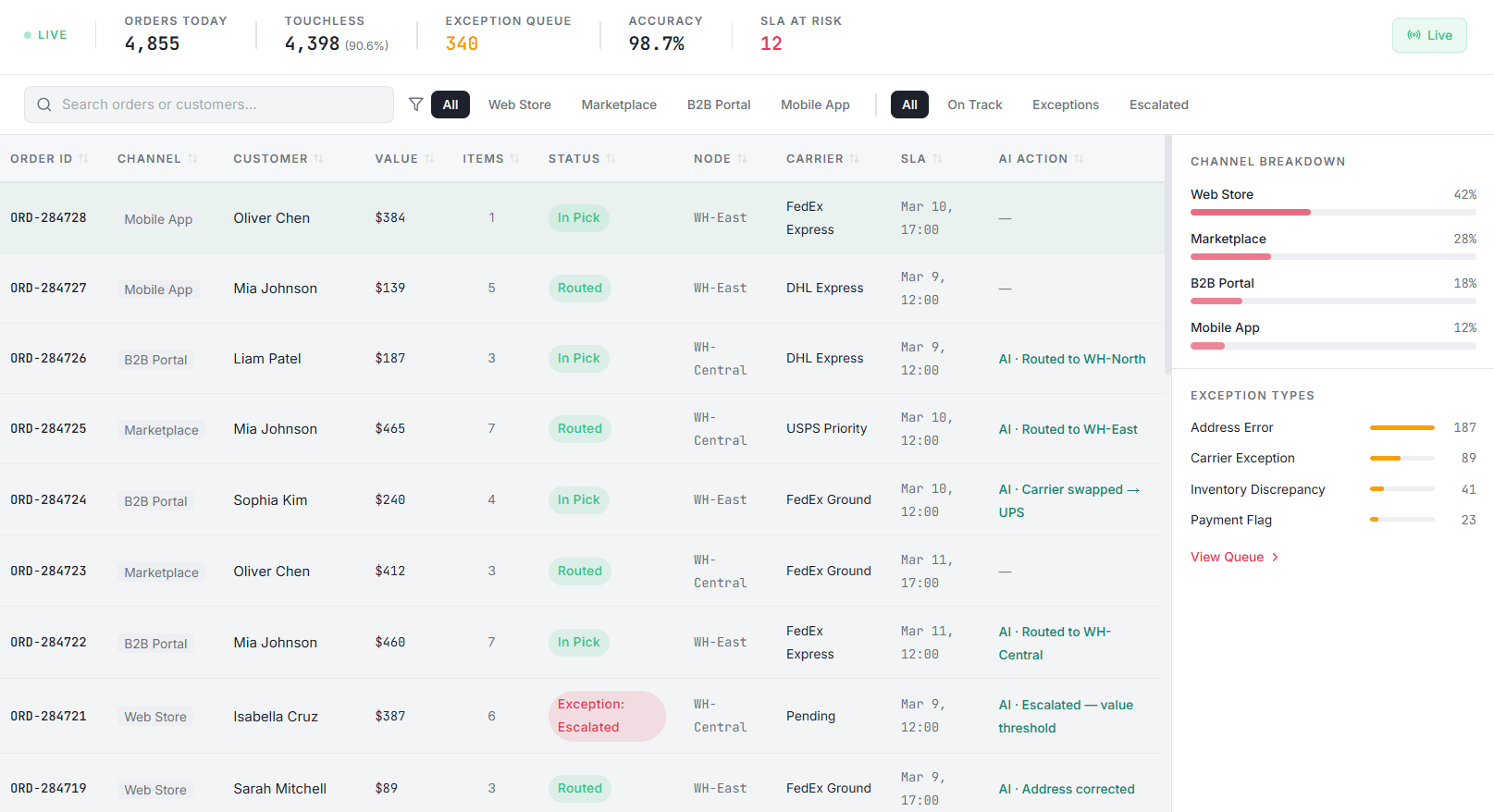
Executive Summary: When Manual Order Management Stops Scaling
Your fulfillment team is manually routing orders across four channels while the exception queue from last night still sits unresolved. A customer just tweeted about a missing shipment your WMS says dispatched three days ago. This is not a staffing problem – it is an architecture problem. An AI-powered order management solution replaces the static rules, manual triage, and reactive firefighting with a single intelligent layer that routes, validates, and orchestrates every order automatically, from the moment a customer clicks Buy to the moment their shipment confirms delivery.
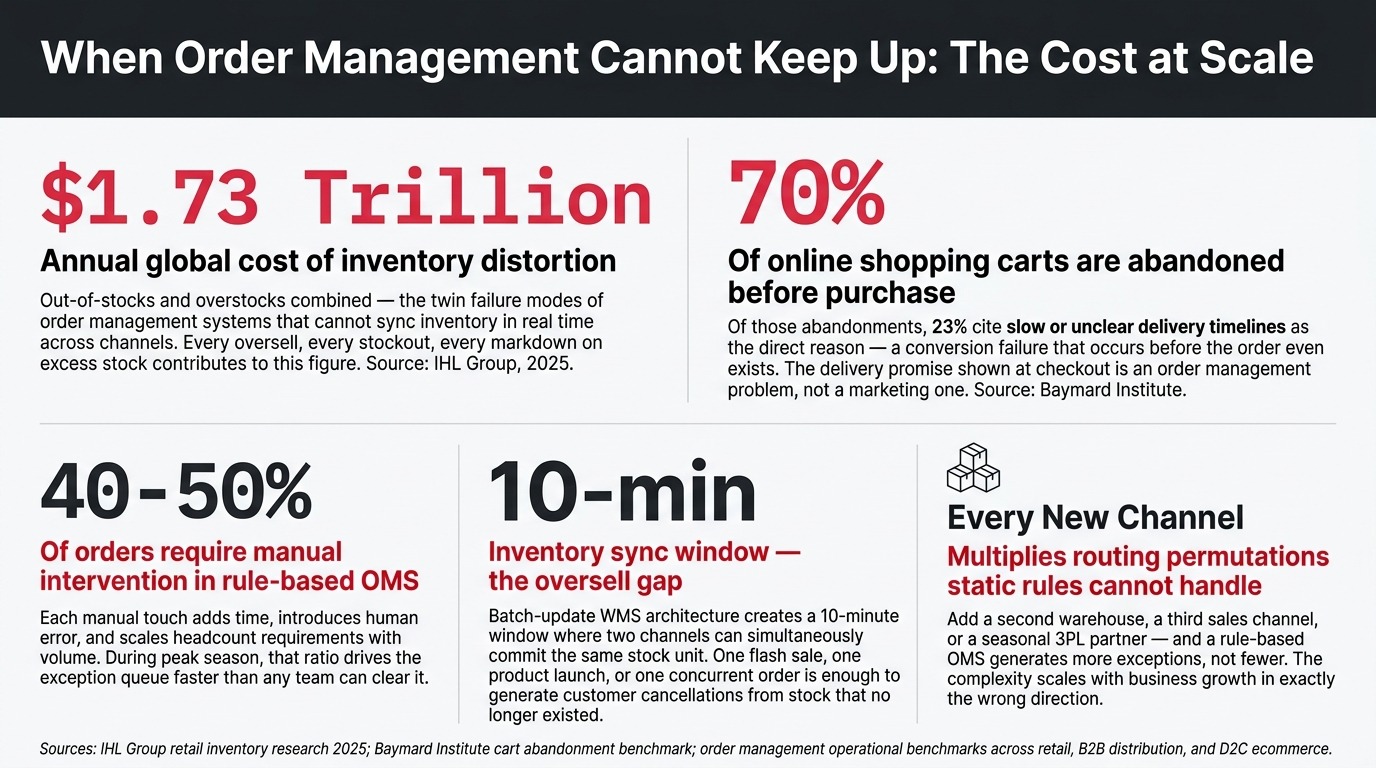
The scale of the underlying problem is well documented. IHL Group’s 2025 research puts the global cost of inventory distortion – out-of-stocks and overstocks combined – at $1.73 trillion annually. Separately, research from Baymard Institute finds that roughly 70% of online shopping carts are abandoned, with slow or unclear delivery timelines a leading contributing factor. Both problems trace back to the same root: order and inventory systems that cannot respond fast enough to real-world conditions. An intelligent order management platform addresses both at the source.
This page explains how AI-powered order management works, where it delivers the strongest returns, what realistic implementation involves, and where the technology has genuine limits worth understanding before you invest.
1. Why Does Order Management Keep Breaking as Your Business Scales?
Order management fails at scale because channel complexity, order volume, and customer expectations compound simultaneously – faster than any manual process can absorb.
Context: The Omnichannel Commerce Environment
An order today arrives from a web store, a marketplace, a retail location, a mobile app, or a B2B portal. Each channel carries its own inventory view, pricing rules, and fulfillment SLA. A single customer journey can touch three channels before the order even enters the warehouse queue. The omnichannelA commerce model where the customer’s experience is unified across all physical and digital sales channels – the same inventory, pricing, and order history regardless of where they shop reality means that accuracy at the channel level is not enough. You need accuracy across all channels simultaneously, updated continuously.
In practice, organisations deploying AI order management for the first time consistently find that their real inventory accuracy is significantly lower than their dashboards suggest – because dashboard data inherits the same errors as the underlying records. A ten-minute sync cycle creates a ten-minute window where an oversell is possible. A batch-update WMS means the fulfillment team is working off yesterday’s reality.
Key Pain Points This AI Solution Addresses
The buyers who end up evaluating this solution are not searching for AI. They wake up asking specific questions – and those questions are the real specification for what the system needs to do.
- “Why did we oversell again last night?” – The answer is almost always the same: inventory updated on a ten-minute cycle, and two channels sold the same unit in the same window. What these teams need is not a better dashboard – it is real-time inventory truth, updated by event trigger the moment stock moves, so no channel can commit stock another channel already claimed.
- “Why are customers still calling us about their order?” – Fragmented systems produce fragmented communication. Status updates arrive late, contradict each other, or do not arrive at all. Baymard Institute research shows 23% of shoppers abandon checkout because delivery timelines appear slow or unclear – a conversion loss that compounds before the order even exists. What these teams need is proactive, accurate, automated communication that requires no manual triggering.
- “Why does connecting our Shopify, WMS, and 3PL feel like duct tape?” – Because point-to-point integrations built one at a time break one at a time. Each new channel or logistics partner adds another fragile connection. What these teams need is an API-first, event-driven integration layer where each system publishes and consumes state changes cleanly – not a web of scheduled syncs that silently fail at 2 AM.
- “Why am I still manually splitting orders between warehouses?” – Because the existing OMS applies a fixed rule – route to Warehouse A first, then B – with no awareness of live capacity, shipping cost, or SLA achievability. What these teams need is zero-touch routing that evaluates all fulfillment nodes simultaneously at the moment of order placement and commits the optimal split in milliseconds.
- “Why do returns create a second chaos loop?” – Returns fail because they get treated as exceptions to the forward order system rather than as a separate domain with its own workflow. Condition assessment, return abuse detection, restocking routing, and reverse logistics all have their own logic – none of which forward order models handle well. What these teams need is a dedicated returns intelligence layer that runs in parallel to forward order management, not manual handling bolted onto a system designed for something else.
- High rate of order exceptions needing manual fixes – unresolved exceptions accumulate into a backlog that grows faster than it gets cleared. Operations teams spend most of their time firefighting instead of improving the underlying process – a pattern that compounds with every new channel or warehouse added.
Why Traditional Approaches Fall Short
A rule-based OMS executes fixed if-then conditions: if stock exists in Warehouse A, route there. It cannot weigh shipping cost, carrier capacity, delivery SLA, and markdown risk simultaneously. Every order receives identical treatment regardless of profitability, customer tier, or fulfillment context. That is adequate when order volume is low and all channels share one clean inventory source. It is not adequate when you add a second warehouse, a third sales channel, or a seasonal demand spike.
Legacy systems also fail at the integration layer. Batch-update architecture was designed for a world where orders arrived by fax. A WMS syncing inventory every ten minutes creates a window where orders can be accepted for stock that no longer exists. That window costs real money during a flash sale or a new product launch. It is structurally incompatible with the real-time availability promise modern checkout experiences require.
Adding a new channel or fulfillment node multiplies the routing permutations the system must evaluate. Static rules do not scale to that complexity – they produce more exceptions, which require more manual intervention, which is exactly the cycle an AI-powered order management solution is designed to interrupt.
2. What Is an AI-Powered Order Management Solution and What Does It Change?
An AI-powered order management solution replaces static routing logic with dynamic, learning models that evaluate every order against live inventory, carrier capacity, cost targets, and customer expectations – simultaneously, in milliseconds.
A traditional OMS follows a fixed script. An AI-driven platform continuously recalculates the optimal decision for each order based on real-time conditions. It ingests data from every channel, normalises it into a unified record, routes it to the optimal fulfillment node, monitors it through dispatch, and flags exceptions for human review – all without manual intervention for the vast majority of transactions. The system improves its own decisions over time as it processes more orders. That compounding improvement is what distinguishes a genuine enterprise AI development engagement from applying automation to a broken process.
Vision and Objectives
- System-first, not task-first – treat the entire order workflow as one orchestrated system rather than a set of automated steps. The difference matters: automating individual tasks creates brittle chains where one step failure cascades. Orchestrating the full system means state is maintained across every step, with retry logic, rollback, and handoff built in from the start.
- Achieve near-complete touchless order processing – where AI handles 95% or more of transactions end-to-end without human intervention for well-scoped B2C implementations with clean, consistent data. Complex B2B operations with multi-line orders, customer-specific pricing, and EDI submission formats will reach lower initial touchless rates and improve over time as the model matures on your specific order patterns.
- Deliver near-real-time inventory accuracy across all channels simultaneously – not ten-minute syncs, but event-driven triggers that react to stock changes as they happen, so no channel commits inventory another has already claimed.
- Route every order to the fulfillment node that best balances delivery speed, shipping cost, and warehouse capacity at the exact moment of placement – with zero manual involvement for standard scenarios.
- Handle returns through a parallel intelligent workflow with its own routing, fraud detection, and restocking logic – not as exceptions dumped into the forward order system. Returns involve different problems: condition assessment, return abuse detection, and reverse logistics routing. Treating them as a secondary manual process after investing in forward order intelligence is where the second chaos loop comes from.
- Generate continuous operational intelligence: which SKUs generate the most exceptions, which carriers miss SLAs in which regions, which channels produce the highest return rates.
- Scale cleanly through peak periods without proportional cost increases in fulfillment labor or management overhead.
3. Where Does an AI Order Management Platform Make the Biggest Difference?
The returns vary significantly by context. Three scenarios show where this solution changes outcomes most concretely.
Omnichannel Fashion Retail: The Flash Sale Oversell Problem
Your flash sale just sold out a product that still showed as available across three store locations – and you found out from customer complaints. This is the textbook omnichannel failure: inventory counts correct in each system individually, but wrong in aggregate because they do not sync in real time. An AI order management system for retail and ecommerce addresses this by maintaining a unified, continuously updated inventory pool across all channels, with AI-driven allocation that reserves stock dynamically as demand signals arrive. When the flash sale launches, the system limits availability per channel to reflect actual commitable stock – not last night’s count – and routes each order to the nearest stocked location automatically. The outcome: near-zero oversells during high-velocity events, and customers who receive accurate delivery promises at checkout rather than cancellation emails two days later.
B2B Industrial Distribution: Multi-Warehouse Order Splitting
A large purchase order just arrived from your most important account, and your team is manually calling five warehouses to determine whether you can fulfill it on time. In B2B distribution, large orders routinely exceed single-location stock. Manual cross-warehouse checking introduces hours of latency – hours during which the customer may already be calling a competitor. An intelligent order management platform for B2B and B2C operations evaluates all warehouse locations in parallel at the moment of order entry. It determines the optimal fulfillment split, identifies which locations cover which line items, and generates a confirmed delivery commitment before the sales team picks up the phone to confirm. The outcome: faster order confirmation, fewer broken promises, and fulfillment plans that account for total shipping cost across the entire split rather than optimising each leg in isolation.
D2C Ecommerce: Peak Season Exception Overload
It is peak season evening and your exception queue holds 340 flagged orders – more than your team can clear before next-day delivery cutoffs expire. Peak exception volumes scale with order intake; manual exception management does not. An AI order fulfillment software layer changes this by classifying exceptions automatically – address error, payment flag, inventory discrepancy, carrier exception – and resolving the majority without human action. Address errors receive AI-corrected suggestions validated against postal databases. Carrier exceptions trigger automatic re-routing. Only genuinely ambiguous cases escalate to the human queue, with full context already attached for the reviewer. The outcome: a peak season where the exception queue stays manageable, next-day cutoffs are met, and the operations team concentrates on real edge cases rather than routine triage.
Ready to explore what this solution looks like for your organisation?
Talk to Our AI Team4. How Does an AI Order Management System Actually Work?
The architecture of an AI-powered order management solution operates across five sequential stages – from raw data ingestion to continuous model improvement. Understanding each stage clarifies both what the system reliably delivers and where human oversight remains essential.
Data Acquisition: What the System Ingests
The system consumes order data from every channel simultaneously: web storefronts, marketplace feeds, mobile apps, EDIElectronic Data Interchange – a standardised format for exchanging business documents like purchase orders between companies electronically, widely used in B2B commerce-based B2B portals, point-of-sale terminals, and orders captured via natural language interfaces. Beyond the order record, it ingests real-time inventory levels from the WMS, carrier capacity and rate data from logistics APIs, historical demand patterns from the data warehouse, and return status feeds. The quality of these inputs directly determines the reliability of every downstream decision – a point that dominates every honest implementation conversation.
The AI Processing Pipeline

- Data Ingestion and Normalisation. First, orders arriving in varied formats – structured API payloads, unstructured email text, marketplace XML feeds – pass through a normalisation layer. Natural Language Processing (NLP)An AI discipline enabling computers to understand, interpret, and extract structured meaning from human language and unstructured text parses unstructured inputs and extracts product, quantity, address, and customer fields into a unified schema. Address validation and product catalog matching run immediately, correcting common errors before they propagate further down the chain.
- Demand Signal Processing. Next, the system evaluates real-time and predictive demand signals. Machine Learning (ML)A branch of AI where models learn patterns from historical data to make predictions without being explicitly programmed for each scenario models analyse historical sales velocity, seasonal patterns, current promotional calendars, and external signals such as weather and local events to generate a forward-looking demand view. This informs inventory reservation decisions – ensuring stock is not committed to low-priority channels when high-demand orders are anticipated. The demand layer also feeds replenishment recommendations upstream to procurement systems.
- Intelligent Order Routing. Once a confirmed order record exists, the routing engine evaluates all eligible fulfillment nodes against a multi-factor objective function. Variables include available inventory, carrier SLAService Level Agreement – a committed delivery window, tied to carrier performance metrics and the delivery promises displayed to customers at checkout achievability, current warehouse pick capacity, shipping cost, and markdown risk for time-sensitive inventory. The system selects the optimal routing decision and commits inventory in real time – with availability checks completing in sub-second timeframes for standard scenarios.
- Exception Detection and Escalation. At this stage, the system monitors every active order against expected progress milestones. Anomalies – unusual address combinations, payment velocity flags, inventory discrepancies from concurrent orders, carrier delay signals – trigger automated classification. The AI resolves exceptions within pre-defined parameters: address corrections, carrier swaps, approved inventory substitutions. Exceptions requiring commercial judgment or involving unusual financial values escalate to a human review queue with full context and a recommended action pre-attached.
- Performance Signal Collection and Scheduled Retraining. Finally, completed order outcomes generate continuous performance signals: delivery results by carrier and route, exception patterns by SKU or channel, return rates by product and customer segment. These signals do not update the model in real time – online learning on live order data without validation creates more risk than it solves. Instead, they feed scheduled retraining cycles, typically weekly or monthly, where model updates are validated before deployment. What this produces in practice is a system that improves meaningfully over time – catching a carrier degrading performance in a region before it generates sustained customer impact – rather than one that claims to learn faster than it safely can.
Human-in-the-Loop: Where Human Judgment Still Matters
What implementation experience reveals that vendor documentation often glosses over: the best-performing deployments are not the ones that eliminate human involvement. They are the ones that concentrate human attention precisely where it genuinely changes the outcome – and escalate gracefully rather than failing silently.
Silent failure is the most damaging pattern in production order management AI. A system that encounters an edge case it cannot resolve and simply drops the order, freezes, or routes incorrectly without flagging the issue is worse than no automation at all. The design principle that separates reliable deployments from failed ones is this: the AI handles 95%+ of orders touchlessly, but every exception it cannot resolve surfaces immediately to a human reviewer with full context already attached – what happened, why it was flagged, and what the recommended next action is. The human makes a decision. They do not conduct an investigation.
- High-value exception escalation – orders exceeding a defined value threshold, or exceptions with ambiguous fraud signals, always route to a human reviewer before commitment. The AI presents the issue and a recommendation; the human makes the call.
- Routing policy decisions – humans set and approve the objective function weightings that govern the routing engine. The AI optimises within those parameters. A policy change – prioritising margin over speed during slow periods, for example – is a human decision the AI then executes consistently.
- New product and channel onboarding – when a new SKU, market, or fulfillment node enters the system, human configuration and validation precedes AI-driven routing. The model needs sufficient transaction history before its decisions on new entities become reliable.
- Carrier and vendor performance decisions – the system flags underperforming carriers and quantifies the impact. Whether to renegotiate, deprioritise, or exit a relationship stays with the operations team.
- Model performance review – routing accuracy, exception classification rates, and demand forecast variance require periodic review to detect model drift before it becomes a customer-facing problem.
Output and Interaction: What Users Actually See
Operations teams interact with a unified dashboard showing real-time order status, exception queues with AI-recommended resolutions, inventory positions across all fulfillment nodes, and carrier performance metrics. Customer-facing outputs include accurate delivery promises at checkout, proactive shipment notifications, and real-time tracking pulled directly from carrier APIs. System outputs also feed adjacent platforms automatically: the ERPEnterprise Resource Planning – software integrating core business processes including finance, inventory, and operations into a single data layer receives confirmed inventory commits, the WMSWarehouse Management System – software controlling warehouse operations including picking, packing, and inventory location management receives pick instructions, and finance receives order value and cost allocation data.
5. What Technologies Power an Intelligent Order Management Platform?
Several distinct technology layers work together in a modern AI order management software stack. Each contributes a specific capability the overall system depends on.
- Event-Driven ArchitectureA system design pattern where actions are triggered by real-time data events rather than scheduled batch processes, enabling immediate responses to inventory or order state changes – propagates inventory updates, order state changes, and exception triggers across all connected systems the moment they occur. Not ten-minute syncs. WebSocket connections or event triggers that react to stock changes as they happen, so no channel can commit inventory another channel already claimed. This is the architectural layer that makes real-time delivery promising at checkout technically achievable – without it, everything else is built on a delayed foundation.
- Microservices ArchitectureA software design pattern where the application is built as a collection of small, independently deployable services – each handling a specific function – rather than a single monolithic system – breaks the order management stack into independently scalable components. Routing, inventory management, exception handling, and demand forecasting each scale to match load without affecting the others. This is most valuable during peak events when one function faces disproportionate demand.
- Constraint-Based Routing Engine with ML Inputs – the routing decision itself is handled by a deterministic constraint optimization engine – not raw ML. This matters for two reasons: optimization engines produce explainable, auditable routing decisions, and they reliably find the best feasible solution given hard constraints like capacity limits and SLA deadlines. ML contributes at the input layer: demand forecasts, carrier performance scores, and markdown risk signals that the optimization engine factors into its objective function. Framing this as “AI picks the route” is imprecise and would concern any supply chain architect. The accurate picture is that ML sharpens the inputs; the optimization engine makes the call.
- Demand Forecasting Models – time-series ML models trained on historical sales velocity, promotional calendars, and external signals generate inventory positioning recommendations before orders arrive. These feed both the routing engine’s cost calculations and upstream replenishment decisions. Accuracy compounds over time as the model trains on more completed order cycles from your specific business.
- Large Language Models (LLMs)Advanced AI models trained on large text datasets, capable of understanding and generating human language – used here for order parsing from unstructured inputs, exception summarisation, and customer communication drafting – parse orders arriving in unstructured formats, summarise exception context for human reviewers, and generate customer notification content. LLMs reduce the cost of handling non-standard B2B order submissions that arrive by email or document rather than structured API.
- Real-Time Inventory Synchronisation – maintains a unified inventory view across all channels and fulfillment nodes, updated by event triggers rather than batch processes. This is the technical foundation of accurate delivery promising at checkout and the primary architectural difference between a modern omnichannel order management solution and a legacy platform with channel connectors bolted on.
- MACH ArchitectureMicroservices, API-first, Cloud-native, and Headless – a set of architectural principles ensuring a platform integrates cleanly with other modern systems and can evolve without full re-implementation – the combination of Microservices, API-first, Cloud-native, and Headless principles has become the standard quality signal for enterprise-grade order management implementations. It determines how easily the platform connects with existing ERP, WMS, and commerce systems.
- Anomaly Detection Models – statistical and ML-based models monitor order patterns in real time for fraud signals, address irregularities, velocity anomalies, and inventory discrepancies. These models sit upstream of the exception queue and prevent false positives from reaching the manual review layer in the first place.
6. What Results Does an AI-Powered Order Management Solution Deliver?
An AI-powered order management solution improves outcomes across fulfillment cost, accuracy, delivery performance, and customer experience simultaneously. Each benefit directly addresses a failure mode from Section 1.
- Lower cost per order processed – touchless processing removes the labor cost of manual validation, exception triage, and routing decisions. Organisations starting from high manual intervention rates – where 40-50% of orders require human handling – see the largest cost-per-order reductions after deployment.
- Fewer fulfillment errors – AI-validated orders with address correction and catalog matching at ingestion remove the upstream causes of downstream picking errors. Fewer wrong shipments means fewer returns, fewer replacement orders, and fewer customer service contacts – each with a measurable unit cost in your operation.
- Higher on-time delivery rates at peak – intelligent routing that accounts for live carrier performance and capacity maintains delivery promise accuracy when it matters most. Unclear or slow delivery is a leading reason shoppers abandon checkout, according to Baymard Institute research – improving promise accuracy has a direct conversion impact.
- Smaller exception queue with faster resolution – automated exception classification reduces manual intervention from industry norms of 40-50% of orders to under 10% for well-implemented systems. Exceptions that do reach humans arrive with full context and a recommended action, cutting resolution time substantially.
- Better inventory utilisation across the network – demand-signal-driven allocation and real-time cross-channel inventory positioning reduces both stockouts and overstocks. IHL Group puts the annual global cost of these two failures at $1.73 trillion – an AI inventory order management platform addresses both simultaneously rather than treating them as separate problems.
- Peak scalability without proportional cost growth – an automated order routing software layer handles three to five times average order volume during a peak event without adding management headcount. The system absorbs the volume increase; the team manages only what the system escalates.
- Customer experience gains through accurate communication – proactive, accurate shipment notifications and real-time tracking reduce inbound support contacts related to order status. Fewer contacts means lower support cost and higher satisfaction scores simultaneously.
- Operational visibility that compounds over time – the data generated by a running omnichannel order management solution surfaces systemic inefficiencies continuously: which carriers underperform in which regions, which SKUs generate the most returns, which channels produce the highest exception rates. That visibility creates an improvement cycle that accelerates with time.
7. Is an AI Order Management Platform Worth the Investment? Building the Business Case
An AI order management platform delivers measurable ROI across several primary business metrics – but building a credible internal business case requires baselining each metric before implementation begins, not after.
Metrics That Move and How to Measure Them
- Cost per order processed – baseline your total order management labor cost divided by order volume. After implementation, run the same calculation. Starting points matter: organisations processing 40-50% of orders manually will see larger percentage reductions than those already running partial automation.
- Exception rate and resolution labor cost – what percentage of orders require manual intervention today, and what does each exception cost in staff time? Reducing a 40% exception rate to under 10% across a meaningful order volume generates calculable labor savings based on your current operations cost structure.
- Fulfillment accuracy rate – track the rate of incorrect picks, wrong shipments, and address-related failures. Each percentage point of improvement represents avoided return freight, replacement fulfillment, and customer service contact costs – all with known unit costs in your operation.
- Checkout abandonment linked to delivery – if your analytics platform tracks abandonment at the delivery step specifically, this metric quantifies direct revenue at risk from poor delivery promise accuracy. Closing the gap between promised and actual delivery times has a measurable conversion impact.
- Inventory distortion cost – what does your business lose annually to stockouts and overstocks? Improved demand forecasting and real-time allocation reduce both simultaneously. For mid-to-large retailers, this is often the largest single line item in the business case.
Realistic Timeline and Payback Expectations
Teams that have worked through this integration consistently find that payback timeline depends more on data readiness than on the AI layer itself. For a mid-size organisation with reasonably clean ERP and WMS data, a phased implementation typically runs three to six months – core routing and exception management live in the first phase, with demand forecasting integration following in a second phase.
Payback periods of twelve to eighteen months are realistic for organisations with high current exception rates or significant manual routing overhead. The businesses that see faster returns are those with a clear quantified baseline before day one, so every efficiency gain appears in the numbers rather than as an anecdotal improvement.
The OMS market is growing at approximately 9.78% annually, tracking from $4.68 billion in 2026 toward $7.46 billion by 2031. The capability gap between organisations running AI-based orchestration and those still on rule-based systems widens with every peak season that passes. Each year without implementation is another year of compounding exception costs, manual overhead, and lost conversion from poor delivery promises.
8. What Does Implementing an AI Order Management System Actually Require?
Successful implementations share one consistent characteristic: they treat order management as a system to be orchestrated, not a list of tasks to be automated. The most frequently underestimated factor in live deployments of this type is not AI capability – it is data quality as the binding constraint on how quickly the system reaches reliable performance.
Where This Solution Has Real Limits
- Data sync latency undermines real-time promises – a system built on ten-minute inventory sync intervals cannot support real-time delivery promising at checkout. This is the most common production failure pattern: AI routing that works in testing collapses in live operation because warehouse staff update stock manually mid-shift and the sync cycle has not yet run. Real-time performance requires event-driven or near-continuous sync – which may require infrastructure changes that extend project timelines beyond initial estimates.
- Edge cases are more numerous than expected – people override prices, edit orders mid-process, and forget to update fields. AI systems designed with the assumption of disciplined data entry break on these edges. Robust exception escalation and graceful failure handling are not optional design choices – they are what separates a production-ready system from a compelling demonstration.
- Cold-start limitations on new SKUs and channels – demand forecasting and routing optimisation depend on historical transaction data. New product launches, new channels, and new market entries start with insufficient signal. Routing decisions in these contexts are less reliable until the system accumulates enough volume to learn from. Human-configured rules should cover new entities until that data threshold is reached.
- Legacy ERP integration complexity is routinely underestimated – connecting a modern AI order management software layer to a legacy ERP running batch-update cycles requires substantial custom work. This is consistently the part of implementations that extends timelines beyond initial estimates. Realistic scoping – including data validation and testing time, not just configuration time – is the most important planning input you have.
Additional Implementation Factors
- Data quality investment before go-live – addressing inaccurate inventory records, inconsistent catalog data, and incomplete historical transaction logs before implementation reduces the time to reliable AI decision-making. Skipping this step does not save time; it moves the problem to production where it costs more to resolve.
- Team onboarding and change management – operations staff need onboarding on the exception queue interface, escalation protocols, and how to interpret AI routing recommendations. Adoption failures in this category are more often cultural than technical.
- Data privacy and compliance obligations – order data crossing borders or containing personally identifiable customer information requires compliance design from the architecture phase, not as a post-deployment addition.
- Ongoing model monitoring – AI models drift as market conditions change. A routing model trained on historical carrier performance may make suboptimal decisions when that carrier’s performance shifts. Periodic review and retraining cycles are maintenance requirements, not one-time activities.
- Phased rollout reduces risk meaningfully – starting with a single channel, warehouse, or order type limits the exposure of early integration issues and builds operational confidence before full-scale deployment.
9. Which Businesses Benefit Most from an AI-Powered Order Management Solution?
The highest returns from an AI-powered order management solution accrue to organisations where order volume, channel complexity, and exception rates have genuinely outpaced the capacity of manual or rule-based systems to manage reliably. This is not a solution that delivers marginal improvement to an already-efficient operation – it delivers transformational change for operations measurably constrained by their current architecture.
Primary beneficiary profiles: mid-market and enterprise retailers managing five or more sales channels with a shared inventory pool; B2B distributors fulfilling large multi-line orders from regional warehouse networks; D2C ecommerce brands experiencing rapid volume growth or high seasonal demand variability; and omnichannel operators where peak season management currently requires headcount increases that are neither cost-effective nor sustainable year-round.
This solution is particularly valuable if:
- More than 20% of your current orders require some form of manual intervention before fulfillment completes.
- Your business operates across three or more sales channels sharing a common inventory pool, with real-time availability accuracy as a customer experience requirement.
- Peak season order volume exceeds average volume by more than 50%, creating a scaling problem that headcount alone cannot solve without eroding margin.
- Your operations team spends a meaningful portion of its working day on exception triage rather than process improvement – and that backlog grows faster than it gets resolved.
10. Frequently Asked Questions About AI-Powered Order Management
What is an AI-powered order management solution, and how is it different from a standard OMS?
A standard OMS executes a fixed set of routing rules: check stock, assign warehouse, ship. An AI-powered order management solution replaces those static rules with machine learning models that evaluate multiple variables simultaneously – inventory position, carrier capacity, delivery SLA, shipping cost, and customer tier – and select the optimal routing decision for each order in real time. The critical difference is adaptability: a standard OMS applies the same logic to every order regardless of conditions; an AI-driven platform refines its decisions continuously based on outcome data. For organisations managing complex inventory networks or high order volumes, this distinction determines whether the system scales cleanly or requires proportional headcount increases to keep exceptions manageable.
How does an AI order management system for retail and ecommerce handle peak season order volumes?
An AI order management system for retail and ecommerce scales through peak seasons by handling the volume increase through automation rather than additional staff. The routing layer processes orders at consistent speeds regardless of intake rate, with no degradation during volume spikes. Exception classification runs automatically, reducing the manual queue to genuinely ambiguous cases. Demand signal processing in the weeks before peak drives inventory pre-positioning decisions – moving stock toward the locations the model predicts will face highest demand. The combination of touchless processing for standard orders and intelligent exception handling for edge cases allows an operations team of unchanged size to manage significantly higher volumes without proportional cost increases.
Can an AI order management system integrate with our existing ERP and WMS?
Yes – ERP and WMS integration is a standard requirement for any enterprise deployment. Modern AI order management platforms use API-first architecture to connect to ERP systems for inventory commits and financial data, WMS systems for pick instructions and stock updates, carrier platforms for rate and tracking data, and ecommerce storefronts for order ingestion. However, the architecture of your existing systems significantly affects integration complexity. Legacy ERP systems running batch-update cycles rather than real-time APIs require custom integration work to bridge the latency gap. This is consistently the area where implementation timelines extend beyond initial estimates – realistic scoping, including data validation and testing time, is the most important input to accurate project planning.
What does intelligent order exception management software actually do with flagged orders?
Intelligent order exception management software first classifies each flagged order by exception type: address error, inventory discrepancy, payment flag, carrier issue, or catalog mismatch. For each type, the system attempts automated resolution within pre-defined parameters – correcting an address against postal validation databases, swapping a carrier when an SLA becomes unachievable, or substituting an equivalent SKU within approved ranges. Exceptions the system cannot resolve autonomously escalate to a human queue with full order context, the detected issue, and a recommended resolution already prepared. The reviewer makes a decision rather than conducting an investigation – which is what keeps resolution times low even as exception volumes remain significant.
Is an AI order management platform suitable for both B2B and B2C operations in the same organisation?
Yes – an AI order management platform for B2B and B2C companies handles the structural differences between these order types within a single system. B2B orders involve higher values, multi-line complexity, EDI or email-based submission, customer-specific pricing, and longer fulfillment windows with documented SLAs. B2C orders require fast delivery promises, real-time availability at checkout, and high-volume touchless processing. An AI-driven platform manages both by applying appropriate routing logic, pricing rules, and exception thresholds based on order type classification at ingestion. For organisations running both models simultaneously – a wholesaler adding a direct-to-consumer channel, for example – unified order management is significantly more efficient than two separate systems that share no operational data.
Build This Solution With Softlabs Group
Softlabs Group builds custom AI agent-driven order management systems designed around your specific channel architecture, inventory structure, and fulfillment network – not configured from a platform that requires your operations to conform to its assumptions. Our implementations cover the full stack: event-driven data integration with your existing ERP and WMS, custom routing objective functions that reflect your actual business priorities, machine learning demand forecasting trained on your transaction history, and exception handling logic built from your real edge cases. Every component is engineered for production reliability, including the retry logic, rollback handling, and state management that vendor documentation rarely acknowledges.
If your organisation is evaluating whether an AI-powered order management solution is the right investment, or if you already know you need to build it and want to understand what the project actually involves, the practical next step is a direct conversation with our AI engineering team. We cover your current state, the specific outcomes you need, your integration landscape, and a realistic path to production – no obligation, no sales pressure.