 India
India  Mongolia
  Sweden
  Australia
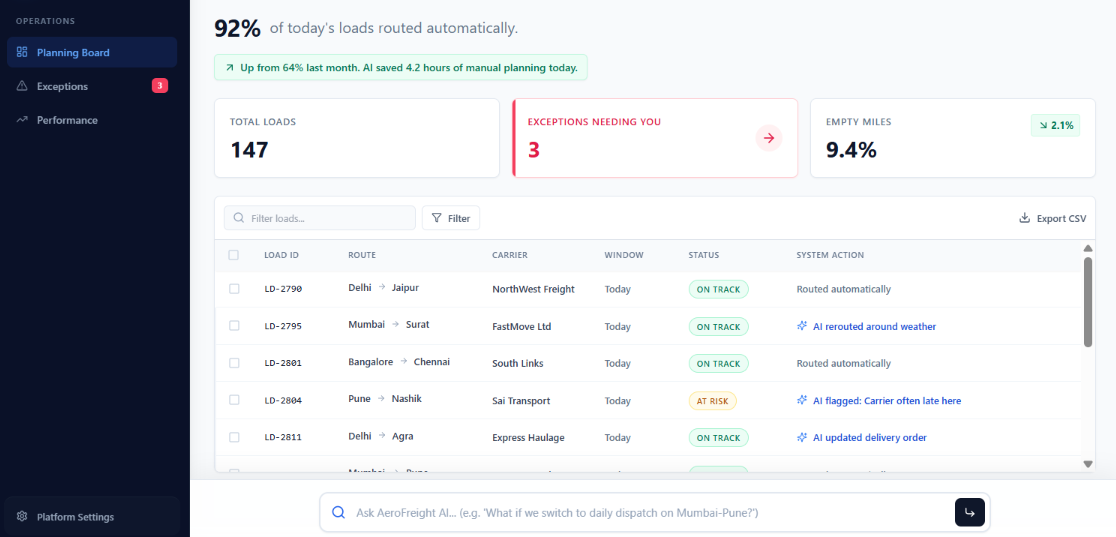
Executive Summary: Why Static Planning Tools Can No Longer Keep Up
Your planning team finishes Thursday’s load plan by 6 PM. By Friday morning, three carriers have cancelled, a key shipper has pushed volume forward by two days, and a driver is unavailable due to an hours-of-service limit nobody flagged. The plan you built is already obsolete – and rebuilding it manually means someone works through the weekend or shipments get delayed. An Agentic LLM Transport Planning Solution changes this equation fundamentally. Rather than waiting for a planner to detect exceptions and re-sequence decisions, an agentic system perceives the change, reasons through its implications, calls the right optimisation tools, and generates a revised plan – often in minutes.
This page explains what an agentic LLM transport planning solution actually is, how the technology pipeline works, where it delivers measurable value, and where its real limits lie. It is written for logistics operations leaders, supply chain directors, and fleet managers who are evaluating whether this category of AI genuinely belongs in their planning stack – and what a realistic deployment looks like.
1. Why Does Transport Planning Keep Breaking Down Despite Better Software?
Traditional planning tools fail not because of missing features, but because they assume a stable world. Freight does not offer one. An agentic LLM transport planning solution addresses a structural gap that rule-based systems and conventional AI transport planning software cannot close: the gap between structured optimisation logic and the messy, unstructured, constantly shifting reality of real logistics operations.
Context: The Operational Environment Where Planning Fails
The American Trucking Associations estimates U.S. trucks move over $940 billion in freight annually – yet research from the American Transportation Research Institute consistently puts the share of miles driven empty at 15 to 20 percent across the industry. That is not a rounding error. For any fleet running near those averages, deadhead miles represent a significant and directly recoverable cost line – one that compounds with every rise in diesel prices or driver wages. Meanwhile, the certified driver pool has contracted, wages have climbed, and shipper expectations around delivery windows have tightened. Planning teams absorb all of this with tools built for a simpler era.
In practice, logistics teams at scale consistently find that the core problem is not load volume – it is exception volume. At large freight operations, daily routing work per service location can consume hours of planner time, and that figure does not account for mid-day exceptions that arrive after the morning plan is already complete. Multiply that across a regional or national network, and the cumulative planning burden becomes a structural constraint on operational quality – not a staffing problem that more headcount alone will solve.
Key Pain Points This AI Solution Addresses
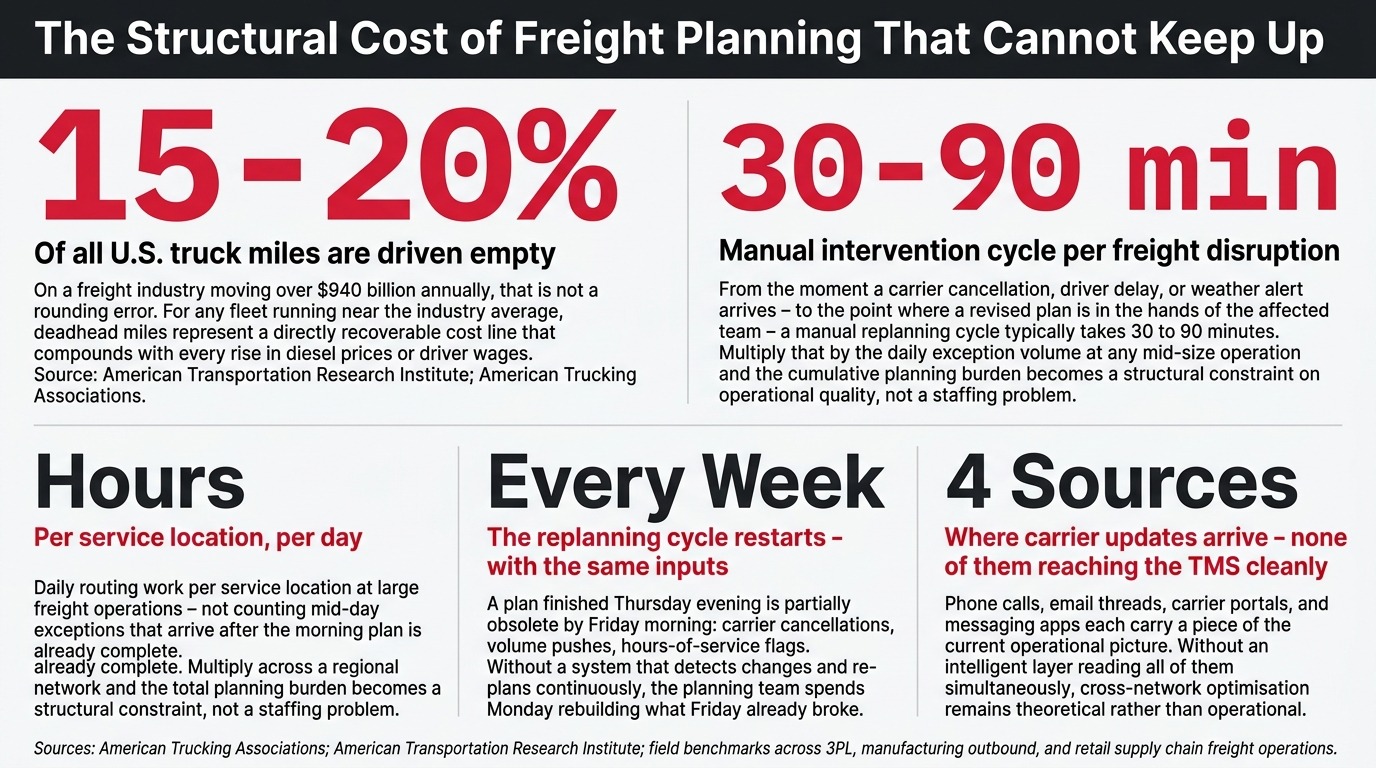
- Freight costs rising with no clear visibility: Planners cannot see in real time which loads are driving cost overruns, which lanes are underperforming, or where consolidation opportunities exist across the full network.
- Manual transport planning too slow for dynamic demand: By the time a planner finishes a route sequence, shipper volumes, cancellations, and traffic conditions have already changed the inputs.
- Poor carrier performance with no real-time tracking: Carrier updates arrive via phone, email, and WhatsApp – creating an information lag that makes proactive disruption management nearly impossible.
- Too many empty trucks on return legs: Without continuous visibility into backhaul opportunities, return legs default to empty – generating cost and emissions with zero revenue offset.
- Delivery windows being missed regularly: Late deliveries compound – a single delay cascades into downstream appointment failures, detention charges, and customer penalties.
- Logistics team overwhelmed managing disruptions manually: Exception handling consumes planning time that should go toward optimisation. Every driver breakdown or weather delay triggers a manual intervention cycle.
- Transport decisions based on guesswork, not data: Without structured data on past lane performance, carrier reliability, and cost-per-shipment, load assignments rely on experience and intuition rather than evidence.
Why Traditional Approaches Fall Short
Conventional Transport Management Systems (TMS)Software platforms that manage the planning, execution, and tracking of freight movements, typically through rule-based workflows and rate databases handle structured data well. They struggle the moment the real world intervenes. Specifically:
- Rule-based optimisers break on unstructured input: A driver texting a delay in Hindi, a carrier emailing a PDF rate update, or a customer rescheduling via WhatsApp – none of these reach the solver cleanly. Someone has to normalise that information first, manually.
- Static solvers cannot re-plan in real time: Most TMS optimisers run in batch mode. By the time the plan is generated, conditions have shifted. They produce the right answer for the inputs they had three hours ago.
- No exception reasoning: Traditional tools can flag an exception. They cannot reason through its implications, check downstream schedule conflicts, identify the best available solution, and act on it – that still requires a human.
- Data silos block consolidation: TMS, ERP, carrier portals, and email inboxes each hold a piece of the picture. Without an intelligent layer that reads all of them simultaneously, cross-network optimisation is theoretical rather than operational.
- AI vs manual transport planning gap is widest on exceptions: AI transport planning software that only handles clean, structured loads provides a fraction of the available value. The highest-cost moments in any operation are exactly the messy ones – which is where traditional tools abandon the planner.
2. What Is an Agentic LLM Transport Planning Solution?
An agentic LLM transport planning solution is a system where one or more AI agents – powered by large language models – autonomously plan, optimise, and coordinate transportation operations by reasoning through goals, using specialised tools, and adapting to real-time changes. It does not merely answer questions or generate suggestions. It orchestrates the full planning cycle end-to-end: ingesting live data, decomposing the problem into tasks, calling the right solvers and APIs, validating outputs, and escalating exceptions that require human judgment.
The critical distinction is the word “agentic.” A standard Large Language Model (LLM)A type of AI trained on vast text datasets that can understand natural language, reason through multi-step problems, and generate structured outputs from unstructured inputs answers a question. An agentic LLM logistics platform takes that reasoning capability and embeds it in a loop – perceive, plan, act, reflect, execute – so the system completes multi-step tasks without waiting for a human prompt at each stage. The LLM does not replace the mathematics of optimisation. It acts as an orchestrator: translating the unstructured, chaotic inputs of real freight operations into clean, constraint-compliant inputs that classical optimisation engines can solve. The solver handles the combinatorics. The LLM handles everything that was previously too messy to reach the solver at all.
Vision and Objectives
- Continuous re-planning: Maintain an optimised plan in near-real-time as loads, carriers, drivers, and conditions change throughout the day – not just at the start of each shift.
- Exception resolution without human intervention: Detect disruptions, evaluate available responses, implement the best option, and notify relevant stakeholders – without a planner having to drive each step manually.
- Empty mile reduction: Identify backhaul and consolidation opportunities across the full order book in real time, not just when a planner happens to notice a pattern.
- Structured output from unstructured input: Process emails, PDFs, phone call transcripts, and messaging app updates into clean, actionable data that the planning system can act on.
- Measurable cost reduction per shipment: Deliver documented improvement in cost-to-serve by lane, carrier, and load type – with data trails that support future planning decisions.
- Scalable planning capacity: Allow a planning team of fixed size to manage significantly higher load volume without proportional headcount growth.
3. How Does This Solution Work Across Different Logistics Operations?
3PL Provider: Rebuilding the Week’s Plan After Weekend Cancellations
Your planning team arrives Monday to find three carriers cancelled over the weekend and two shippers have added volume they need moved by Wednesday. Rebuilding the week’s load plan takes the better part of Monday morning – and by the time it is finished, two more changes have arrived. For a 3PL managing hundreds of weekly shipments across a fragmented carrier base, this cycle repeats every week without resolution.
An agentic LLM transport planning solution monitors carrier availability, shipper order changes, and capacity constraints continuously. When a cancellation arrives – whether by email, portal, or message – the orchestrator agent detects it, identifies affected loads, checks available carrier options against contract rates and historical performance, and generates a revised assignment plan. The planner reviews a recommendation rather than rebuilding from scratch. Result: Monday morning planning time drops from hours to minutes, and the backlog of changes stops accumulating.
Manufacturing Outbound Logistics: Trucks Leaving Half-Empty Due to Late-Order Changes
Your outbound trucks leave the dock 60 percent full because customer orders keep changing at 4 PM and there is no time to replan consolidation before cutoff. Your transport cost per unit is significantly above target, and the variance is almost entirely avoidable – but no one has time to find it.
A route optimisation agentA specialist AI agent that calls vehicle routing problem solvers to find the lowest-cost or fastest set of routes given a specific set of loads, locations, and constraints within an agentic AI logistics platform runs consolidation analysis continuously against the live order book. As late changes arrive, the system re-solves the load plan against updated constraints and presents the planner with a revised dispatch sequence. Hard constraints – weight limits, driver hours, delivery windows – are encoded directly into the solver, not the LLM, so the output is always feasible. Result: measurable improvement in average truck utilisation and a corresponding reduction in cost per delivery unit across outbound lanes.
Retail Supply Chain: Carrier Underperformance Invisible Until the Complaints Arrive
Your last-mile carrier is missing delivery windows on roughly one in eight shipments, but you only find out when a customer calls or a chargeback arrives. By then, the pattern has been running for weeks and recovering the customer relationship is expensive. The data to catch this earlier exists – it is just scattered across carrier portals, TMS logs, and a spreadsheet someone updates monthly.
An intelligent transport management solution with continuous carrier performance monitoring pulls tracking data, delivery confirmation records, and exception logs into a unified model. A performance agent flags the underperforming carrier, quantifies the service failure rate by lane, and surfaces this in a planner dashboard with an alternative carrier recommendation ranked by historical reliability and contracted rate. The AI freight planning tool does not make the switch automatically – it escalates to the planner with evidence. Result: carrier underperformance is detected weeks earlier, chargebacks decrease, and load assignment decisions are grounded in measured performance rather than preference. For organizations managing vehicle movement at the infrastructure or site level rather than the fleet planning level, our AI-based traffic management system for India addresses access control, signal optimization, and real-time congestion management as a complementary layer to transport planning.
Ready to explore what this solution looks like for your organisation?
Talk to Our AI Team4. How Does an Agentic LLM Transport Planning Solution Actually Work?
The architecture combines three distinct layers: an LLM orchestrator that reasons and manages task flow, a set of specialist agents that execute specific sub-tasks, and classical optimisation solvers that handle the mathematical heavy lifting. Understanding how data moves through all three layers explains both the solution’s power and its boundaries.
Data Acquisition: What the System Reads
The system ingests data from multiple sources simultaneously. Structured inputs include TMS load data, ERP order records, contracted carrier rate tables, driver hours-of-service logs, and warehouse inventory feeds. Unstructured inputs – where the agentic capability earns its value – include email threads containing rate quotes and cancellations, PDF bills of lading and proof of delivery documents, carrier portal API feeds, GPS and telematics streams, weather and traffic APIs, and in some deployments, voice call transcripts from driver or carrier check-ins. Standard data formats such as GTFSGeneral Transit Feed Specification – a standardised open data format for public transit schedules and associated geographic information feeds and EDIElectronic Data Interchange – a structured format for exchanging business documents between systems, commonly used for purchase orders, shipment notices, and invoices in freight transaction records are consumed directly through connectors. A common pattern across real deployments of agentic transport AI is that data normalisation – connecting these sources and cleaning inconsistencies – consumes the majority of the initial implementation timeline, often two to three months before the agents themselves are even configured.
The AI Processing Pipeline
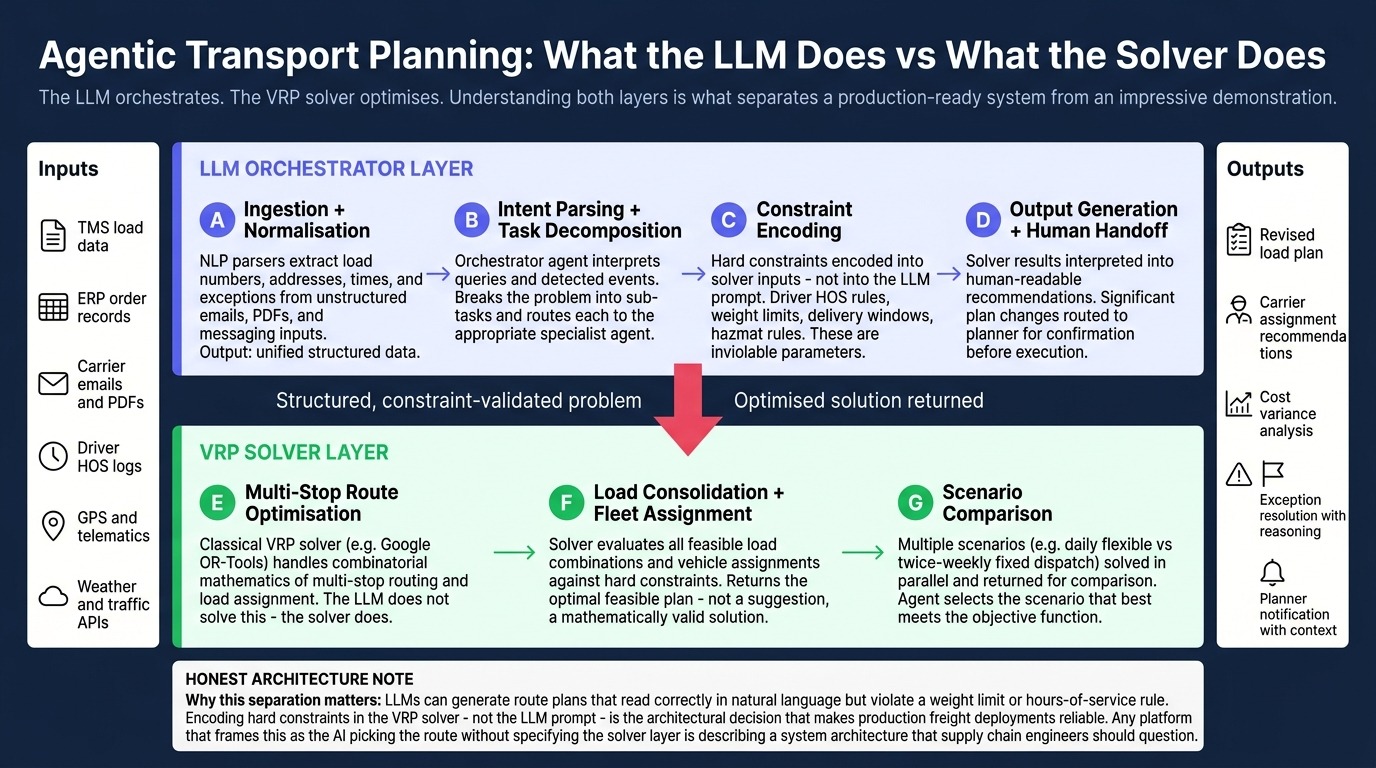
- Data Ingestion and Normalisation: First, all incoming data streams – structured and unstructured – pass through an ingestion layer. The system uses NLPNatural Language Processing – the AI discipline enabling computers to understand and interpret human language in context, extracting meaning from emails, documents, and spoken text parsers to extract key entities from unstructured sources: load numbers, addresses, weights, times, and exceptions from email text, PDF documents, and API responses. The output is a unified, structured data layer that the planning agents operate on.
- Intent Parsing and Task Decomposition: Next, the master orchestrator agent – built on a framework such as LangGraphAn open-source framework for building stateful, multi-step AI agent workflows with explicit control over task sequencing, memory, and tool calls – interprets an incoming query or detected event. Whether a planner types “what happens if we shift Friday’s volume to Saturday?” or the system detects a carrier cancellation, the orchestrator breaks the problem into a sequence of specific sub-tasks and assigns each to the appropriate specialist agent.
- Constraint Encoding and Validation: Once the task is decomposed, hard operational constraints are encoded directly into the solver inputs – not into the LLM prompt. Driver hours-of-service regulations, vehicle weight limits, hazardous materials rules, delivery window commitments, and lane-specific rate contracts are treated as inviolable parameters. This step prevents the LLM from generating a plan that looks reasonable in natural language but violates a legal or contractual constraint in practice.
- Optimisation Solver Handoff: The route optimiser agent calls a classical VRP solverVehicle Routing Problem solver – mathematical optimisation software that finds the lowest-cost or fastest set of routes for a fleet of vehicles given specific loads, locations, time windows, and capacity constraints with the structured, constraint-validated inputs. Solvers such as Google OR-Tools handle the combinatorial mathematics of multi-stop routing, load consolidation, and fleet assignment. The LLM does not attempt to solve the routing mathematics itself – it prepares the problem and interprets the output.
- Multi-Agent Execution: The system then runs specialist agents in parallel or sequence depending on the task. A cost calculator agent evaluates the financial impact of each scenario. A scenario simulator agent models alternative plans – for example, a two-day fixed dispatch schedule versus daily flexible dispatch – and surfaces the results for comparison. An alerting agent monitors live feeds for conditions that would invalidate the current plan.
- Exception Detection and Re-Planning: The system watches live data streams continuously. When a GPS feed shows a vehicle significantly behind schedule, a carrier portal logs a missed pickup, or a weather API signals a storm affecting a key lane, the alerting agent triggers the replanning cycle. The orchestrator evaluates urgency, checks whether the exception falls within automated resolution parameters, and either acts or escalates.
- Output Generation and Human Review Handoff: Finally, the system presents results – a revised load plan, a carrier recommendation, a consolidation opportunity, or a flagged exception requiring decision – through a dashboard, a natural language chat interface, or an integration into the team’s existing workflow tool. All significant plan changes route through a human confirmation step before execution.
Human-in-the-Loop: Where Human Judgment Still Matters
An agentic LLM transport planning solution handles the 80 percent of decisions that are data-driven and repeatable. The remaining 20 percent – which is often the most consequential – requires human judgment, and the architecture must explicitly preserve that.
- Material plan changes: Any revision affecting customer delivery commitments, significant cost variance, or carrier relationship decisions routes to a planner for confirmation before execution.
- Novel exception types: When the system encounters a situation outside its training distribution – a new lane, an unfamiliar regulatory requirement, or a carrier it has no historical data on – it escalates rather than guesses.
- Regulatory and compliance decisions: Hazmat routing, cross-border documentation, hours-of-service edge cases, and weight exemption decisions require human sign-off and are never automated.
- Carrier relationship management: Performance conversations, contract escalations, and dispute resolution remain human-led. The AI surfaces the evidence; the operations team manages the relationship.
- High-value shipper exceptions: When a top-tier shipper’s load is at risk, the system flags and escalates immediately rather than applying a standard automated response.
Output and Interaction: What Users Actually See
Planners interact with the system through a natural language chat interface embedded in their existing collaboration environment – Teams, Slack, or a web application – where they can ask questions like “which lanes are at risk today?” or “show me this week’s consolidation opportunities.” The system returns structured recommendations with supporting data, not just answers. Dashboards surface real-time plan status, carrier performance metrics, and exception queues. When an exception requires human action, the system sends a notification with the relevant context and recommended response already prepared – the planner approves, modifies, or overrides.
5. What Technologies Power an Agentic AI Logistics Platform?
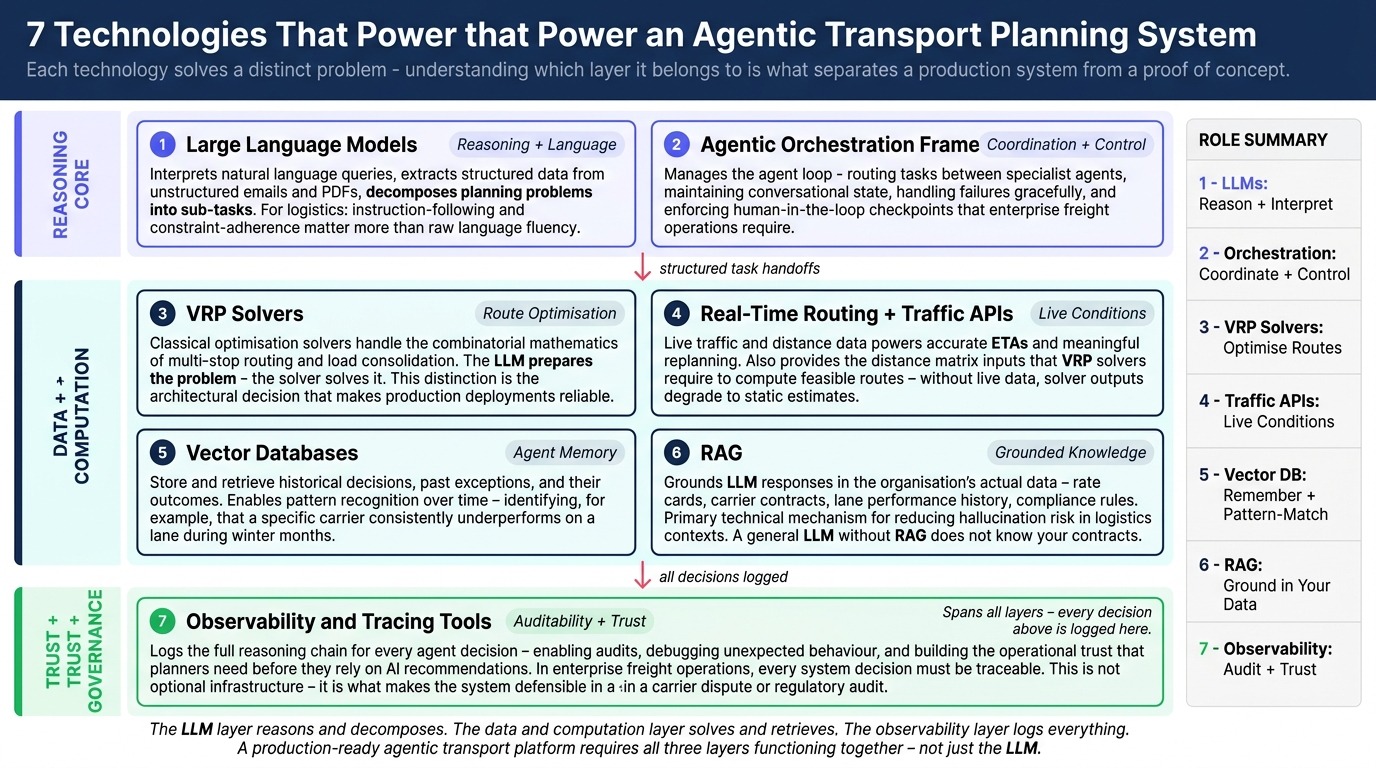
- Large Language Models (LLMs)Foundation AI models trained on large text corpora that enable natural language understanding, multi-step reasoning, and structured output generation from unstructured inputs: The reasoning core of the system. LLMs interpret natural language queries, extract structured data from unstructured documents, decompose complex planning problems into sub-tasks, and generate human-readable explanations of system decisions. For a logistics deployment, selecting a model with strong instruction-following and constraint-adherence capabilities matters more than raw language fluency.
- Agentic orchestration frameworksSoftware libraries such as LangGraph or LangChain that enable developers to build stateful, multi-step AI workflows where multiple agents collaborate, share memory, and call external tools in sequence: These frameworks manage the agent loop – routing tasks between specialist agents, maintaining conversational state, handling failures gracefully, and enforcing the human-in-the-loop checkpoints that enterprise operations require.
- Vehicle Routing Problem (VRP) solversMathematical optimisation engines that compute the lowest-cost or fastest set of routes for a fleet given loads, time windows, vehicle capacities, and constraints – far more reliable than LLM-generated routing: Classical optimisation solvers handle the combinatorial mathematics of multi-stop routing and load consolidation. Open-source options handle standard fleet configurations well; commercial solvers handle larger-scale or highly constrained problems. The LLM prepares the problem; the solver solves it.
- Real-time routing and traffic APIsCloud APIs providing live traffic conditions, distance matrices, geocoding, and turn-by-turn routing data – essential for accurate ETAs and dynamic replanning: Live traffic and distance data is essential for accurate ETAs and meaningful replanning. These APIs also power the distance matrix inputs that VRP solvers require to compute feasible routes.
- Vector databasesDatabases that store and retrieve data as mathematical vectors, enabling semantic search and memory for AI agents – for example, finding historically similar exceptions and their resolutions: Agent memory systems use vector databases to store and retrieve historical decisions, past exceptions, and their outcomes. This allows the system to apply pattern recognition over time – identifying, for instance, that a particular carrier consistently underperforms on a specific lane in winter months.
- Retrieval-Augmented Generation (RAG)A technique that grounds LLM responses in a specific document or data corpus at inference time, reducing hallucination by forcing the model to cite retrieved evidence rather than rely on training memory: RAG grounds the LLM’s responses in the organisation’s actual data – rate cards, carrier contracts, historical lane performance, and compliance rules – rather than generic training knowledge. This is the primary technical mechanism for reducing hallucination risk in logistics contexts.
- Observability and tracing toolsSoftware that logs every agent decision, tool call, and reasoning step in an AI workflow – essential for debugging errors, auditing decisions, and building trust in the system’s outputs: For enterprise operations, every agent decision must be traceable. Observability tooling logs the full reasoning chain for each output – enabling audits, debugging unexpected behaviour, and building the trust that operations teams need before they rely on AI recommendations.
6. What Results Does an Agentic LLM Transport Planning Solution Deliver?
- Empty mile reduction: Continuous backhaul and consolidation analysis across the live order book surfaces opportunities that planners miss during high-volume periods – directly addressing the single largest avoidable cost in truckload operations.
- Planning throughput at scale: Operations that previously required a planner to process individual loads manually can handle significantly higher volumes without proportional headcount growth – a documented benefit in large-scale deployments of this AI freight planning tool architecture.
- Faster exception resolution: When a disruption occurs, the system detects it, evaluates responses, and presents a recommendation in minutes rather than the 30 to 90 minutes a manual intervention cycle typically requires. Missed delivery windows decrease as a direct result.
- Carrier performance visibility: Structured carrier scorecards, built from data the system aggregates continuously, give operations teams an evidence base for load assignment that replaces historical preference and guesswork.
- Cost-per-shipment reduction: Better consolidation, higher vehicle utilisation, and faster exception resolution compound into measurable improvement in cost-to-serve per lane and per load type – with data trails that document the improvement for finance and procurement review.
- Reduced manual data normalisation: The system’s ability to extract structured data from emails, PDFs, and unstructured carrier communications eliminates a significant share of the manual data entry burden that consumes planner time in every freight operation.
- Scalable knowledge retention: Experienced planners carry institutional knowledge about carriers, lanes, and seasonal patterns in their heads. An intelligent transport management solution captures that knowledge in the agent memory layer, making it accessible across the team and reducing vulnerability to staff turnover.
- Audit trail for compliance and customer disputes: Every system decision is logged with the data and reasoning behind it – providing a defensible record for carrier disputes, customer chargebacks, and regulatory audits.
7. How Do You Build the Business Case for an AI Transport Planning Solution?
An agentic LLM transport planning solution delivers measurable ROI – but the business case requires honest baseline measurement, not vendor-supplied projections. Teams that have worked through this ROI calculation consistently find that the hardest part is establishing the current-state baseline, because most logistics operations do not have clean, accessible data on their actual cost-per-shipment variance, empty mile rate, or exception resolution time before the project starts. Establishing that baseline in Phase 1 is not overhead – it is the foundation that makes the improvement measurable and the investment defensible.
Key Metrics to Measure Before and After Implementation
- Empty mile percentage: Measure average loaded versus empty miles per vehicle per week. A reduction in empty miles of even a few percentage points generates material savings at fleet scale – calculate against your actual fuel cost and driver cost per mile.
- Average load planning time per planner per day: Track how long planners spend building and rebuilding daily plans, including exception handling. Compare pre- and post-deployment to quantify the productivity recapture.
- Exception resolution time: Measure the average time from disruption detection to plan revision and stakeholder notification. This translates directly into on-time delivery performance and downstream penalty avoidance.
- Vehicle utilisation rate: Average payload as a percentage of vehicle capacity across all loads. Consolidation improvement shows here directly.
- Cost-to-serve per shipment by lane: The primary financial metric. If the system improves this by a measurable amount across your top 20 lanes, the annual impact scales predictably.
Realistic Implementation and Payback Timeline
A focused implementation targeting a single logistics vertical – for example, outbound freight from one distribution network – can reach production-ready status in three to four months with a team of four to six engineers. However, that timeline assumes reasonably clean data connectors exist. In practice, the data integration phase – connecting TMS, ERP, and carrier systems – frequently extends the timeline materially, particularly where the TMS is a legacy system or data is partially held in spreadsheets. The honest scoping conversation acknowledges this upfront rather than treating it as a contingency.
Payback timelines for this class of solution vary significantly by fleet size, lane density, and current empty mile rate. Mid-size fleets running 50 to 200 vehicles typically see the largest proportional impact in the first 12 months, as the consolidation and backhaul improvements are most visible at that scale. Larger operations see slower relative impact but larger absolute savings. The business case for acting now rather than waiting rests on a simple compounding logic: every week of planning at current empty mile rates is recoverable cost that will not come back.
8. What Does Implementing This AI Solution Actually Require?
Implementation of an agentic LLM transport planning solution is achievable for most mid-to-large logistics operations – but several factors consistently distinguish successful deployments from stalled ones. What implementation experience reveals that theoretical explanations often miss is this: the technology risk is smaller than most operations teams expect, and the data and organisational risk is larger.
Where This Solution Has Real Limits
- LLMs hallucinate under constraint pressure: An LLM can generate a route plan that reads correctly in natural language but violates a weight limit or a driver hours-of-service rule. This is not hypothetical – it happens. The solution is architectural: hard constraints must be encoded in the VRP solver layer, not in the LLM prompt. Any deployment that relies on the LLM to self-enforce operational constraints is fragile.
- The system optimises for what it can measure: If your cost-to-serve data is incomplete, the optimiser will miss opportunities that your experienced planners would catch. Garbage-in, garbage-out applies to agentic systems at least as much as to traditional ones.
- Edge cases remain partially manual: The system handles the structured, repeatable 80 percent of planning decisions well. The remaining 20 percent – novel exceptions, relationship-sensitive situations, regulatory edge cases – still require human judgment. This is by design, not a limitation to be engineered away.
- Multimodal complexity increases integration effort: Cross-border shipments involving multiple modes – rail, ocean, road – require more data connections and more constraint layers than single-mode domestic freight. An agentic AI transport solution for multimodal logistics is more complex to implement and requires longer for the system to accumulate enough historical data to reason reliably.
Practical Implementation Factors
- Data quality and normalisation time: Practitioners who have deployed this at scale consistently report that data connectivity and normalisation consumes the majority of initial implementation effort – often more than the agent configuration work itself. Legacy TMS data, carrier portals, and ERP exports rarely arrive in clean, consistent formats, and normalising them is not a task that can be parallelised easily.
- Scope discipline: Attempting to solve outbound freight, last-mile, cross-border, and LTL simultaneously in the first deployment is the most reliable path to a stalled project. Start with one vertical, prove the value, then expand.
- Baseline measurement as Phase 1: If the organisation cannot state its current empty mile rate, average planning time, or cost-per-shipment before the project starts, establish those metrics first. Without a baseline, the improvement is invisible to finance and procurement.
- Planner trust is earned incrementally: Planners who have built expertise over years are right to be sceptical of system recommendations until they have seen the system perform under real conditions. Plan for a parallel-run period where planners validate AI recommendations against their own judgment. This builds confidence and surfaces edge cases.
- Infrastructure and model hosting decisions: Organisations handling commercially sensitive freight data and carrier contracts will need to evaluate whether cloud-hosted LLM APIs are acceptable or whether a private LLM deployment is required for data sovereignty reasons.
- Ongoing model and agent maintenance: Carrier networks change, lane structures shift, and regulatory requirements evolve. The agents and their constraint layers require periodic review and updating – this is an operational commitment, not a one-time deployment.
9. Which Organisations Get the Most Value from This Solution?
An agentic LLM transport planning solution delivers its highest value to organisations where planning volume, exception frequency, and data fragmentation have already overwhelmed the capacity of manual workflows and conventional AI transport planning software. The solution is not a fit for every freight operation – but for the right profile, the compounding impact across consolidation, exception resolution, and carrier performance is substantial.
This solution is particularly valuable if your organisation meets one or more of the following conditions:
- You operate a fleet or manage freight volume large enough that empty mile reduction of even a few percentage points represents a material dollar figure – typically 50 or more vehicles or equivalent equivalent freight spend.
- Your planning team spends a significant share of its time on exception management and manual data normalisation rather than strategic optimisation.
- You manage a multi-carrier network where performance visibility is fragmented across portals, spreadsheets, and email – and load assignment still relies heavily on planner relationships rather than measured performance data.
- You operate in a sector where delivery window compliance directly affects customer penalties, chargebacks, or contract renewals – retail, manufacturing, or high-frequency distribution.
The solution fits well across several specific buyer profiles. Intelligent freight planning software for 3PL providers addresses the multi-client, multi-carrier complexity that defines the 3PL operating model. An AI transport management solution for manufacturing companies targets the outbound logistics cost pressure that finance teams flag in every operations review. An AI supply chain transport tool for retail supply chains addresses last-mile performance and carrier visibility simultaneously. For fleet operators, AI route optimisation software targeting empty mile reduction offers the clearest and most directly measurable return on investment.
10. Frequently Asked Questions About Agentic LLM Transport Planning
How does an agentic LLM for transport planning in logistics companies actually work in practice?
An agentic LLM transport planning system wraps a large language model in an agent loop – perceive, plan, act, reflect, execute – so it can complete multi-step planning tasks autonomously rather than just answering individual questions. In practice, the LLM acts as an orchestrator: it reads incoming data (including unstructured emails, PDFs, and API feeds), decomposes the planning problem into sub-tasks, calls specialist agents and mathematical solvers, validates outputs against hard operational constraints, and presents results to a human planner for confirmation. The key architectural point is that the LLM handles reasoning and coordination while a classical VRP solver handles the routing mathematics – the two layers each do what they are best at.
What is the difference between an agentic LLM transport planning solution and a standard TMS?
A standard TMS processes structured data through rule-based workflows – it executes what it is told, within the parameters it was configured for. An agentic LLM logistics planning platform reasons through problems, handles unstructured inputs, detects and responds to exceptions without being explicitly triggered, and adapts to situations outside its original configuration. The practical difference shows up most clearly on exceptions: a TMS flags a missed pickup; an agentic system detects it, evaluates available responses, identifies the best option given current constraints, and presents a recommendation – or acts, within pre-defined parameters. Many deployments layer an agentic system on top of an existing TMS rather than replacing it, using the TMS as the data source and execution layer while the agentic layer handles reasoning and planning.
Can AI transport planning really reduce empty miles, and by how much?
Yes – empty mile reduction is one of the most directly addressable targets for an AI transport planning tool because it is a consolidation and backhaul optimisation problem that continuous AI analysis handles better than periodic manual review. The scale of reduction depends heavily on the current empty mile rate, the density of the freight network, and the quality of order data available to the system. Operations with fragmented planning processes and limited backhaul visibility typically see more improvement than those already running tight optimisation. Rather than accepting a vendor benchmark figure, measure your current empty mile rate by lane and use that as the baseline against which to project impact during the scoping phase.
Is an agentic LLM transport platform reliable enough for cross-border shipping and multimodal logistics?
Cross-border and multimodal deployments are achievable but require more integration complexity and a longer implementation timeline than single-mode domestic freight. The additional layers – customs documentation, multiple carrier types, regulatory variance by jurisdiction, and mode-switching decision logic – each require dedicated data connections and constraint encoding. The risk of LLM hallucination is higher in multimodal contexts because the constraint space is larger and the consequences of an error (a missed customs filing, an infeasible intermodal transfer) are more severe. For this reason, cross-border deployments benefit from a tighter human-in-the-loop design and a longer parallel-run validation phase before autonomous execution is enabled.
How long does it take to implement an intelligent transport planning tool for a mid-size supply chain team?
A focused deployment targeting one logistics vertical typically reaches production-ready status in three to four months with a competent engineering team. However, data integration is consistently the phase that extends timelines: connecting a legacy TMS, normalising carrier data, and establishing clean order feeds frequently runs longer than initial estimates – especially where data is fragmented across old systems and spreadsheets. Organisations that underestimate data preparation consistently struggle to hit go-live targets. The practical planning assumption is to treat data integration as the first and heaviest workstream rather than a prerequisite that can be handled in parallel.
Build This Solution With Softlabs Group
Softlabs Group builds custom agentic LLM transport planning solutions tailored to each client’s specific freight data, carrier networks, TMS environment, and operational workflows. That means a multi-agent architecture designed around your load types and exception patterns – not a generic platform configured to approximate your needs. Our enterprise AI development work in logistics covers the full stack: data integration from TMS, ERP, and carrier systems; orchestrator and specialist agent design; VRP solver integration with hard constraint encoding; and the observability tooling that gives your operations team confidence in every system decision. We work with clients from initial scoping through to production deployment and ongoing agent maintenance.
If your planning team is managing more exceptions than optimisation – or if empty miles, missed windows, and fragmented carrier visibility are costs you have accepted as unavoidable – the conversation starts with understanding your specific freight operation. Reach out to discuss a scoped assessment of where an agentic LLM transport planning solution would deliver the clearest, most measurable value for your network.