 India
India  Mongolia
  Sweden
  Australia
Executive Summary: When Field Operations Scale Faster Than Your Dispatch Can Handle
You are managing a service operation where 40 technicians start their day and, by 9 AM, a third of the schedule has already shifted – a no-access site, a technician running two hours over, a priority job just added. Your dispatcher is making judgment calls on skill matching, parts availability, and travel time all at once, under pressure, with imperfect data. An AI Smart Field Management Solution directly addresses this operational reality. It combines scheduling optimisation, predictive intelligence, mobile job delivery, and technician knowledge assistance into one connected system – so the right person reaches the right job with the right information and parts, on the first attempt.
For organisations running large or distributed field teams, this is not a marginal efficiency gain. Reducing repeat dispatches, shrinking travel time, and improving first-time fix rates each carry direct cost and revenue consequences. This page explains what the solution is, how it works technically, where it delivers genuine value, and what realistic implementation requires.
Why Does Field Service Keep Losing Money Without an AI Smart Field Management Solution?
Field service profitability erodes quietly – not through one visible failure, but through hundreds of small inefficiencies that compound daily. Without an AI Smart Field Management Solution, each of those inefficiencies stays invisible until it appears as a missed SLA, a cost overrun, or a customer complaint.
Context: The Field Service Operational Environment
Field service organisations across utilities, telecom, HVAC, industrial equipment, medical devices, and facilities management share a common structure: a dispatcher or scheduling team coordinating mobile technicians who travel to customer or asset locations to perform installations, repairs, and preventive maintenance. The coordination challenge scales non-linearly. At 10 technicians, a skilled dispatcher manages it. At 100 technicians spread across multiple zones, real-time changes – traffic delays, cancellations, skill mismatches, parts shortages – create cascading disruption that manual tools cannot absorb.
In practice, organisations deploying this type of system typically encounter a gap between what their legacy scheduling tools promise and what actually happens when a job changes mid-route. That gap represents daily leakage across labour cost, fuel, SLA compliance, and customer satisfaction simultaneously.
Key Pain Points This AI Solution Addresses
- Field technicians arriving without the right parts: Incomplete pre-job diagnostics and poor parts forecasting mean technicians regularly arrive on-site only to discover the required component is not on their van – triggering a repeat visit and all the cost that follows.
- Inefficient manual scheduling of field teams: Dispatchers building schedules in spreadsheets or basic calendar tools cannot simultaneously account for skill requirements, location, traffic, SLA deadlines, and shift constraints. The result is suboptimal assignment and idle time.
- Too many missed service appointments: When schedules do not adapt dynamically to same-day changes, jobs slip, customers wait, and appointment windows are missed – eroding trust and creating backlog.
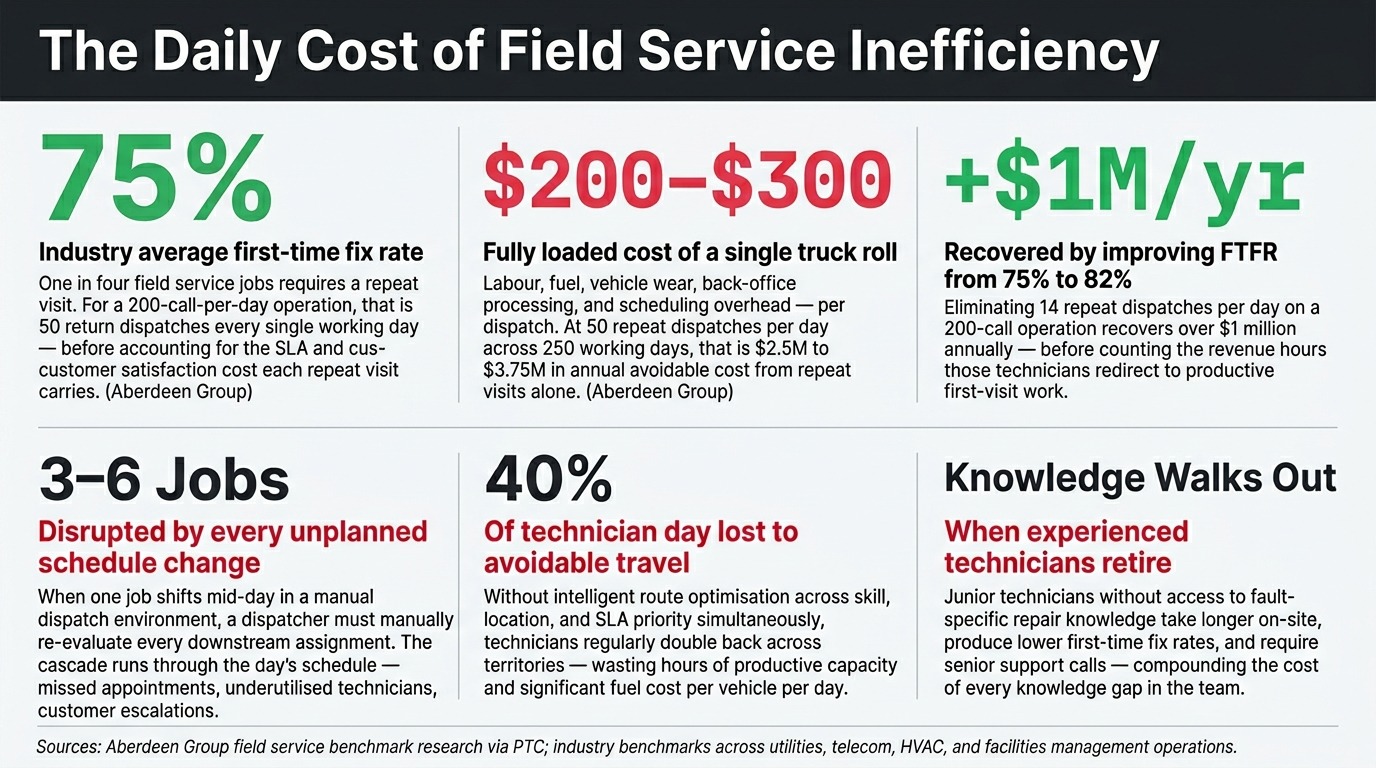
- High travel costs from poor route planning: Without intelligent routing, technicians frequently double back across territories, wasting hours of productive time and significant fuel cost per vehicle per day.
- SLA deadlines being breached regularly: Without automated SLA tracking tied to live scheduling, high-priority jobs often do not receive the urgency weighting they require. Breaches trigger penalties and churn.
- No real-time visibility into field team location: Service managers operating without live crew location data cannot respond to delays, reassign jobs, or accurately update customers – leaving the back office reactive rather than proactive.
- Customers waiting too long for service visits: Overly wide appointment windows and poor arrival-time prediction create a negative customer experience regardless of how well the actual repair goes.
Why Traditional Approaches Fall Short
Conventional field service management tools – spreadsheet scheduling, basic calendar-based dispatch, and rule-of-thumb routing – fail at scale for specific, structural reasons. They handle static inputs well but collapse under dynamic conditions.
- Rule-based dispatch cannot handle real-time change: When three jobs change simultaneously, a dispatcher with a static schedule must manually re-evaluate each assignment. An AI field dispatch tool re-optimises the entire schedule in seconds, accounting for all constraints at once.
- Skill and certification matching is manual and error-prone: Matching job requirements to technician qualifications by memory or manual lookup leads to misassignment – sending an uncertified technician, or an over-qualified one to a simple task, wasting their capacity.
- Parts management runs on guesswork: Without predictive parts forecasting tied to asset history and job type, technicians carry ad-hoc stock. First-time fix rates suffer directly as a result. Research confirms that insufficient inventory is among the primary causes of failed first-visit resolution – a problem that compounds across every repeat dispatch.
- Knowledge stays locked in senior technicians: When experienced staff retire or are unavailable, junior technicians lack access to fault-specific repair knowledge. Time on-site increases, first-time fix rates fall, and training costs rise.
- No learning loop from outcomes: Traditional AI field management software does not learn from job history. Each scheduling decision starts from the same static assumptions, regardless of patterns the data could reveal.
What Is an AI Smart Field Management Solution and What Does It Actually Do?
An AI Smart Field Management Solution is a connected operational system that uses machine learning, constraint optimisation, and generative AI to coordinate every dimension of field service delivery – from the moment a job is created to the moment it closes.
In plain terms, it solves one core problem: getting the right person to the right place at the right time with the right information and parts, while keeping the customer informed and the business on SLA. Unlike a standalone field service automation platformSoftware that automates scheduling, dispatch, work order management, and mobile job delivery for field service operations or a basic route-optimisation tool, a full intelligent field management solution coordinates scheduling, parts, knowledge, and customer communication as a single connected workflow. Dispatchers, service managers, field technicians, and operations directors all interact with it differently – but every role benefits from the same underlying improvement: better decisions, made faster, based on complete data.
Vision and Objectives
- Increase first-time fix rates by ensuring every technician arrives with the right skills, parts, and job context before the visit begins.
- Reduce cost per job by eliminating unnecessary truck rolls, optimising technician routing, and cutting idle time between assignments.
- Maintain SLA compliance at scale by automatically weighting job priority and escalating time-critical assignments in real time.
- Improve technician productivity through mobile-first job delivery, AI knowledge assistance on-site, and automated post-visit documentation.
- Give service managers live operational visibility – crew location, job status, SLA risk flags – without relying on manual check-ins.
- Build a learning system that improves scheduling accuracy continuously as job outcome data accumulates over time.
How Does This Solution Perform Across Real Field Service Industries?
The following scenarios show the solution in action across distinct operational contexts – each with a different pressure point, a different failure mode, and a different measurable outcome.
Utilities: Emergency Outage Response and SLA Compliance
When a major network fault hits at 2 AM and your dispatcher has 40 technicians scattered across 200 square miles, the difference between a 4-hour and a 12-hour restoration window often comes down to which crew gets dispatched first.
Manual dispatch in this moment fails not because dispatchers are incompetent – it fails because the decision involves live crew location, high-voltage certification requirements, estimated drive time in real-time traffic, and parts availability, all simultaneously. Spreadsheet-based tools cannot resolve all of those constraints at once under time pressure.
An AI smart field management for utility companies automatically re-optimises the entire crew schedule the moment the fault is logged, ranks available certified technicians by proximity and current load, and dispatches with pre-populated asset history on the affected infrastructure. The outcome: faster restoration, fewer regulatory SLA breaches, and a clear audit trail for incident reporting.
Telecom: Installation Scheduling at Volume
A telecom operations manager overseeing 300 daily installations knows the problem: 30 jobs rescheduled before 9 AM because yesterday’s schedule did not account for traffic, a technician who called in sick, and three access-denied sites from the day before.
Static schedules in telecom field operations create cascading delays. When one job slips, a manual dispatcher must re-evaluate five downstream assignments. Without dynamic rebalancing, this cascading effect runs through the entire day’s schedule – resulting in missed appointments, customer escalations, and underutilised technician hours.
An AI field management solution for telecom operators continuously re-optimises the active schedule in response to real-time changes. Cancelled jobs are automatically filled from a prioritised backlog. Skill-matched reassignments happen in seconds. The result is more completions per technician per day, fewer missed appointment windows, and less time dispatchers spend firefighting instead of planning.
HVAC and Facilities: Balancing Preventive and Reactive Work
Facilities directors managing 50 or more commercial buildings across a city carry a familiar tension: reactive breakdowns keep displacing the preventive maintenance schedule, and by end of month, half the planned PM visits have been pushed again.
Without predictive intelligence, reactive work always wins against planned maintenance – because it is urgent and visible. Over time, deferred preventive visits increase breakdown frequency, raising the ratio of reactive work and creating a self-reinforcing cycle. Parts management suffers too: technicians stockpile generic spares rather than job-specific kits, reducing van space and increasing emergency procurement costs.
An AI work order management software approach integrates IoTInternet of Things – a network of connected sensors and devices that transmit real-time performance data from physical equipment sensor data with asset service history to flag equipment approaching failure before breakdown occurs. Predictive scheduling protects PM slots while prioritising genuine emergencies. Parts kits are auto-generated from asset bills of materials and fault predictions. First-time fix rates improve, and the reactive-preventive ratio gradually shifts in the right direction.
Ready to explore what this solution looks like for your organisation?
Talk to Our AI TeamHow Does an AI Smart Field Management Solution Process and Execute Each Job?
The system operates as a continuous loop across five connected stages – from the moment a job is created to the moment outcomes feed back into the model. Understanding this pipeline helps service leaders assess exactly where the intelligence lives and where human judgment still plays a central role.
Data Acquisition: What the System Ingests
The system consumes data from multiple operational sources simultaneously. Customer requests arrive via CRM, web portals, or automated IoT fault alerts. Work orders pull in asset service history, prior fault codes, and equipment age from the ERP or Enterprise Asset Management (EAM)Software that manages the full lifecycle of physical assets including maintenance history, condition monitoring, and performance records system. Technician profiles supply certifications, skill categories, shift schedules, and current location via GPS. Inventory systems provide real-time van stock and warehouse availability. All of this flows into a unified operational data layer that the scheduling and prediction engines read continuously.
The AI Processing Pipeline
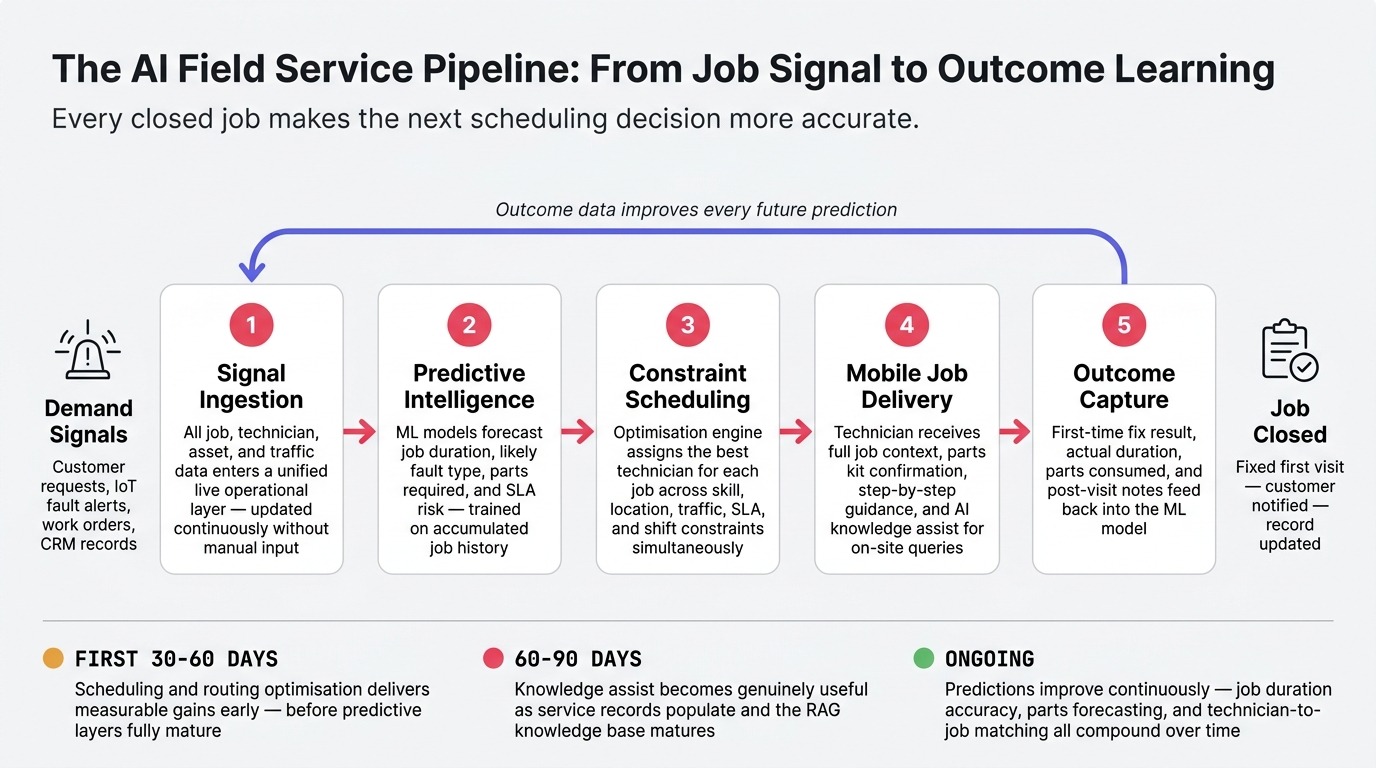
- Signal Ingestion: First, the system ingests data from customer requests, work orders, IoT sensors, CRM records, ERP systems, and asset service history into a unified operational data layer. This layer updates in real time – new jobs, technician status changes, and live traffic data all enter the system without manual input. The goal at this stage is a complete, accurate picture of the current state of every active job, technician, and asset.
- Predictive Intelligence: Next, machine learning (ML)A subset of AI where algorithms learn patterns from historical data to make predictions or decisions without being explicitly programmed for each scenario models analyse the ingested data to forecast job urgency, likely fault type, estimated job duration, and the parts or skills the job will require. Models trained on historical job outcomes improve these predictions over time – if jobs at a particular asset type consistently run 30 minutes longer than estimated, the model adjusts its duration forecasts accordingly. This stage transforms raw data into actionable predictions before a dispatcher makes a single decision.
- Constraint-Based Scheduling: Once predictions are generated, a constraint optimisationA mathematical approach to finding the best possible solution from a set of options while satisfying multiple simultaneous rules and restrictions engine assigns each job to the best available technician. It evaluates technician skills, certifications, current location, real-time traffic, van stock, SLA priority, and shift constraints simultaneously. The system then proposes an optimised schedule, showing dispatchers the trade-offs behind each assignment rather than presenting assignments as black-box outputs. This transparency is what builds dispatcher trust over time.
- Mobile Job Delivery: The scheduled job arrives on the technician’s mobile app with full context – asset history, prior fault codes, step-by-step repair guidance, and access to an AI knowledge assistant for on-site questions. This knowledge assistant uses Retrieval-Augmented Generation (RAG)An AI approach that retrieves relevant documents or records from a knowledge base and uses a language model to generate accurate, context-specific answers from that retrieved content to surface the most relevant manuals, prior fixes, and escalation procedures in response to natural language queries. A junior technician can ask “what caused this fault code on this asset model last time” and receive a direct, sourced answer from internal service records.
- Outcome Learning: After job closure, the system captures first-time fix result, actual duration, parts consumed, and any post-visit notes. These outcomes feed back into the ML models, improving future scheduling accuracy and parts predictions. Over time, the system builds a progressively more accurate model of how long specific job types take, which technicians perform best on which asset types, and which assets are trending toward failure – creating a continuously improving operational intelligence layer.
A common pattern across real implementations of this solution is that the scheduling optimisation delivers immediate, measurable gains in the first 60 days, while the technician knowledge assist component becomes genuinely useful only once the knowledge base matures with real service records – typically over 60 to 90 days of active use. Organisations that expect full value on day one often underestimate how much the RAG-based components depend on the quality and depth of internal documentation they feed into the system.
Human-in-the-Loop: Where Human Judgment Still Matters
The best-designed AI field dispatch tools position AI as a decision-support layer, not a fully autonomous one. Human oversight remains essential at several points in the workflow.
- Schedule approval: The optimisation engine proposes assignments with trade-off rationale visible. Dispatchers review, override, and approve – the system does not push jobs to technicians without dispatcher confirmation, especially in early deployment phases.
- High-stakes or unusual jobs: Jobs involving complex asset types, regulatory compliance requirements, or first-of-kind fault patterns are flagged for senior dispatcher or manager review before assignment.
- Customer escalation decisions: When SLA breach is imminent and the system identifies a resolution trade-off – for example, serving one high-priority customer means pushing another – a human manager makes the final call, informed by the AI’s analysis.
- Knowledge base curation: AI-generated repair summaries and knowledge articles are reviewed by experienced technicians before entering the searchable knowledge base. This quality gate prevents low-quality or inaccurate guidance from entering the system.
- Predictive maintenance action triggers: When the system flags an asset as high-risk for near-term failure, a service manager reviews the recommendation and decides whether to schedule preventive intervention – particularly where the cost of the intervention versus the risk of failure requires human judgment.
Output and Interaction: How Results Are Delivered
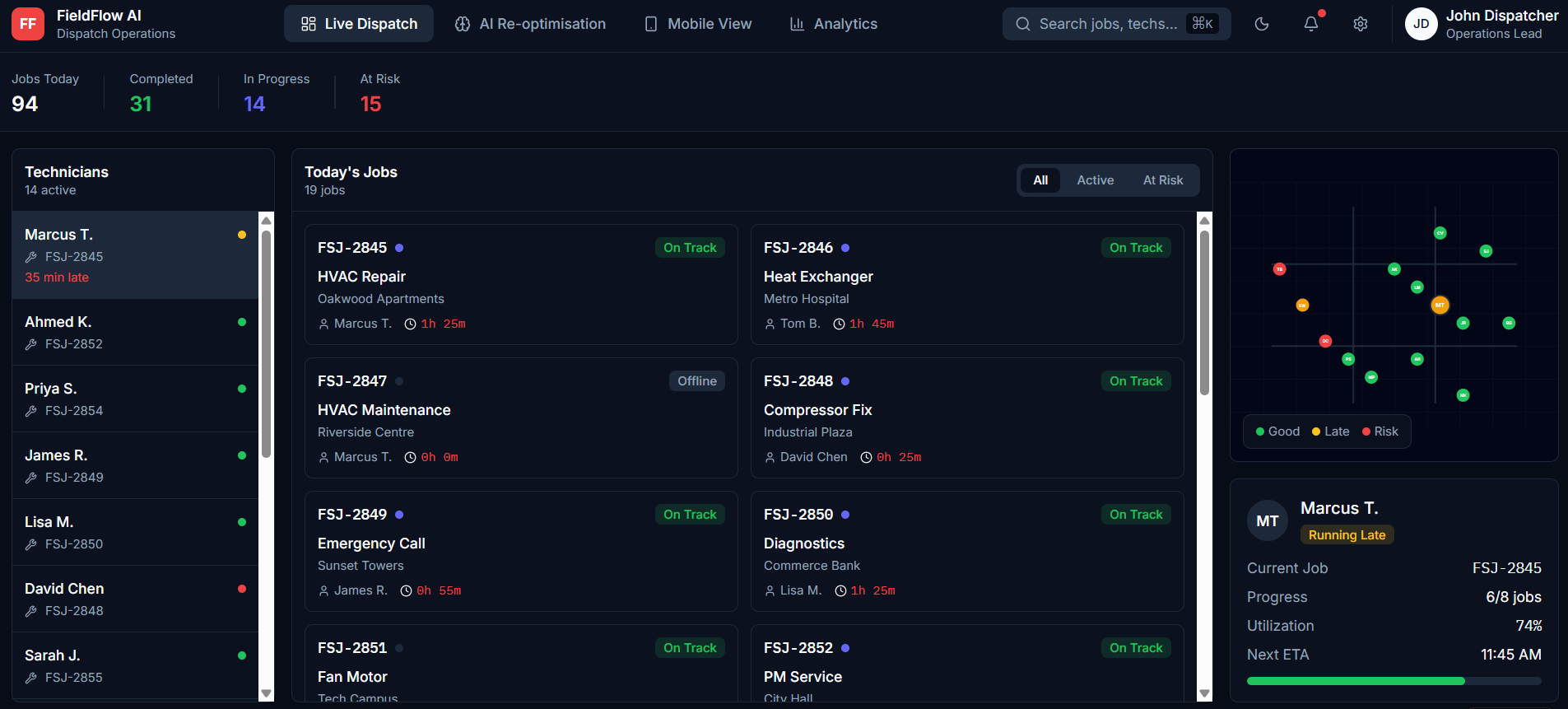
Dispatchers see a live scheduling dashboard with crew locations, job status, SLA countdown timers, and AI-generated assignment recommendations. Technicians receive jobs via a mobile app with full context, offline capability, and an AI query interface for on-site support. Service managers access real-time operational reports tracking first-time fix rate, utilisation, SLA compliance, and cost per job. Customers receive automated status updates and arrival-window notifications. Post-visit, the system auto-populates job completion records, reducing manual documentation time for technicians significantly.
See the Platform in Action
The walkthrough below shows the full interface – from live dispatch scheduling and technician assignment through to mobile job delivery and post-visit reporting.
What Technologies Power an Intelligent Field Management Solution?
Several distinct AI and engineering disciplines combine to make this solution work. Each addresses a different dimension of the field service coordination problem.
- Constraint optimisation and combinatorial schedulingMathematical techniques for solving large-scale assignment problems involving many variables, constraints, and objectives simultaneously: The core of any AI scheduling and dispatch architecture. These algorithms find the optimal assignment across technicians, jobs, skills, and geography in real time – something no human dispatcher or static rule set can replicate at scale.
- Machine learning for prediction: Trained on historical job, asset, and technician data, ML models forecast job duration, parts requirements, failure risk, and SLA exposure. Prediction quality improves continuously as more outcome data accumulates – making this a system that gets more valuable the longer it runs.
- Natural Language Processing (NLP)The AI discipline that enables computers to understand, interpret, and generate human language in context and generative AI for technician copilots: NLP powers the on-site knowledge assistant, allowing technicians to ask questions in plain language and receive precise, sourced answers from internal service documentation – eliminating the need to search through manuals or call the back office.
- RAG-based knowledge retrieval: Retrieval-Augmented Generation connects the AI knowledge assistant to internal service records, manuals, and fault histories. Unlike a general-purpose chatbot, it grounds every response in the organisation’s specific documentation, reducing the risk of incorrect guidance.
- Computer visionAI technology that enables machines to interpret and understand visual information from images or video feeds for remote diagnostics: Camera-based diagnosis via mobile or wearable devices allows senior engineers to assess a fault remotely, verify part identification, or guide a less experienced technician through a complex repair without travelling to the site. This is a high-value capability for field service automation platforms operating in geographically spread operations.
- IoT integration for predictive maintenance: Sensor feeds from connected equipment provide real-time performance data – temperature, vibration, pressure, cycle counts – that the ML models use to identify anomalies and forecast failure risk before breakdown occurs.
- Route optimisation and real-time traffic integration: Dynamic routing engines calculate optimal daily travel sequences per technician, incorporating live traffic data, job time windows, and geographic clustering to minimise drive time and maximise job completions per shift.
- ERP and CRM integration: Connecting to existing ERPEnterprise Resource Planning – business software that manages core processes including inventory, finance, procurement, and operations in one connected system and CRMCustomer Relationship Management – software that manages customer interactions, service history, and account data systems allows the solution to use live inventory levels, customer contract terms, and asset records without manual data re-entry.
What Results Does AI Field Management Software Actually Deliver?
A well-implemented smart field service platform delivers measurable improvements across every core field service metric – not through one large change, but by systematically addressing each of the inefficiencies that erode profitability at scale.
- Higher first-time fix rates: When every technician arrives with the correct skills, parts, and job context already prepared, the primary cause of repeat dispatches – incomplete information – is directly eliminated. Organisations deploying this type of solution see first-time fix rate improvements as one of the earliest and most consistent gains.
- Reduced cost per job: Fewer repeat dispatches, shorter travel distances from optimised routing, and less idle time between assignments each cut the direct cost of completing a job. With each unnecessary truck roll costing $200 to $300 in fully loaded cost, an operation eliminating 15 repeat dispatches daily recovers over $1 million annually – before counting the revenue capacity freed up by those technicians returning to productive work.
- SLA compliance improvement: Automated priority weighting ensures high-priority jobs receive the scheduling attention they require. Real-time SLA monitoring with breach-risk alerts allows dispatchers to intervene before a deadline is missed rather than after.
- Increased technician utilisation: Dynamic route optimisation and intelligent job sequencing reduce unproductive travel time and allow each technician to complete more jobs per shift – without extending work hours. Technicians also report less frustration from arriving unprepared, which positively affects retention.
- Faster on-site resolution through knowledge access: Junior technicians using the AI knowledge assistant resolve complex faults faster and with greater confidence. This compresses the effective skill gap between experienced and newer technicians – a critical advantage for organisations managing an aging workforce and technician shortage.
- Reduced emergency procurement costs: Predictive parts management generates accurate job-specific parts kits rather than relying on ad-hoc van stock. Emergency procurement of missed parts – typically the most expensive sourcing channel – decreases significantly as parts prediction accuracy improves.
- Improved customer experience: Accurate arrival-time predictions, fewer missed appointments, and consistent first-visit resolution each contribute to higher customer satisfaction. For contract-based service businesses, this directly affects renewal rates and net promoter scores.
- Scalable operations without proportional headcount growth: An AI work order platform for multi-site field operations allows service volume to grow without requiring a proportional increase in scheduling and dispatch staff. The coordination layer scales through software rather than headcount.
Is an AI Smart Field Management Solution Worth the Investment?
Yes – for service organisations above a critical scale threshold, the financial case for an AI Smart Field Management Solution is typically strong and measurable within the first year of deployment.
Teams that have worked through this integration consistently find that the ROI calculation shifts once they account for the hidden cost of SLA breach penalties and customer churn from repeat-visit failures – costs that rarely appear in the initial business case but represent a significant share of the true savings. The framework below identifies the five business metrics where this solution has the most direct financial impact, and how to measure them.
Key Metrics to Measure Before and After Implementation
- First-time fix rate: Measure the percentage of jobs closed without a return visit across a 90-day baseline period before implementation. Post-deployment, track the same metric monthly. Each percentage point improvement in FTFR directly reduces repeat dispatch costs. Aberdeen Group research puts the industry average FTFR at 75% – meaning one in four jobs requires a return visit. For a 200-call-per-day organisation, moving from 75% to 82% eliminates 14 repeat dispatches daily.
- Cost per truck roll: Calculate the fully loaded cost of a single dispatch – labour, fuel, vehicle wear, back-office processing time, and scheduling overhead. Aberdeen Group estimates each truck roll at $200 to $300 depending on industry and job type. Use your own actuals for a precise figure, then track how this changes as routing optimisation and repeat-dispatch reduction take effect.
- Technician utilisation rate: Measure the proportion of each technician’s working day spent on billable, productive work versus travel and idle time before implementation. Route optimisation and intelligent job sequencing typically improve utilisation meaningfully, allowing the same headcount to handle greater job volume.
- SLA compliance rate: If your contracts carry financial penalties for missed SLAs, calculate the annual penalty exposure under your current compliance rate. Post-deployment SLA improvements translate directly into reduced penalty liability – a hard financial saving that is easy to quantify.
- Parts emergency procurement cost: Track the volume and cost of emergency or same-day parts procurement over a baseline period. Predictive parts management reduces this category of spend as job-specific kitting improves over time.
Realistic Implementation and Payback Timeline
For a mid-size organisation with 50 to 200 technicians, a full AI Smart Field Management Solution typically requires 3 to 6 months from data integration to production deployment. Scheduling and routing optimisation benefits tend to appear earliest – often within the first 30 to 60 days once the system is live with real job data. An AI technician scheduling tool component delivers measurable utilisation gains within this early window, before the deeper predictive layers fully mature. Predictive maintenance and knowledge assist capabilities develop over a longer period as the models accumulate job history and the knowledge base is populated with validated service content.
Payback periods vary significantly by organisation size, job volume, and current FTFR baseline. Organisations with low first-time fix rates or high SLA penalty exposure typically see the strongest near-term financial returns. The business case for acting now rather than waiting rests primarily on compounding cost: every month of repeat dispatches, poor routing, and missed SLAs represents a quantifiable loss that an implemented solution would have recovered.
What Does Implementing an AI Smart Field Management Solution Actually Require?
Implementing an AI Smart Field Management Solution requires more than deploying software – it requires preparing data, aligning teams, and building the integration layer that connects the AI to your existing operational systems.
Practical Implementation Factors
- Data quality and completeness: The most frequently underestimated factor in live deployments of this type is the quality and completeness of existing asset and job history data. Scheduling models trained on incomplete or inconsistently formatted historical records produce unreliable predictions. A data audit before implementation – assessing job outcome recording, technician skill data accuracy, and asset service history depth – is not optional. It is the foundation everything else rests on.
- ERP, CRM, and inventory integration: Connecting the AI system to existing enterprise systems requires structured API integration work. For organisations running multiple legacy platforms – a separate CRM, ERP, and inventory system – this integration layer is often the most complex and time-consuming phase. Underestimating this is a common project risk. As a enterprise AI development partner, Softlabs designs integration architectures that reduce this risk from the outset.
- Technician adoption and mobile UX: Field technicians are the end users who determine whether the system works in practice. A mobile interface that is too complex, too click-heavy, or unreliable in low-signal areas will be abandoned. Offline capability for job instructions and form completion is not a nice-to-have – it is essential for field environments with patchy connectivity.
- Change management for dispatchers: Experienced dispatchers have built scheduling intuition over years. Introducing an AI scheduling engine that proposes assignments can trigger resistance if dispatchers feel their judgment is being replaced rather than supported. Implementations that succeed treat dispatcher trust-building as a project workstream, not an afterthought. Transparency in how the system reasons – showing trade-offs rather than just outputs – is central to this.
- Model maintenance and retraining: ML scheduling models require periodic retraining as job mix, service territories, or technician rosters change. This is ongoing maintenance, not a one-time setup. Organisations should plan for regular model review cycles and assign ownership of this process.
- Data privacy and compliance obligations: Customer data, technician location tracking, and asset records each carry data protection obligations. Deployment on private infrastructure or with strict data residency requirements may require a private LLM development approach for the knowledge assist components, particularly in regulated industries such as utilities and healthcare.
- Realistic timeline expectations per capability: Scheduling and routing gains arrive in weeks. Predictive maintenance takes months. The knowledge assist component needs a populated, curated knowledge base before it delivers reliable on-site guidance – it will not be useful on day one with an empty repository. The single most common disappointment in field service AI projects is judging the entire system by the state of the slowest-maturing component in month two.
Where This Solution Has Real Limits
- Predictive maintenance requires clean sensor data: If your assets are not instrumented with IoT sensors, or if sensor data is fragmented and unreliable, predictive failure forecasting will not deliver meaningful results. This component depends entirely on data quality and coverage.
- Knowledge assist is only as good as internal documentation: The RAG-based technician copilot cannot generate accurate repair guidance from thin or outdated service records. Organisations with poor knowledge management practices need to invest in documentation quality alongside system deployment.
- Optimisation works within your existing constraints: If technician skill coverage in a region is genuinely insufficient, the scheduling engine cannot create technicians that do not exist. The system optimises what you have – it does not solve workforce shortages.
- Human override remains essential: In genuinely novel situations – a fault type not seen before, an unusual customer requirement, a safety decision – the system will lack sufficient historical context to make confident recommendations. Human judgment must remain in the loop for edge cases.
Which Service Organisations Benefit Most from AI Field Management Software?
A smart field service platform delivers the clearest return for organisations where field team scale, job volume, and coordination complexity have outgrown what manual or basic digital tools can handle reliably. The ideal profile is not defined by industry alone – it is defined by operational characteristics.
This solution is particularly valuable for organisations running 50 or more field technicians across multiple zones or territories, for service businesses where first-time fix rate directly affects customer contract renewal, and for asset-intensive operations where unplanned downtime carries significant financial or regulatory consequences. An AI technician scheduling tool also delivers disproportionate value where the technician workforce is mixed in experience level and knowledge transfer from senior to junior staff is a recurring challenge.
Industry Contexts Where This Solution Delivers the Highest Value
- Utilities and energy: High-volume reactive dispatch, stringent regulatory SLAs, and safety-critical certification requirements make utilities one of the strongest fits for an AI smart field management for utility companies.
- Telecom operators: Installation and repair scheduling at scale, with high customer volume and tight appointment windows, benefits directly from dynamic optimisation and automated rescheduling.
- HVAC, building services, and facilities management: Organisations balancing reactive breakdowns against a large portfolio of preventive maintenance contracts gain from predictive scheduling and IoT-driven fault forecasting.
- Industrial and manufacturing equipment maintenance: Asset-intensive environments where unplanned downtime costs are high and technician expertise is specialised and unevenly distributed across the team.
- Medical device and healthcare equipment servicing: Regulatory compliance requirements for technician certification, strict SLA obligations, and the need for detailed job documentation each align well with what an intelligent field management solution provides.
Conversely, this solution is likely premature for organisations running fewer than 20 field technicians in a single geography, or those where scheduling is already simple enough that a dispatcher handles it without daily friction. Start with a strong FSM core and basic route optimisation first – the AI layer earns its complexity at scale.
Frequently Asked Questions About AI Smart Field Management
How does AI dispatch and scheduling software for service companies work differently from traditional dispatch?
Traditional dispatch assigns jobs based on dispatcher judgment, basic rules, or simple calendar tools – each decision is made in isolation and does not account for all active constraints simultaneously. An AI field dispatch tool solves a constraint optimisation problem across every open job and every available technician at once, factoring in skills, location, live traffic, parts availability, SLA deadlines, and shift limits in a single calculation. When a job changes mid-day, the system re-optimises the entire affected schedule in seconds rather than requiring a dispatcher to manually evaluate each downstream impact. The key practical difference is that the AI handles the combinatorial complexity of large-scale dispatch, while the dispatcher focuses on decisions that genuinely require human judgment.
What makes an intelligent field service platform better for large field teams than manual scheduling?
Manual scheduling scales poorly because the number of variables that must be considered grows exponentially with team size. A dispatcher managing 20 technicians can build a reasonable schedule intuitively. The same dispatcher managing 150 technicians across five zones, handling 40 same-day changes, cannot process all the relevant information fast enough to make consistently optimal decisions. An intelligent field service platform for large field teams handles this scale without degradation in decision quality. It also continuously learns from job outcomes, improving duration estimates and skill-to-job matching over time – something a manual scheduling process does not capture systematically.
Can an AI smart field management solution integrate with existing ERP and CRM systems?
Yes – integration with existing ERP, CRM, and inventory systems is standard in a well-designed AI smart field platform integrating with ERP systems. The integration connects live inventory levels, asset service history, customer contract terms, and technician records into the scheduling and prediction engine without requiring manual data entry. The complexity of this integration depends on the age and architecture of your existing systems. Modern ERP and CRM platforms typically expose well-documented APIs that reduce integration time. Legacy systems with limited API connectivity require a custom integration layer, which is a manageable but meaningful project component that should be scoped carefully before deployment.
Is an AI smart field management solution worth it for a mid-size service business?
For most mid-size service organisations, yes – the financial case is measurable and typically pays back within the first year of deployment. The strongest returns come from three sources: reducing repeat dispatches through higher first-time fix rates, cutting travel cost through route optimisation, and avoiding SLA breach penalties. For an organisation running 100 daily service calls with a 75% first-time fix rate, improving to 82% eliminates approximately seven repeat dispatches per day – each carrying its own labour, fuel, and back-office cost. The total financial impact of those seven dispatches, multiplied across 250 working days, tends to comfortably exceed implementation cost in year one.
How does AI field management work differently for utility companies and telecom operators compared to other industries?
Both utilities and telecom operators run very high daily job volumes with strict regulatory or contractual SLA obligations and geographically distributed crews – characteristics that make AI scheduling optimisation particularly high-value. For utility companies, the additional dimension is emergency response: when a fault requires certified crews to be dispatched rapidly across a large territory, the AI smart field management system’s ability to instantly identify the nearest certified technician and re-optimise surrounding jobs is a direct operational advantage. For telecom operators, the volume of installation and repair scheduling – often hundreds of jobs daily – combined with tight appointment windows means dynamic rescheduling of cancelled or delayed jobs has an outsized impact on daily completion rates and customer experience scores.
Build This Solution With Softlabs Group
Softlabs Group builds custom AI Smart Field Management Solutions tailored to your organisation’s operational data, existing systems, and field service workflows. We design and develop the scheduling optimisation engine, predictive intelligence layer, technician mobile experience, and AI knowledge assist component as a connected system – integrated with your ERP, CRM, and inventory infrastructure, not bolted on top of it. Our approach is grounded in what actually works in field environments: human-controlled dispatch with transparent AI recommendations, offline-capable mobile interfaces, and data pipelines built from your real job history rather than generic training data.
Whether you need a full smart field service platform built from the ground up, or an AI work order management software layer integrated into your existing FSM stack, we scope the solution to match your actual operational context. The right starting point is a scoping conversation about your current setup, the bottlenecks you most need to address, and how a solution would integrate with your existing systems.