 India
 Mongolia
 Sweden
 Australia

Executive Summary: Why do family offices need modern family office software?
Family office software becomes most valuable when a small, trusted team needs to manage more entities, more documents, more reporting obligations, and more family-specific workflows without losing discretion. Statements arrive from different custodians, capital call notices require review, beneficial ownership evidence must stay traceable, and relationship managers often depend on fragmented institutional knowledge. In that environment, a modern family office software platform needs to do more than store information. It should help the office read, reconcile, search, and surface operational exceptions while keeping sensitive information under control.
This solution concept combines family office management software, document intelligence, governed AI, and secure workflow controls into one operating layer for family-office teams. It is designed for offices that need a practical way to support reconciliation, reporting, governance, and family-specific knowledge work without turning sensitive operations into a public-AI experiment. Human teams still approve the important actions. AI supports the reading, matching, drafting, and flagging work around them.
1. The Challenge: Why do family offices struggle as operations become more complex?
Operational pressure in wealth structures often comes from volume, variation, and discretion all at once.
Context: Family wealth creates complex operational workflows
A single family office may oversee trusts, foundations, holding entities, portfolio reporting, legal documentation, governance records, and a constant stream of custodian or administrator documents. A multi-family office handles the same categories across multiple families while keeping each family’s information isolated. That is why family office software solutions need to serve both operational efficiency and confidentiality. The challenge is rarely just “finding a dashboard.” It is creating a reliable process around document-heavy work that currently lives across email, spreadsheets, portals, and specialist staff knowledge.
Key Pain Points This AI Solution Addresses
- Custodian statements arrive in different formats and take time to extract, compare, and reconcile.
- Capital call notices require commitment checks, funding reviews, and approval controls.
- Ownership structures across trusts, foundations, and holding companies can be difficult to evidence quickly.
- Important family decisions, approvals, and governance history often remain buried in documents and email threads.
- Relationship managers and operations teams lose time answering routine status questions and searching for supporting records.
- Compliance, reporting, and oversight work depends on traceability rather than just speed.
- Multi-family offices need strong separation so one family’s information never appears in another family’s workflow.
- Small teams need capacity without compromising discretion or control.
Why Traditional Approaches Fall Short
Manual operations still work in many family offices because the underlying teams are trusted and experienced. The problem is that manual work does not scale cleanly when document volume increases and obligations multiply. A spreadsheet may track tasks, but it rarely keeps extraction, evidence, approvals, and reporting aligned. Traditional systems may also be too narrow: one tool for documents, another for reporting, another for communication, and too much context living only in staff memory.
A stronger family office platform should reduce repeated reading, repeated searching, and repeated reconciliation work. It should also make the process more resilient when formats change, staff changes occur, or the office expands the number of entities and families it supports.
2. The AI Solution Concept: What does family office software do in this use case?
It creates a governed operating layer for document-heavy family-office workflows.
This concept combines secure data access, workflow logic, and AI assistance into a practical form of family office management software. It does not position AI as a decision-maker. Instead, the system reads documents, extracts structured information, reconciles data across sources, answers from approved records, and flags what requires human attention. Teams still control approvals, communications, and sensitive actions.
The same approach also supports family office reporting software use cases by helping the office convert unstructured documents into typed, searchable, traceable data. It can support statement reconciliation, ownership evidence, knowledge retrieval, and exception-based operational review without forcing the office into a rigid one-size-fits-all application model.

Vision & Objectives
- Reduce time spent reading and reconciling repetitive custodian or administrator documents.
- Turn family-office operational knowledge into a governed, searchable, auditable asset.
- Support reporting, governance, and compliance workflows with better evidence trails.
- Keep each family’s records, answers, and workflows properly segregated.
- Use AI to assist operations without removing human control from sensitive decisions.
- Support future deployment in customer cloud, dedicated environment, or on-premise setups where required.
3. How would this solution work in real family office scenarios?
The strongest use cases appear where document-heavy processes repeat and skilled teams spend time gathering context before they can apply judgement.
Custodian statement reconciliation across multiple sources
A family office receives statements from several custodians, each with its own format and delivery pattern. Analysts currently re-key or compare balances manually before checking them against the reporting system. A stronger family office reporting software workflow reads statements in different formats, extracts relevant data, compares positions across sources, and highlights only the breaks. The team reviews exceptions instead of reprocessing everything line by line.
Capital call review and approval routing
Capital call notices arrive by email and require teams to verify commitments, unfunded amounts, due dates, and payment instructions. A governed workflow can match incoming notices to known commitments, check details against approved records, and route the case to named approvers. Changed bank details or missing evidence can be flagged before any action is taken. This makes the office’s family office administration software workflow more controlled and easier to evidence later.
Beneficial ownership and structure evidence
Ownership and control often run through layered trusts, foundations, holding companies, and family arrangements. Teams may need to answer “who ultimately owns or controls this?” with confidence and supporting evidence. In this scenario, the solution traces roles and percentages across documents and returns cited, reviewable evidence. That makes it especially useful where family office governance and documentation discipline matter.
Relationship manager and operations knowledge support
A relationship manager wants to know what needs attention across the families they serve today: a capital call awaiting approval, an expiring document, a reconciliation break, or a pending reporting item. Instead of searching across emails and folders, the system can summarise what requires attention and provide traceable supporting context. For a multi family office software environment, those summaries remain limited to the right families and permissions.
Institutional memory over agreements, minutes, and family records
Teams often need to answer questions such as “What did we agree with this family?”, “Which document supports this structure?”, or “What was decided in the last council or governance meeting?” A governed search-and-answer layer lets the office query approved records and receive cited answers rather than depending only on individual memory. This is particularly useful for both single family office software and multi-family office environments where continuity matters.
Ready to explore what AI-powered family office software could look like for your organisation?
Talk to Our AI Team4. How does AI-powered family office software work inside?
The solution works by combining secure access controls, document processing, AI assistance, and human review inside one governed workflow.
A common pattern across this type of implementation is that the office first defines what records the system can use, which roles can access them, and where human approval is required. Once those rules are clear, AI can support reading, reconciliation, search, and operational briefings without becoming an uncontrolled black box.
Data Acquisition: What inputs does the system work with?
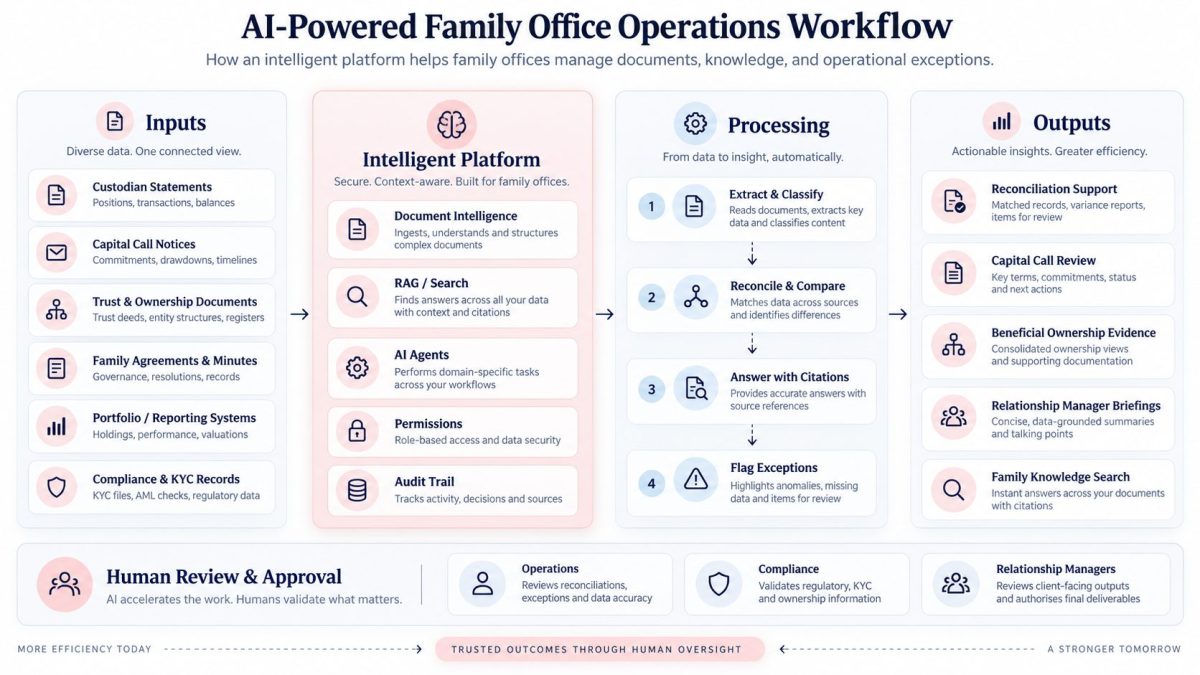
The platform can work with custodian statements, capital call notices, trust and ownership documents, family agreements, council or board minutes, compliance records, portfolio reporting systems, and operational correspondence. These records can enter through uploads, structured workflows, admin interfaces, shared repositories, and API connections Controlled software interfaces that allow systems to exchange data securely . A strong family office data software approach focuses on clean access, clear permissions, and useful structure rather than collecting data without governance.
The AI Processing Pipeline
- Document Intake: The office receives statements, notices, governance documents, ownership records, and operational files from internal or external sources.
- Access & Permission Check: The system first applies family-level access rules so only approved data enters the relevant workflow for the relevant users.
- Extraction & Classification: AI and document-processing components read files, identify the document type, extract key fields, and structure the information into usable data.
- Reconciliation & Cross-Checking: Extracted data is compared across custodians, commitments, or reporting systems to identify mismatches, gaps, and exceptions.
- Grounded Search & Response: A retrieval augmented generation A method that supplies relevant documents or records to an AI model before it answers layer helps the system answer from approved documents rather than general model memory.
- Exception Routing: Breaks, changed details, missing records, or sensitive cases move to the right user or approver for review.
- Human Review & Approval: Operations, compliance, and relationship teams validate important actions, communications, and outcomes before anything sensitive is confirmed.
Human-in-the-Loop: Where Human Judgement Still Matters
- Operations teams review reconciliation breaks and resolve process exceptions.
- Compliance or governance teams validate ownership evidence and other sensitive supporting records.
- Relationship managers decide how to act on family-specific context, communication, or escalation items.
- Named approvers review payment-related actions, sign-offs, or other controlled decisions.
- Administrators define roles, permissions, source systems, and workflow rules.
Output & Interaction: What does the office receive?
The office receives structured outputs such as reconciled positions, cited ownership evidence, family-specific summaries, capital call review packs, and “what needs attention” operational briefings. Search results, extracted fields, and workflow actions should remain explainable and traceable. For this reason, the platform should show not only the answer, but also the approved source or supporting document behind it.
5. What technologies power this family office software solution?
The stack should combine secure workflow, document handling, controlled AI, and strong permissions.
- Document intelligence AI-assisted extraction and structuring of information from documents such as statements, notices, agreements, and evidence files : Helps turn unstructured records into typed, reviewable data.
- Relational database A database that stores structured information in linked tables for reliable record-keeping and transactions : Supports families, entities, workflows, documents, extractions, and approvals.
- Vector search A search method that finds meaning-based matches across records instead of only exact keyword matches : Helps users search family records and supporting documents in natural language.
- Large language model An AI model that understands and generates human language from prompts and supporting context : Assists with summaries, search responses, drafting, and operational briefings under governed conditions.
- Role-based access control A permission model that grants access based on each user’s approved role and scope : Supports family-level separation and controlled access to records.
- Audit logs System records that capture who did what, when, and against which records : Important for traceability, reviews, and internal accountability.
- Workflow engine A system component that routes tasks, approvals, exceptions, and status changes through controlled steps : Keeps review and approval actions structured.
- Deployment controls Configuration choices that support customer cloud, dedicated environments, or on-premise/private setups : Useful where privacy, residency, or infrastructure rules matter.
In practice, this makes the solution a blend of family office technology, governed AI, and operational workflow rather than a single narrow application category.
6. What benefits can family offices expect from this solution?
The main benefit comes from giving skilled teams back time without reducing discretion or control.
- Cleaner reconciliation workflows: Analysts review breaks rather than manually re-keying every statement.
- Better document intelligence: The office can turn more records into usable, searchable, cited information.
- Stronger operational continuity: Agreements, ownership records, and historical decisions become easier to retrieve and evidence.
- More useful reporting support: A governed family office reporting software workflow can reduce manual preparation effort.
- Better RM visibility: Relationship managers receive more relevant, family-specific attention summaries.
- Clearer governance: Permissions, traceability, and review points become more explicit.
- Scalable operations: A new document format or repetitive workflow becomes a configuration challenge rather than another full-time manual burden.
- Practical AI adoption: The office can begin with one workflow and expand only after results and controls are proven.
That is why this type of solution is better understood as operational family office software solutions rather than simply another search tool or another dashboard.
7. Is family office software worth it for operational improvement?
The business case becomes strongest where repeated document-heavy work consumes skilled time across reconciliation, reporting, evidence gathering, and exception handling.
A family office should evaluate this solution based on measurable workflow outcomes, not just on AI features. For many teams, value appears first in reduced review time, cleaner evidence retrieval, fewer repeated searches, and better exception visibility.
- Time spent per statement cycle: Measure how long statement reading, extraction, and reconciliation currently take.
- Exception-review effort: Track how much time analysts spend on actual breaks versus preparation work.
- Ownership evidence turnaround: Measure how quickly teams can provide supporting ownership or structure evidence when needed.
- Knowledge retrieval effort: Track time spent answering recurring operational or governance questions.
- Family reporting support: Measure how much manual effort goes into collecting and checking the required supporting material.
- Operational resilience: Evaluate whether critical knowledge remains available beyond a small number of experienced staff.
A practical implementation path often starts with statements or capital calls for a small set of families, then expands after the team confirms accuracy, governance, and operational value.
8. What should family offices check before implementing this solution?
Family offices should validate access rules, workflow priorities, document quality, and approval boundaries before starting implementation.
This is where governance matters. Good outcomes depend on deciding which families, documents, and actions the system can touch, who may review the outputs, and which processes must stay under named human approval.
- Workflow priority: Start with the operational process that creates the most repeat friction, such as statement reconciliation, capital calls, or document retrieval.
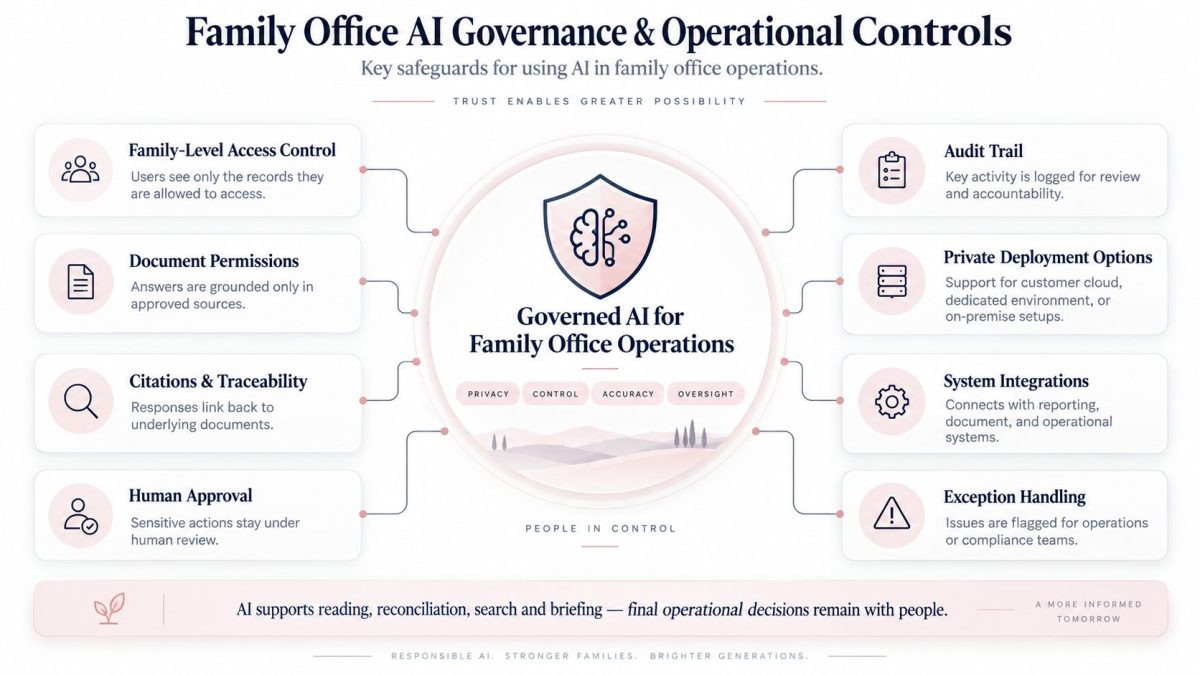
- Family-level access model: Define who should see which family records, entities, workflows, and summaries.
- Source quality: Review the completeness and reliability of statements, agreements, ownership documents, and reporting records.
- Approval boundaries: Decide which actions always require named human approval and which tasks can stay informational only.
- Integration scope: Clarify which systems the platform needs to read from, write to, or remain separate from.
- Deployment choice: Align the architecture with the office’s privacy, residency, and infrastructure requirements.
- Audit and traceability: Ensure the solution records enough evidence for internal review and process accountability.
- Adoption path: Keep the first release focused enough that the team can validate the workflow before expanding it.
Where This Solution Has Real Limits
- AI cannot provide evidence that does not exist in the approved underlying records.
- Reconciliation quality depends on the quality and completeness of source data.
- Family-level segregation must be designed carefully and validated in the permissions model.
- Governed search is useful, but sensitive decisions still require human judgement and approval.
- Not every workflow needs full automation; some are better supported through exception handling and evidence retrieval.
9. Who benefits most from this family office software solution?
The best fit comes from teams that handle recurring document-heavy operations, reporting, governance, and family-specific review work.
This solution suits both single family office software and multi family office software needs when the office wants stronger operational control without sacrificing discretion. It can also suit private wealth teams or specialist service environments where family structures, approvals, and reporting obligations create repeated manual work.
This solution has high value if:
- Your team spends significant time reading and reconciling statements from multiple custodians.
- You need faster access to ownership, trust, foundation, or governance evidence.
- Important operational context currently lives in scattered files, folders, or staff memory.
- You need a more controlled family office wealth management software support layer around operational rather than pure investment workflows.
- You want AI to assist operations, but only within a governed and reviewable framework.
10. Frequently Asked Questions
These questions reflect how buyers often search before they evaluate a custom solution.
What is family office software in this use case?
In this use case, family office software helps a family office manage document-heavy operational work such as statement reconciliation, capital call review, ownership evidence retrieval, reporting support, and family-specific knowledge search. It is designed to help teams work faster and more consistently without reducing discretion or human oversight.
How is family office management software different from portfolio management tools?
Portfolio management tools focus mainly on investment records, positions, and performance. This family office management software concept focuses on the operational layer around family-office work: documents, evidence, workflow, reporting support, and governed access to information. It complements rather than replaces core investment systems.
Can family office reporting software help reconcile custodian statements?
Yes. A strong family office reporting software workflow can support statement extraction, comparison, and exception detection across custodians and internal reporting records. The team can then focus on the mismatches that actually need judgement.
Can this work for a multi family office software environment?
Yes, if the permissions model is designed correctly. A multi-family office software environment needs strong separation between families, clear role-based access, and traceable workflow controls so one family’s records never appear in another family’s process or answers.
Can single family office software be deployed privately?
Yes. Depending on the office’s requirements, the solution can be designed for customer cloud, dedicated environment, or private infrastructure setups. The right model depends on operational requirements, internal controls, and infrastructure preferences.
How does AI avoid wrong answers in family office operations?
AI should answer from approved records rather than from unsupported general model memory. A governed setup uses document intelligence, controlled retrieval, citations, permissions, and human review so the system can explain where information came from and escalate uncertain cases rather than improvising them.
Build a Family Office Software Solution With Softlabs Group
Softlabs Group builds custom AI and software systems around each client’s operational model, governance requirements, data sources, and workflow controls. For this use case, our team can design a secure family office software solution for reconciliation support, capital call workflows, evidence retrieval, reporting support, and governed AI search as part of an enterprise AI development engagement.
If your current operating model depends on manual document reading, fragmented reporting support, staff memory, and repeated searches for supporting records, this page can serve as a starting blueprint. Softlabs can help define which parts need workflow logic, which parts need document intelligence, and which parts can benefit from controlled AI assistance through AI chatbot development and custom solution design.