 India
India  Mongolia
  Sweden
  Australia
Executive Summary: Why do cold chain manufacturers need a cleaner order-to-payment workflow?
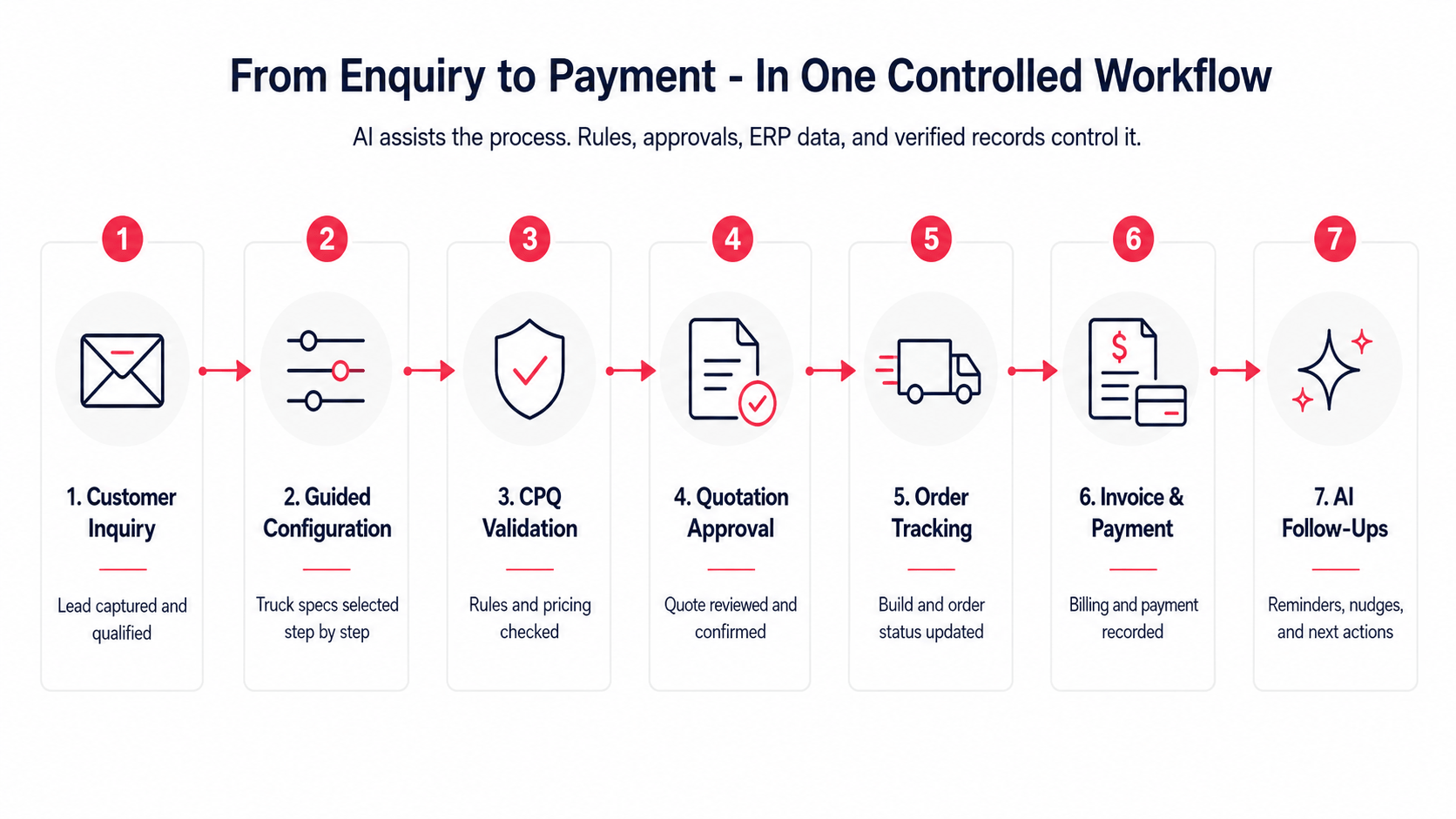
A sales enquiry for a refrigerated body often starts with a partial requirement, a chassis detail, a temperature range, and a long message thread. Reefer truck management software can turn that scattered enquiry into a guided workflow before the quote reaches the sales desk. The goal goes beyond a web portal. It gives refrigerated truck body manufacturers a controlled way to capture requirements, validate configurations, generate quotes, track approvals, show order status, share invoices, and follow up on payments.
This AI-powered customer portal for cold chain manufacturers works best when AI supports the process rather than controls it. In this form, reefer truck management software gives teams structure without turning sales into a rigid portal exercise. Approved rules, ERP records, pricing matrices, and human review handle the critical decisions. AI assists with customer questions, payment reminders, document search, and follow-up nudges. As a result, the manufacturer gets a more reliable B2B order management portal without forcing customers into a complex system.
1. The Challenge: Why do reefer truck manufacturers struggle to quote fast and track orders?
Manual quotation work breaks down when configurable products, approvals, and customer follow-ups run through scattered channels.
Context: Custom cold chain manufacturing creates quotation complexity
A reefer body sale rarely follows a fixed catalogue flow. The buyer may ask for a body size, insulation profile, cooling capacity, floor type, monitoring accessory, delivery term, and warranty detail in one exchange. A customer portal for refrigerated truck manufacturers must capture those details without making the customer feel trapped inside a long form. In practice, organisations deploying this type of system typically encounter the same early blocker: product knowledge sits with sales and engineering teams, not in a clean database.
Key Pain Points This AI Solution Addresses
- Customer enquiries arrive through calls, email, dealer messages, and chat threads.
- Sales teams prepare quotes by hand because product and pricing rules remain scattered.
- Configuration changes create repeated quote revisions and unclear approval trails.
- Customers call the sales team for production status, invoice copies, and payment updates.
- Finance teams chase outstanding payments after delivery documents and invoices get separated.
- Dealers need a dealer portal for manufacturing that fits their daily sales process.
- Management lacks a single view of enquiries, quotes, orders, invoices, and collections.
Why Traditional Approaches Fall Short
Manual quoting works for low volume or repeat orders. It fails when a cold chain customer portal must handle mixed products, custom specifications, and approval rules. In contrast, AI vs manual quotation work differs in one core way: AI can help retrieve context and trigger follow-ups, while the system enforces approved rules and workflow states.
Spreadsheets also create version risk. Reefer truck management software reduces that risk when the quote path follows approved stages. One sales executive may use an old price sheet, while another applies a discount that needs approval. A quotation management system for manufacturing gives the team a controlled quote path. The same quotation management system for manufacturing reduces that risk by storing quote versions, approval status, and final customer acceptance in one place.
2. The AI Solution Concept: What does reefer truck management software do for customer portals?
It converts the full enquiry-to-payment workflow into a controlled digital system for cold chain manufacturers.
This reefer truck management software combines a customer portal, a CPQ engineA rules-based system that helps configure a product, calculate price, and generate a quote, order tracking, invoice access, payment follow-ups, and AI-assisted support. It does not replace manufacturing judgment. Instead, it creates a consistent path from customer requirement capture to approved order handover.
The concept also supports a manufacturing customer self-service portal for buyers and dealers. Customers can view quotes, request revisions, approve orders, download documents, and check payment status. Sales and operations teams still control pricing, engineering review, and exceptions.
Vision & Objectives
- Reduce quote preparation effort for standard reefer body configurations.
- Move custom requirements into sales, pricing, or engineering review without losing context.
- Create one order trail from enquiry to invoice closure.
- Give customers a low-friction dashboard for quotes, orders, payments, and documents.
- Use an AI payment assistant to reduce repetitive finance follow-ups.
- Support future integration with production, dispatch, and accounting systems.
3. How would this solution work in real cold chain manufacturing scenarios?
The strongest use cases appear where product choices, customer approvals, and payment follow-ups create repeat friction. Reefer truck management software works best when it removes repeated handoffs, not when it adds more screens.
Reefer body sales team handling custom truck enquiries
Your sales team receives five partial enquiries before lunch, and each one needs a different reefer body configuration. Legacy quoting pushes the team into manual calls, Excel checks, and repeated engineer confirmation. The system captures chassis, dimensions, temperature range, cooling choice, and add-ons through guided forms. Next, CPQ software for truck body manufacturers validates compatibility and routes exceptions to review. The quote gets generated, revised, approved, and converted into an order in one workflow. The outcome: sales spends more time closing and less time rebuilding the same quote.
Dealer network selling cold chain bodies across regions
A dealer wants to quote fast, but the factory controls pricing, discounts, and final approvals. Email-based quoting gives the dealer no clear status, so customers keep asking for updates. A dealer portal for manufacturing gives the dealer controlled access to product options, quote templates, and approval status. The system can expose only approved price rules and required documents. If the customer requests a semi-custom option, the workflow sends it to sales review. The outcome: dealers respond faster without bypassing factory controls.
Finance team managing invoice visibility and payment follow-ups
Your finance team knows payment follow-up starts after the customer loses track of invoices and delivery paperwork. A basic email reminder does not solve ledger questions or missing document requests. The ERP integrated customer portal shows invoices, outstanding amounts, ledger entries, and secure payment links. The AI payment assistant can explain invoice status from approved records and resend links. However, payment receipt still comes from verified accounting data. The outcome: fewer routine calls and a cleaner payment trail.
Ready to explore what this solution looks like for your organisation?
Talk to Our AI Team4. How does AI-powered reefer truck management software work inside?
The system works by structuring business rules first, then adding AI around support, search, and follow-up.
A common pattern across real implementations of this solution is that the portal succeeds only after product logic becomes explicit. The technology can help manage complexity, but it needs clean rules for standard configurations, exceptions, approvals, and finance status.
Data Acquisition: What inputs does the system collect from customers and internal teams?
The platform consumes customer enquiries, product catalogues, price lists, engineering rules, quote templates, order stages, invoice data, ledger data, and product documents. It can also ingest dealer submissions, purchase orders, payment confirmations, dispatch updates, and service requests. For a B2B customer portal software setup, these inputs come from forms, uploads, admin dashboards, internal databases, and API connectionsControlled software interfaces that allow two systems to exchange data.
The AI Processing Pipeline
- Requirement Capture: First, the customer or dealer enters structured requirements for chassis, body size, temperature range, insulation, cooling system, flooring, accessories, and delivery context. The portal stores each field as usable data rather than free-text chatter.
- Configuration Validation: Next, the CPQ engine checks whether the selected product options can work together. It flags impossible combinations, missing details, and configurations that need engineering review.
- Pricing and Approval Routing: Once processed, the system applies pricing rules, add-ons, tax logic, freight assumptions, warranty terms, and discount controls. Standard quotes can move ahead, while semi-custom or complex requests go to review.
- Quotation Generation: The system then creates a quote document with specifications, commercial terms, validity, and approval status. Each revision remains linked to the original enquiry for clean traceability.
- Order Conversion: At this stage, an approved quote turns into an order after customer acceptance, purchase order upload, or advance payment. The order carries the final configuration into production and finance workflows.
- ERP and Payment Sync: Next, the portal synchronises customer records, order status, invoice details, payment links, and ledger status with connected business systems. This step depends on data quality and integration depth.
- AI-Assisted Communication: Finally, the AI layer answers customer questions from approved records and documents. It can explain invoice status, resend payment links, summarise quote progress, and route exceptions to the right team.
Human-in-the-Loop: Where Human Judgment Still Matters
- Sales teams approve discounts, commercial terms, and non-standard customer requests.
- Engineering teams review complex reefer body configurations before final quote release.
- Finance teams confirm payment reconciliation before the portal marks accounts as closed.
- Admins maintain price rules, product compatibility matrices, and access controls.
- AI responses should follow governance practices aligned with the NIST AI Risk Management Framework.
Output & Interaction: What does the customer or dealer see?
A B2B customer portal software interface should hide backend complexity from buyers. The customer sees a low-friction dashboard with quotes, order stages, invoices, payment links, product documents, and support actions. The order tracking portal for manufacturing can show stages such as approval received, engineering review, material planning, fabrication, insulation work, quality check, dispatch ready, and delivered. A second order tracking portal for manufacturing view can serve sales and operations teams. Notifications can reach the customer through email, SMS, or chat links, so the portal supports existing behaviour instead of demanding a new habit.
Optional Integration Layer: Can the portal include live reefer tracking and temperature monitoring?
Yes, but live monitoring should stay an optional layer unless the manufacturer also operates fleets or manages post-dispatch service. The core manufacturer workflow remains product configuration, quotation, order visibility, invoice access, and payment follow-up.
When a client needs post-dispatch visibility, the portal can ingest telematics dataVehicle, sensor, and equipment data collected from connected devices during operation such as GPS location, temperature logs, door events, alarm records, and delivery proof. Those records can support warranty discussions, customer status pages, service history, and handover documents. However, this layer should not turn the page into generic fleet tracking. It should extend the customer portal only where the business model requires operational proof after dispatch.
5. What technologies power this cold chain customer portal?
The stack needs rule-based workflow, secure integration, document handling, and controlled AI assistance.
- Rule engineA software layer that applies approved business rules to decisions such as pricing, approvals, and product compatibility: This controls configuration checks, pricing logic, approval routing, and exception handling.
- Relational databaseA database that stores structured information in linked tables for reliable transactions: Quotes, orders, invoices, payments, customers, dealers, and approvals need strong data relationships.
- ERP integrationA connection between the portal and existing business systems for orders, invoices, inventory, or accounting data: The ERP integrated customer portal must read and write verified business data where the client allows it.
- Telemetry ingestionA data pipeline that collects equipment, location, temperature, alarm, or door-event data from connected systems: This optional layer supports live reefer visibility when manufacturers also need post-dispatch proof or service records.
- Large language modelAn AI model that can understand and generate human language from prompts and context: The AI layer can answer support questions and explain documents, but it must stay bound to approved records.
- Retrieval augmented generationA method that gives an AI model relevant source documents before it generates an answer: This helps the assistant answer from quotes, invoices, manuals, and product documentation.
- Vector searchA search method that finds related meaning across documents instead of matching exact keywords only: It helps users search technical drawings, brochures, FAQs, and quote terms in plain language.
- Role-based access controlA permission model that gives users access based on their role in the organisation: Customers, dealers, sales, production, finance, and admins need different permissions.
- Audit logsSystem records that show who changed what and when: Quote revisions, approval changes, payment status updates, and document access need a traceable history.
Security controls should follow a risk-based approach. For example, the NIST Cybersecurity Framework gives organisations a structured way to govern, identify, protect, detect, respond, and recover from cybersecurity risk.
6. What benefits can reefer truck manufacturers expect from this solution?
The main benefit comes from faster, cleaner movement from enquiry to approved order.
- Faster quotation flow: The system turns repeat configurations into guided quote workflows.
- Fewer quote errors: CPQ software for truck body manufacturers reduces manual mismatch between product options and pricing rules.
- Better customer visibility: A customer portal for cold chain manufacturers gives buyers access to quote, order, invoice, and document status.
- Lower sales dependency: A manufacturing customer self-service portal lets customers retrieve routine information without calling sales.
- Cleaner dealer operations: A dealer portal for manufacturing gives regional sellers a controlled way to submit and track quotes.
- Improved finance follow-up: Invoice and payment automation gives finance teams a clearer view of pending amounts.
- Better order traceability: Production and dispatch updates support customer trust when teams keep stages current.
- More useful management data: Leaders can review quote conversion, order cycle time, payment delay, and customer demand patterns.
A cold chain manufacturing software approach also supports traceability thinking. Standards such as GS1 EPCIS show how event data can create supply chain visibility across physical movements and status changes.
7. Is reefer truck management software worth it for cold chain manufacturers?
The business case becomes strong when quote delays, rework, and payment follow-ups consume skilled team time.
Teams that have worked through this integration consistently find that ROI depends on process discipline more than AI features. A buyer should measure the workflow before and after deployment across specific metrics.
- Quotation turnaround time: Measure average time from enquiry received to first quote sent.
- Quote revision count: Measure how many quote versions occur before approval.
- Sales effort per order: Track calls, messages, and manual tasks needed per approved order.
- Order visibility requests: Count customer status calls and document requests before and after portal access.
- Payment follow-up effort: Measure overdue amount, reminder count, and finance team time per invoice.
A mid-size manufacturer can start with product configuration, quote workflow, and customer dashboard before deep integration. After that, the team can add invoice sync, payment links, AI assistance, and production-stage visibility. The case for action grows when the same manual effort repeats across dealers, sales users, finance teams, and order coordinators.
8. What should manufacturers check before implementing this system?
Manufacturers should validate product rules, data quality, integrations, user roles, and AI guardrails before development starts.
What implementation experience reveals that theoretical explanations often miss is the human work behind clean automation. Teams need to convert informal product knowledge into rules, permissions, statuses, and exception paths.
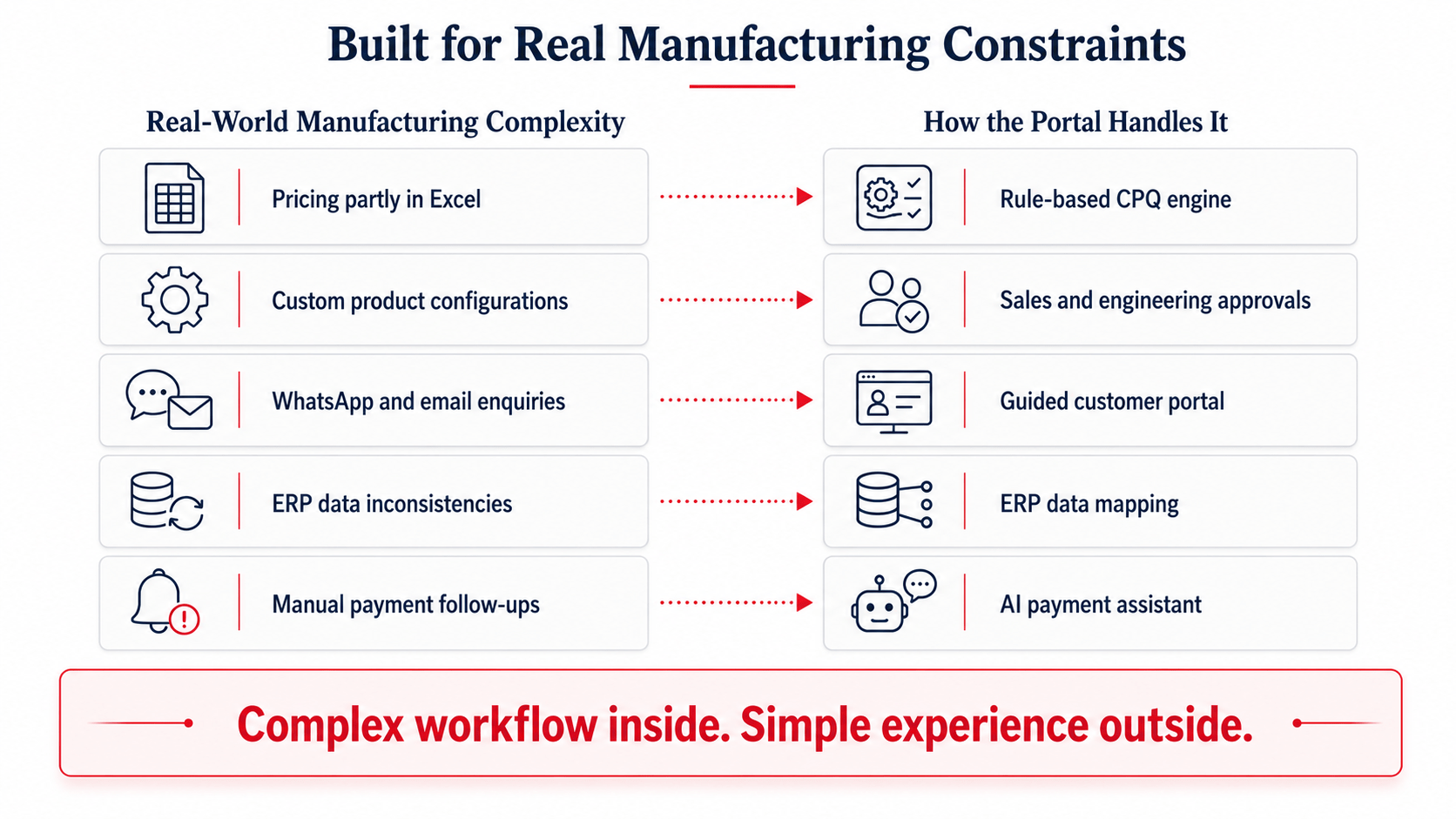
- Product model readiness: Define body types, insulation options, cooling choices, accessories, and compatibility logic.
- Pricing rule clarity: Document price sheets, discounts, dealer margins, freight logic, taxes, and approval thresholds.
- Data quality: Clean customer records, product masters, invoice references, and order stages before integration.
- Integration scope: Decide which data the portal reads, which data it writes, and which updates need human review.
- Telemetry scope: Add live temperature, GPS, or door-event data only when the client needs post-dispatch visibility.
- Security model: Define customer, dealer, sales, production, finance, and admin permissions before launch.
- AI limits: Design the assistant to answer from approved records and escalate uncertain cases.
- Adoption path: Keep the first release small enough for customers and internal teams to use without training fatigue.
Where This Solution Has Real Limits
- AI cannot guess final pricing when the required product rule does not exist.
- Production tracking fails if internal teams do not update stages or system records.
- Live temperature visibility depends on reliable sensor feeds, device uptime, and clean event mapping.
- ERP data sync adds risk when item masters, ledgers, and order records contain inconsistent values.
- Large language model assistants need controls for prompt injection and data exposure. The OWASP Top 10 for Large Language Model Applications highlights these AI security risks.
9. Who benefits most from this reefer truck management software?
The best fit comes from manufacturers with configurable products, repeat quotations, dealer involvement, and payment follow-up friction.
This solution suits refrigerated truck body manufacturers, insulated container manufacturers, cold chain equipment makers, dry freight body manufacturers, and specialty transport body builders. It also suits companies that need refrigerated truck body manufacturing software or insulated body manufacturing software but cannot use a fixed off-the-shelf process. The same pattern fits refrigerated truck body manufacturing software and insulated body manufacturing software when each product has custom rules.
This solution has high value if:
- Your team prepares many custom or semi-custom quotes each month.
- Your customers ask sales teams for order, invoice, or payment status.
- Your dealer network needs controlled quote access and approval visibility.
- Your operations team wants a B2B order management portal connected to verified records.
10. Frequently Asked Questions
These questions reflect how buyers search before they evaluate a custom build.
What is reefer truck management software for cold chain manufacturers?
Reefer truck management software for this use case manages the sales, quotation, customer portal, order tracking, invoice, and payment workflow for manufacturers. It helps teams capture requirements, validate configurations, generate quotes, and show order status. It differs from fleet tracking because it focuses on manufacturing and customer experience.
Can a customer portal for refrigerated truck manufacturers generate instant quotations?
A customer portal for refrigerated truck manufacturers can generate instant quotations for standard configurations. Semi-custom orders should route to sales or pricing review. Complex reefer body requirements should move to engineering approval before the final quote reaches the customer.
Does this include live reefer tracking and temperature monitoring?
It can include live reefer tracking and temperature monitoring when the manufacturer needs post-dispatch visibility. However, those features should work as an optional integration layer. The core system should still focus on customer portal, CPQ, quotation workflow, order status, invoice access, and payment follow-up.
How does an AI-powered customer portal for cold chain manufacturers avoid wrong answers?
An AI-powered customer portal for cold chain manufacturers should answer from approved system records. It should use quote data, invoices, order stages, product documents, and FAQs as its source. It should escalate unclear pricing, discount, payment, or delivery questions to a human reviewer.
Do we need an ERP integrated customer portal from day one?
An ERP integrated customer portal gives stronger visibility, but the first release does not need every integration. Many manufacturers start with customer login, product configuration, quote workflow, and document access. Invoice, payment, ledger, and production sync can follow after data mapping.
Can this work as cold chain manufacturing software for dealers and direct customers?
Yes, cold chain manufacturing software can support both dealers and direct customers when roles stay clear. Dealers can create or track quotes within approved limits. Direct customers can view quotes, orders, invoices, and payment links through a controlled dashboard.
Build This Solution With Softlabs Group
Softlabs Group builds custom AI and software systems around each client’s product logic, approval process, customer journey, and integration needs. For this solution, our team can design the customer portal, CPQ workflow, quote engine, order tracking layer, payment follow-up assistant, and secure integration architecture as part of an enterprise AI development engagement.
If your current process depends on sales memory, spreadsheet pricing, manual quote revisions, and repeated payment calls, this page can become a starting blueprint. Softlabs can help assess which parts need rule-based workflow, which parts need AI assistance, and which parts should stay under human review through AI chatbot development for controlled customer communication.