 India
India  Mongolia
  Sweden
  Australia
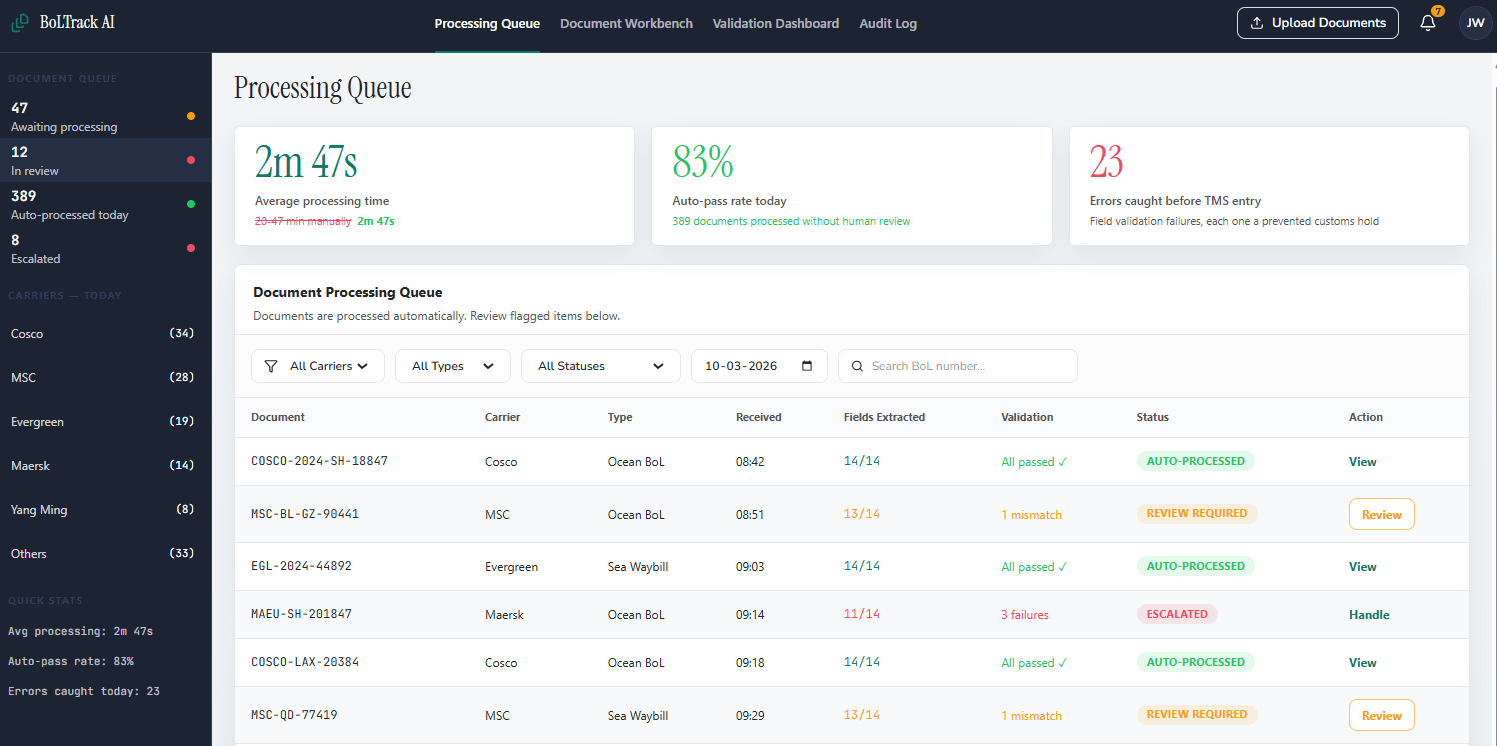
Executive Summary: Why Manual BoL Processing Is Quietly Draining Your Freight Operation
Your freight team spends a meaningful portion of every working day re-entering data that already exists – locked inside carrier PDFs, scanned faxes, and email attachments your systems cannot read directly. A bill of lading automation solution changes that workflow entirely. Every international shipment generates a bill of lading: a legal document that simultaneously serves as a cargo receipt, a contract of carriage, and proof of ownership. One field error on it can freeze cargo at customs. One missed detail triggers a demurrage charge that compounds daily – and a single documentation hold at a busy port can cost more than a week of back-office processing time.
Ocean carriers issue approximately 45 million bills of lading annually, and most still arrive as unstructured documents requiring manual reading and re-keying. An AI-powered freight document processing solution now handles that entire pipeline automatically – extracting key fields, validating them against authoritative external databases, and routing clean structured data to your TMS, ERP, and customs filing systems without human re-entry for the majority of documents. This page explains exactly how the technology works, what results it realistically delivers, and what implementation genuinely requires.
1. Why Does Manual Bill of Lading Processing Keep Breaking Freight Operations?
Manual BoL processing fails at scale because volume, format variation, and compliance stakes compound faster than headcount can absorb. A mid-size freight forwarder processing 500 shipments per week faces not just 500 documents – but 500 different carrier layouts, each requiring a human to read, interpret, and re-key into a downstream system. Every field carries a penalty for being wrong.
Context: The Operational Environment Where BoL Problems Compound
Global shipping depends on a single foundational document that has not fundamentally changed in over a century. Freight forwarders, customs brokers, importers, exporters, and third-party logistics providers all touch the bill of lading at different points in the supply chain. Each party extracts different fields for different downstream purposes: customs declarations, cargo tracking, invoice matching, inventory receipt, and payment release. The same document feeds five to eight separate system entries across a single shipment lifecycle.
In practice, organisations deploying this type of system typically encounter a more complex environment than vendor documentation suggests. Documents arrive from dozens of carriers in printed, partially handwritten, or low-resolution scanned formats – some containing mid-transit corrections made with a pen at the dock. That operational reality, not the clean digital PDF scenario, is where manual BoL entry causing delays and errors genuinely breaks down. An AI-powered shipping document automation tool must handle the full range of real-world document quality, not just ideal inputs, to deliver meaningful value.
Key Pain Points This AI Solution Addresses
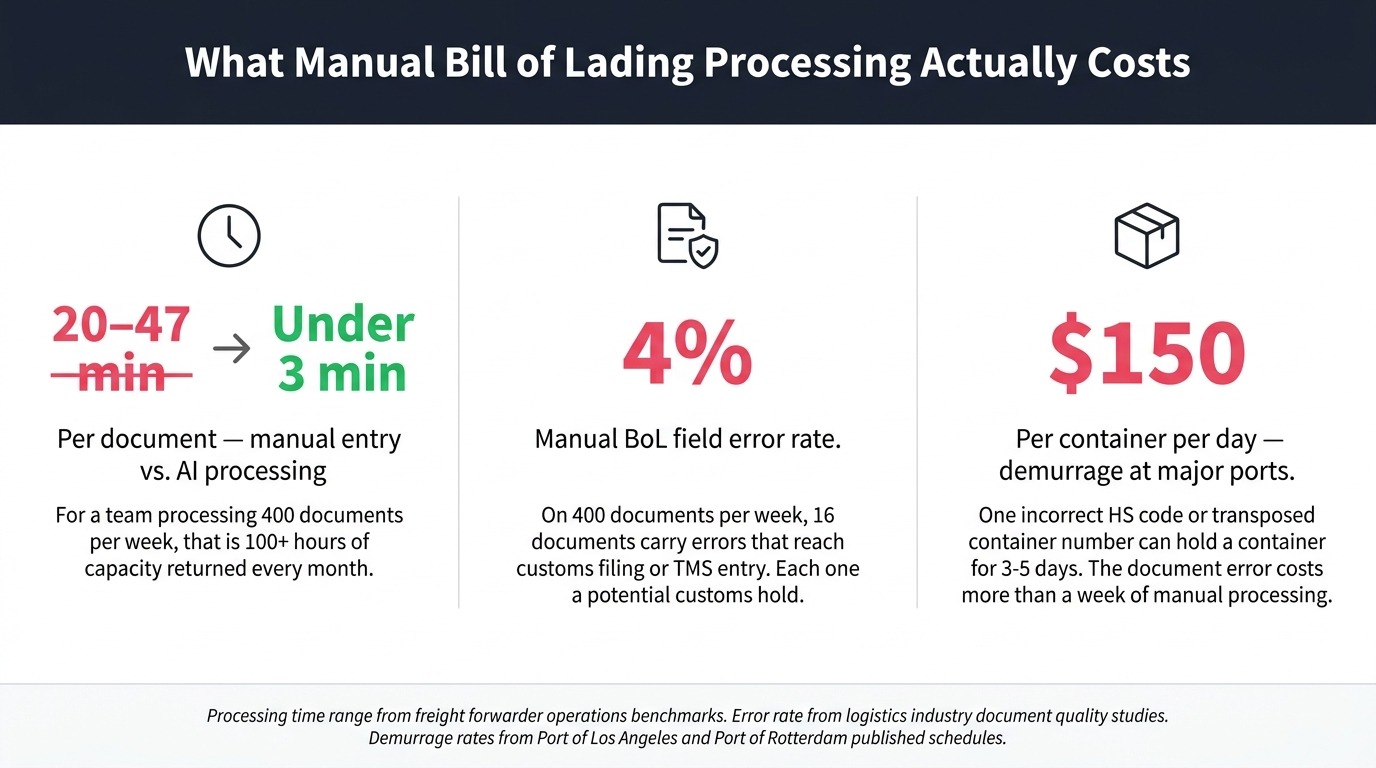
- Manual BoL entry causing delays and errors: Processing each document manually takes 20 to 47 minutes and introduces a roughly 4% field error rate – enough to generate customs holds, carrier disputes, and cargo release delays on a meaningful share of shipments every week.
- Paper shipping documents slowing customs clearance: Documents that arrive late, incomplete, or illegible delay customs entry filing. Each day of delay adds demurrage charges of $75 to $300 per container per day, escalating the longer the container sits at the terminal past its free time allowance.
- BoL mistakes causing cargo holds and extra charges: A single transposed container number, a misread HS code, or an incorrect consignee address can hold a container for days. The cost of one such hold often exceeds the total document processing cost for the entire week.
- Too much staff time spent on document processing: Freight coordinators who should be managing exceptions and serving clients instead spend the majority of their capacity on data entry – a task that creates no operational value beyond moving information from one format to another.
- Shipping document errors causing payment disputes: Letter of credit transactions require exact field matches between BoL data and credit terms. A single discrepancy triggers a documentary credit rejection, delaying payment by weeks and straining trade relationships.
- No automated verification of BoL against orders: Without system-level cross-checking, teams manually compare extracted BoL data to purchase orders and booking confirmations – a time-consuming step that still misses errors at the rate human attention allows under volume pressure.
- Re-entering shipping data from paper into systems: Most logistics back-offices run on TMS and ERP platforms designed for structured data entry, not for ingesting unstructured carrier documents. Every document requires a manual bridge between the carrier’s format and the company’s system – and that bridge breaks under volume.
Why Traditional Approaches Fall Short
Template-based OCR tools – the standard answer to document processing before AI – require building a separate extraction template for every carrier format. A freight forwarder working with 50 carriers needs 50 templates, each requiring setup time, ongoing maintenance, and updates whenever a carrier changes their document layout. Format changes break templates silently, meaning errors propagate for days before anyone identifies the failure.
Manual data entry, in contrast to AI-powered bill of lading automation software, scales linearly: double the shipment volume means double the headcount. Neither template-based OCR nor manual entry provides automated validation against external data sources. Errors that a container ID check-digit algorithm or UNLOCODE port registry would catch immediately instead pass through undetected – reaching customs filing or invoice matching where they are most costly to correct.
Hiring more staff addresses volume temporarily while compounding error and training costs permanently. The core problem is that the task is repetitive enough to be automatable but complex enough that rule-based tools consistently fail on the 30% of documents carrying handwriting, stamps, or format variations – precisely the high-value or time-critical shipments where documentation errors are most expensive.
2. What Is a Bill of Lading Automation Solution and How Does It Change the Workflow?
A bill of lading automation solution replaces the manual read-extract-rekey cycle with an AI pipeline that ingests BoL documents from any source, extracts structured data from any format, validates key fields against authoritative external databases, and delivers clean records to downstream systems – without human re-entry for the majority of documents.
The core capability shift is from format-dependent extraction to context-aware understanding. Modern enterprise AI development for document processing uses transformer-based models that understand document layout, field relationships, and semantic meaning – not fixed positions on a page. A single BoL processing platform therefore handles ocean bills of lading, inland BoLs, air waybills, and sea waybills across hundreds of carrier formats without per-carrier template setup, eliminating the maintenance overhead that makes template-based systems unsustainable at scale.
Vision and Objectives
- Eliminate manual re-keying for 80 to 90% of incoming BoL documents, routing clean structured data directly to TMS, ERP, and customs platforms automatically.
- Achieve field-level accuracy that meets or exceeds the 95% threshold required for customs filing – validated against external authoritative databases rather than client master data.
- Reduce per-document processing time from the industry average of 20 to 47 minutes to under 3 minutes for the majority of clean documents through the automated BoL extraction platform.
- Maintain a complete, immutable audit trail of every extraction decision – timestamped and traceable – for customs dispute resolution and compliance review.
- Scale processing capacity without linear headcount increases, handling peak season volume spikes without additional manual processing staff.
- Improve accuracy continuously through a self-learning feedback loop that incorporates human corrections on flagged documents back into the extraction model over time.
3. How Does BoL Automation Play Out Across Real Freight Operations?
Ocean Freight Forwarder: Eliminating Format Chaos at Volume
Your operations team processes 200 or more carrier BoLs every week – and each one arrives in a different format from a different carrier portal. Some come as clean digital PDFs. Others arrive as low-resolution scans with handwritten corrections in the margins. Your team currently maintains a patchwork of OCR templates that break whenever a carrier updates their document layout. The AI-powered automated shipping document processing platform for logistics ingests documents from all sources simultaneously, extracts key fields without per-carrier templates, and cross-checks data against port registries and container ID validation rules before routing structured records to your freight management system. Processing time per document drops from 35 minutes to under 3 minutes, and your operations team shifts from data entry to exception management.
Licensed Customs Broker: Accuracy at the Stakes That Matter
A single field error on a BoL means a customs hold – and you are the one who receives the call at 11pm when a client’s cargo is stuck at the port awaiting a corrected filing. Manual extraction from carrier PDFs introduces errors at rates your clients will not accept, and the compliance consequences of an incorrect HS code or wrong consignee detail go far beyond the document itself. The automated BoL extraction platform validates every extracted field against the Harmonised System code database and UNLOCODE port registry before generating pre-filled customs declaration data. Fields that pass validation route automatically. Fields that fail trigger a targeted review notification with the specific discrepancy highlighted, so reviewers address the actual problem rather than re-reading the entire document. Customs holds attributable to documentation errors fall measurably, and the audit trail provides a defensible record for any subsequent inquiry.
Third-Party Logistics Provider: Scaling Without Adding Headcount
You manage BoL processing for 40 different clients, each with different TMS platforms, carrier relationships, and data format requirements – and your back-office team is the throughput bottleneck for all of them. Adding volume means adding staff, and adding staff means adding training time, quality variance, and fixed overhead that erodes document service margins. The bill of lading automation solution handles multi-client, multi-carrier processing from a single platform, with each client receiving a dedicated output routing configuration pushing data to their specific TMS, ERP, or customs portal automatically. Processing capacity scales with document volume rather than headcount. SLA compliance on document turnaround improves, and your team focuses on the 10 to 15% of shipments that genuinely require human judgment rather than the 85% that do not.
Ready to explore what this solution looks like for your organisation?
Talk to Our AI Team4. How Does a Bill of Lading Automation Solution Actually Process Documents?
A production-grade bill of lading automation solution processes documents through a multi-stage pipeline – from raw ingestion to validated structured output – in under 3 minutes for most clean documents and under 10 minutes for complex cases requiring secondary model processing. The pipeline below reflects how a well-architected AI document processing platform for freight operations handles the full range of real-world document quality, not just ideal inputs.
Data Acquisition: What the System Ingests
The system accepts BoL documents through multiple input channels simultaneously. Email listeners connect to existing freight team inboxes and automatically capture BoL attachments from carrier notifications. API endpointsApplication Programming Interface connections that allow different software systems to exchange structured data automatically over the internet receive documents pushed from TMS platforms or carrier portals in real time. Upload interfaces handle manual submissions for one-off documents or bulk batches. The system accepts digital PDFs, scanned paper documents, faxed copies converted to image files, and mobile camera captures taken at the dock. Processing covers documents in over 60 languages and handles printed text, handwritten annotations, rubber stamps, and barcodes within the same document.
The AI Processing Pipeline
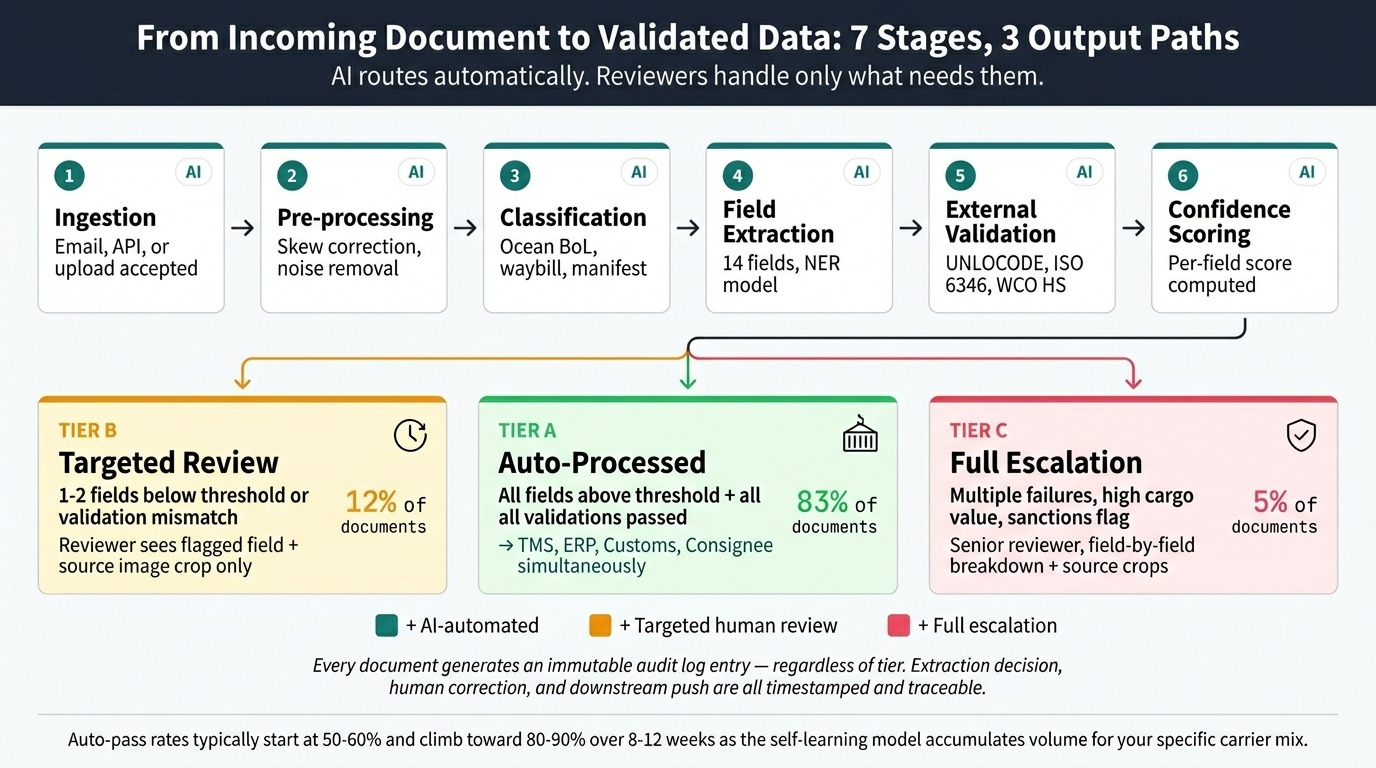
- Document Ingestion and Pre-Processing: First, the system receives the raw document and prepares it for extraction. Image pre-processing removes visual noise, corrects document skew, and normalises resolution on low-quality scans. Digital PDFs bypass the image correction step and proceed directly to text layer extraction. The system assigns a document intake identifier and timestamps the entry for the audit log, establishing the traceable record from the first moment of processing.
- Document Classification: Next, a classification model determines the document type before field extraction begins. The model distinguishes between ocean BoLs, inland BoLs, air waybills, sea waybills, and related shipping documents such as cargo manifests or packing lists. This step prevents the extraction model from attempting to pull BoL-specific fields from non-BoL documents and routes each document to the correct extraction schema automatically.
- OCR and Text Extraction: The system applies Optical Character Recognition (OCR)Technology that converts images of text – whether printed, handwritten, or stamped – into machine-readable digital text that software can process to convert the document image into machine-readable text. A fast transformer-based OCR model handles standard printed documents in under 2 seconds. When model confidence on any text region falls below threshold – typically on handwritten edits, smudged areas, or overlapping stamps – the system flags those regions and routes the document to a secondary, more capable model for reprocessing rather than accepting the low-confidence extraction.
- AI Field Extraction and Parsing: Once the text layer exists, a Named Entity Recognition (NER)An AI technique that identifies and classifies specific types of information – such as company names, locations, dates, and numeric codes – within unstructured text model identifies and extracts the key BoL fields: BoL number, shipper name and address, consignee name and address, vessel and voyage number, port of loading, port of discharge, container and seal numbers, commodity description, gross weight, and HS code where present. Every extracted field receives a confidence score. Fields below the system confidence threshold flag for targeted human review rather than failing silently – meaning reviewers address specific fields, not entire documents.
- External Validation and Cross-Checking: The system then validates extracted fields against authoritative external databases – not the client’s internal master data. Port codes are checked against the UN/LOCODE registry. Container IDs are checked against the ISO 6346 check-digit algorithm. HS codes are verified against the WCO Harmonised SystemThe World Customs Organisation’s international nomenclature for classifying traded goods, used by 200+ countries for customs duties and trade statistics database. Vessel names are cross-referenced against the IMO vessel registry. This validation layer catches errors that would otherwise reach customs filing or TMS entry undetected, and each validation failure generates a specific alert identifying the mismatch and its likely cause.
- Confidence-Tiered Routing and Output: Finally, the system routes each document to one of three output tiers based on combined confidence scores and validation results. Documents with all fields above threshold and all external validations passing auto-route to downstream systems without human review. Documents with one or more fields below threshold or a validation mismatch route to a single-screen review interface where a reviewer approves, corrects, or rejects specific fields in seconds. Documents with multiple failures, high cargo value, or regulatory sensitivity escalate for full review with field-by-field breakdown and source image crops. Every document, regardless of tier, generates a timestamped audit log entry.
Human-in-the-Loop: Where Human Judgment Still Matters
A common pattern across real implementations of this solution is that automation efficiently handles expected volume while human review adds the judgment layer that protects against the unexpected cases AI systems get confidently wrong. Human oversight remains essential in the following situations specifically:
- Low-confidence field review: Any extracted field below the confidence threshold routes to a targeted review queue displaying the source image crop alongside the extracted value – giving reviewers the exact evidence needed to confirm or correct in seconds rather than re-reading the full document.
- Validation mismatch resolution: When extracted data contradicts an external database entry – for example, a port code matching no UNLOCODE record – a human reviewer determines whether the document contains an error, an unusual abbreviation, or a legitimate new value requiring knowledge base update.
- High-stakes escalation: Shipments above a configurable cargo value threshold, shipments involving restricted or dual-use commodities, and documents matching sanctioned-party screening criteria route to senior reviewers regardless of confidence scores.
- New carrier format onboarding: When the system encounters a carrier document format not previously processed, it flags the document for human review and uses reviewer corrections to build understanding of the new format for future processing – turning every edge case into a training event.
- Exception firewall catches: Documents where the system detects logical inconsistencies – a departure date earlier than the arrival date, or a weight-to-volume ratio outside normal parameters for the stated commodity – escalate for human verification before any downstream output is generated.
Output and Interaction: What the User Actually Receives
For auto-processed documents, the output is a structured data payload pushed simultaneously to all configured downstream systems: TMS for freight management and container tracking, ERP for goods receipt and accounts payable triggering, customs filing platforms for pre-populated declaration data, and consignee email notification with a BoL summary. For reviewed documents, the reviewer works through a single-screen interface showing the source document, extracted fields, confidence indicators, and validation results side by side – with every correction feeding back into the client-specific extraction model.
The audit trail is immutable and timestamped. Every extraction decision, human correction, and downstream push is logged with the source document image preserved. For customs compliance and dispute resolution, this trail provides a complete, traceable record of exactly what data was extracted, when, from which document, and how each field was validated – a requirement that manual processing simply cannot meet.
5. What Technologies Power a Modern BoL Processing Platform?
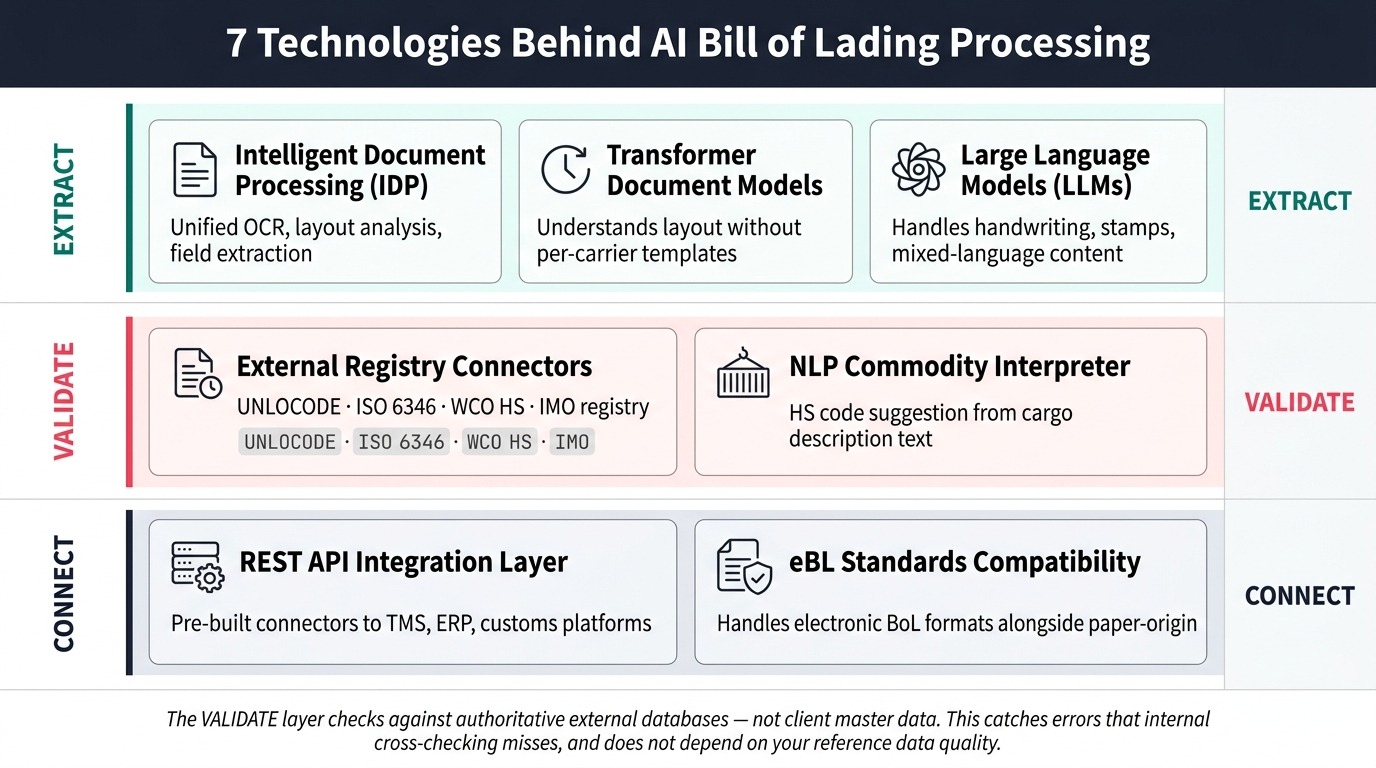
- Intelligent Document Processing (IDP)A category of AI technology combining OCR, machine learning, and natural language processing to extract and classify information from unstructured documents at scale: The foundational technology layer that combines OCR, document layout analysis, and field extraction into a unified pipeline. IDP platforms trained specifically on logistics document formats handle the full spectrum of BoL types without per-carrier configuration – making this the core technology category any serious trade document AI software must be built on.
- Transformer-based Document ModelsAI models that process both the text content and the visual layout of a document simultaneously, enabling accurate field extraction from documents with complex, variable structures: Document-understanding models that treat layout and text as a combined signal – essential for BoLs where field meaning depends on position, table structure, and proximity to labels rather than keyword matching alone. These models handle format variation across carriers without template configuration.
- Large Language Models (LLMs)AI systems trained on vast text datasets that understand context, meaning, and relationships within language – enabling interpretation of ambiguous or semi-structured document content beyond what pattern matching can achieve: Applied specifically to the subset of documents where standard extraction fails – handling handwritten text, crossed-out corrections, mixed-language content, and commodity descriptions requiring semantic interpretation. LLMs serve as the secondary processing layer for the 15 to 20% of documents that defeat faster, cheaper extraction models.
- Natural Language Processing (NLP)The AI discipline enabling computers to understand and interpret human language in context – including entity recognition, semantic classification, and meaning extraction from unstructured text: Supports commodity description interpretation, consignee name normalisation across variant spellings, and HS code suggestion based on cargo description text – tasks that require understanding meaning, not just matching patterns.
- External validation database connectors: Direct integration with the UN/LOCODE port registry, WCO Harmonised System database, IMO vessel registry, and ISO 6346 container ID check-digit algorithm provides authoritative cross-checking that does not depend on client master data quality – the architectural choice that separates robust AI shipping document tools from those that simply automate existing data quality problems.
- REST API integration layerA standardised communication protocol enabling different software systems – TMS, ERP, customs platforms – to exchange structured data reliably without custom point-to-point connections: Pre-built connectors to major freight management platforms, ERP systems, and customs filing software allow structured BoL data to push to all downstream systems simultaneously – eliminating the need for custom integration development for each system connection.
- Electronic Bill of Lading (eBL)A fully digital bill of lading carrying the same legal standing as a paper original in jurisdictions that have adopted formal electronic transferable records legislation standards compatibility: For organisations operating in jurisdictions where eBLs carry legal standing, the system supports ingestion and processing of electronic BoL formats alongside paper-origin documents – providing a unified pipeline as the industry transitions toward digital originals over the coming decade.
6. What Results Does a Bill of Lading Automation Solution Deliver?
- Dramatic reduction in per-document processing time: AI-powered extraction and routing cuts average per-document handling from 20 to 47 minutes down to under 3 minutes for clean documents and under 10 minutes for complex cases – directly addressing the data entry burden that consumes freight coordinator capacity and limits throughput. This is the primary benefit that makes the business case for a digital BoL processing software investment straightforward to calculate.
- Field accuracy that meets customs compliance thresholds: External validation against authoritative databases catches field errors before they reach customs filing – reducing the documentation-related holds that generate demurrage charges and disrupt client SLAs. Fewer customs holds means fewer emergency calls, fewer amended entries, and fewer demurrage invoices to dispute.
- Processing capacity that scales with volume, not headcount: The system handles peak season volume spikes without additional manual processing staff, removing the linear cost relationship between shipment volume and back-office headcount. For growing freight operations, this is the benefit that most directly affects the economics of scale.
- Reduced letter of credit discrepancies: Automated field matching between BoL data and purchase order or booking confirmation records catches mismatches before document presentation – reducing the documentary credit rejections that delay payment and strain importer-exporter relationships. An AI BoL system reducing manual data entry in logistics addresses this problem at its root rather than at the point of rejection.
- Complete, immutable audit trail for compliance: Every extraction decision and downstream data push is logged with the source document preserved – providing the traceable record required for customs dispute resolution, letter of credit discrepancy defence, and trade compliance review.
- Faster customs declaration preparation: Pre-populated customs entry data generated directly from validated BoL extraction reduces manual preparation time for customs brokers and accelerates clearance filing – addressing the paper shipping documents slowing customs clearance problem at its operational source.
- Continuous accuracy improvement over time: The self-learning feedback loop incorporates human corrections on reviewed documents back into the extraction model – meaning auto-pass rates and field accuracy both improve with accumulated document volume rather than plateauing after initial deployment.
- Reallocation of skilled staff to higher-value work: Freight coordinators, customs brokers, and logistics coordinators freed from repetitive data entry redirect their capacity to exception management, client service, and relationship work – the activities where human judgment genuinely creates operational value that no automated shipping paperwork tool can replicate.
7. Is a Bill of Lading Automation Solution Worth the Investment?
A bill of lading automation solution delivers measurable ROI across five distinct business metrics – and the business case becomes strongest when you measure the full cost of the current manual process rather than labour hours alone.
Key Metrics to Measure Before and After Implementation
- Per-document processing time: Measure the average time from document receipt to completed data entry in your TMS or ERP today. After implementation, track the same metric separately for auto-processed documents and reviewed documents. The recovered time per document, multiplied by weekly document volume, translates directly into recovered staff capacity.
- Documentation error rate and its downstream cost: Count the number of customs holds, carrier amendment requests, and letter of credit discrepancies attributable to BoL field errors per 1,000 documents processed today. After implementation, measure the same rate for AI-processed documents. Each prevented customs hold eliminates demurrage exposure that escalates with every additional day a container sits past its free time – making this metric the most impactful single line in the ROI calculation for high-volume ocean freight operations.
- Staff hours allocated to document processing versus exception management: Calculate what percentage of your freight coordinator capacity goes to data entry tasks versus client-facing work today. After implementation, track the shift in that ratio. This metric makes the staff reallocation benefit concrete in terms of capacity for revenue-generating activities rather than back-office cost reduction alone.
- Cost per customs entry: For customs brokerage operations specifically, measure the total back-office cost per customs entry filed today – including document preparation, data entry, and error correction time. After implementation, track the same metric with reduced manual preparation overhead. This figure supports the ROI conversation with finance and operations leadership directly.
- Volume capacity ceiling without headcount increase: Measure the maximum document volume your current team can sustain before SLA performance deteriorates. After implementation, measure the volume ceiling with the same headcount. The difference between these two numbers represents your growth capacity without additional fixed labour cost – often the most compelling metric for organisations in growth mode.
Realistic Implementation and Payback Timeline
Teams that have worked through this integration consistently find that the first four to six weeks of live operation determine long-term performance. The system processes its first real documents during this period, accumulates client-specific extraction knowledge, and establishes the human review workflow that handles edge cases. Auto-pass rates improve progressively as the self-learning model accumulates volume for the client’s specific carrier mix – the ramp is measurable and visible in the first few months, but the exact pace depends heavily on document diversity, carrier mix, and how actively reviewers engage with the correction workflow.
For a mid-size freight forwarder or 3PL processing 300 to 600 documents per week, the break-even on implementation cost against labour savings typically falls within 4 to 8 months – depending on current labour costs, carrier mix complexity, and how aggressively the human review workflow is optimised during the ramp period. The business case for acting now rather than waiting rests on the compounding nature of the accuracy improvement: a system that has processed 50,000 documents performs meaningfully better than one that has processed 5,000. Earlier deployment means a more capable, more accurate system sooner – and a stronger competitive position in a service category where document speed and accuracy are direct client retention drivers.
8. What Does Implementing a Bill of Lading Automation Solution Actually Require?
A bill of lading automation solution is genuinely complex to implement well. Understanding what that complexity involves is the difference between a deployment that reaches high auto-pass rates within a few months and one that stalls early and loses internal support.
Where This Solution Has Real Limits
What implementation experience reveals that theoretical explanations often miss is that the hardest 30% of documents – low-quality scans, heavily annotated copies, mixed-language BoLs with handwritten edits – are precisely the documents that matter most operationally. AI extraction accuracy on clean digital PDFs is consistently high across serious platforms in this category. Accuracy on real-world messy documents varies significantly between implementations and depends heavily on the volume of similar documents the model has been trained or fine-tuned on.
- Handwriting and mid-transit annotations: Crossed-out numbers, dock-side corrections, and rubber-stamp overlays challenge even well-designed extraction pipelines. Confidence-tiered routing handles these cases by routing them to human review – but they will not fully auto-process. That human review volume needs operational planning, not just technical architecture.
- Dirty master data: If your existing TMS or ERP holds inaccurate consignee records, inconsistent commodity descriptions, or non-standard port codes, the system will consistently flag validation mismatches – not because the AI made errors, but because your reference data is wrong. Automating on top of bad master data surfaces data quality problems faster rather than solving them. Address master data quality before or alongside implementation, not after.
- eBL legal fragmentation: Electronic bills of lading represented around 11% of all BoLs globally as of mid-2025, up from 5.7% at the start of the year. Legal recognition of eBLs varies significantly by jurisdiction – the UK, Netherlands, France, and Germany have passed formal recognition legislation, but the majority of trade corridors still depend on paper originals. A bill of lading automation solution handles paper-origin documents excellently, but full end-to-end electronic trade depends on legal infrastructure still developing in most markets.
- Cross-partner exception handling: AI handles clean, complete, internally consistent documents autonomously. However, decisions requiring coordination between shipper, carrier, customs authority, and buyer – amendments, disputes, discrepancies identified mid-transit – still require human judgment in the vast majority of cases. Planning for this layer is a design requirement, not a limitation to engineer around.
Additional Implementation Requirements
- Data quality baseline assessment: Before implementation, audit existing consignee and commodity master data for completeness and accuracy. The external validation layer reduces the impact of poor master data, but clean reference data accelerates the ramp to high auto-pass rates measurably.
- System integration complexity: Connecting to legacy TMS and ERP platforms – particularly those on older architectures – requires API development or middleware accounting for your specific system version, data schema, and authentication requirements. Budget 4 to 8 weeks for integration work on a standard freight management platform stack, and longer for mainframe-era systems.
- Compliance and data privacy obligations: BoL documents contain personally identifiable information on shippers and consignees alongside commercially sensitive cargo data. Implementation requires clear data handling policies, appropriate encryption in transit and at rest, and compliance with trade data regulations in all operating jurisdictions.
- Team training on review workflows: The human review interface is designed for minimum cognitive load – but your team needs to understand what they are reviewing, why specific fields get flagged, and how corrections feed the learning model. Plan for a half-day of structured training plus two weeks of supervised operation before expecting target performance levels.
- Ongoing model maintenance relationship: As carriers update document layouts and new carrier relationships develop, the system accumulates new format knowledge through the human review loop. Major carrier format changes may require engineering attention to update extraction schemas. Building a maintenance relationship with your implementation partner from the start is essential, not optional.
9. Which Organisations Get the Most from a Bill of Lading Automation Solution?
The highest-value deployments of a bill of lading automation solution share a consistent profile: high document volume, multi-carrier complexity, accuracy requirements driven by compliance stakes, and back-office teams whose capacity is constrained by manual processing rather than by a shortage of skilled professionals. The solution delivers the greatest return where those constraints are most acute and where the cost of documentation errors – in demurrage, customs holds, or payment disputes – is most visible on the P&L.
The most suitable user profiles for a digital BoL processing software deployment include:
- Freight forwarders processing 200 or more BoL documents weekly across multiple carrier relationships and document formats – particularly those whose team capacity limits their ability to take on additional clients or shipment volume.
- Licensed customs brokers and customs brokerage operations where field accuracy requirements are non-negotiable and documentation errors carry direct regulatory consequences in the form of customs holds, amended filings, and potential penalties.
- Third-party logistics providers managing document processing for multiple clients simultaneously, where scaling document throughput without proportional headcount growth is a direct margin driver and competitive differentiator.
- Importers and exporters with high ocean freight volume whose back-office teams spend significant capacity on manual BoL entry and cross-checking against purchase orders and booking confirmations.
- Shipping companies and carriers seeking to reduce internal document processing costs while improving data quality in their freight management and invoicing systems.
This solution is particularly valuable if: your team processes documents from more than 15 carriers with different format standards; your documentation error-related costs – demurrage, amendments, payment disputes – represent a meaningful share of back-office operating costs; your document volume already exceeds your team’s sustainable processing capacity; or your operation is growing and you need to scale document throughput without proportional headcount growth.
10. Frequently Asked Questions About Bill of Lading Automation
How does a bill of lading automation system work for freight forwarders?
A bill of lading automation system for freight forwarders connects to your existing email inbox or TMS platform and automatically captures BoL documents as they arrive from carriers. The system applies AI-powered extraction to pull key fields – shipper, consignee, vessel, container IDs, commodity, weight, port codes – validates them against external authoritative databases, and pushes structured data directly into your freight management platform. Documents passing all validation checks route automatically with no manual handling. Documents with low-confidence extractions or validation failures route to a targeted review queue where a team member confirms or corrects specific fields in seconds, not minutes. The result is that your operations team handles only the exceptions – typically 10 to 20% of volume – while the automated BoL extraction platform handles everything else without human re-keying.
What accuracy can I expect from an AI BoL extraction tool for ocean freight?
An AI BoL extraction tool for ocean freight consistently reaches 95 to 98% field accuracy on clean, digital documents on well-trained systems. Accuracy on low-quality scans, handwritten documents, or heavily annotated copies is lower and depends significantly on the volume of similar documents the system has processed previously for your specific carrier mix. A well-designed system addresses this variation through confidence-tiered routing rather than binary pass/fail: high-confidence extractions auto-process, while lower-confidence fields route to human review rather than failing silently or passing incorrect data downstream. Over 8 to 12 weeks of live operation, auto-pass rates typically climb from 50 to 60% toward 80 to 90% as the self-learning model accumulates client-specific extraction knowledge from reviewer corrections.
How does automated trade document processing help customs clearance teams reduce delays?
An automated trade document platform for customs teams addresses the two primary sources of documentation-related clearance delays: field errors and late submission. AI extraction with external validation catches errors – incorrect HS codes, invalid port codes, container ID format failures – before data reaches the customs filing system, rather than after a rejection that requires an amended entry and further delay. Pre-populated customs entry data generated from validated BoL fields reduces the manual preparation time required before filing, allowing earlier submission relative to cargo arrival. For customs brokers, the timestamped audit trail provides immediate access to the source document and extraction record when customs authorities raise queries – eliminating the time spent reconstructing documentation history from scattered email threads.
Is a bill of lading automation solution worth the cost for 3PL providers?
For 3PL providers managing document processing across multiple clients, a bill of lading automation solution typically delivers a strong ROI because the implementation cost is largely fixed while throughput capacity scales with volume. The economics improve significantly with scale: a system processing 1,500 documents per week has a much lower cost-per-document than one processing 300 per week, but both carry similar implementation and maintenance cost structures. Beyond direct cost savings, 3PL operations benefit from the competitive positioning advantage – faster, more accurate document processing with a complete audit trail differentiates the service offering in a category where speed and accuracy are primary client retention criteria. Break-even on implementation cost against labour savings typically falls within 4 to 8 months for operations processing 300 or more documents weekly.
What are the biggest limitations of AI-powered BoL processing platforms today?
The most significant limitation of current AI-powered BoL processing platforms is extraction accuracy on the hardest document types: low-resolution scans, heavily handwritten copies, and documents with mid-transit corrections remain challenging for all platforms and require human review rather than full automation. Dirty master data compounds the problem – a system validating extracted data against inaccurate internal reference records generates false validation failures that erode team confidence in the system. Electronic BoL interoperability is still limited: eBL platforms from different providers cannot yet exchange documents seamlessly, and electronic bills of lading represented only around 11% of global BoL issuances as of mid-2025, with legal recognition covering only a fraction of active trade corridors. Cross-partner exception handling – disputes between shipper, carrier, and buyer – still requires human judgment in the vast majority of cases regardless of automation maturity, and realistic implementation planning must account for this persistent human review requirement.
Build This Solution With Softlabs Group
Softlabs Group builds custom bill of lading automation solutions engineered for the actual document complexity your freight operation handles – not the clean-PDF scenario vendor demonstrations typically show. Our work in freight document processing covers the full pipeline: multi-source document ingestion, transformer-based extraction models trained on logistics document formats, external validation database integration against UNLOCODE, HS code, and IMO vessel registries, confidence-tiered routing workflows, and pre-built connectors to major freight management and ERP platforms. For operations requiring agentic AI workflows that handle multi-step document decisions autonomously, we build those pipelines too. Every implementation is designed around your specific carrier mix, downstream systems, compliance requirements, and realistic document quality range.
Whether you are a freight forwarder eliminating manual BoL entry, a customs broker needing field accuracy that meets regulatory standards, or a 3PL provider scaling document capacity without proportional headcount growth – the right starting point is a technical conversation about what your documents actually look like, where your current process breaks down, and what a realistic implementation timeline and performance improvement curve looks like for your specific operation.