 India
India  Mongolia
  Sweden
  Australia
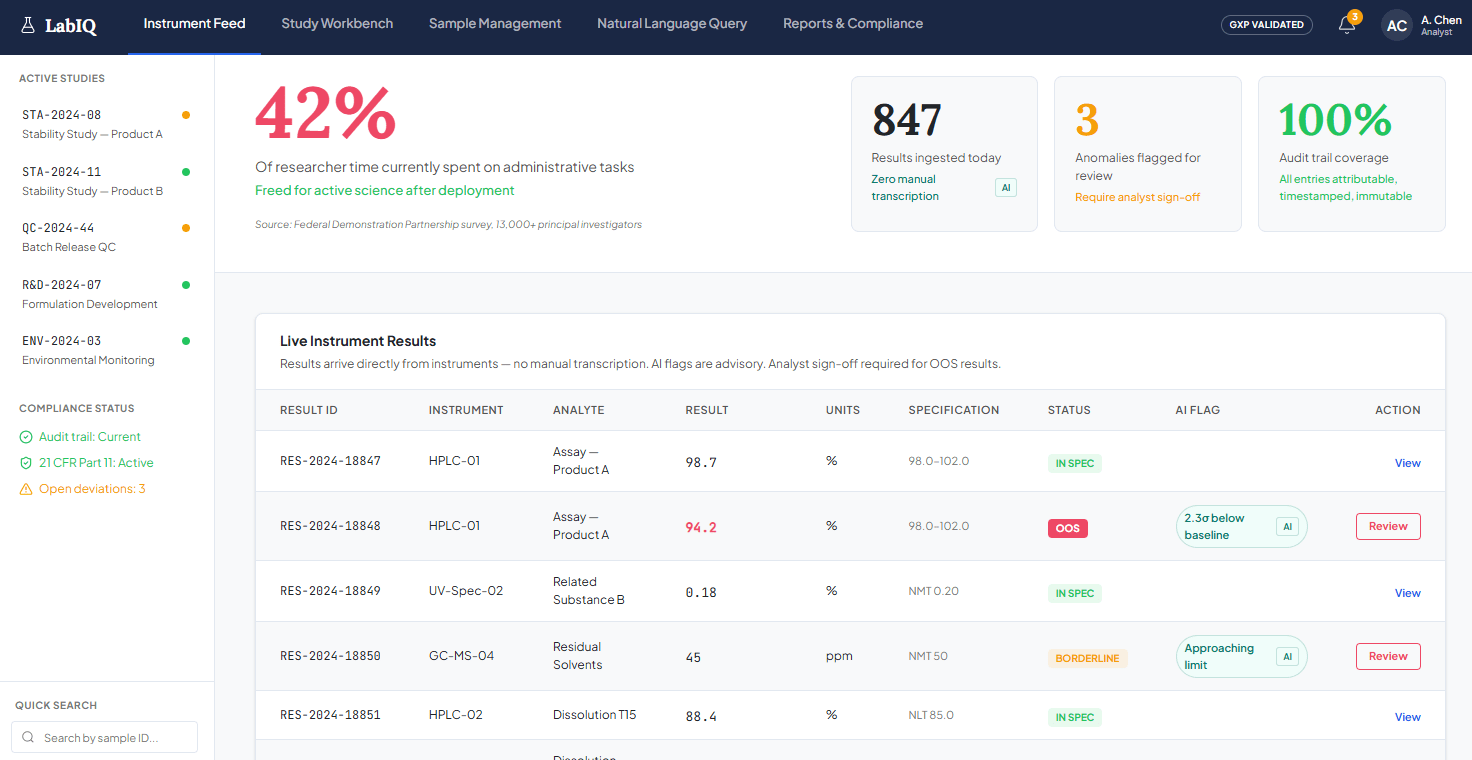
Executive Summary: The Hidden Cost Buried Inside Every Laboratory
You finish an experiment and the real work begins. Instrument readings need transcribing into spreadsheets. Sample IDs need reconciling across two disconnected systems. Protocol records require writing up before details fade from memory. Then comes the audit trail check – ensuring every entry will hold up during the next regulatory inspection. An AI based lab informatics solution eliminates this hidden administrative tax on scientific productivity. By connecting instruments, sample tracking, experiment notebooks, and compliance documentation into a single AI-driven environment, researchers redirect time from data wrangling back to actual discovery.
This page explains how the technology works, what a realistic implementation requires, and where it has genuine limits – because understanding both sides is the foundation of a sound deployment decision.
Why Does Lab Data Management Keep Getting Harder Without an AI Based Lab Informatics Solution?
Laboratory data management fails at scale because volume, instrument diversity, and compliance requirements compound faster than manual workflows can absorb. The problem is not that scientists work carelessly – it is that the systems surrounding them generate data faster than any manual process can handle accurately.
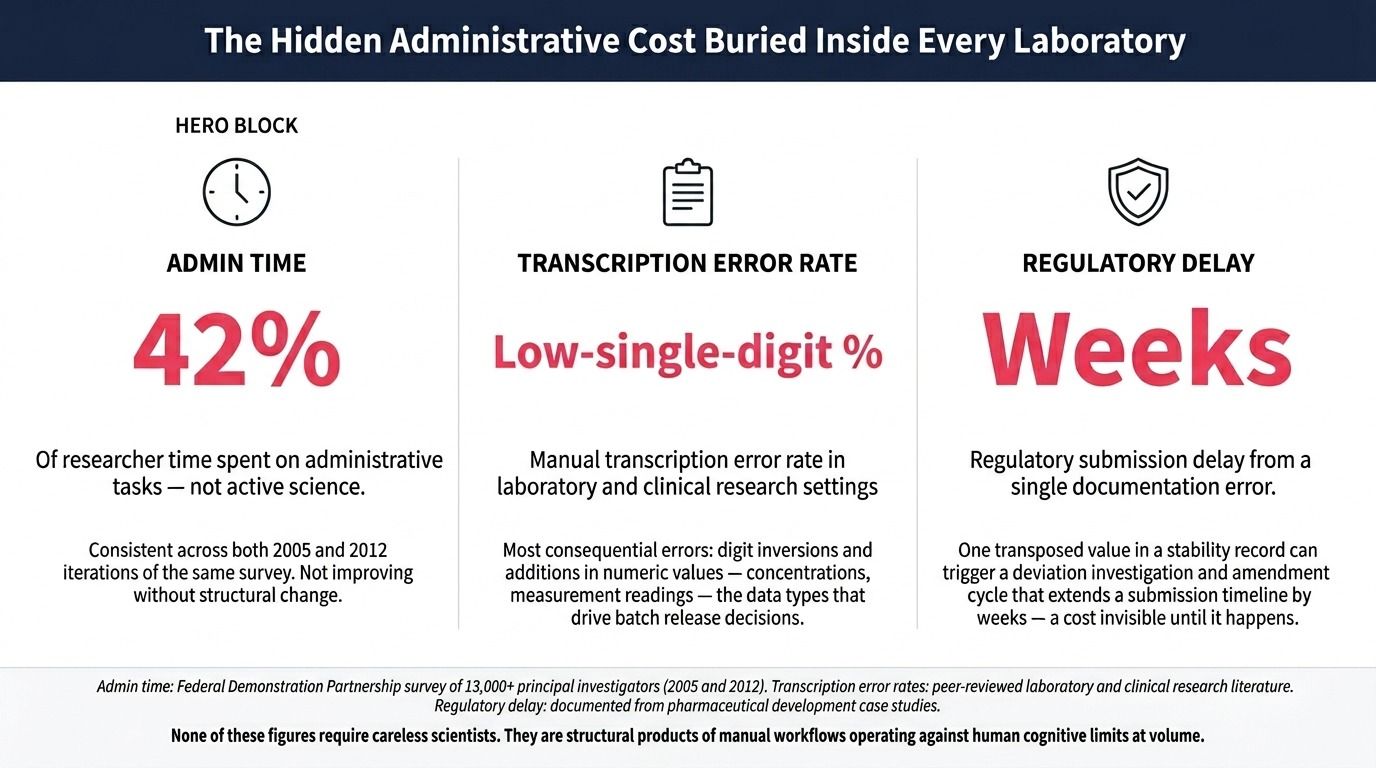
Context: The Modern Scientific Laboratory Environment
Today’s laboratory operates a mix of analytical instruments from multiple generations – HPLCHigh-Performance Liquid Chromatography – an instrument that separates, identifies, and quantifies chemical components in a mixture, mass spectrometers, spectrophotometers, DNA sequencers, and more – each producing data in a proprietary format. Alongside these instruments, scientists maintain digital notebooks, regulatory records, and sample management logs across systems that rarely communicate with each other.
In regulated environments – pharmaceutical manufacturing, clinical diagnostics, food safety testing – every data point carries compliance weight. Regulations including 21 CFR Part 11 govern electronic records and require complete, unalterable audit trails. The pressure to maintain those trails manually, across fragmented systems, drives the administrative burden that consumes analyst time.
In practice, organisations deploying lab data systems consistently encounter a gap between what vendors promise during implementation and what scientists experience at the bench on day one. The usability gap – not the technical gap – is typically the bigger problem in a real deployment.
Key Pain Points an AI Based Lab Informatics Solution Addresses
- Manual data entry errors in lab notebooks introduce transcription mistakes that cascade through downstream analysis, batch release decisions, and regulatory filings. Peer-reviewed measurement of manual transcription in laboratory and clinical research settings documents error rates consistently falling in the low-to-mid single-digit percentage range, with the most consequential errors involving inversions or additions of digits in numeric values such as concentrations and measurement readings.
- Lab data siloed across instruments and systems prevents scientists from connecting results across experiments. A result living in a chromatography data system never speaks to the LIMS holding the sample record, and the analyst bridges that gap manually every time.
- Scientists spending too much time on admin work – data preparation, manual transfer, spreadsheet maintenance – reduces the hours available for actual research. A Federal Demonstration Partnership survey of more than 13,000 principal investigators found researchers spend an average of 42% of their working time on administrative tasks rather than active science – a figure consistent across both 2005 and 2012 iterations of the same survey.
- Audit trails incomplete or inconsistent, because manual record-keeping produces gaps, timestamps that depend on human diligence, and entry fields that analysts fill out retroactively under deadline pressure.
- Slow turnaround from experiment to result analysis, because raw instrument output requires manual cleaning, formatting, and transfer before any interpretation can begin – adding hours or days to what should be an automated step.
- Paper-based lab records creating compliance risk in regulated settings where ALCOA+FDA data integrity framework requiring records to be Attributable, Legible, Contemporaneous, Original, Accurate, plus Complete, Consistent, Enduring, and Available principles require records to be attributable, legible, contemporaneous, original, and accurate.
- No automated way to connect data across experiments, so scientists frequently repeat prior work simply because earlier results cannot be quickly retrieved from a fragmented archive of ELN entries, shared drives, and instrument exports.
Why Traditional Approaches Fall Short
Spreadsheets fail at scale because their data integrity depends entirely on human discipline. Research on manual data entry error rates in scientific contexts documents structural failure rates even in carefully managed environments – the errors are not a product of carelessness but of human cognition working against cognitive limits at volume.
Legacy LIMSLaboratory Information Management System – software that manages samples, workflows, test results, and instrument data within a laboratory environment platforms were designed in the 2000s as record-keeping systems – document repositories with workflow modules bolted on. Adding AI capabilities on top of a record-keeping architecture is fundamentally different from building intelligence into the data layer itself. The result is a system that stores data well but cannot reason about it.
Paper-based ELNElectronic Lab Notebook – a digital system that replaces paper laboratory notebooks for recording experiments, results, protocols, and observations replacements address one narrow pain point but leave the instrument integration, cross-experiment search, and compliance automation problems entirely unsolved. Each tool solving a narrow problem adds another disconnected system to the environment rather than reducing fragmentation.
What Does an AI Based Lab Informatics Solution Actually Do?
The platform replaces manual data transfer with an intelligent layer that automatically captures, connects, and analyses scientific data across the full laboratory workflow. Rather than adding another siloed tool, it functions as a connective intelligence layer sitting across existing instruments, notebooks, sample management systems, and compliance records.
The distinction from conventional AI lab informatics software approaches matters here. Traditional lab software stores and retrieves. An AI-driven platform reasons – identifying anomalies, predicting quality outcomes, surfacing relevant prior results, and generating compliance documentation as a natural byproduct of normal work. Scientists interact with data using plain language rather than database queries. The system adapts to patterns rather than requiring manual rule-writing for every scenario.
Vision and Objectives
- Eliminate manual instrument-to-system data transfer – instrument outputs flow directly into the data environment without transcription steps, removing the primary source of entry errors.
- Detect anomalies and out-of-specification results in real time – trained models compare each incoming result against baselines, specification limits, and historical patterns continuously rather than during periodic manual review.
- Enable natural language access to all experimental data – scientists query across the lab’s full experimental history in plain English without requiring database expertise or IT support for every data question.
- Generate compliance-ready audit trails automatically – every action, every data point, and every review decision creates an attributable, timestamped, immutable record without any additional steps from the scientist.
- Make prior experimental results immediately findable – semantic search and knowledge graph architecture transforms archived data into an active resource, reducing experiment repetition driven by retrieval failures.
- Support predictive quality decisions – trend analysis across batches, reagent lots, and instrument performance profiles enables proactive intervention before a failure occurs rather than reactive investigation after it does.
How Does an AI Based Lab Informatics Solution Work? The Technology Explained
The system processes data through a five-stage pipeline – from raw instrument output through to actionable insight delivery – with human oversight integrated at the decision points where it genuinely matters. Understanding the pipeline helps teams assess both the technical requirements and the realistic scope of an implementation project.
Data Acquisition: What the System Consumes
The system ingests data from analytical instruments – HPLC, GC, mass spectrometers, spectroscopy platforms, DNA sequencers, pH meters, and environmental sensors – through a combination of direct instrument integration, file parsing, and manual entry interfaces. Modern implementations target zero-copy-paste data entry: the instrument pushes its output directly, and the system assigns it to the correct experiment, sample batch, and analyst automatically.
Integration with existing systems – legacy LIMS, SDMSScientific Data Management System – a repository that stores, organises, and archives raw instrument data files alongside their metadata platforms, CDSChromatography Data System – software that controls chromatography instruments, acquires raw data, and processes results for compounds analysis, ERP systems, and regulatory platforms – happens through APIs and integration adapters. The data acquisition layer also captures ELN entries, voice notes, images, and scanned documents, using OCROptical Character Recognition – technology that converts printed or handwritten text in images into machine-readable digital text and document parsing to extract structured content from unstructured sources.
The AI Processing Pipeline
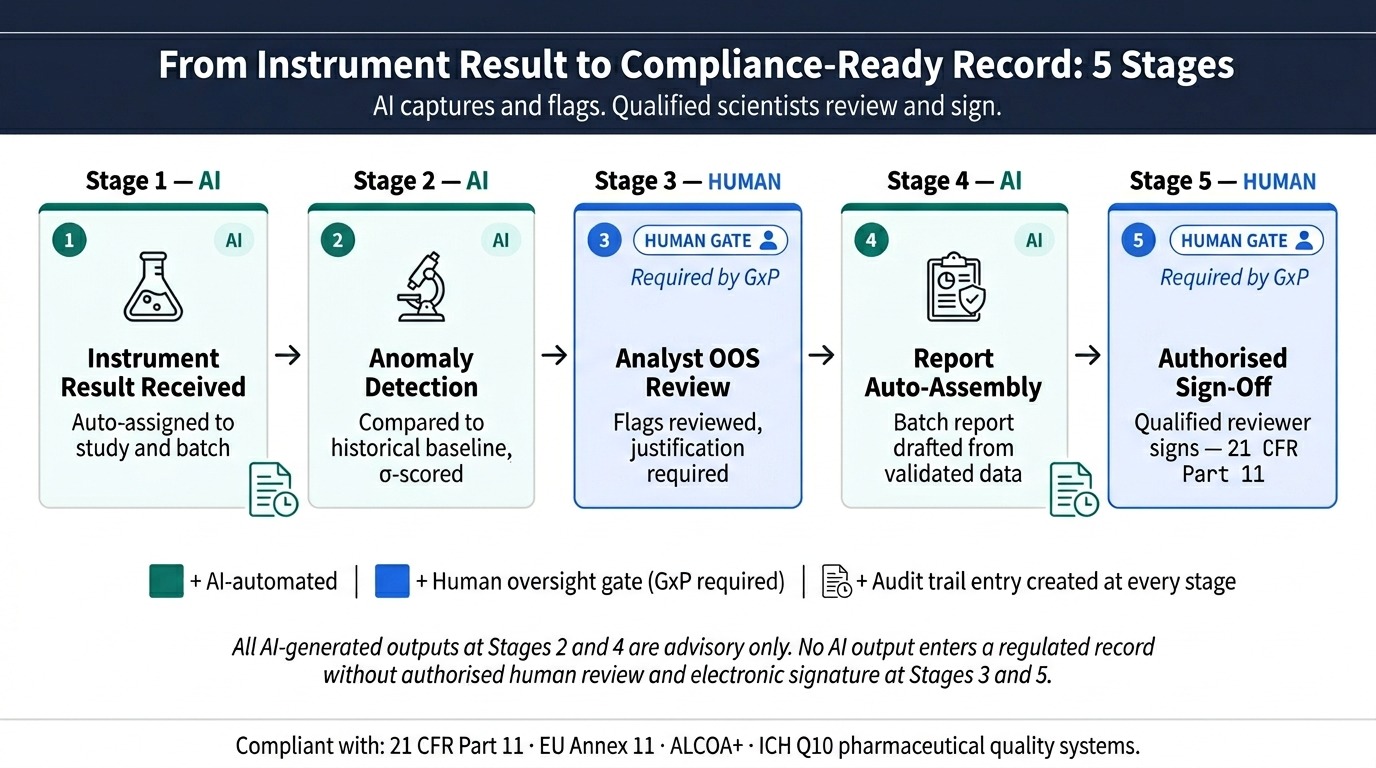
- Instrument Data Ingestion and Format Parsing. First, the system receives raw output from connected instruments and automatically parses each file format into a normalised structure. Integration adapters handle proprietary formats from instruments across multiple vendors and generations. The system assigns each data point to the correct experiment, sample identifier, and analyst without requiring manual input at this stage.
- Automated Data Normalisation and Structuring. Next, the normalisation layer standardises units, naming conventions, and data formats across all instrument types. NLPNatural Language Processing – the AI discipline that enables computers to understand, interpret, and generate human language from text or speech components parse free-text ELN entries and experiment notes, extracting structured metadata and tagging observations automatically. This step is foundational – inconsistent normalisation undermines every downstream AI process.
- Anomaly Detection and Quality Flagging. Once processed, machine learningA branch of AI in which models learn patterns from data and improve their performance over time without being explicitly reprogrammed models compare each incoming result against historical baselines, defined specification limits, and instrument performance profiles. The system flags out-of-range results, statistical anomalies, unusual trends, and potential instrument drift. Unlike manual review, this layer operates on every data point continuously and applies the same criteria without fatigue.
- Semantic Indexing and Knowledge Graph Population. The system then maps each result, sample, experiment, instrument, and analyst action as a node in an underlying knowledge graphA database structure that maps entities and their relationships as interconnected nodes, enabling complex queries across linked data. A vector databaseA database that stores data as mathematical embeddings, enabling semantic search – finding conceptually similar content even when exact words differ runs alongside it, encoding experiment records as mathematical embeddings for semantic retrieval. Scientists can find relevant past results using plain-language descriptions rather than exact database queries.
- Insight Delivery and Decision Support. At this stage, the intelligence layer surfaces findings through dashboards, a natural language query interface, automated reports, and compliance documentation. Scientists type or speak questions in plain English and receive contextualised answers drawn from the lab’s actual data. Batch release summaries, trend analyses, stability reports, and audit-ready documentation generate automatically rather than requiring manual assembly from multiple sources.
A common pattern across real implementations of AI lab data systems is that instrument integration – not the AI algorithms themselves – consumes the majority of technical effort during deployment. Labs operating instruments from 10 or more vendors, many predating universal communication standards, face a significant integration engineering challenge before the AI layer can operate on complete, reliable data.
Human-in-the-Loop: Where Human Judgment Still Matters
- Anomaly review and investigation decisions: the system flags exceptions, but the scientist decides whether to investigate further, quarantine a sample, or accept a result with documented justification.
- Out-of-specification approvals: results outside defined limits require review and authorised sign-off before any batch release or analytical conclusion proceeds – AI surfaces the information but cannot sign the release.
- LLM-generated outputs in regulated contexts: AI-generated summaries, trend interpretations, and draft reports require review and authorised signature before use in any regulatory or quality submission. The AI accelerates assembly; the authorised reviewer confirms accuracy.
- Workflow and protocol changes: AI recommendations for workflow modifications surface as suggestions for qualified personnel to evaluate, not as automatic changes to validated procedures.
- Calibration and maintenance decisions: predictive maintenance alerts inform engineers of instrument performance trends, but physical inspection, recalibration, and documentation remain human responsibilities.
Output and Interaction: What Scientists and Managers Actually See
The primary scientist-facing interface in a well-designed system is a natural language query layer – the scientist types “show me all failed QC samples from batch B-221 in the last 90 days” and receives a structured answer with source citations. Alongside this, instrument dashboards display real-time result streams with anomaly flags highlighted. Compliance teams access automatically generated audit trails, electronic signature workflows, and regulatory-formatted reports directly from the system without requiring data exports or manual assembly.
For laboratory management, the system surfaces operational analytics – throughput rates, instrument utilisation, out-of-specification trends, and analyst workload distribution – through configurable dashboards. Mobile interfaces support on-bench data capture through barcode scanning, voice notes, and image submission, feeding directly into the central data environment without desktop access.
What Technologies Power an AI Based Lab Informatics Solution?
This type of solution relies on a layered technology stack where each component solves a distinct problem in the laboratory data challenge. Understanding these components helps technical evaluators assess build complexity, infrastructure requirements, and vendor capability claims accurately.
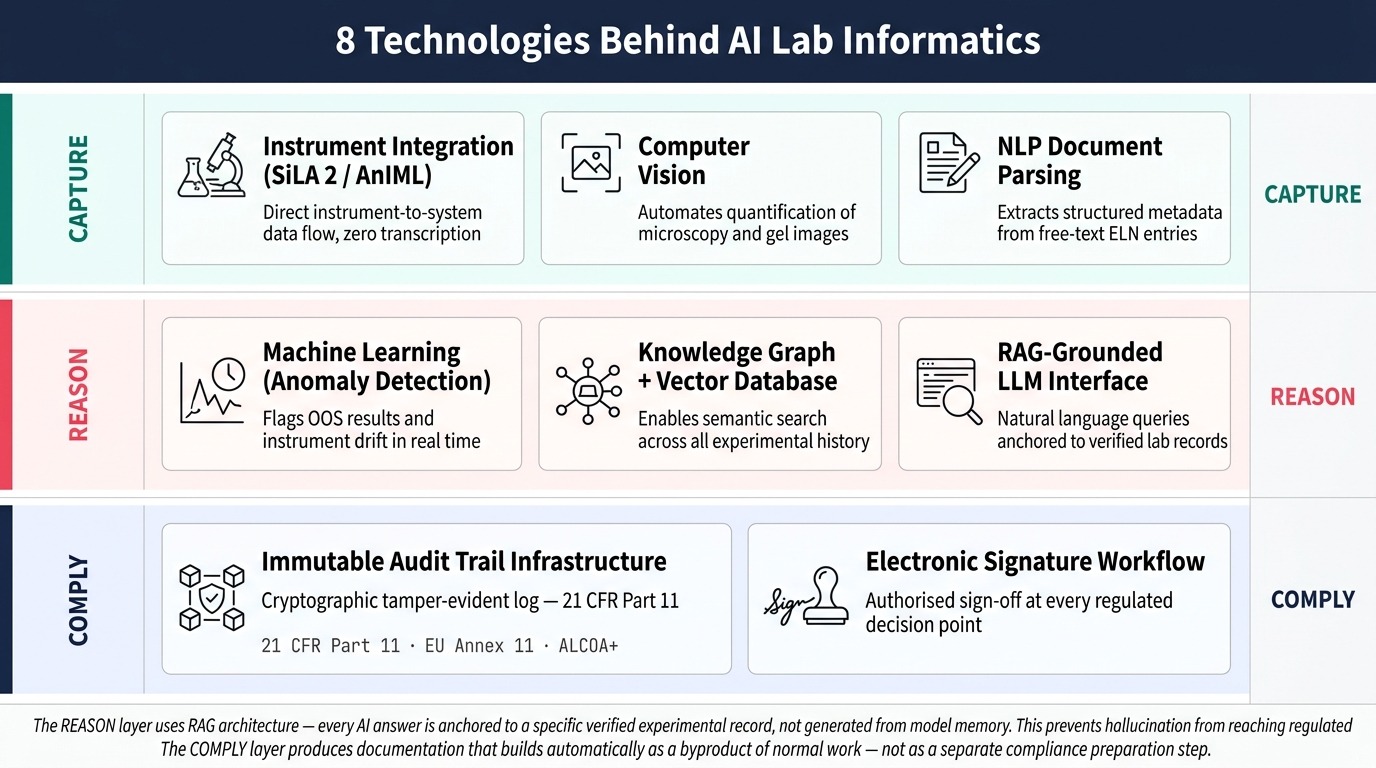
- Machine Learning (ML) models – trained on historical laboratory data to identify anomalies, predict quality outcomes, and detect instrument drift. Supervised models require sufficient labelled historical data to establish reliable baselines; labs with novel assay types or limited historical data need to account for model training timelines during deployment planning.
- Natural Language Processing (NLP) – enables the plain-English query interface and powers automatic parsing of free-text ELN entries, extracting structured metadata from unstructured scientific notes without requiring scientists to fill in structured forms for every observation.
- Knowledge Graph technology – maps relationships between samples, experiments, instruments, reagent lots, analysts, and results as interconnected nodes. This architecture enables complex cross-experiment queries – “find all experiments using reagent lot X that produced results outside specification” – that relational databases cannot perform efficiently.
- Vector Database – stores experiment records as mathematical embeddings, enabling semantic search. A scientist searching for “stability results similar to this degradation profile” retrieves relevant records even when the exact terminology differs across experiments or analysts.
- Retrieval-Augmented Generation (RAG) – grounds large language modelA deep learning model trained on vast text data that can understand context, generate coherent text, and answer questions in natural language queries against the lab’s actual data, preventing AI-generated hallucinations by anchoring every answer to verified experimental records with source citations.
- Computer Vision – applies trained image analysis models to microscopy outputs, gel electrophoresis results, colony counts, and other visual laboratory data, automating quantification tasks that currently require manual review of each image.
- Laboratory integration standards (SiLA 2, AnIML) – open communication protocols that define how instruments and software systems exchange data. SiLA 2Standardisation in Lab Automation version 2 – an open standard using gRPC/HTTP2-based microservices to enable plug-and-play communication between lab instruments and software in particular enables plug-and-play device communication for newer instruments, reducing custom integration work.
- Immutable audit trail infrastructure – cryptographically timestamped logging that creates tamper-evident records of every action, data entry, review, and approval. This layer satisfies FDA data integrity requirements and ALCOA+ principles automatically rather than requiring separate compliance workflows.
What Does an AI Based Lab Informatics Solution Look Like in Practice?
The scenarios below show how the solution addresses specific operational realities across different laboratory contexts – each with a distinct pain, a distinct failure mode in existing systems, and a distinct measurable outcome.
Pharmaceutical Stability Testing Laboratory
Your stability study has six time points, three instruments, and results that need manual transcription before any analysis can even start. In pharmaceutical development labs, stability testing generates recurring data from HPLC, spectroscopy, and dissolution instruments across monthly intervals over one to two years. Each result moves from instrument output to spreadsheet to LIMS to review – manually, at every step.
A single transcription error at any stage can invalidate a time point, trigger a deviation investigation, and delay a regulatory submission timeline by weeks. An AI based lab informatics solution for pharmaceutical research connects directly to each instrument and pulls time-point data automatically, associating each reading with the correct batch, study, and analyst identifier. Anomaly detection compares each reading against prior time points and flags deviations immediately – not at end-of-week review.
The concrete outcome: scientists spend their time interpreting results and writing scientific conclusions rather than transcribing numbers. The audit trail builds itself throughout the study rather than requiring reconstruction before submission.
Quality Control Laboratory in Manufacturing
Every batch release depends on a QC analyst manually comparing instrument outputs against specification limits in a spreadsheet that one person maintains and everyone depends on. Quality control laboratories in pharmaceutical and food manufacturing operate under tight timelines where batch release delays carry direct revenue and supply chain consequences. Manual specification checking, manual non-conformance reporting, and manual report assembly create compounding bottlenecks.
When a single analyst owns the comparison process, the team inherits both a throughput bottleneck and a single point of failure. An AI LIMS software layer automates specification checking by comparing incoming results against defined limits in real time. Non-conformances trigger investigation workflows automatically. Batch release reports generate from the system with the full audit trail embedded rather than requiring manual data assembly from multiple sources.
The outcome: the primary bottleneck in the release process disappears, non-conformance investigation timelines shorten measurably, and the dependence on a single analyst’s spreadsheet knowledge is eliminated.
Biotech R&D and Collaborative Research Teams
Half your scientists re-run experiments not because the first run failed – but because no one can quickly find what someone else did six months ago. In research-focused settings – biotech R&D teams, academic-industry collaborations, and environmental or food testing laboratories – the primary data problem is retrieval failure rather than entry error. Results exist somewhere across ELN entries, shared drives, and instrument archives. Finding a specific prior result to inform the current experiment often takes longer than simply repeating the work.
This is a knowledge retention and retrieval failure as much as a technical one. A laboratory AI platform with semantic search and knowledge graph architecture transforms archived results from passive storage into an active, queryable resource. Scientists ask questions in plain English and receive contextualised answers drawn from the lab’s actual experimental history – whether they remember the exact sample ID or not.
The outcome: experiment repetition rates driven by retrieval failures fall significantly within the first months of deployment, and scientific knowledge becomes genuinely cumulative rather than siloed in individual scientists’ memories.
Ready to explore what this solution looks like for your organisation?
Talk to Our AI TeamWhat Results Does an AI Based Lab Informatics Solution Deliver?
Deploying this platform delivers measurable improvements across data accuracy, scientist productivity, compliance readiness, and time to insight – specifically because it addresses the structural causes of each problem rather than adding another layer of manual process on top.
- Significant reduction in manual data entry volume – direct instrument-to-system data flow eliminates the transcription step, removing the structural source of data entry errors and freeing analyst time previously spent on manual transfer tasks.
- Real-time anomaly and out-of-specification detection – instead of discovering problems during end-of-day or end-of-week review, the system flags deviations at the moment they occur, enabling faster investigation and reducing the downstream impact of a failed result.
- Automatic audit trail generation meeting ALCOA+ and 21 CFR Part 11 standards – compliance documentation builds continuously as a byproduct of normal work, eliminating the separate compliance preparation workload before inspections and audits.
- Faster experiment-to-insight turnaround – data normalisation, structuring, and quality checks happen automatically after instrument output, compressing the gap between generating a result and acting on it from days to hours in high-throughput environments.
- Cross-experiment search and knowledge retention – prior results become findable in seconds rather than hours, reducing duplicate experiment runs and enabling scientists to build directly on previous work across the full team history.
- Proactive instrument maintenance alerts – trend analysis across instrument performance data identifies calibration drift and performance degradation before a full failure occurs, reducing unplanned downtime and invalid result events.
- Natural language data access without specialist support – scientists query the full experimental dataset without requiring IT assistance, SQL knowledge, or specialist informatics training – addressing the AI lab informatics tool reducing manual data entry goals and the broader information accessibility gap simultaneously.
- Reduced shadow AI risk – scientists currently using personal LLM accounts to query sensitive experimental data gain a secure, compliance-grounded alternative within the controlled data environment, eliminating the data governance and IP risk that shadow AI behaviour creates.
Is an AI Based Lab Informatics Solution Worth the Investment?
For laboratories where data errors, rework, and compliance preparation consume significant analyst time each week, an AI based lab informatics solution creates a calculable return on that specific cost – and the calculation becomes most compelling when organisations measure the true hidden cost of the current state honestly.
Key Metrics to Measure Before and After Implementation
- Analyst hours spent on data transfer and preparation per week – establish a baseline before deployment by time-tracking the actual hours analysts spend on transcription, format conversion, spreadsheet maintenance, and manual report assembly. Post-deployment, this number should fall substantially for instrument-connected workflows.
- Data error rate and rework rate per 100 instrument readings – audit a representative sample of current data records to establish the baseline transcription error rate. Post-deployment, compare against the error rate in instrument-direct data flows.
- Time from final instrument reading to completed batch release or analytical report – measure the current elapsed time between the last instrument result and the signed release report. This spans data transfer, manual checking, report assembly, and review cycles.
- Number of repeat experiments per quarter attributed to retrieval failures – survey scientists directly about how frequently they repeat work because prior results were inaccessible or too time-consuming to find. This cost is consistently underestimated in pre-deployment assessments.
- Compliance preparation hours per audit cycle – track the staff hours dedicated to assembling audit-ready documentation for each regulatory inspection. Automatic audit trail generation should reduce this number significantly.
Realistic Implementation and Payback Timeline
Teams that have worked through this integration consistently find that the ROI calculation becomes most compelling when they measure analyst time lost to data preparation honestly – because most organisations significantly undercount this cost before deployment begins. A core implementation covering instrument integration, sample management, and automated audit trail generation typically requires 6 to 12 months for a mid-size pharmaceutical or life sciences laboratory. AI feature deployment – anomaly detection, predictive analytics, natural language query – generally follows after core system stabilisation.
Budget expectations for enterprise-grade deployments must account for configuration, regulatory validation, data migration, and integration engineering – not just software licensing. For regulated environments, GxPGood Practice quality guidelines and regulations covering pharmaceutical and life sciences manufacturing, testing, and data management validation requirements add time and cost that purely commercial software deployments do not face. The business case for acting now rather than waiting rests on two factors: regulatory expectations around data integrity continue to strengthen, and legacy data volumes grow every month – making the eventual migration more complex and expensive the longer it is deferred.
What Does Implementing an AI Based Lab Informatics Solution Actually Require?
Successful implementation requires careful planning across data migration, instrument integration, regulatory validation, and organisational change management – each carrying its own timeline and expertise demand. These are manageable challenges with the right partner and preparation, but treating any of them as minor increases the risk of a deployment that delivers system functionality without delivering scientist adoption.
- Data quality and legacy migration: legacy LIMS, paper records, and spreadsheets often contain years – sometimes decades – of data in inconsistent formats. Migrating this data effectively is typically the most time-consuming phase of any deployment. The quality of the migration determines whether historical data becomes usable in the new system or remains inaccessible.
- Instrument integration complexity: connecting existing instruments – particularly older equipment with proprietary output formats – requires integration expertise and often custom connectors or middleware. No universal communication standard currently covers every instrument type in use across a typical laboratory. For labs operating 10 or more instruments from different vendors and eras, integration planning deserves dedicated effort before any AI feature planning begins.
- GxP validation requirements: pharmaceutical and regulated laboratories require formal IQ/OQ/PQInstallation Qualification, Operational Qualification, Performance Qualification – three progressive validation stages confirming that regulated software is installed, operates, and performs correctly for its intended use validation for any software affecting data integrity. Every post-deployment configuration change triggers controlled change procedures and potential revalidation. This reality makes fast-moving agile deployments structurally incompatible with regulated lab environments – a fact that vendor timelines sometimes understate.
- Compliance framework alignment: the system must satisfy all applicable regulations across the lab’s operating jurisdictions – 21 CFR Part 11 for FDA-regulated environments, EU Annex 11 for European operations, and ALCOA+ principles throughout. Mapping these requirements to system configuration requires both informatics expertise and regulatory knowledge working in tandem.
- Change management and scientist adoption: scientists who have experienced poor previous LIMS or ELN implementations approach new systems with justified scepticism. Adoption depends on demonstrating measurable usability improvement at the bench level on day one. A system that delivers management reporting value while increasing the scientist’s workload will face sustained resistance regardless of its technical capability.
- Team expertise requirements: configuration, validation, and ongoing maintenance require a combination of informatics expertise, domain science knowledge, and regulatory understanding that rarely exists within a single internal team. Most organisations require external specialist support during deployment and often ongoing support for model maintenance, revalidation cycles, and instrument integration updates.
- Realistic timeline expectations: core system deployment runs 6 to 18 months for enterprise-scale regulated environments. AI feature deployment and stabilisation extend beyond that. Planning for the full timeline – rather than the software vendor’s minimum estimate – prevents the downstream disruption that comes from underestimating scope.
Where This Solution Has Real Limits
What implementation experience reveals that theoretical explanations often miss is the extent to which change management – not technical integration – determines whether a deployment succeeds or fails. A system scientists find slower or harder than their current process generates no return, regardless of its technical sophistication.
- Instrument diversity is a genuine constraint. Labs operating legacy instruments from multiple vendors, many from the pre-IoT era, face a significant integration engineering challenge. Some older instruments cannot connect to any modern informatics system without custom hardware adapters or middleware – and some cannot be connected at all without replacement.
- AI anomaly detection requires sufficient historical data. Supervised ML models need labelled historical records to establish reliable baselines. New labs, or labs running novel assay types with limited prior history, face a model cold-start problem – the AI layer performs below its capability until adequate training data accumulates.
- LLM-based natural language interfaces carry hallucination risk in compliance contexts. Every AI-generated answer, summary, or report touching regulated data requires human review before regulatory or quality use. The AI accelerates work but cannot replace the authorised reviewer – any deployment claiming otherwise should raise a red flag.
- No current solution fully solves every laboratory data challenge simultaneously. Labs achieve better results by identifying the 2 to 3 highest-cost pain points and deploying against those first, rather than expecting a comprehensive platform to deliver value across all dimensions from day one. Phased deployment with clear success metrics per phase outperforms big-bang rollouts in this domain consistently.
Who Gets the Most Value from an AI Based Lab Informatics Solution?
Life sciences, pharmaceutical, and analytical chemistry laboratories with high data volumes, regulated operating environments, or significant compliance burdens gain the highest return from deploying this solution – because those are the contexts where the cost of the current state is highest and the regulatory tailwinds for modernisation are strongest.
An intelligent laboratory informatics tool for R&D teams delivers particularly strong value in the following contexts. This solution is especially valuable if your organisation matches one or more of these profiles:
- Pharmaceutical and biopharmaceutical R&D or QC laboratories operating under FDA, EMA, or equivalent regulatory frameworks – where data integrity obligations are highest and the cost of compliance failures most severe.
- Clinical diagnostics and pathology laboratories processing high daily sample volumes across multiple instruments, where throughput, turnaround time, and audit readiness drive operational performance.
- Food safety, environmental testing, and contract research organisations where multi-client sample management, regulatory accreditation, and turnaround time commitments create data management pressure at scale.
- Biotech and life sciences R&D teams running iterative discovery programmes where the ability to query and connect prior experimental results directly accelerates the research cycle.
- Quality control operations in manufacturing where batch release timelines carry direct financial consequences and current manual checking processes create consistent bottlenecks.
This solution delivers less immediate value in very small laboratories with limited instrument volume, or in highly novel research environments where process standardisation – which underlies ML model training – has not yet been established. For those settings, a phased AI development approach starting with targeted automation rather than full-platform deployment typically generates better early returns.
Frequently Asked Questions About AI Based Lab Informatics Solutions
How does an AI based lab informatics solution for pharmaceutical research help with FDA compliance?
This solution satisfies FDA compliance requirements – including 21 CFR Part 11 electronic records rules and ALCOA+ data integrity principles – by generating compliant audit trails automatically as scientists work, rather than requiring separate compliance documentation steps. Every data entry, review action, anomaly flag, and electronic signature is logged with an attributable timestamp that cannot be altered after the fact. The result is that compliance documentation builds continuously throughout the study rather than requiring reconstruction before an inspection. This approach directly reduces the risk of FDA Form 483 data integrity findings – a peer-reviewed analysis in the International Journal of Pharmaceutics identifies data integrity as the main compliance issue the pharmaceutical industry currently faces, with missing audit trails, uncontrolled system access, and retroactive record completion among the most cited inspection observations.
What is the difference between a traditional LIMS and an AI electronic lab notebook platform with AI?
A traditional LIMS was designed primarily as a record-keeping and workflow tracking system – it stores sample information, assigns tests, and records results, but it does not reason about data or learn from patterns. An AI electronic lab notebook platform built on modern architecture goes further: it applies machine learning to detect anomalies, uses NLP to parse and query unstructured records, implements semantic search so scientists can find prior results in plain English, and generates predictive insights from accumulated experimental data. The practical difference is that scientists interact with a traditional LIMS by filling in forms and running reports, while a modern AI-driven platform answers questions, flags problems, and surfaces relevant prior work proactively. The distinction matters most for organisations where the bottleneck is not storage or retrieval by exact lookup – but discovery, analysis, and compliance automation.
How long does implementing an AI LIMS software for life sciences organizations typically take?
For a mid-size life sciences organisation deploying AI LIMS software in a regulated environment, the realistic core implementation timeline runs 6 to 12 months for instrument integration, sample management, and automated audit trail generation. AI feature deployment – anomaly detection, predictive analytics, and natural language querying – typically follows after the core system has stabilised and the training data set has matured, adding further time. Regulated environments face additional complexity from GxP validation requirements: IQ/OQ/PQ qualification adds both time and specialist resource demand that non-regulated deployments do not face. Data migration from legacy systems is consistently the most time-consuming phase. Organisations that plan for the realistic timeline rather than a vendor’s minimum estimate consistently report better outcomes than those that treat the vendor’s fastest-case scenario as the base case.
Can an AI lab informatics tool really reduce manual data entry errors in research labs?
Yes – specifically by eliminating the transcription step rather than trying to make manual transcription more accurate. An AI lab informatics tool reducing manual data entry achieves this by connecting instruments directly to the data environment, so results flow from the instrument into the correct experiment record automatically without human re-entry. Research into manual data entry error rates in scientific contexts consistently documents structurally significant error rates in high-throughput environments – not because scientists are careless, but because human attention under volume and time pressure is an unreliable data transfer mechanism. Removing that mechanism removes the error source. The remaining error modes – incorrect instrument setup, sample mislabelling, or specification limit errors – require separate controls, but transcription errors from manual data transfer effectively disappear in direct-connected instrument workflows.
Which types of labs benefit most from an AI lab data platform for regulatory compliance?
An AI lab data platform for regulatory compliance delivers the highest return in environments where regulatory data integrity requirements are most stringent and where the cost of compliance failures – failed audits, rejected batches, regulatory actions – is highest. Pharmaceutical manufacturing QC labs, biopharmaceutical development laboratories, clinical diagnostics facilities, and contract research organisations operating under FDA, EMA, MHRA, or equivalent frameworks are the primary beneficiaries. These environments face the most demanding audit trail requirements, the highest frequency of regulatory inspections, and the strictest consequences for data integrity deficiencies. Food safety and environmental testing laboratories operating under ISO 17025 accreditation face similar compliance demands at a somewhat lower regulatory severity level and also benefit significantly. Smaller academic or early-stage research laboratories where regulatory compliance is not yet a primary operational driver will find more targeted automation tools a better starting point before committing to a full platform deployment.
Build This Solution With Softlabs Group
Softlabs Group builds custom AI based lab informatics solutions tailored to each client’s instrument environment, data architecture, regulatory obligations, and scientific workflows. That means instrument integration engineering for your specific equipment mix, ML model development trained on your laboratory’s historical data, compliance framework alignment to your regulatory context, and a scientist-facing interface designed around how your team actually works – not a generic off-the-shelf configuration. Our enterprise AI development practice brings both the technical depth to build the data pipeline and the domain understanding to get the scientist experience right. For regulated environments requiring on-premise deployment or data sovereignty controls, our private LLM development capability ensures the natural language interface runs entirely within your secure infrastructure.
The most useful next step is a technical conversation about your current data environment – what instruments you operate, where your biggest data handling bottleneck sits, and what a realistic deployment scope looks like for your organisation. That conversation costs nothing and grounds the project in your actual requirements before any commitment is made.