 India
India  Mongolia
  Sweden
  Australia
Executive Summary: From Field Uncertainty to Verified Project Status
Your subcontractor just submitted a progress certificate claiming 70% complete. Your site manager’s update says everything is on track. But your last proper walkthrough was three weeks ago – and something about the MEP (Mechanical, Electrical, and Plumbing)The critical services infrastructure within a building: mechanical systems, electrical wiring and distribution, and plumbing networks rough-in schedule does not add up. An AI-powered construction monitoring solution closes that gap between what the plan claims and what is actually installed on site. Rather than depending on self-reported updates and periodic inspections, this type of system converts site imagery into structured, plan-linked progress data.
Actual installed work gets compared against drawings and schedules continuously, delays and risk surface early, and project managers, schedulers, and owner’s representatives gain a shared, evidence-backed view of where the project actually stands. The result is not more data for its own sake – it is earlier warnings, faster decisions, and fewer costly surprises at every stage of the project lifecycle.
1. The Challenge: Why Does Construction Progress Always Feel Invisible Until It’s Too Late?
Construction projects lose weeks of recovery time because progress gaps go undetected between inspection rounds. Teams end up reacting to delays rather than preventing them.
Context: The Reality of Managing a Live Construction Site
Managing an active construction site means tracking dozens of trade packages, hundreds of tasks, and thousands of individual decisions simultaneously. Progress data typically arrives through weekly site meetings, periodic walkthroughs, and subcontractor self-reports – none of which provide a continuous, independent view of what is actually installed. The gap between the plan and the field reality grows quietly, week by week, until a delay becomes undeniable and expensive to correct. McKinsey research has found that 98 percent of megaprojects suffer cost overruns exceeding 30 percent, and 77 percent run at least 40 percent over schedule – a pattern driven in large part by information gaps that compound across project phases before anyone with authority to act sees them clearly.
Most project teams rely on field engineers walking sections of the site and recording observations manually. A large commercial project may have hundreds of distinct zones and trade activities running in parallel. No inspection schedule can cover all of them with sufficient frequency. By the time a delay surfaces through formal reporting, recovery options are already limited and the float has evaporated.
In practice, organisations deploying this type of system typically encounter the same structural problem: manual monitoring was designed for a world where one experienced site manager could walk a project in an afternoon. Today’s large commercial, infrastructure, and mixed-use developments are too complex and too fast-moving for that model to function reliably at scale.
Key Pain Points This AI Solution Addresses
- Site inspections happen too infrequently to catch delays before they compound into critical path impacts – by the time a missed activity appears in a report, the float is already consumed
- Safety incidents happen between inspection rounds, in zones that supervisors visit once a week or less, leaving hazardous conditions unaddressed for days at a stretch
- No real-time visibility into construction progress exists for project managers working remotely or overseeing multiple active sites simultaneously
- Manual progress reports are inconsistent, time-consuming to compile, and often based on subcontractor estimates rather than independent field verification
- Equipment idle time and underutilised resources remain invisible without continuous monitoring, making it hard to identify productivity losses before they affect the programme
- Unauthorised access to construction sites goes undetected between security rounds, creating both safety exposure and contractual liability risk
- Construction delays are only discovered when it is too late for low-cost corrective action – forcing expensive acceleration measures, programme revisions, or dispute proceedings
Why Traditional Approaches Fall Short
Self-reported progress updates create a structural information problem. Subcontractors have incentives to report optimistically, and project managers typically have no independent data source to challenge those reports before the next site visit. This is not a failure of personnel – it is a failure of the monitoring architecture itself.
McKinsey Global Institute research identifies construction as one of the least digitized major sectors in the world economy – a finding that explains, at an industry level, why most project teams are still reconciling progress through weekly meetings, email chains, and manual photo logs rather than continuous, spatially linked data. The gap is not a technology problem; it is an adoption and workflow problem that AI-based monitoring directly targets.
- Weekly site meetings produce status snapshots, not continuous monitoring – delays compound silently in the intervals between them
- Photo logs and manual inspection records are unstructured, difficult to compare across time periods, and rarely linked to specific floor plan locations or schedule tasks
- Traditional CCTV cameras generate footage but produce no actionable progress or safety intelligence without dedicated staff reviewing hours of recorded video each day
- Progress information travels through multiple layers – subcontractor, site manager, project manager, report – losing accuracy and timeliness at every handoff
2. The AI Solution Concept: What Is an AI-Powered Construction Monitoring Solution?
An AI-powered construction monitoring solution converts site imagery into structured, plan-linked progress data – comparing actual installed work against drawings and schedules automatically, without depending on manual field input.
The core function is straightforward: create trustworthy ground truth from the site and attach it to the right location and time. The system then flags the gap between what should be done and what is actually done. It achieves this by combining field capture methods – smartphones, 360-degree cameras, drones, and optional fixed cameras – with spatial grounding, computer visionAI technology that enables machines to interpret and extract meaning from visual information in photographs and video inference, and schedule analytics. No single capture method suits every site, so a well-designed AI construction monitoring software platform supports multiple input types to match the project context.
What separates this approach from traditional monitoring is the shift from reactive reporting to continuous, evidence-linked awareness. Rather than replacing the site team, the system reduces the volume of manual observation work, surfaces exceptions for human review, and gives every stakeholder a shared, spatially accurate picture of project status – updated with each new capture session rather than once a week.
Vision and Objectives
- Provide a continuous, independent, spatially grounded record of what is installed on site – not what subcontractors self-report or what the plan assumes
- Compare actual progress against plan automatically by zone and trade package, without manual data entry from the field team
- Surface delays, out-of-sequence work, and schedule risk early – while recovery options are still relatively low-cost and manageable
- Reduce time spent on manual progress reporting, documentation compilation, and weekly status meeting preparation
- Create a verifiable evidence trail that supports payment verification, QA/QC review, and dispute resolution at any project stage
- Give remote stakeholders – developers, investors, and project controls teams – a trusted, up-to-date view of site reality without requiring a physical site visit
How This Solution Is Realistically Built: Three Maturity Tiers
This solution exists on a spectrum. The full vision – automatic spatial localization, trained custom computer vision models, multi-source forecasting, deep BIM integration – represents a multi-year product. A working, commercially viable system delivering real value to clients is achievable in 12 to 18 months. Understanding the difference matters before any build decision.
Tier 1 – Foundation (12 to 18 months, realistic for most teams): Mobile capture app with guided walkthrough routes, QR code or manual zone selection for spatial grounding, cloud-based computer vision via existing APIs for element detection, basic planned-versus-actual dashboard by zone and trade, structured progress reports, and Procore integration. This tier solves the core problem – independent, spatially tagged, time-stamped site evidence – without requiring custom ML model training or advanced localization research. It is commercially deployable and generates real value from day one.
Tier 2 – Intelligence (18 to 36 months, requires dedicated ML capability): Floor plan and BIM alignment, trained detection models for construction-specific element types, confidence scoring, exception routing to a human review workbench, and expanded integration with scheduling and document management platforms. This tier adds structured inference – not just “here is the image” but “here is what it means against your plan.” It requires labeled training data and ML engineering investment that goes beyond standard software development.
Tier 3 – Full Platform (3 to 5 years, requires significant capital and data scale): Automated indoor spatial localization in dynamic construction environments, delay forecasting using weather and resource signals, multi-site portfolio intelligence, and a grounded AI assistant that answers project questions from verified evidence. This tier is where the most capable products in the market operate after years of data accumulation and engineering. It is the right long-term direction – not a starting point.
The rest of this page describes the full solution concept across all three tiers. A phased build starting from Tier 1 is the realistic path to delivering it.
3. Real-World Application Scenarios: How Does an AI Construction Monitoring Platform Work in Practice?
A construction site AI platform delivers consistent value across three distinct operational contexts: trade-level progress assurance for general contractors, portfolio oversight for developers, and independent payment verification for owner’s representatives.
Scenario 1 – General Contractor: Catching Trade Delays Before They Hit the Critical Path
Your MEP subcontractor’s weekly report says rough-in is 65% complete – but your scheduler flagged a float issue three days ago, and you have no independent data to settle it before the coordination meeting tomorrow.
Commercial fit-out projects run dozens of simultaneous trade packages across multiple floors. Manual walkthroughs can sample only a fraction of active zones each week. By the time an MEP delay propagates to drywall, painting, and fixture installation, the critical path impact is already locked in.
An intelligent construction tracking tool maps each capture session to floor plan zones by day. Computer vision detects installed versus missing elements per trade. When a zone falls behind its planned completion rate, an alert reaches the GC and scheduler before the delay cascades downstream. Trade slippage surfaces meaningfully earlier than manual inspection cycles allow – while replanning costs a meeting, not a contract amendment.
Scenario 2 – Real Estate Developer: Portfolio Visibility Without Constant Site Visits
You are overseeing four active developments simultaneously, and your investors want a verified progress update – but you cannot be on-site at all four projects in the same week.
Developers managing a project portfolio rely on contractor-submitted reports, periodic consultant visits, and informal updates. All of these lag field reality and carry inherent reporting bias. No existing tool gives the developer’s team a single, independent view across all active sites without a physical visit.
An AI construction monitoring software dashboard centralises progress data across the full portfolio. Each project’s zone-by-zone status updates from the latest capture session. Deviations from planned milestones surface automatically, so the team reviews only the exceptions needing attention. Portfolio reporting shifts from assembling contractor updates across four phone calls to reviewing a single exception queue – with independent, evidence-backed data behind every project status shown.
Scenario 3 – Owner’s Representative: Independent Verification for Payment Certification
The contractor just submitted a 72% complete progress payment certificate, and you need to approve or dispute it by end of week – with no independent field evidence of your own.
Owner’s representatives on large projects face a structural information gap. Payment certificates arrive monthly. Independent verification typically means a site visit that covers only what the inspector happens to walk on that particular day. Disputes over progress valuation carry significant financial and legal risk on both sides.
Photo-linked evidence of installed work packages – tied to specific zones, trade activities, and plan elements – gives the owner’s rep an independent, time-stamped verification layer. The AI-powered construction monitoring solution generates structured progress reports matching the certificate claim against captured field evidence. Payment disputes and certification delays reduce, and an auditable evidence trail supports any future claim or arbitration proceeding.
Ready to explore what this solution looks like for your organisation?
Talk to Our AI Team4. How It Works: How Does an AI-Powered Construction Monitoring Solution Process Site Data?
A construction site AI platform does not work like a surveillance system that analysts review manually. Instead, it runs an evidence pipeline. Site imagery enters first, then spatial algorithms locate it within the project. Computer vision interprets what is visible. A progress inference layer maps observations to scheduled tasks. Human review handles uncertain or contract-sensitive conclusions before anything reaches a dashboard or external system.
Data Acquisition: What Site Data Does the System Consume?
The system accepts multiple capture inputs to suit different site types and project scales. Field users walk guided routes using smartphones or 360-degree cameras for interior and floor-level coverage. Drones supply aerial and facade data for exteriors, rooftops, and large open areas. Optional fixed IP cameras provide continuous monitoring at site gates, high-risk zones, or areas with specific safety requirements.
Beyond imagery, the system also ingests floor plans, BIM (Building Information Modelling)A digital 3D model of a building that combines geometry, spatial relationships, and construction data to represent the full project in a single linked model models where available, schedule data, and trade package definitions. Every observation links back to its correct project context – floor, zone, trade activity, and planned task – rather than existing as an isolated photograph.
The AI Processing Pipeline
A common pattern across real implementations of this solution is that the pipeline – not the models – is where the hard engineering work lives. Getting data from a messy, connectivity-challenged construction site into a state where reliable inference is possible requires careful handling of quality, duplication, and spatial alignment at every stage.
The steps below describe the full pipeline as it operates at Tier 2 and beyond. In a Tier 1 build, steps 1 through 4 operate in simplified form: zone grounding uses QR codes or manual user selection rather than photogrammetry, and computer vision in step 5 runs against cloud APIs using pre-trained models rather than custom-trained construction-specific detectors. The architecture is the same. The complexity of each stage scales with the maturity tier – which means a working system is buildable without solving the hardest problems first.
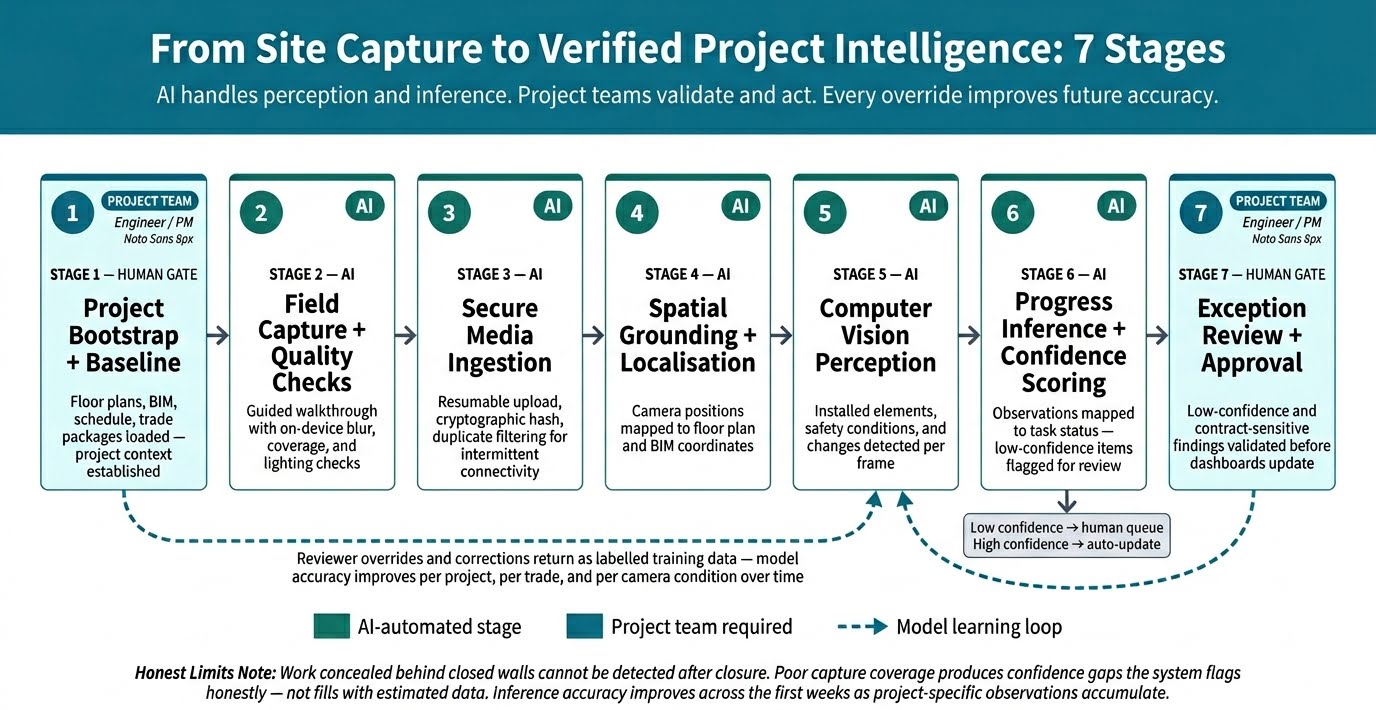
- Project Bootstrap and Baseline Setup. First, the system imports all project metadata: floor plans, WBS (Work Breakdown Structure)A hierarchical decomposition of a project into manageable tasks and deliverables, used to organise and track all work on the project items, trade packages, schedule milestones, and BIM geometry where available. All floors, zones, trades, and task names normalise into one canonical schema. This means every future observation links back to a specific location, planned activity, and baseline date – creating the foundation for all planned-versus-actual comparisons.
- Field Capture with Edge Quality Checks. Next, field users start a guided walkthrough in the mobile app. The app displays the capture route, coverage target, and upload health in real time. On-device quality checks screen for blur, low light, motion artifacts, and missed route segments – flagging problems immediately so the user can recapture before leaving the area, rather than discovering the gap hours later during processing.
- Secure Media Ingestion. Once captured, media uploads via a resumable protocol designed for intermittent site connectivity. Each file receives a cryptographic hash, device metadata, session ID, and route context. Perceptual hashingA technique that generates a fingerprint of image content, enabling near-duplicate images to be detected and filtered automatically without manual review filters duplicate or near-duplicate content automatically. Corrupted or incomplete sessions route for retry without requiring manual intervention from the field team.
- Spatial Grounding and Localization. The system then estimates camera positions and maps imagery to floor plan and BIM coordinates using visual localization algorithms and photogrammetryThe science of using photographs to measure positions and reconstruct 3D geometry, enabling precise spatial grounding of camera locations within a building. When full BIM alignment is unavailable – which is common on real projects with outdated or incomplete models – the system falls back to zone-level grounding using floor plans, QR markers, or manual zone confirmation. A missing BIM file never blocks progress tracking.
- Computer Vision Perception. Trained detection models identify visible work packages in each frame: structural elements, MEP components, cable trays, ductwork, safety barriers, doors, fixtures, and temporary works. A change detectionA computer vision technique that compares images captured at different times to identify what has been installed, modified, reworked, or removed since the previous session layer then compares new evidence against prior captures, classifying each observed element as newly installed, reworked, removed, or unchanged. This comparison layer is what turns isolated photographs into a time-linked progress record.
- Progress Inference and Confidence Scoring. A hybrid rules-plus-machine learning (ML)A branch of AI where algorithms learn patterns from labelled data and improve their predictions over time, without being explicitly reprogrammed for each new scenario layer maps observations to task status using element visibility, construction sequence logic, and patterns learned from earlier project phases. Every output carries an explicit confidence score. Low-confidence results, out-of-sequence installs, and contract-sensitive items route to the human review workbench rather than updating dashboards automatically.
- Exception Review, Action, and Learning. Reviewers validate flagged items in a side-by-side workbench – image evidence alongside the floor plan and planned status. Approved observations update zone health, trade progress, and schedule variance views, then push into connected project management systems via integration. Every reviewer override returns as labelled feedback for model calibration, improving accuracy per project, per trade, and per camera condition over time.
Human-in-the-Loop: Where Human Judgment Still Matters
A well-designed AI-powered construction monitoring solution does not aim to remove humans from the loop. It targets labour reduction on high-volume, lower-complexity tasks – and escalates to humans on the decisions that carry real consequence.
- Low-confidence detections always route to a human reviewer before affecting any dashboard, schedule integration, or payment report – the system never promotes uncertain outputs silently
- Out-of-sequence installs and potential rework flags require human validation before the system records negative progress or raises a formal issue visible to project stakeholders
- Contract-sensitive claims – particularly those affecting payment certificates, milestone sign-offs, or QA/QC acceptance – require explicit human approval before any downstream action
- PPE (Personal Protective Equipment)Safety gear required on construction sites – including helmets, high-visibility vests, safety harnesses, and protective footwear – mandated by site safety regulations compliance alerts and structural safety observations route immediately to the responsible supervisor for human assessment and corrective action
- Final progress reports used for client reporting or payment certification remain under human sign-off authority – the AI provides the evidence layer and the summary, not the final decision
Output and Interaction: How Results Are Delivered
Project managers and site engineers access results through a web-based dashboard displaying zone-by-zone progress against plan, trade completion heatmaps, and schedule variance indicators updated after each capture session. Alerts for delays, safety flags, and out-of-sequence activity push to email or mobile notification in near real time. Structured progress reports generate on demand for owner reporting, payment certification support, or QA/QC review packages.
The system also connects to external project management platforms via API (Application Programming Interface)A standardised connection that allows two software systems to exchange data automatically, without manual export or import steps between them, pushing approved progress updates and issue flags into the scheduling, document management, and programme controls tools where the project team already works – so the monitoring system enhances existing workflows rather than creating a parallel one.
5. Key Enabling Technologies: What Powers an AI Site Monitoring Solution?
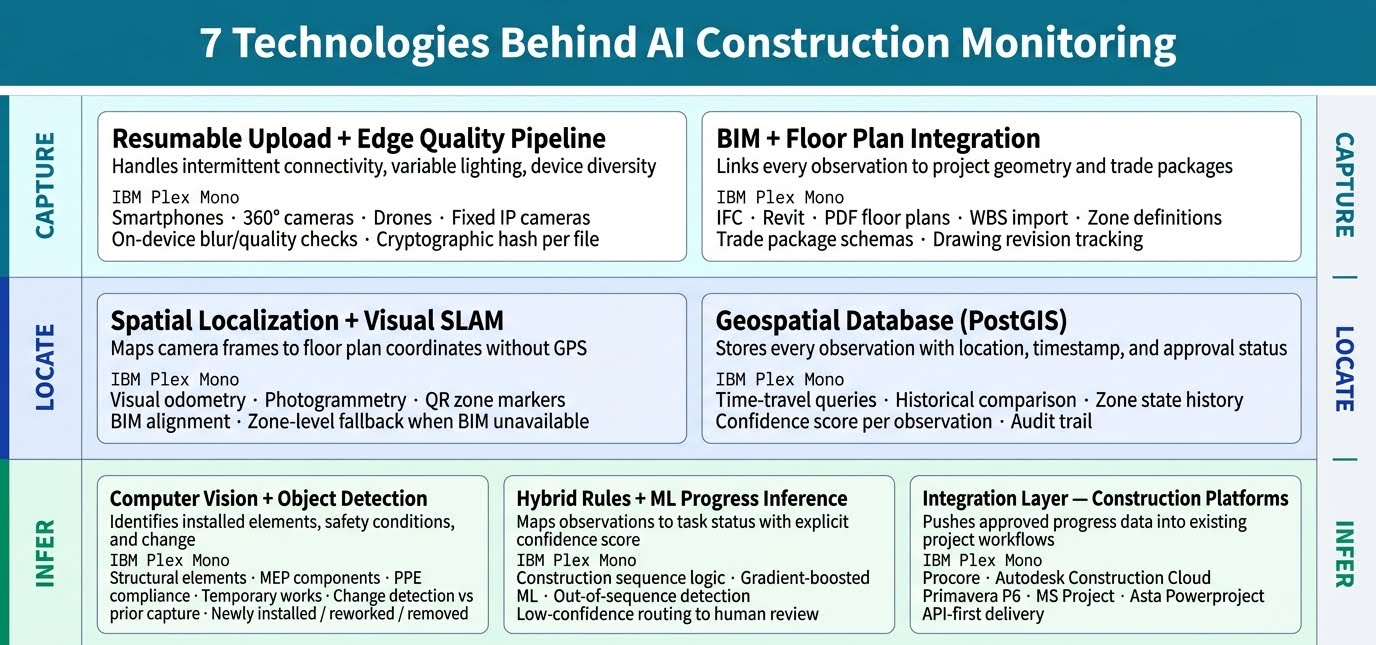
A construction site AI platform combines spatial computing, computer vision, and machine learning in a layered architecture that converts raw site imagery into actionable project intelligence – handling the full chain from field capture to integrated reporting.
- Computer Vision and Object Detection: Deep learning models trained on construction-specific imagery identify installed elements, temporary works, safety equipment, and structural components – distinguishing permanent from temporary installations and detected presence from inferred completion
- Spatial Localization and Visual SLAMSimultaneous Localisation and Mapping – an algorithm that builds a spatial map of an environment while simultaneously tracking the camera’s position within it, enabling indoor navigation without GPS: Algorithms map camera frames to floor plan coordinates without requiring GPS, enabling precise spatial grounding of every observation inside a building or across a multi-floor structure
- BIM and Floor Plan Integration: Parsers for standard BIM formats and PDF drawing sheets ingest project geometry, element classifications, and drawing revision histories – linking observed site conditions to specific model elements, trade packages, and scheduled tasks
- Hybrid Rules and ML Progress Inference: A deterministic rules engine handles construction sequence logic and element visibility requirements, while gradient-boosted ML models handle ambiguous or partially visible cases – combining precision on known patterns with adaptability for project-specific variation
- Geospatial Database with PostGIS: A spatially aware database stores every observation, evidence object, confidence score, and zone state with its precise location, timestamp, and approval status – enabling historical comparisons and time-travel queries at any point in the project lifecycle
- Resumable Upload and Edge Quality Pipeline: On-device quality checks and resumable chunked upload protocols handle the intermittent connectivity, variable lighting, and device diversity that are normal conditions on active construction sites
- Integration Layer for Construction Platforms: Standardised connectors push approved progress data, issues, and structured reports into project management platforms, scheduling tools, and business intelligence systems – keeping the monitoring system embedded in existing team workflows
6. Potential Impact and Benefits: What Results Does an AI-Powered Construction Monitoring Solution Deliver?
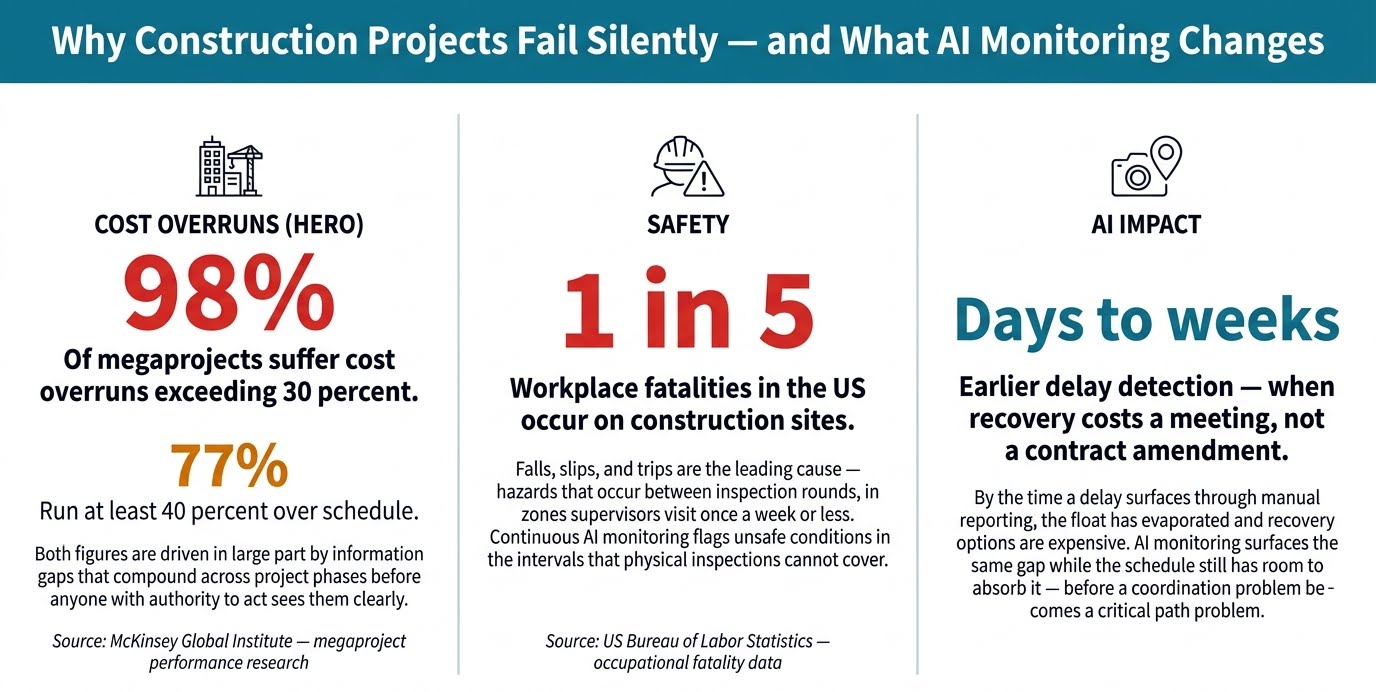
An AI-powered construction monitoring solution reduces manual reporting effort, surfaces delays earlier, and provides a spatially grounded evidence record that periodic manual inspection cannot match in frequency or consistency.
- Earlier delay detection: Trade and activity delays surface days to weeks earlier than manual inspection cycles allow – when the cost of recovery is still manageable, rather than programme-critical and contractually complex
- Significant reduction in reporting labour: Automated progress documentation and structured report generation cut the time project controls and site engineering teams spend compiling weekly status updates – freeing those hours for higher-value decision-making work
- Independent progress verification: Plan-linked evidence of installed elements gives project controls teams and owner’s representatives an independent data source for payment certification and milestone sign-off, separate from subcontractor self-reporting
- Continuous safety monitoring: An AI construction safety software layer monitors for missing PPE, exposed hazards, and unauthorised site access between physical inspection rounds. Construction accounts for roughly 1 in 5 workplace fatalities in the US according to Bureau of Labor Statistics data, with falls, slips, and trips the leading cause – hazards that continuous AI monitoring can flag in the intervals between formal safety inspections
- Portfolio-level visibility: Real estate developers and programme managers gain a unified dashboard across multiple active sites, replacing fragmented phone calls and contractor-submitted reports with independent, time-stamped status data they can act on
- Reduced dispute exposure: A complete, time-stamped visual record of installed work at each construction stage creates an auditable evidence trail for payment disputes, defect claims, and project handover documentation
- Equipment and resource visibility: Continuous site capture surfaces patterns in equipment positioning and utilisation that are invisible to weekly inspection schedules, supporting idle-time analysis and productivity monitoring across the site
- Faster stakeholder reporting: An intelligent site analytics tool reducing manual inspection work shifts the project team from hours of manual data compilation to exception-driven review backed by verified field data – freeing project controls capacity for analysis and decision-making rather than report assembly
7. ROI and Business Case: Is an AI-Powered Construction Monitoring Solution Worth the Investment?
Teams that have worked through this integration consistently find that the business case rests on three measurable impacts: how much earlier delays are detected, how much reporting labour is recovered, and how much payment dispute risk is reduced – not on platform features alone.
The value of earlier delay detection is straightforward to quantify on any project. Start by calculating the average daily cost of a one-week programme extension on a typical project – including acceleration costs, prolongation claims, and downstream trade disruption. Then assess how many weeks of delay, per project, are currently discovered after recovery is already expensive. Detecting even one critical delay two weeks earlier changes the economics of the system entirely on a project of any meaningful value.
For reporting labour, the calculation is equally direct. Measure the hours your project controls and site engineering team spend each week on progress data compilation, photo documentation, and status report preparation. An AI site progress monitoring tool that automates this data gathering recovers those hours for site engineering and decision-making work – a real productivity gain that compounds across a multi-year project.
Key Business Metrics to Measure Before and After Implementation
- Days between delay occurrence and detection – the primary leading indicator of programme risk reduction; a shorter detection window directly reduces recovery cost
- Hours per week spent on progress report preparation – measurable before implementation begins; provides a clean baseline for labour recovery calculations
- Number of subcontractor progress claims requiring dispute, correction, or re-inspection – a proxy for payment certification friction and the legal risk it carries
- Frequency of safety non-conformances detected per month – before and after AI monitoring coverage begins, tracking both the detection rate and the response time to each flag
- Cost per progress inspection event – including travel, labour, and documentation time per site visit; compare against cost per AI-assisted capture and review cycle
For a mid-size organisation deploying across two to five active projects, implementation typically requires four to eight weeks from project baseline setup to live monitoring. Longer timelines apply when BIM and schedule data need significant cleaning before baseline import. A realistic payback horizon depends heavily on project value and risk profile, but the clearest path to early ROI is on high-value developments where a single avoided two-week delay or a disputed payment certificate more than covers the system cost for the year.
The case for acting at project start rather than mid-project rests on a simple compounding effect. Every week of undetected delay costs more to recover than the week before it. A construction monitoring system deployed from project start captures the baseline it needs to make accurate comparisons. Deploying mid-project means working with incomplete historical data and reduced inference accuracy until enough new captures accumulate – delaying the point at which the system becomes genuinely reliable.
8. Important Considerations for Implementation: What Does Implementing an AI-Powered Construction Monitoring Solution Actually Require?
Successful implementation requires clean project baselines, consistent field capture habits, and realistic expectations about the first weeks of inference accuracy – not just access to the technology itself.
What implementation experience reveals that theoretical explanations often miss is this: the technology layer is rarely the hard part. The harder work is establishing consistent capture routes, normalising trade and zone naming conventions across subcontractors, and ensuring that the floor plans and schedule data loaded into the system are actually current. Projects with poor schedule hygiene or frequently revised drawings need a baseline cleanup phase before reliable progress monitoring can begin.
- Data quality and baseline cleanliness: Floor plans, schedule data, and trade package definitions must be current and consistent before the system can produce reliable planned-versus-actual comparisons – garbage-in applies here exactly as in any data system
- Capture consistency: AI-driven inference quality depends directly on capture frequency and route coverage; teams that capture consistently produce reliable outputs, while inconsistent walkthroughs produce confidence gaps that the system flags honestly rather than fills
- BIM availability: The system operates without full BIM by falling back to zone-level floor plan grounding, but projects with accurate, current BIM achieve higher spatial precision in element detection and linking
- Model warm-up period: Progress inference accuracy improves as the system accumulates project-specific data; early-project predictions carry higher uncertainty and benefit most from supplemental human review during the initial weeks
- Integration complexity: Connecting to existing project management platforms, scheduling tools, and document management systems requires API configuration and data mapping work that varies by technology stack and platform maturity
- Privacy and access controls: Construction sites involve workers whose image data requires appropriate handling – face blurring, role-based access controls, and data residency requirements must be configured per project and jurisdiction before go-live
- Change management with field teams: Field adoption determines data quality above all else; capture routes must be simple, and the value of the system must be visible to site engineers – not just project managers – for capture discipline to hold week after week
Where This Solution Has Real Limits
An honest assessment matters here. Current AI construction monitoring software performs well across many conditions – but specific situations genuinely reduce its effectiveness, and planning around them produces better outcomes than ignoring them.
- Work installed behind closed walls or above sealed ceiling panels cannot be detected visually after closure – prior capture before closure, combined with sign-off documentation, is the practical workaround for these hidden work packages
- Poor capture coverage caused by inconsistent walkthroughs or avoided zones produces confidence gaps that the system flags honestly rather than filling with estimated progress data
- Forecasting reliability improves over the project lifecycle; predictions in the first few weeks carry meaningful uncertainty until enough project-specific observations accumulate for the models to calibrate against
- Heavy civil, underground, and highly distributed infrastructure projects are a significantly worse fit than vertical construction with defined interior zones – the solution delivers strongest value on commercial and mixed-use buildings with repeatable floor layouts and consistent trade sequences
For organisations with sensitive project imagery, commercially confidential drawing data, or regulatory data residency obligations, on-premise deployment via private LLM development approaches may be appropriate – keeping all project data, inference outputs, and model weights within the organisation’s own infrastructure.
9. Who Benefits Most: Which Teams and Organisations Get the Most from an AI Construction Monitoring Platform?
An AI construction monitoring platform delivers the highest value where project complexity, portfolio scale, or contractual risk makes manual monitoring structurally inadequate – regardless of how capable or experienced the site team is.
The solution fits general contractors running large commercial, mixed-use, or healthcare projects with multiple active trade packages and tight programme constraints. Real estate developers managing portfolios of active sites benefit from centralised visibility without requiring dedicated monitoring personnel at each location. Owner’s representatives and project controls consultants gain an independent evidence layer for payment certification and milestone verification. Infrastructure owners and public sector clients with programme assurance obligations gain structured, time-stamped documentation supporting both internal reporting and construction site safety compliance monitoring requirements across their project portfolio.
This solution is particularly valuable if:
- Your projects involve five or more simultaneous active trade packages, where manual coverage of every zone every week is operationally impossible regardless of team size
- You manage three or more active construction sites and currently rely on contractor-submitted reports as your primary progress data source
- Your project risk profile includes significant payment certification exposure, a history of subcontractor disputes, or contractual milestone obligations tied to independently verified progress
- Your site operations require continuous AI-powered construction safety monitoring between formal inspection rounds, or operate in a sector where documented safety compliance evidence is a regulatory requirement
10. Frequently Asked Questions About AI-Powered Construction Monitoring
How does an AI construction monitoring system work for general contractors?
A construction monitoring system for general contractors works by converting site walkthroughs – captured on smartphones, 360-degree cameras, or drones – into spatially grounded progress data linked to the project’s floor plans and schedule. Computer vision models detect installed elements by zone and trade package, and a progress inference layer compares actual installation status against the planned completion for each area. When a zone falls behind plan, or when out-of-sequence work appears, the system surfaces an alert to the GC and scheduler before the delay cascades downstream. The key difference from manual reporting is that the GC receives independent, evidence-backed status data – not a subcontractor’s self-assessment – updated with each capture session rather than once a week. This shifts the project controls conversation from “what did you say is complete?” to “here is what the site evidence shows.”
Can an AI-powered construction safety monitoring solution actually reduce site incidents?
An AI safety compliance monitoring tool for construction sites can meaningfully reduce incidents by detecting hazardous conditions and PPE non-conformances in the time gaps between physical inspection rounds – which is where most site incidents occur. Computer vision models identify missing PPE, exposed leading edges, unsecured materials, and unauthorised personnel in restricted zones. The system routes these detections immediately to the responsible supervisor for human assessment and corrective action – it does not make autonomous safety decisions. The reduction in incident frequency depends directly on capture coverage: the more consistently the site is captured, the more continuous the safety monitoring layer becomes. However, AI monitoring complements but does not replace qualified safety officers and formal physical inspection protocols – it extends coverage, not the authority of the inspection itself.
How accurate is automated construction progress tracking software with AI?
Accuracy in automated construction progress tracking software with AI depends on four factors: capture consistency, image quality, model training on relevant construction types, and the cleanliness of the baseline data against which progress is measured. On well-configured projects with regular capture routes and current floor plans, the system achieves reliable detection of visible work packages – identifying installed elements and surfacing gaps with high confidence. Accuracy reduces for hidden work behind closed walls, poorly lit areas, and project types with highly bespoke or non-repeating work packages. A well-designed system is transparent about confidence levels, routing low-confidence outputs to human review rather than presenting uncertain inferences as verified facts. The practical benchmark that matters is not theoretical precision but whether the system surfaces actionable delays and risks measurably earlier than your current manual monitoring approach does.
What does an intelligent site progress tracking platform with AI actually involve to implement?
Implementing an intelligent site progress tracking platform with AI involves four main workstreams: project baseline setup (importing floor plans, schedule data, and trade packages), site configuration (defining capture routes, review rules, and privacy masks), field team onboarding (training site engineers on capture discipline and the exception review process), and system integration (connecting to existing project management platforms via API). The technology setup is typically the fastest element of the four. The slower, more effort-intensive work is baseline data cleanup – ensuring floor plans are current, schedule data is structured correctly, and zone naming is consistent across all subcontractor packages. For a mid-size commercial project, plan for four to eight weeks from contract to live monitoring, with inference accuracy improving progressively as project-specific capture data accumulates.
Is an AI construction monitoring platform worth it for a real estate developer managing multiple projects?
An AI construction monitoring platform for real estate developers makes a compelling case specifically because the alternative – relying on contractor-submitted reports across multiple active sites – scales poorly and carries inherent reporting bias. The platform replaces fragmented updates, periodic consultant visits, and inconsistent photo logs with a unified, independently verified view of progress across the full portfolio. The business case is strongest for developers running three or more active projects simultaneously, where the time saved on status reporting and the reduction in payment dispute risk measurably outweigh the platform cost. For smaller single-project operations, the ROI case depends more on project value and risk profile than on portfolio scale – high-value or high-risk single projects can still justify the system when the cost of a missed delay or a disputed certificate is large relative to the monitoring cost.
11. Build This Solution With Softlabs Group
Softlabs Group builds AI-powered construction monitoring systems starting from a deployable Tier 1 foundation – mobile capture, QR-based zone grounding, cloud computer vision, planned-versus-actual dashboards, and Procore integration – and extends toward BIM alignment, trained detection models, and forecasting as the client’s data and requirements mature. That means your first working system reaches the field in 12 to 18 months, not after years of platform development. The architecture is designed from day one to support the full roadmap, so Tier 2 and Tier 3 capabilities build on the foundation rather than replacing it. For organisations with sensitive project data or specific infrastructure requirements, Softlabs also offers enterprise AI development with on-premise deployment options.
If you want to understand what a realistic Tier 1 build looks like for your specific project types, data environment, and team – or want a clear-eyed view of what it takes to reach the full platform over time – the right starting point is a direct conversation about scope, not a product demo.