 India
 Mongolia
 Sweden
 Australia

Executive Summary: Why does a State Government need a governed AI platform?
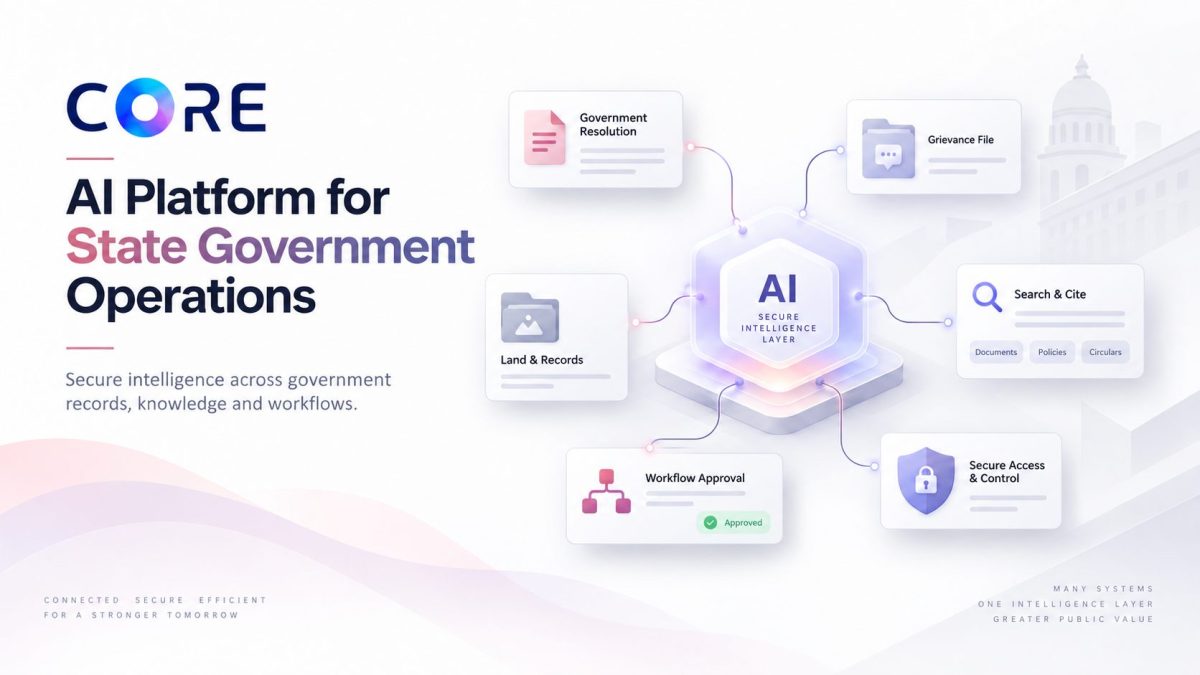
An AI platform for state government operations becomes useful when the information an officer needs already exists, but is scattered across Government Resolutions, circulars, case files, scanned records, grievances, departmental systems and policy documents. The challenge is not simply digitising more records. It is helping authorised officers find the current information quickly, understand what changed, trace the source and move the right workflow forward.
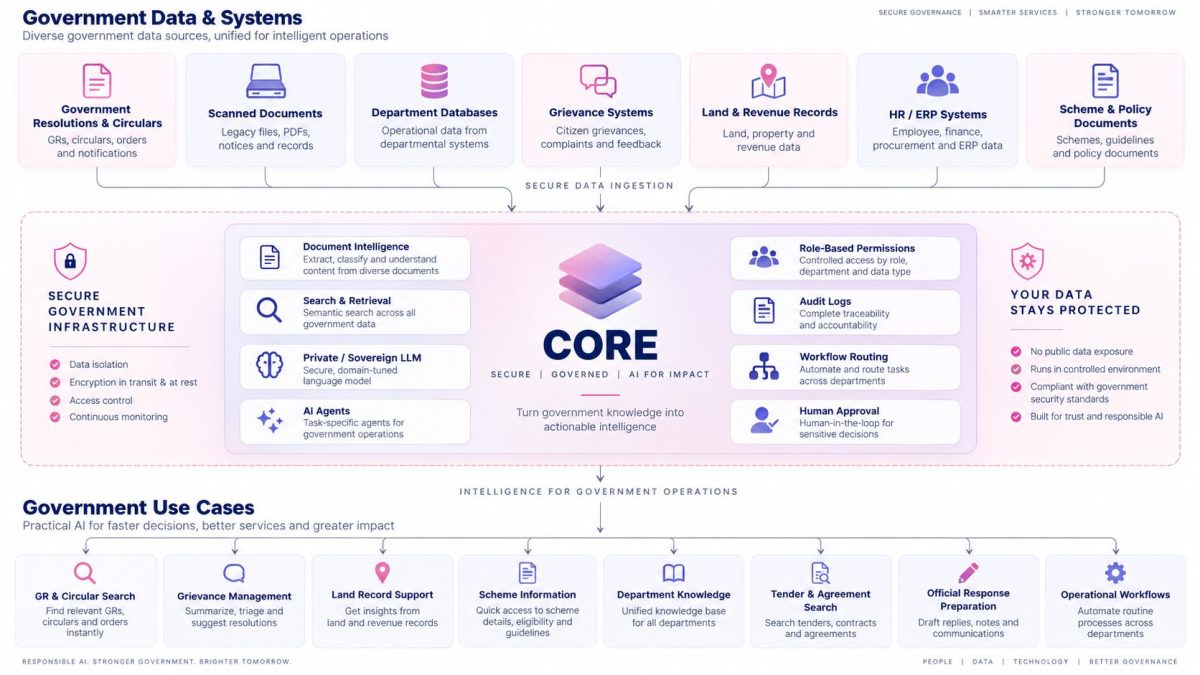
CORE is designed as a governed intelligence layer over that existing State record. It combines document intelligence, search and retrieval, private or sovereign LLM capability, permissions, audit trails, workflow routing and human approval. The system can support questions in the officer’s working language, return answers with source evidence, and keep the final decision with the competent authority.
1. The Challenge: Why is government information still difficult to act on?
Government departments can have digital portals, scanned records and online workflows while officers still spend significant time finding the right document, checking whether it is current and understanding which action belongs to whom.
Context: Digitisation does not automatically make information answerable
A scanned records room is still a records room if the documents are difficult to search, versions are not connected and the user cannot see which rule is currently in force. This is why government document intelligence matters: the system must be able to read, structure, classify and retrieve information from the record rather than merely store files.
Key Pain Points This AI Solution Addresses
- Government Resolutions, circulars and amendments can be difficult to search across departments and years.
- Officers may find an older version of a rule without immediately seeing what later amended or superseded it.
- Grievances and departmental cases can move into queues without clear ownership, deadlines or escalation.
- Important records may exist in Marathi, English, scanned Devanagari documents and older archival formats.
- Preparing an official response often requires gathering evidence from several files and systems under time pressure.
- Sensitive citizen and departmental information requires controlled access rather than unrestricted use of public AI tools.
- Separate AI tools for every department can create repeated security, integration and governance work.
Why Traditional Approaches Fall Short
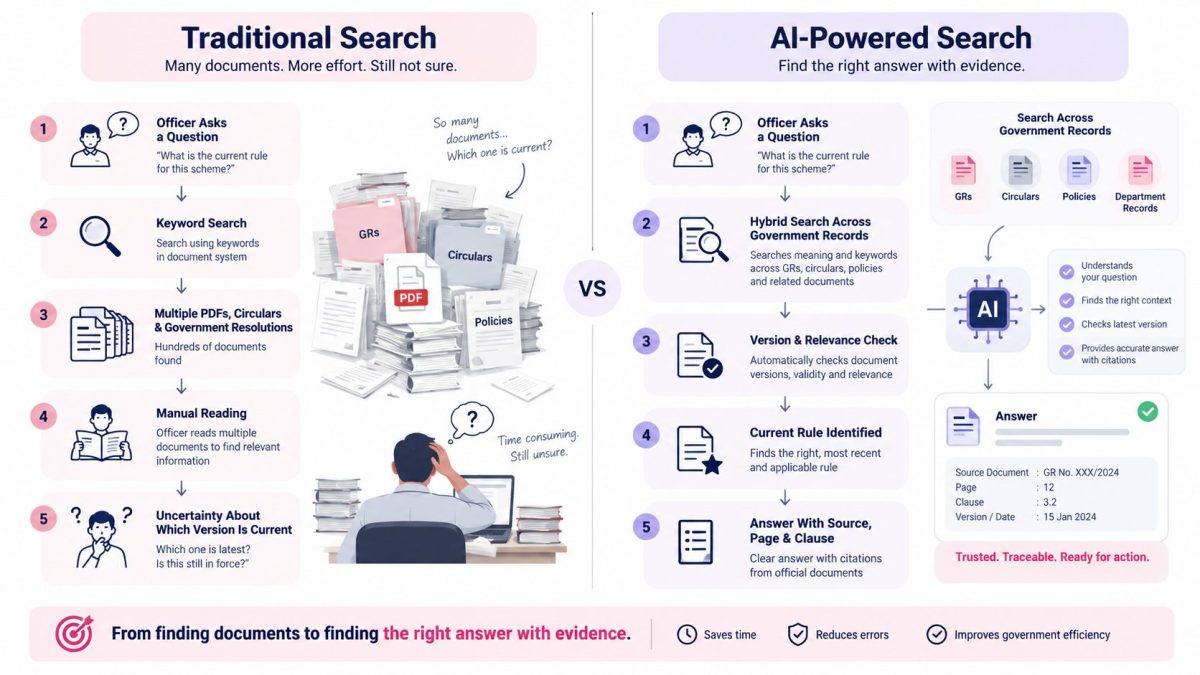
Conventional keyword search is useful when the officer knows the exact document number or phrase. It is weaker when the officer asks a natural-language question such as “What is the current ceiling under this scheme?” Government work needs both exact retrieval and meaning-based retrieval, together with a way to identify the relevant version.
A general-purpose AI assistant creates a different problem: it may answer from general model knowledge rather than the State’s approved record. For administrative work, the useful answer is not simply fluent. It must be grounded in the relevant record and show the document, page or clause that supports it.
2. The AI Solution Concept: What is an AI platform for state government?
It is a shared intelligence layer that connects government records, approved systems and departmental workflows without turning the AI itself into the decision-maker.
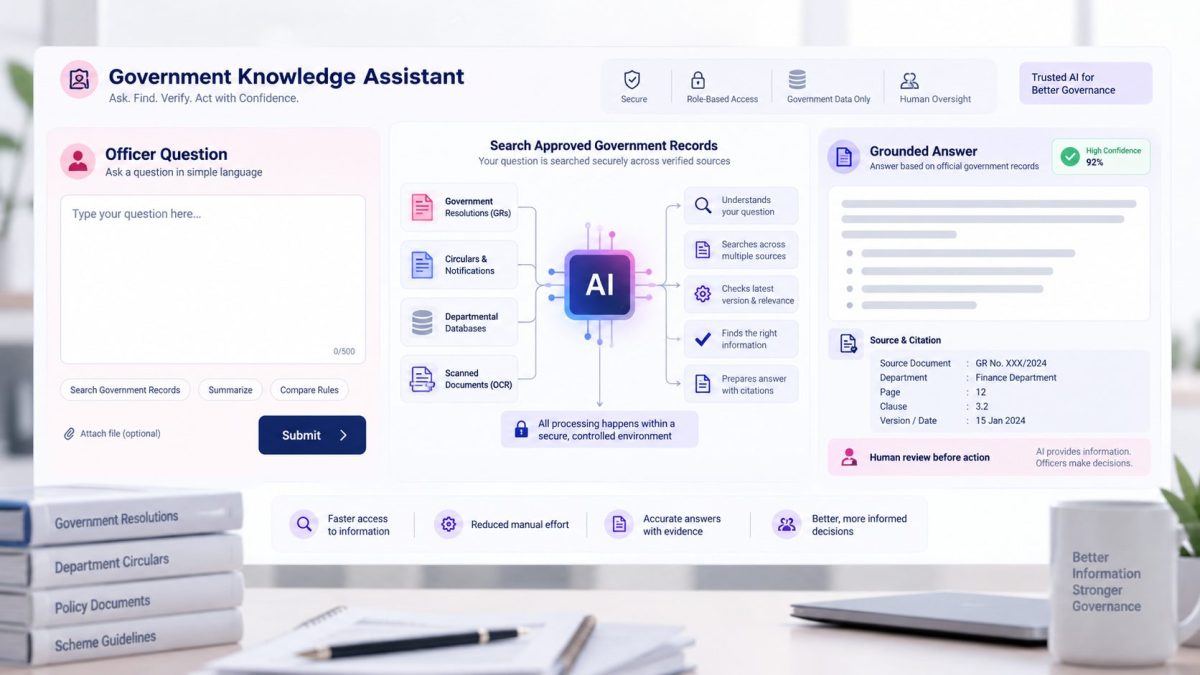
CORE ingests and indexes approved documents and data, retrieves the relevant evidence for a question, and uses a private or sovereign model to compose an answer from that retrieved context. Permissions are checked before retrieval, audit logs record what happened, and workflows can route exceptions or approvals to the right officer.
This makes CORE more than a private LLM. The LLM is one component inside a broader sovereign AI platform for government that also includes document intelligence, search, version control, orchestration, workflow, access control, citations and human review.

Vision & Objectives
- Bring Government Resolutions, circulars, case files, grievances and departmental knowledge into one governed search layer.
- Ground answers in approved government records using retrieval-augmented generation.
- Support deployment inside State-controlled infrastructure where required.
- Apply access controls before documents are retrieved for the model.
- Return traceable answers with source documents and citations.
- Support multilingual government workflows, with Marathi retrieval and citation accuracy validated on the department’s own corpus during the pilot.
- Keep officers responsible for decisions, approvals and actions with legal or administrative effect.
3. Where can AI support real State Government operations?
The strongest use cases are not generic chatbots. They are repetitive administrative workflows where the answer depends on the State’s own records and where traceability matters.
Government Resolution and circular search
An officer asks which rule is currently applicable. Government resolution AI search combines exact keyword retrieval with meaning-based search, then surfaces the relevant Government Resolution, amendment or clarification together with the supporting source. The officer can review what is current and what it replaced before acting.
Government grievance management
A government grievance management system can use AI to classify incoming grievances, retrieve related records, route the case to the appropriate workflow and highlight overdue or unresolved items. The system assists triage and follow-up; the authorised officer remains responsible for disposal and final action.
Land and revenue record support
Revenue and land-related workflows often depend on scanned records, older entries, supporting orders and multiple document formats. AI can help authorised officers retrieve and compare relevant information faster, while title determination and other legally consequential decisions remain outside the AI.
Scheme, policy and eligibility information
Departments can use grounded search across scheme guidelines, circulars and policy documents to answer operational questions from the approved corpus. This reduces the need to manually search several files before identifying the rule currently in force.
Department knowledge and official response preparation
For departmental notes, Assembly responses or time-sensitive official communication, the platform can retrieve supporting records, draft a response and attach the provenance behind each important statement. The draft remains subject to officer review and approval.
Tender, agreement and administrative document search
Authorised users can search tenders, agreements, office orders and related correspondence using natural language while retaining document-level permissions and citations. This is a practical form of government knowledge management system functionality over the State’s own corpus.
Ready to explore one high-value government workflow with CORE?
Talk to Our AI Team4. How does the State Government AI platform work?
The platform works by bringing approved records into a governed retrieval pipeline, applying access control before search, and using AI only after the relevant source material has been found.
Data Acquisition: What can the platform work with?
The source material can include Government Resolutions, circulars, office documents, scanned records, grievance threads, scheme documents, tender papers, departmental correspondence, databases and selected live system feeds. Integrations should be scoped around the department’s actual systems, with reads handled through approved APIs, extracts or replicas rather than uncontrolled access to production systems.
The AI Processing Pipeline
- Ingestion & Normalisation: Documents and approved records are parsed, classified and tagged with useful metadata such as department, date, subject and classification.
- Language & Document Processing: Marathi and English content can be brought into the same searchable corpus, including Devanagari text recovered from scans where extraction quality is sufficient.
- Hybrid Indexing: A semantic index and conventional keyword index work together so both natural-language questions and exact document references can be retrieved.
- Version & Relevance Check: Related amendments, clarifications and superseding records can be linked so the retrieval layer can surface the most relevant current source.
- Private LLM Reasoning: A model running in the approved environment composes the answer from the retrieved passages rather than relying on unrestricted general knowledge.
- Access & Governance: Role-based controls filter what can be retrieved before the model receives the context.
- Grounded Answer Delivery: The response includes the source document and supporting citation. If the available corpus does not support an answer, the system should say so rather than guess.
Human-in-the-Loop: Where Human Judgement Still Matters
- Officers confirm whether the retrieved rule or evidence applies to the case before taking action.
- Grievance disposal, land-title decisions, sanctions, tender approvals and other legally significant actions remain with the competent authority.
- Outbound communications, escalations and approvals can be configured as explicit human review steps.
- Departments define access rights, source systems and workflow boundaries before deployment.
- Marathi and other multilingual workflows should be evaluated on the department’s own documents during the pilot.
5. What technologies power this sovereign AI platform for government?
The technology stack combines private AI with retrieval, document processing, permissions, workflow and audit controls.
- Document intelligence Technology that extracts, classifies and structures information from documents, scans and records : Converts government records into searchable, usable information.
- Retrieval-augmented generation A method that retrieves relevant approved records before an AI model generates its answer : Helps keep answers grounded in the department’s own corpus.
- Hybrid search A retrieval approach that combines meaning-based search with exact keyword matching : Supports both natural-language questions and exact GR, circular or document references.
- Private / sovereign LLM A language model operated within an approved customer-controlled environment rather than a public consumer chatbot : Supports controlled language understanding and answer generation.
- Role-based access control A permission model that restricts data and actions according to the user’s authorised role : Prevents unauthorised records from entering the retrieval context.
- Workflow orchestration A software layer that routes tasks, exceptions and approvals through controlled process steps : Enables government workflow automation without removing human approval.
- Audit logs Records of questions, retrieved sources, generated outputs, approvals and system events : Supports traceability and review.
- Evaluation layer A testing layer used to measure retrieval and answer quality against labelled questions or expected outputs : Helps departments validate quality before expanding a workflow.
6. What benefits can State Government departments expect?
The value comes from making existing government information easier to retrieve, verify and act on while preserving administrative control.
- Faster access to current rules: Officers can move from manual document hunting to grounded retrieval with citations.
- Better institutional knowledge: Departmental records become easier to search even when experienced staff move roles.
- Clearer grievance workflows: Cases can be routed, tracked and escalated with better visibility into ownership and delay.
- More traceable official responses: Drafts can carry the underlying source information needed for review.
- Multilingual access: Government information can be made easier to query in the officer’s working language, subject to corpus-level validation.
- Reusable platform foundation: Multiple departmental applications can reuse the same governed ingestion, retrieval, permissions and audit layer.
- Controlled AI adoption: Departments can begin with one measurable workflow instead of attempting a large multi-department rollout from day one.
7. How should a State Government measure the value of this AI platform?
The business case should be based on measurable administrative outcomes rather than the number of AI features deployed.
- Information retrieval time: Compare how long officers take to locate the relevant rule or supporting record before and after the pilot.
- Answer traceability: Measure how consistently responses include the correct source document and citation.
- Grievance handling visibility: Track ownership, overdue cases and escalation time where the workflow is in scope.
- Draft preparation effort: Measure time spent assembling evidence for departmental notes or official responses.
- Retrieval accuracy: Test the platform against a labelled set of real departmental questions.
- Cost per query or workflow: Use telemetry to understand operating cost before expanding to more departments.
A practical pilot can begin with a bounded corpus such as Government Resolutions and circulars, run alongside the current process, and expand only after retrieval quality, governance and value are demonstrated on real departmental work.
8. What should departments check before implementation?
The most important questions are not only about the model. Departments need clear decisions on data boundaries, access rights, source quality, integrations, deployment and human approval.
- Deployment model: Decide whether the platform should run in a State-controlled cloud environment, on-premise infrastructure or an air-gapped setup where required.
- Data sovereignty: Define where records, indexes, model inference, logs and backups are allowed to reside.
- Permissions: Map roles and document access before retrieval is enabled.
- Corpus readiness: Assess document quality, scan quality, metadata and version relationships before promising answer quality.
- Marathi validation: Test retrieval and citation accuracy on the department’s own Marathi documents during the pilot.
- Integration scope: Define which systems are read-only, which require write-back and which actions need staged approval.
- Auditability: Retain the information needed to reconstruct how a response was produced and approved.
- Evaluation: Use real questions and labelled expected answers to measure performance before scaling.
What CORE Will Not Do
CORE reads, extracts, retrieves, drafts, flags and routes. It does not dispose of a grievance, determine title to land, sanction a claim, approve a tender or take another action with legal effect. A competent authority remains responsible for the decision and sign-off.
Grounded answers are designed to be auditable and reviewable, not infallible. If the approved record does not contain enough information to answer a question, the safer behaviour is to decline or escalate rather than invent an answer.
9. Who can use this AI platform for state government operations?
The platform is most relevant to departments where administrative work depends heavily on documents, rules, records, case movement and traceable answers.
- Revenue and land administration teams working with records, orders and supporting case documents.
- Grievance and citizen-service teams that need routing, tracking and escalation support.
- Scheme and policy teams answering questions from guidelines, circulars and Government Resolutions.
- Departmental secretariats preparing notes, briefings and official responses from multiple sources.
- Procurement and administrative teams searching tenders, agreements and supporting records.
- IT and digital-governance teams building a reusable, governed AI layer across departments.
10. Frequently Asked Questions
What is an AI platform for state government?
An AI platform for state government is a governed technology layer that helps authorised users search government records, retrieve evidence, generate grounded answers and support workflows. In this solution, the LLM is one component alongside document intelligence, retrieval, permissions, audit logs and human approval.
Is CORE simply a private LLM?
No. The private or sovereign LLM provides language understanding and answer generation, but CORE also includes document ingestion, hybrid retrieval, access control, workflow orchestration, citations, auditability and evaluation. The surrounding platform is what makes the model usable for controlled government workflows.
Can government data remain inside a State-controlled environment?
Yes. The platform can be designed for State-controlled cloud, on-premise or air-gapped deployment models depending on the department’s security and infrastructure requirements. The exact data boundary should be defined for documents, indexes, inference, logs and backups before implementation.
Can the platform work with Marathi government records?
The solution is designed for multilingual workflows and can work with Devanagari content. However, Marathi retrieval, OCR and citation accuracy depend on the actual corpus, so performance should be tested and proven on the department’s own documents during the pilot rather than assumed in advance.
What happens when the government record does not contain the answer?
In grounded mode, the system should state that the available corpus does not support the answer rather than filling the gap from general knowledge. This behaviour is important for administrative and compliance-oriented use cases.
Will CORE make decisions on behalf of government officers?
No. CORE can read, retrieve, extract, draft, flag and route information, but decisions with administrative or legal effect remain with the competent authority. Human approval can be built directly into the workflow and recorded in the audit trail.
Build a Governed State Government AI Solution With Softlabs Group
Softlabs Group can design and implement an AI platform for state government operations around the department’s own documents, systems, permissions and workflows. The engagement can begin with one bounded use case, such as Government Resolution intelligence or departmental knowledge search, before expanding to additional applications on the same governed core.
The implementation can combine enterprise AI development , document intelligence, private AI deployment and workflow integration while keeping human authority at the centre of the process.
Note on this page: CORE is a Softlabs Group platform. The State Government applications described here are proposed applications of the platform and should not be read as a claim of deployment, contract or endorsement by any specific State Government or department. Capabilities such as multilingual retrieval, OCR quality and integration performance should be validated against the customer’s own records and systems during implementation.