 India
India  Mongolia
  Sweden
  Australia

Executive Summary: The Revenue Gap Between Market Reality and Published Fares
Your revenue management team sets fares each morning. By midday, a competitor has undercut your highest-demand route, search volume has spiked on another market for reasons no one spotted yet, and the next scheduled pricing review is still hours away. That gap – between where the market is and what your published prices say – is precisely where airline revenue erodes quietly and consistently. An AI-based dynamic pricing solution for airlines closes that gap by replacing periodic manual updates with a continuous, data-driven pricing engine that reads demand signals, models competitor behavior, and publishes adjusted fares on direct and NDC channels in near real time.
This page explains what this solution actually is, how its technical pipeline works, what it realistically delivers, and what any airline needs to consider before building or deploying it. The goal is an honest, informed picture – not a vendor promise.
1. Why Does Legacy Airline Pricing Keep Leaving Revenue on the Table?
Legacy fare management leaves airline revenue on the table because pricing cycles move far slower than market conditions. The mismatch between a commercial team’s capacity and the speed of real demand is the root cause – not strategy failures or bad data alone.
Context: The Commercial Environment Where This Problem Lives
Airline pricing sits at the intersection of perishable inventory, competitive markets, and complex distribution systems. A single medium-haul network carrier may manage thousands of origin-destination pairings, each with its own demand curve, booking window behavior, and channel mix. Historically, Revenue Management Systems (RMS)Software platforms that control how seats are allocated across pre-defined booking classes and when fare levels open or close based on load factor rules governed this by dividing inventory into a fixed set of booking classes and opening or closing them based on load factor thresholds. That approach worked when pricing changes took days to propagate through distribution channels. Markets now move in minutes, and the operational pressure on commercial teams has compounded accordingly.
In practice, airlines deploying early AI pricing pilots typically encounter a version of the same surprise: the problem is not the math. It is the gap between what a model recommends and what the current data pipeline, distribution infrastructure, and analyst workflow can actually act on in time. Fragmented systems, stale inventory feeds, and rigid reservation architecture slow the signal-to-response chain at every step.
Key Pain Points This AI Solution Addresses
- Airline revenue being left on the table from legacy pricing: Fixed booking class structures prevent granular price adjustment between major fare levels, creating gaps where genuine demand exists but pricing does not capture the full yield available.
- Manual fare updates too slow for fast-moving markets: A commercial analyst reviewing fares on a morning schedule cannot respond to demand shifts that occur at 11pm when bookings open following a newly announced event on a key route.
- No real-time pricing response to competitor changes: When a competitor drops fares on a shared route, legacy workflows require manual detection, internal approval, and a full distribution update cycle – losing booking momentum in the process.
- Demand forecasting too inaccurate during disruptions: Traditional time-series forecasting breaks down during irregular operations, major events, or sudden market shifts, forcing commercial teams to fall back on intuition rather than reliable data.
- Pricing decisions not using all available demand signals: Search volume trends, no-show rates, cancellation patterns, ancillary take-up behavior, and loyalty booking signals all carry pricing intelligence that manual workflows cannot process at route scale.
- Airline commercial team overwhelmed with manual fare management: Analysts spend a significant share of each week on repetitive monitoring and adjustment tasks that an automated airline fare management platform with AI can handle continuously and more reliably.
- Competitor airlines responding faster to market changes: Airlines with AI-assisted pricing operate at a structural speed advantage in competitive markets – capturing booking momentum that slower-moving carriers lose by default on every overlapping route.
Why Traditional Approaches Fall Short
The comparison between an AI airline pricing platformA software system that uses machine learning and real-time data feeds to continuously adjust fare levels and bundled offers based on demand, competition, and inventory state and a traditional RMS reveals a structural limitation – not just a performance gap. Legacy systems optimize within constraints they were designed for: a fixed set of booking classes, rule-based opening and closing logic, and periodic analyst review. They do not fail because of poor design. They fail because those constraints no longer match market speed or the breadth of data now available. According to OAG’s 2025 analysis of live shopping data, only around one in four air ticket offers in 2024 were dynamically created – meaning the vast majority of airline prices still move through static frameworks that respond to the market on a schedule, not in real time.
Specifically, traditional approaches fall short on three fronts. First, they cannot process demand signals originating outside the RMS in real time – search behavior, event calendars, and competitor snapshots all require manual interpretation before influencing a fare decision. Second, they treat fare adjustment as a discrete event rather than a continuous optimization problem, leaving prices static between review cycles. Third, they were built to manage inventory allocation, not to optimize a combined offer across base fare, ancillary bundle, and channel simultaneously. AI-driven demand forecasting and pricing tools for airlines address all three gaps within a single decision pipeline.
2. What Is an AI-Based Dynamic Pricing Solution for Airlines?
An AI-based dynamic pricing solution for airlines is a guardrailed pricing and offer decision engine that sits as an overlay alongside existing reservation and distribution systems – not replacing them. It reads signals from the Passenger Service System (PSS)The core airline technology platform managing reservations, inventory, check-in, and ticketing – the system of record for seat availability and booking state, from fare filing infrastructure, and from external market sources. Then it runs predictive models and returns adjusted fare or bundle recommendations through direct and New Distribution Capability (NDC)IATA’s XML-based API standard enabling airlines to deliver dynamically constructed fare and ancillary content through travel agents and aggregators, beyond the constraints of traditional GDS fare classes channels – while retaining legacy fare logic as the ticketing and accounting base.
That overlay architecture is deliberate. Full airline retail transformation – completely class-free pricing across every channel and partner flow simultaneously – remains a long-horizon industry goal. A buildable, deployable AI-based dynamic pricing solution for airlines today focuses on the channels the carrier controls most directly: its website, mobile app, and selected NDC connections. IATA’s Dynamic Offers framework confirms that contextual pricing – using signals like days before departure, remaining capacity, and competitive positioning – does not require additional personal data, and that the core constraint of legacy systems is not the underlying math but the hard ceiling of 26 booking classes that limits how precisely a price can match the actual demand curve at any moment. A well-scoped AI airline pricing platform captures exactly this contextual uplift within practical constraints.
Vision and Objectives
- Continuous fare responsiveness: Move from periodic analyst-driven review cycles to a system that monitors demand signals around the clock and adjusts within approved corridors without waiting for a scheduled update.
- Competitive awareness at scale: Automatically detect competitor fare movements on monitored routes and evaluate whether to match, hold, or differentiate on ancillary value – faster than any manual workflow allows.
- Full demand signal integration: Incorporate booking pace, search behavior, cancellation trends, event calendars, and historical booking patterns into a single decision context per shopping request.
- Ancillary offer optimization: Adjust the composition of bundle offers – seat upgrades, baggage allowances, flexibility options – based on propensity models for each departure and cabin rather than uniform segment-level rules.
- Analyst empowerment rather than replacement: Shift analyst effort from repetitive fare monitoring to strategic oversight, exception handling, and simulation – tasks where human judgment adds genuine value above what the model produces.
- Controlled rollout with hard fallbacks: Deploy route by route with clear rollback capability to filed fares at any time, ensuring the system never becomes a single point of failure for revenue operations.
3. How Does an AI-Based Dynamic Pricing Solution for Airlines Perform Across Different Carrier Types?
Network Carrier: Capturing Demand Surges Before Competitors Do
Your route to a key city shows a 300% search spike this morning – because a major event was announced last night while your pricing team was offline. By the time the Monday briefing runs, competitors have already moved.
Network carriers managing hundreds of origin-destination pairs cannot manually detect and respond to every demand trigger across every market. Review cycles run on analyst schedules; demand does not. An intelligent fare optimization platform for network carriers connects event calendars, real-time search demand feeds, and live booking pace into a single demand model. When the surge signal crosses a pre-configured threshold, the engine adjusts fares within approved corridors on direct and NDC channels automatically. Analyst review is flagged simultaneously; revenue protection does not wait for it. The measurable outcome is earlier capture of peak-demand yield before competitive displacement erodes it.
Low-Cost Carrier: Responding to Competitor Fare Moves in Minutes
Your highest-volume route was undercut at 11pm by a competitor’s promotional fare. You will not know until the morning briefing – and by then booking momentum has already shifted away.
For low-cost carriers competing primarily on price, delayed response is a structural disadvantage. Manual monitoring runs on analyst schedules; bookings do not pause for them. An AI airline revenue management tool for low-cost carriers monitors competitor fares on watched routes through automated snapshot feeds and flags movements to the decision engine in near real time. Within approved guardrails, the system evaluates whether to match, hold position, or differentiate on bundle value instead. Commercial policy sets the boundaries; AI executes the evaluation inside them at speed. The measurable outcome is a response time to competitor moves that drops from hours to minutes on monitored routes, with a complete audit trail of every decision made.
Regional Airline: Maximizing Ancillary Revenue Per Departure
You know Friday evening leisure flights convert better with seat upgrade offers, but manually configuring departure-level bundle logic across fifty routes is impossible at your current commercial team size.
Regional carriers often carry the strongest ancillary opportunity but the smallest teams to act on it. Uniform bundle rules applied across all departures leave revenue behind where specific flights show unusually high upgrade appetite. An AI yield management platform builds propensity models for ancillary take-up at the departure, cabin, and booking-window level. The decision layer then adjusts bundle composition per departure based on current inventory state, historical ancillary conversion, and remaining seat mix – without changing the base fare strategy. The measurable outcome is higher ancillary revenue per booking on high-propensity departures, with no additional commercial headcount or manual configuration required.
Ready to explore what this solution looks like for your organisation?
Talk to Our AI Team4. How Does the AI-Based Dynamic Pricing Solution for Airlines Process Each Fare Decision?
This solution uses a request-driven architecture, not a batch update cycle. When a shopper requests a fare, the engine processes a complete decision in near real time – reading fresh features, running predictive models, applying rules, and returning a channel-ready price within the latency constraints of a live shopping experience.
Data Acquisition: What the System Reads Before Pricing a Request
Every pricing decision draws on multiple real-time and periodically refreshed data sources. Shopping request data provides origin-destination pair, travel dates, cabin class, passenger mix, and channel identity. Inventory state from the PSS supplies remaining seat counts and class availability at the moment of the request. Booking pace feeds capture how reservations are arriving relative to historical patterns for equivalent departures at the same point in the selling window. Filed fare data from the fare filing system establishes the legal and accounting base that ticketing must honor. Competitor fare snapshots from market monitoring feeds provide the external competitive context. Reference data covering event calendars, seasonal demand patterns, school holiday periods, and route market groupings completes the demand picture.
A common pattern across real implementations of this solution is that the data acquisition layer takes longer to stabilize than the model development work. Airlines commonly hold booking and inventory data across three or four separate systems with different schemas, different update latencies, and different completeness levels. The ingestion strategy must account for stale feeds, missing fields, and late-arriving events from day one – not as an edge case to address later.
The AI Processing Pipeline
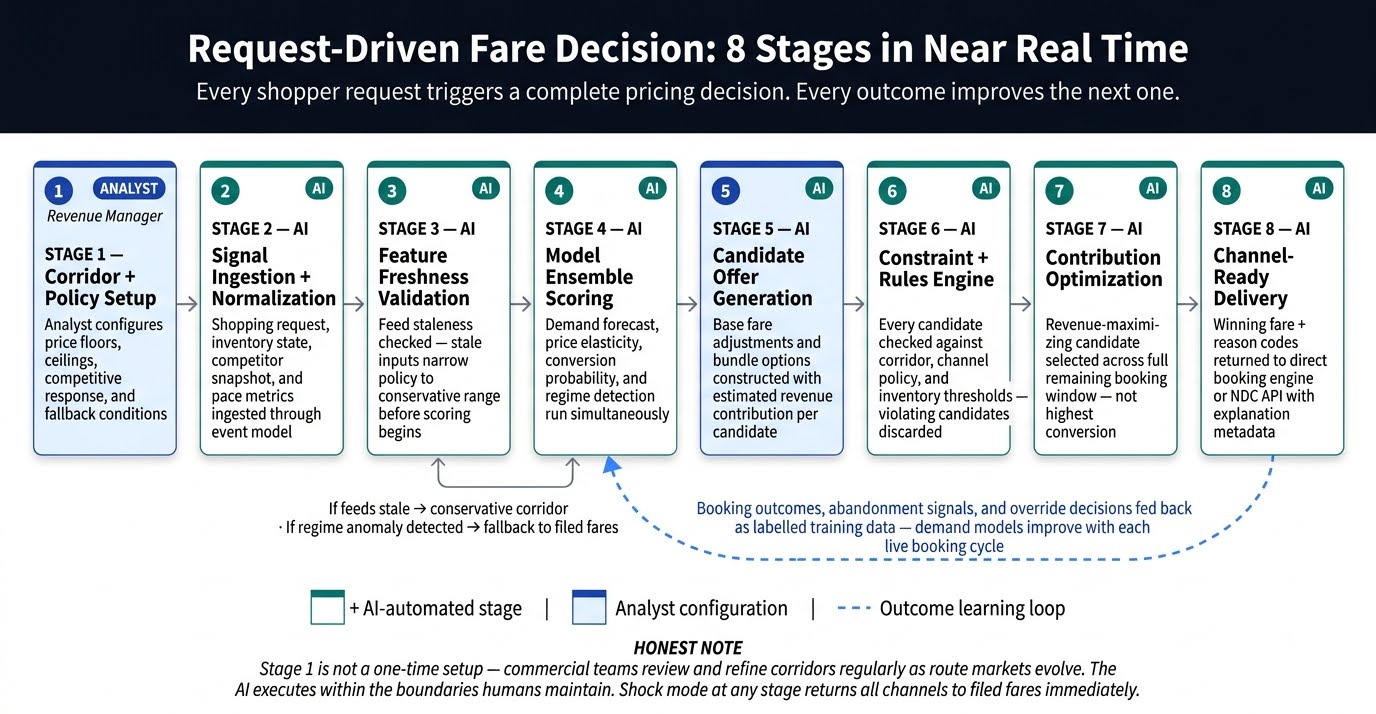
- Signal Ingestion and Normalization: First, all incoming data events – shopping requests, booking confirmations, cancellations, inventory updates, competitor fare snapshots, and filed fare changes – flow into a canonical event modelA standardized internal data schema that normalizes events from multiple airline source systems into a consistent, queryable format regardless of the original system’s structure through source-specific adapters. Each event passes through a data quality validator that checks completeness, schema conformance, and timestamp freshness. Incomplete or stale events receive a confidence tag rather than being discarded, so downstream logic knows exactly how much to trust each feature at decision time.
- Feature Freshness Validation: Before any model scores a pricing request, the engine checks the age and completeness of every feature in the request context. If the inventory snapshot exceeds a defined staleness threshold, if a competitor feed has not updated within its expected window, or if booking pace metrics show an anomaly flag, the system automatically narrows the decision policy to a safer, more conservative range. This step prevents models from generating confident price recommendations on inputs that are no longer reliable.
- Model Ensemble Scoring: Next, the validated feature set passes to a parallel set of predictive models running simultaneously. A demand forecast model estimates booking probability across the remaining selling period for this departure. A price elasticityThe measured sensitivity of booking demand to a price change on a specific route, cabin, and booking window – quantifying how many bookings are gained or lost per unit of price movement model estimates how demand would respond to upward or downward price movement. A customer choice probability scorer rates conversion likelihood at each candidate price point. An anomaly and regime detectionA model component that identifies when current market conditions fall outside the historical patterns the forecasting models were trained on, triggering a safe fallback rather than an unreliable prediction component flags whether current conditions resemble the distribution on which the models were trained – and downgrades the decision confidence if they do not.
- Candidate Offer Generation: Using model outputs, the engine constructs a set of candidate actions for this request. Options might include a base fare with a positive adjustment, a base fare with a negative adjustment to stimulate early booking, a bundled offer pairing the base fare with selected ancillaries, or a static fallback returning the filed fare without modification. Each candidate carries an estimated revenue contribution score derived from conversion probability weighted against seat scarcity and remaining selling time.
- Constraint and Rules Engine: Every candidate then passes through a hard constraint layer. This layer enforces price corridor floors and ceilings by route, cabin, season, and booking window. It checks compatibility with fare-family logic and the downstream ticketing base. It applies channel-specific rules – a price point valid on the direct website may not be publishable through a legacy OTA connection. It also enforces inventory protection thresholds to ensure high-yield seat classes are not diluted by aggressive discounting on low-load departures. Any candidate that violates a constraint is discarded before the optimizer evaluates it.
- Contribution Optimization: The constrained optimizerA decision-making component that selects the revenue-maximizing offer from a set of constraint-validated candidates, balancing immediate conversion value against the probabilistic yield of selling remaining seats later at higher prices selects the candidate that maximizes expected revenue contribution across the full remaining booking window – not just the candidate with the highest immediate conversion probability. This distinction matters in practice: a system optimizing only for conversion tends to drive prices downward to capture cheap early bookings, destroying the yield available from later high-value demand closer to departure.
- Channel-Ready Delivery: The winning offer is formatted for the target channel and returned through the appropriate interface – the airline’s direct booking engine, mobile app API, or NDC API endpointAn IATA-standard application programming interface through which airlines deliver dynamically constructed fare and ancillary offers directly to travel agent systems and aggregators. Every response carries structured explanation metadata: reason codes such as demand surge detected, low remaining inventory, high conversion probability, or ancillary upsell opportunity. These codes serve analyst review, regulatory audit, and ongoing model monitoring simultaneously.
- Outcome Capture and Retraining Loop: After the transaction resolves – whether the customer books, abandons the session, or selects an ancillary – the system writes that outcome back as a labeled training event. These events feed model monitoring dashboards tracking prediction accuracy and revenue lift versus baseline in near real time. Periodic retraining cycles incorporate accumulated outcomes so the models improve continuously from live-market results rather than remaining fixed on historical training data alone.
Human-in-the-Loop: Where Human Judgment Still Matters
This solution automates the high-frequency, repetitive decision layer – not the commercial strategy layer. Several decision types explicitly retain human oversight in a well-designed deployment.
- Route and market strategy: Analysts configure price corridors, floor and ceiling levels, and competitive response policies per route. The AI operates within those boundaries; it does not set them.
- Unusual uplift approvals: When the engine recommends an adjustment above a defined percentage threshold – during a sudden demand spike or a sharp competitor move – the system flags the decision for analyst review before it goes live on that route.
- New route cold starts: Routes without sufficient booking history default to conservative analyst-supervised pricing until enough data accumulates for reliable model inference. Deploying the model on insufficient data is worse than holding the simpler logic longer.
- Shock mode activation: During major irregular operations, geopolitical disruptions, or confirmed upstream data degradation, analysts can freeze dynamic adjustment across affected markets with a single control-plane action, returning immediately to filed fares across every impacted channel.
- Ongoing model review: Scheduled analyst reviews examine prediction accuracy, revenue lift versus baseline, and any drift in model behavior – ensuring system recommendations stay aligned with commercial objectives as market structure evolves.
Teams that have worked through airline pricing transformation consistently find that analyst roles shift rather than shrink. Less time goes to manual fare monitoring; more time goes to strategy oversight, exception handling, and competitive intelligence – tasks where domain expertise compounds the value AI signal processing cannot replicate on its own. The agentic architecture underlying this decision layer is designed explicitly to keep the human strategist in the loop at the points where judgment matters most.
Output and Interaction: What the Analyst and Shopper See
For the shopper, the output is a fare – presented through the airline’s normal booking interface with no visible difference from a standard fare response. For the commercial analyst, the output is a control-plane console showing live pricing decisions across active routes, recommendation dashboards with reason codes and confidence levels, alert feeds for outlier decisions or data quality degradation, and simulation tools for testing proposed corridor changes against historical demand scenarios before pushing them live.
That combination of a live decision feed and a simulation environment is what separates a robust airline pricing automation solutionA technology system that automates the generation, evaluation, and publication of fare adjustments based on real-time data inputs and commercially defined pricing rules from a black-box model. Analysts can interrogate every decision, understand the reason code driving it, and adjust boundary conditions through configuration rather than model retraining.
5. What Technologies Power an AI Airline Pricing Platform?
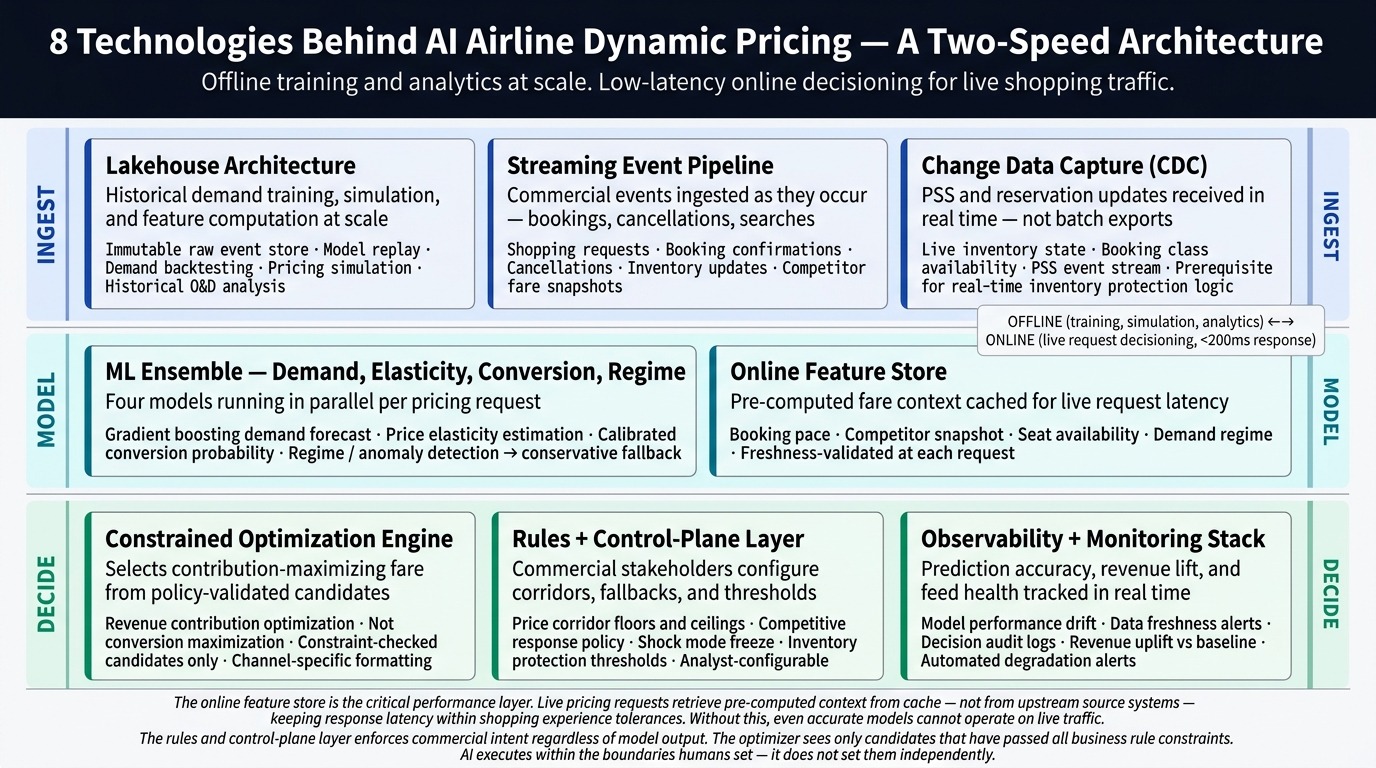
A production AI airline pricing platform requires a two-speed architecture: an offline training and analytics environment for model development and feature engineering, and a low-latency online decisioning layer for live shopping traffic. These serve different performance requirements and should not share the same infrastructure design.
- Lakehouse architectureA data storage and processing design combining the scalability of a data lake with the governance and query performance of a data warehouse, supporting model training, analytics, and feature computation on the same dataset: Powers historical demand training, pricing simulation, and feature computation at scale. Stores every event in immutable raw form so that model updates and mapping corrections can be replayed against identical historical data without permanent data loss.
- Streaming event pipelineA real-time data infrastructure that ingests, validates, and routes high-volume commercial events – bookings, cancellations, shopping requests, inventory changes – in near real time using message queue technologies: Ingests commercial events – shopping activity, booking confirmations, cancellations, inventory changes – as they occur. A separate batch pipeline handles slowly changing reference data like fare family metadata, route market groupings, and partner channel mappings.
- Online feature storeA low-latency data service that pre-computes and caches route-level, flight-level, and search-level features so predictive models can access fresh context within milliseconds during a live pricing request: Caches pre-computed features – current booking pace, seat availability, competitor snapshot, and demand regime classification – so that live pricing requests retrieve fresh context without querying upstream source systems at request time, keeping response latency within shopping experience tolerances.
- ML ensembleA group of multiple machine learning models whose outputs are combined to produce more reliable demand and elasticity predictions than any single model, with gradient boosting models typically handling the core demand and conversion tasks: Gradient boosting models handle demand forecasting and price elasticity estimation. Calibrated classifiers produce conversion probability scores at the offer level. Anomaly and regime detection models flag when current conditions fall outside the training distribution and trigger conservative fallback logic rather than unreliable predictions.
- Constrained optimization engineA decision-making component that selects the revenue-maximizing action from a set of validated candidates by optimizing an objective function – such as expected revenue contribution – while enforcing hard constraints like price floors, ceilings, and channel-specific rules: Selects the contribution-maximizing offer from constraint-validated candidates. This is where commercial policy becomes executable logic – the optimizer sees only candidates that have already passed all business rule checks.
- Change Data Capture (CDC)A database integration technique that streams data changes in real time as they occur in source systems, enabling the pricing engine to receive inventory and booking updates instantly rather than waiting for scheduled batch file exports: Enables the system to receive inventory and booking updates from PSS and reservation systems as they occur – not hours later when scheduled batch exports finally arrive. This is a prerequisite for any meaningful real-time inventory protection logic.
- Rules and control-plane layer: A human-configurable rules engine where commercial stakeholders set price corridors, channel policies, inventory thresholds, competitive response parameters, and fallback conditions. This layer enforces commercial intent regardless of model output and is the primary interface between airline strategy and automated decision logic.
- Observability and monitoring stack: Tracks model prediction accuracy, decision audit logs, data freshness metrics, and revenue lift versus a baseline in near real time. Automated alerts fire when model performance degrades, upstream feeds go stale, or pricing behavior departs meaningfully from expected patterns – surfacing issues before they affect revenue at scale.
6. What Results Does AI Fare Optimization Software Deliver?
AI fare optimization software delivers measurable improvements across revenue capture, operational efficiency, and competitive responsiveness – when scoped realistically to the channels and routes where data quality supports reliable model inference. The benefits below reflect what a disciplined, phased deployment of an airline revenue management AI tool produces when implementation scope matches infrastructure readiness.
- Higher revenue per seat on direct and NDC channels: Continuous fare adjustment captures demand at the price point the market will bear in the current moment rather than the price set in the last manual review cycle – directly addressing the revenue left on the table from legacy pricing structures.
- Faster competitive response across monitored routes: Competitor fare monitoring integrated into the decision engine reduces the time between a competitor price move and an evaluated response from hours to minutes, on routes where monitoring feeds are active and guardrails are configured.
- Significant reduction in analyst time spent on manual fare management: Routing repetitive monitoring and adjustment tasks to automated decision logic frees analyst capacity for the strategic and exception-handling work where human judgment genuinely adds value above what the model produces.
- More reliable demand forecasting during irregular operations: Regime detection logic identifies when current conditions differ materially from historical patterns and shifts to a conservative policy rather than generating unreliable forecasts. The system degrades safely and flags conditions for review rather than misfiring silently.
- Improved ancillary revenue without changing base fare strategy: Propensity models for seat upgrades, baggage, and flexibility options allow bundle composition to vary by departure and booking window based on actual conversion likelihood – not uniform rules applied across all flights regardless of demand profile. Ancillary services already account for nearly 14% of total airline revenue according to IATA’s 2025 industry forecast, making offer-level optimization one of the highest-leverage applications of AI in commercial aviation.
- Better use of all available demand signals in pricing decisions: Integrating search behavior, booking pace, event calendars, and cancellation trends into one pricing context means each decision reflects the full current demand picture rather than only the load factor metrics that traditional airline demand pricing tools surface.
- Auditability and explainability on every decision made: Structured reason codes on every pricing output support regulatory review, internal compliance checks, and analyst investigation – a capability that pure black-box systems cannot provide and that enterprise buyers in regulated aviation environments consistently require.
- Scalable pricing intelligence across large route networks: An AI yield management platform processes every monitored route simultaneously without the analyst-to-route ratio constraint that makes truly comprehensive manual pricing operationally impossible above a certain network size.
7. Is an AI-Based Dynamic Pricing Solution for Airlines Worth the Investment?
An AI-based dynamic pricing solution for airlines delivers measurable revenue uplift when scoped to direct and NDC channels, but the return depends entirely on the carrier’s data maturity, direct channel volume, and implementation discipline. The framework below gives enterprise buyers the structure to build that case internally.
Key Business Metrics to Measure Before and After Deployment
- Revenue per available seat on direct and NDC channels: Baseline this figure on target routes before deployment. Post-deployment, track the delta on routes where dynamic pricing is live against a control group running on existing logic. This is the cleanest indicator of revenue impact and the most credible number to bring to a CFO review.
- Average time from demand signal detection to live fare update: Measure the current analyst workflow time from identifying a market shift to publishing a fare response. The comparison on automated routes after deployment typically shows a shift from several hours to minutes – a metric with direct commercial significance in high-competition markets.
- Pricing analyst hours per route per week: Document the current manual monitoring and update burden per route before deployment. Making this operational cost visible to finance and HR stakeholders – not just revenue management – strengthens the business case for automation beyond the revenue uplift argument alone.
- Demand forecast accuracy rate during irregular operations: Measure forecast accuracy on target routes before and after implementing the AI demand model, specifically during irregular operations and demand spike periods. Traditional forecasting underperforms most severely exactly when accurate forecasting matters most; improvement here quantifies a real operational risk reduction.
- Ancillary attach rate per booking on bundle-enabled routes: For deployments including ancillary propensity optimization, this metric captures incremental ancillary revenue attributable to offer personalization rather than base fare changes – separating the two revenue impacts cleanly for reporting purposes.
Realistic Implementation and Payback Timeline
For a mid-size carrier beginning with a focused scope – direct web and app channels, a defined set of monitored routes, and data pipelines built on existing PSS and booking event feeds – a realistic timeline from project start to initial production pricing is 6 to 12 months. That range reflects the variable time airlines typically need to stabilize data ingestion, complete data quality remediation on historical records, and align commercial policy with rules engine configuration.
Payback typically falls within 12 to 18 months for a focused direct-channel deployment where the carrier holds adequate booking volume and clean-enough historical data for reliable model training. Projects that attempt broader scope from the outset – full channel coverage, all routes active simultaneously, ancillary optimization from day one – commonly stretch both the timeline and the payback horizon significantly beyond that range.
The Case for Acting Now Rather Than Waiting
What implementation experience reveals that theoretical explanations often miss is this: the competitive value of AI pricing on direct channels is not a one-time advantage that can be captured at any future date. It accrues incrementally – with each quarter of live operation producing better-trained demand models, more refined pricing corridors, and a larger stock of labeled outcomes feeding continuous improvement. Carriers that start today build a compound model quality and calibration advantage over those that delay. Airlines with established continuous pricing capability become structurally harder to catch with each passing booking cycle. That compounding effect is the honest reason to act now rather than waiting for a more “complete” solution.
8. What Does Implementing an AI Airline Pricing Solution Actually Require?
Deploying an AI-based dynamic pricing solution for airlines requires sustained attention to factors well beyond model accuracy. The following reflects what separates a successful production deployment from a pilot that never reaches operational scale. Airlines that treat integration, data quality, and commercial alignment as afterthoughts consistently find that their airline revenue management AI tool stalls before it ever goes live at scale.
- Data quality and completeness before model training: The system requires clean, consistent historical data for demand forecasting and elasticity modeling. Airlines commonly discover on audit that booking and pricing data across PSS, RMS, and distribution systems contains inconsistent schemas, duplicate events, and missing fields accumulated over years. Data remediation is not optional – it is a prerequisite for reliable model output, and it should be budgeted as a distinct project phase rather than assumed to be quick.
- PSS and distribution integration complexity: Connecting the pricing engine to live inventory, booking events, and channel APIs requires cooperation from PSS vendors, IT teams, and potentially distribution partners. These integrations take time to stabilize. Integration risk is the most frequently underestimated factor in live deployments of this type – plan for it explicitly rather than treating it as a minor implementation detail.
- Channel rollout maturity and partner constraints: Not all channels can honor dynamically computed prices in their current technical state. Legacy OTA connections and many interline or codeshare flows will require fallback to filed fares for an extended period. A realistic rollout plan starts with fully controlled direct channels and expands to NDC connections for selected partners before addressing legacy channel compatibility.
- Commercial policy alignment and analyst buy-in: The rules engine requires commercial stakeholders to explicitly define price corridors, competitive response policies, and inventory protection thresholds before the system can operate within approved boundaries. Organizations where pricing policy exists informally or is contested across teams face a governance challenge alongside the technical integration work.
- Compliance, data privacy, and regulatory awareness: Dynamic pricing in aviation faces increasing regulatory scrutiny in several markets, particularly where pricing outputs could appear to reflect individualized profiling rather than market conditions. Transparent reason codes, audit-ready decision logs, and documented policy boundaries are compliance requirements from day one – not optional additions after launch.
- Model maintenance and retraining cadence: Demand patterns shift seasonally and structurally over time. The system requires scheduled retraining cycles, monitoring for model performance drift, and a defined process for incorporating major market structure changes into the feature and training pipeline. This is an ongoing operational cost, not a one-time engineering effort that ends at launch.
- Cloud infrastructure cost management: Airlines with high search-to-booking ratios – particularly carriers with significant metasearch-driven traffic – can generate very large scoring request volumes. Selective request scoring, response caching, tiered serving logic, and route-level traffic policies are not performance optimizations; they are core to keeping infrastructure costs proportional to actual revenue impact from the outset.
Where This Solution Has Real Limits
Honest assessment of limitations is part of building a system that performs reliably in production. Any informed airline buyer should understand these boundaries before committing to a deployment scope.
- Legacy fare structures remain the ticketing base during the transition period: The overlay architecture preserves PSS and revenue accounting continuity, but it also means the full theoretical upside of completely class-free, continuous pricing across all channels cannot be realized immediately. That transformation requires PSS-level change that goes well beyond what any pricing overlay system can deliver on its own.
- Apparent personalization carries real consumer and regulatory risk: If pricing output appears to reflect individual user profiling rather than transparent market conditions, consumer backlash and regulatory action can materially outweigh the revenue gain. US Senate scrutiny of AI-assisted airline pricing – including formal letters questioning whether pricing models use personal data to set individual fares – illustrates why this risk is no longer theoretical. The guardrail architecture, reason code logging, and policy-boundary design are not engineering preferences – they are risk management requirements for any carrier operating in scrutinized markets.
- Partner channel coverage will remain uneven for years: Codeshare, interline, and legacy OTA connections will force fallback to filed fares for a meaningful share of distribution volume for the foreseeable future. Any deployment plan assuming full-channel dynamic pricing from a near-term go-live date is not grounded in distribution reality.
- Extreme regime changes break historical model assumptions: Geopolitical disruptions, major infrastructure failures, pandemic-scale demand shocks, or sudden irrational competitor pricing all push conditions outside the distribution the models were trained on. Regime detection and shock mode are essential mitigations – but they make the system safely conservative during extreme events, not reliably predictive. Human override remains essential under these conditions.
9. Which Airlines Benefit Most from Airline Dynamic Pricing Software Powered by AI?
An AI-based dynamic pricing solution for airlines delivers the highest value where direct channel volume, data maturity, and commercial team readiness create the right conditions for reliable outcomes. Size alone does not determine fit – operational readiness does. This airline demand pricing tool performs best when scope discipline is built into the programme design from the first conversation.
The ideal carrier profile combines sufficient direct booking volume to generate meaningful model training data, a commercial team willing to define and maintain explicit pricing policy boundaries, IT capacity to support PSS and data integration work, and leadership appetite for staged evidence-based deployment rather than an all-channels-simultaneously launch. Selecting airline dynamic pricing software without first assessing these internal readiness factors is one of the most common reasons programmes stall before delivering measurable returns.
This Solution Is Particularly Valuable If…
- Your commercial team spends a disproportionate share of analyst time on manual fare monitoring and competitor response rather than strategic pricing analysis – meaning automation recovers significant operational capacity alongside any revenue uplift.
- Your direct and NDC channel share is large enough that pricing improvements on those channels produce meaningful total revenue impact – typically carriers where direct and selected NDC connections represent a substantial and growing portion of total bookings.
- Your route network includes high-competition origin-destination pairs where competitor pricing moves directly affect booking momentum and where response speed has documented commercial consequences.
- Your current RMS uses fixed booking class logic without real-time demand signal integration, and your team recognizes that this creates systematic gaps in peak-demand yield capture on high-value departures.
Specific carrier profiles that benefit most include network carriers managing large domestic or intra-regional networks with competitive pressure on key O&D pairs, low-cost carriers where price competitiveness on direct channels is a primary customer retention mechanism, mid-size carriers with growing NDC distribution seeking to use that channel’s richer content capability for dynamic offer construction, and regional airlines with strong ancillary programs wanting to optimize bundle composition without adding commercial headcount.
Airlines with very low digital booking volume, significant historical data quality gaps, or no internal IT capacity for integration work will find that prerequisite investment outweighs near-term returns from deploying AI fare optimization software. For those carriers, a phased data readiness programme is a more honest and productive starting point. The right airline pricing automation solution is not always the most technically advanced one – it is the one that matches the carrier’s current data infrastructure and integration maturity.
10. Frequently Asked Questions About AI Airline Dynamic Pricing
How does an AI dynamic pricing solution for airline revenue management differ from a traditional RMS?
A traditional RMS manages pricing by opening and closing pre-defined booking classes based on load factor rules and periodic analyst review cycles. An AI dynamic pricing solution for airline revenue management goes further by processing a broader set of real-time signals – search behavior, competitor fares, event calendars, cancellation trends – and generating continuous fare adjustments rather than discrete class movements. The practical difference is speed and signal coverage: a traditional RMS updates pricing on a schedule, while an AI system evaluates every shopping request in its full market context. However, most airlines deploy the AI layer as an overlay on top of existing RMS infrastructure rather than replacing it – preserving ticketing and revenue accounting continuity while adding the continuous pricing capability that legacy systems cannot provide.
Can AI airline pricing software work alongside our existing reservation system without replacing it?
Yes – and this overlay approach is how most production deployments are designed. AI airline pricing software typically sits as a decision layer between the shopper’s request and the PSS. The PSS continues to manage inventory, ticketing, and revenue accounting using existing fare class logic. The AI layer intercepts the shopping request, computes a dynamic adjustment or bundle recommendation based on current market context, and returns a channel-ready price before the booking flow proceeds. The PSS still tickets against a valid base fare class, preserving downstream continuity for revenue accounting and distribution. Carriers do not need to replace their reservation system to deploy AI pricing – they need clean, timely data feeds from it and integration points for the pricing layer to read inventory state and publish offer results.
How does AI-driven demand forecasting improve pricing accuracy during disruptions compared to traditional methods?
Traditional demand forecasting typically relies on time-series models trained on historical booking patterns, which perform adequately in stable conditions but degrade quickly when current conditions diverge from history – exactly what happens during disruptions. An AI-driven demand forecasting and pricing tool for airlines addresses this through two mechanisms. First, it incorporates real-time signals – current search volume, live booking pace, cancellation rates – that update continuously rather than relying solely on historical curves from equivalent prior periods. Second, regime detection logic identifies when current conditions are statistically unusual and automatically shifts to a more conservative pricing policy rather than continuing to generate confident predictions on inputs the model was never trained to handle. The result is not perfect forecasting during disruptions – that is not achievable – but a system that fails safely and flags the situation for analyst review rather than misfiring at scale.
What does an AI yield management solution actually reduce in terms of manual fare update work?
An AI yield management solution reducing manual fare update work operates by automating the high-frequency monitoring and adjustment tasks that currently absorb significant analyst capacity: checking booking pace against thresholds, comparing competitor fares on watched routes, evaluating whether current inventory levels warrant a price adjustment, and publishing that adjustment through the approved channel. In a typical manual workflow, these tasks run on scheduled cycles – morning review, midday check, end-of-day sweep. An automated airline fare management platform with AI runs this evaluation continuously on every incoming shopping request and every material market event. What analysts recover is time previously spent on repetitive surveillance tasks – time that can shift toward setting strategy, investigating anomalies, building competitive intelligence, and reviewing model performance: work where experienced commercial judgment genuinely adds value above what automation produces.
How does an AI airline pricing platform respond to competitor fare changes in real time?
An AI airline pricing platform responding to competitor fares works by ingesting competitive fare data through automated monitoring feeds that snapshot key routes at defined intervals – typically every 15 to 60 minutes on high-priority origin-destination pairs. When a competitor fare change is detected, the event updates the competitive context feature in the online feature store, which influences the next pricing decision evaluated on that route. The decision engine then assesses – within pre-configured commercial policy guardrails – whether to match the price, hold position, or differentiate through bundle value rather than base fare movement. The outcome is not fully autonomous pricing; it is constrained, auditable competitive response that operates within commercially approved boundaries and logs every decision with a structured reason code. The airline sets the response policy; the AI executes it faster and more consistently than any manual workflow can match.
Build This Solution With Softlabs Group
Softlabs Group builds custom airline dynamic pricing and offer decision engines designed to integrate with your existing reservation, distribution, and revenue accounting systems – not replace them. Our work covers the full controllable software stack: data ingestion and canonical event modeling, demand forecasting and price elasticity models, constrained decision and rules engine, analyst control console, NDC and direct channel APIs, and live observability infrastructure. Every component is built around your route network, your pricing policy boundaries, and your channel capability – not a generic vendor template adapted to fit. For airlines with strict data sovereignty requirements or on-premise deployment constraints, our private LLM development capability supports fully contained AI model deployment architectures where sensitive commercial pricing data never leaves your controlled infrastructure environment.
For airlines evaluating whether a phased, overlay-based approach is the right path for their pricing transformation – or wanting an honest assessment of what is buildable given their current systems and data maturity – the right next step is a direct conversation. Our enterprise AI development team will tell you clearly what is achievable, what depends on your existing infrastructure and partner ecosystem, and what a realistic scope and timeline looks like for your specific situation. No inflated promises, no generic scope document – just an informed starting point grounded in how airline systems actually work.