India
India  Mongolia
  Sweden
  Australia

Custom LLM development companies in India build large language model systems trained or adapted for one organization: your data, your workflows, your compliance rules. In 2026 that usually means fine-tuning an open-weight model, building a RAG knowledge system, or deploying a private LLM inside your own infrastructure, not training a model from scratch.
Quick answer: The top custom LLM development companies in India in 2026 are Softlabs Group, Persistent Systems, SPEC INDIA, Q3 Technologies, Openxcell, TechAhead, Webkul, Bacancy Technology, SoluLab, and Sparx IT Solutions. This guide compares them on real LLM capability, explains what custom LLM development actually costs, and covers the two things that changed everything in 2026: Indian open-source base models and the DPDP Act enforcement timeline.
On this page
What custom LLM development means in 2026
The customization ladder with costs
Indian base models you can build on
Compute economics in India
DPDP and RBI compliance
Comparison table
Company profiles
What separates good vendors
What it costs
FAQ
What Custom LLM Development Actually Means in India in July 2026
The phrase “custom LLM” gets used loosely, and that looseness costs buyers money. Almost no business needs a model trained from scratch. Training a foundation model is the work of sovereign labs and well-funded startups, not enterprises. What businesses actually buy from custom LLM development companies in India is one of a small set of proven approaches: prompt and system design on an existing model, a RAG system that answers from your documents, fine-tuning an open-weight model on your data, or in rare cases continued pretraining for deep domain language.
A vendor who cannot tell you plainly which rung of this ladder your problem needs, and why, is not a vendor you want. Here is the honest map.
The Customization Ladder: Approaches, Costs, and When Each Is Justified
| Approach | What it means | Typical cost | Timeline | When it is justified |
|---|---|---|---|---|
| Prompt and system design | Careful instructions, guardrails, and output structure on an existing model, no training | Lowest, often part of a larger build | Days to weeks | Well-defined tasks where a strong general model already performs well |
| RAG (retrieval-augmented generation) | The model answers from your documents and databases retrieved at question time | $15,000 to $40,000 for a scoped MVP | 4 to 10 weeks | Internal knowledge assistants, policy and contract Q&A, support automation. The right starting point for most enterprises |
| Fine-tuning (LoRA and PEFT) | Training an open-weight model further on your examples to change its behaviour, tone, or domain skill | Tens of thousands of dollars depending on data and evaluation depth | 6 to 14 weeks | When RAG alone cannot reach the accuracy or style you need, and you have quality training data |
| Continued pretraining | Feeding large volumes of domain text into a base model before task tuning | Six figures, driven by compute and data preparation | Months | Deep domain language such as legal, medical, or Indic-language corpora at scale. Rare |
| Training from scratch | Building a foundation model from raw data | Millions of dollars in compute alone | A year or more | Sovereign AI programs and funded model labs. Not an enterprise purchase |
Most real projects combine the first three rungs: full enterprise LLM platforms typically run $100,000 to $500,000+ depending on data complexity, integrations, and customization depth, while a focused first system costs a fraction of that. If a vendor quotes scratch-training prices for a RAG problem, walk away.
The 2026 Shift: Indian Base Models You Can Now Build On
The biggest change in custom LLM development this year is that India now has its own open foundation models. At the India AI Impact Summit in February 2026, Sarvam AI released Sarvam-30B and Sarvam-105B, trained from scratch in India and open-sourced under the Apache license. Krutrim has open-sourced Krutrim-2, and the government-backed BharatGen program is building multilingual models for Indian languages.
For a business, this means a custom LLM can now be fine-tuned on an Indian, permissively licensed base: trained with Indian language coverage, hostable inside India, with no foreign licensing dependency. A year ago this option did not exist. For government work, regulated industries, and Indic-language products, it changes the default architecture conversation, and it is a question worth asking every vendor on this list: have you fine-tuned an Indian base model yet?
Alongside the Indian models, the open-weight menu that Indian teams actually fine-tune in mid-2026 includes DeepSeek V4, Qwen 3.6, GLM-5, Kimi K2.x, MiniMax M3, and the Llama family. Open-weight quality has closed enough of the gap with closed frontier models that private, self-hosted custom LLMs are now a practical default rather than a compromise.
Compute Economics: Why Fine-Tuning Got Cheaper in India
Custom LLM work used to be bottlenecked by GPU access. That bottleneck is easing fast. The government committed over ₹10,300 crore to the IndiaAI Mission, a large part of it for subsidised compute; under the mission, Sarvam alone received access to 4,096 Nvidia H100 GPUs. On the private side, Blackstone led a $600 million investment in Indian AI cloud company Neysa, which plans over 20,000 GPUs, joining domestic GPU clouds like Yotta.
The practical effect for buyers: fine-tuning runs that once required foreign cloud spend can now run on Indian infrastructure, which lowers cost and keeps data in the country. It is one more reason the fine-tuning rung of the ladder has become affordable for mid-sized enterprises, not only large ones.
DPDP and RBI: The Compliance Reasons Custom LLMs Exist
Most demand for custom and private LLMs in India is driven by regulation, not fashion. The Digital Personal Data Protection Act rules were notified in November 2025, with obligations phasing in through November 2026. Banks and insurers additionally work under the RBI’s FREE-AI framework for responsible AI in financial services, and sector regulators are following the same direction: know where your data goes, control it, and be able to prove it.
Sending customer records, claims documents, medical data, or contracts through public AI APIs makes those proofs hard. A custom LLM deployed in your own cloud account or on-premise makes them straightforward: prompts, embeddings, logs, and model outputs all stay inside infrastructure you control. That is the compliance logic behind this entire category, and it is why the vendor questions later in this guide focus so heavily on data handling.
Custom LLM Development Companies in India at a Glance
| # | Company | HQ | Best for | LLM strength |
|---|---|---|---|---|
| 1 | Softlabs Group | Mumbai | Custom and private LLM systems built into real business workflows | Private LLM and RAG systems, fine-tuning open and Indian base models, agentic workflows, on-premise deployment, DPDP-conscious architecture |
| 2 | Persistent Systems | Pune | Enterprise-scale LLM engineering inside larger modernization programs | GenAI platform engineering, the SASVA AI platform, secure production deployment, integration with enterprise systems |
| 3 | SPEC INDIA | Ahmedabad | Mid-market enterprises adding LLM features to existing software | LLM integration, custom AI development, data engineering, enterprise application modernization |
| 4 | Q3 Technologies | Gurugram | Enterprise LLM projects with structured delivery | LLM development and integration, RAG systems, evaluation pipelines, document intelligence |
| 5 | Openxcell | Ahmedabad | Custom LLM and RAG product builds | Custom LLM development, RAG solutions, AIOps, AI application engineering |
| 6 | TechAhead | Los Angeles, with major India delivery | Global businesses wanting India delivery with US contracting | Training models on private data, on-premise and private-cloud deployment, GDPR and HIPAA aware delivery |
| 7 | Webkul | Noida | Task-specific fine-tuning | Supervised fine-tuning, RLHF, DPO, and PEFT for retail, education, travel, HR, and legal use cases |
| 8 | Bacancy Technology | Ahmedabad | Startups and mid-market AI application builds | LLM-powered application development, AI integration, dedicated AI teams |
| 9 | SoluLab | Ahmedabad | AI product development with emerging-tech breadth | Custom LLM applications, generative AI development, AI plus blockchain products |
| 10 | Sparx IT Solutions | Noida | Web and app businesses adding AI capability | AI and LLM feature development inside broader digital engineering |
How this list was selected
Companies were assessed on demonstrated LLM service depth (fine-tuning, RAG, private deployment, not just API wrappers), India headquarters or major India delivery, public evidence of AI work, and relevance for businesses that need production systems rather than demos. In this update we removed one company that is not India-headquartered and replaced it with Persistent Systems, whose enterprise LLM capability is independently cited among the strongest in India. TechAhead remains listed with its US headquarters stated plainly, because its India delivery capability is real and relevant.
Top 10 Custom LLM Development Companies in India: Profiles
1. Softlabs Group
Mumbai · Custom software and AI development company since 2003
Softlabs Group leads this list for businesses that need a custom LLM built into real operations rather than a standalone chatbot. The company’s LLM work spans the full ladder described above: RAG knowledge systems that answer from internal documents, fine-tuning open-weight and Indian base models on client data, private deployment inside the client’s own cloud or on-premise hardware, and agentic workflows where the model retrieves data, triggers actions, and routes work with human approval gates.
What makes the approach credible is the engineering discipline around the model. Requirements and data are assessed before any architecture is chosen, evaluation sets are built so accuracy is measured rather than assumed, and every system ships with access controls, logging, and a maintenance path. For regulated Indian businesses, deployments are designed with the DPDP Act obligations in mind: data, prompts, embeddings, and logs stay inside infrastructure the client controls.
The clearest proof of this capability is a product. Ainfinite Core, built by Ainfinite AI, the AI arm of Softlabs Group, is a private knowledge platform that applies everything this guide describes: RAG over your internal documents with every answer cited back to its source file, deployment on-premise or in your own private cloud so data never trains external models, access control that mirrors your existing file permissions, and connectors for Google Drive, Confluence, Slack, SharePoint, and Teams. The platform publishes its full stack openly, from Llama and Mistral base models and LoRA/QLoRA fine-tuning to vLLM serving and RAGAS evaluation, which is exactly the evaluation-pipeline transparency this guide tells you to demand from any vendor. A standard private cloud setup can be running in about a day.
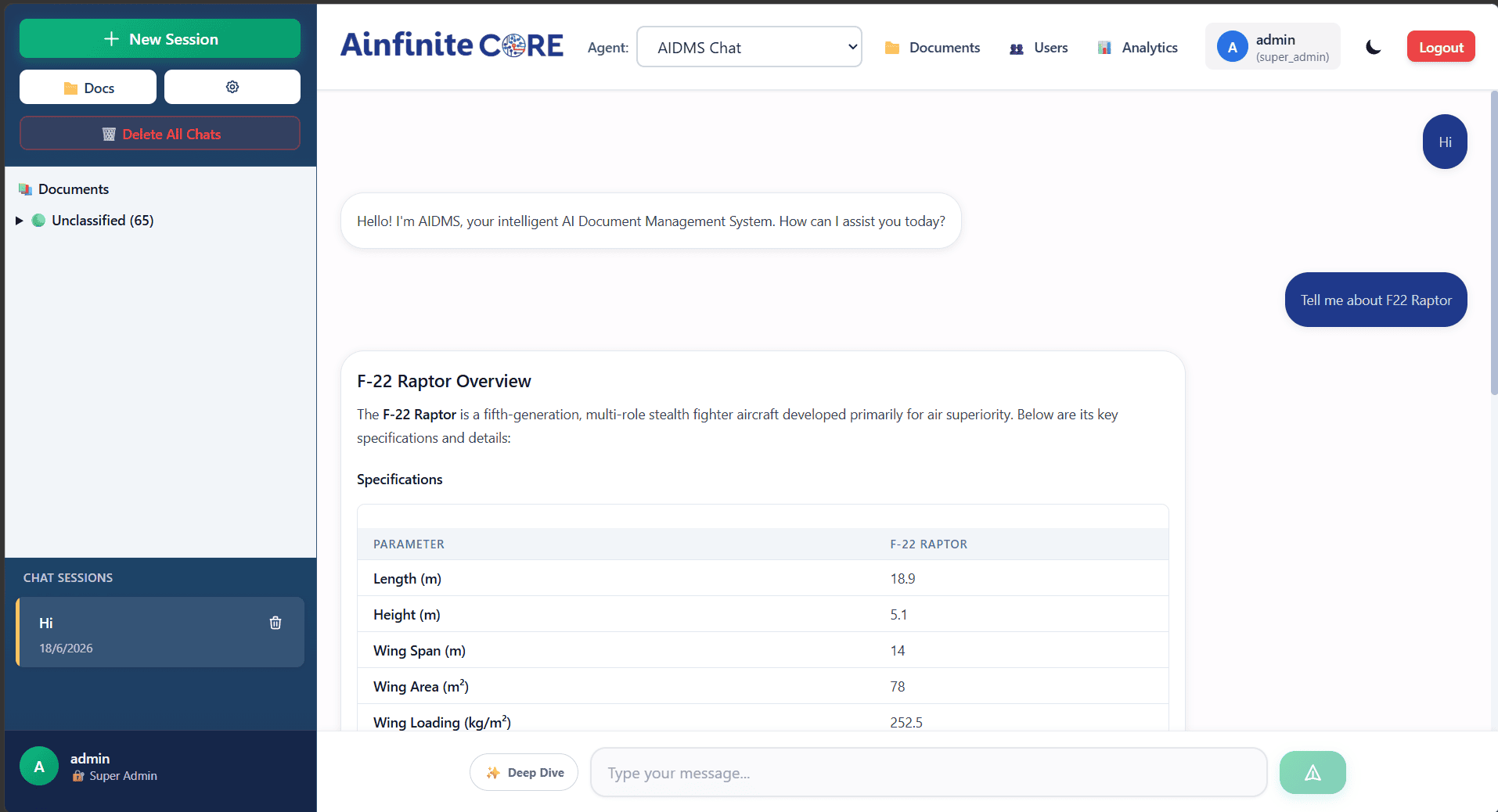
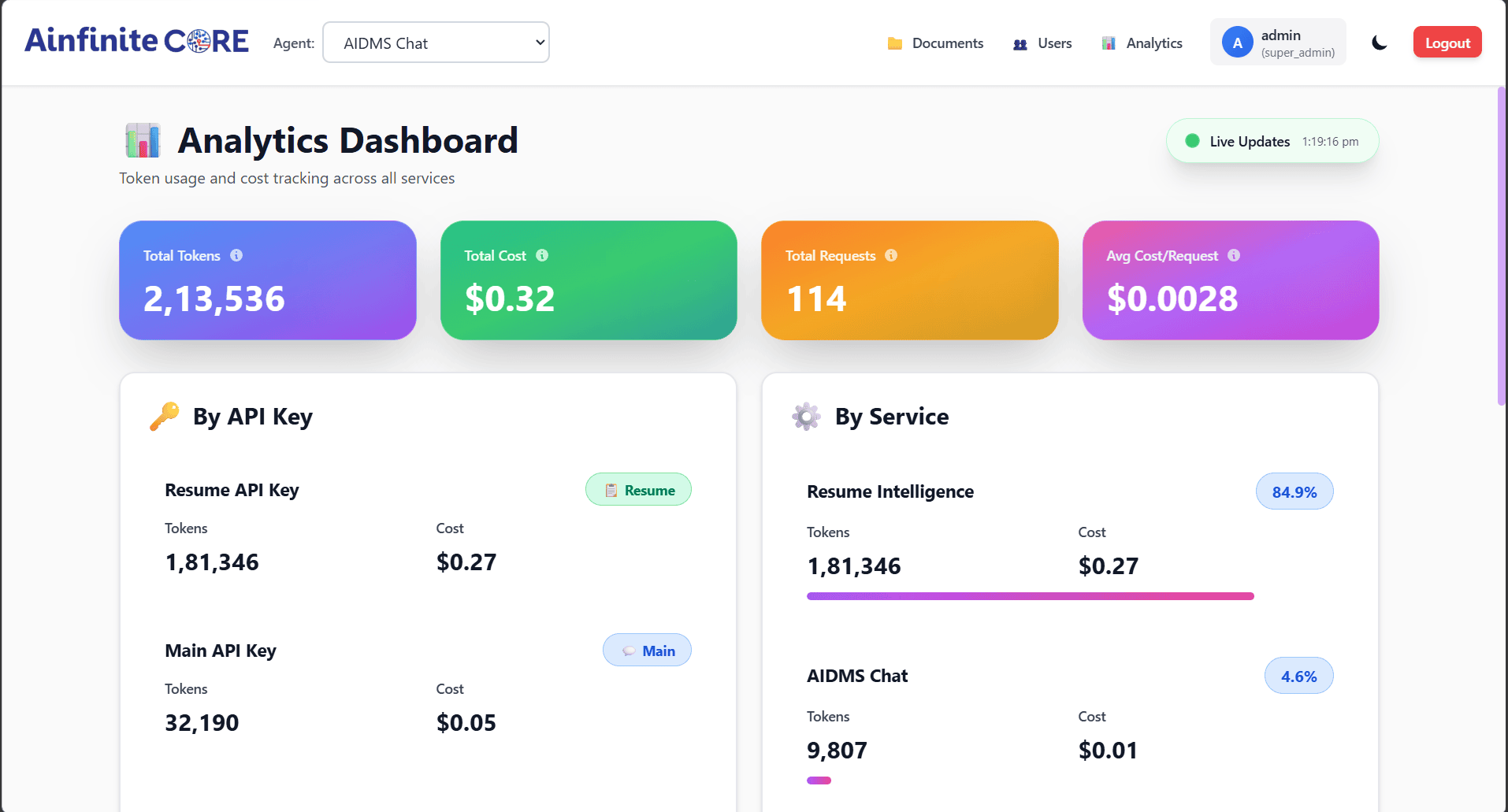
Softlabs also offers a dedicated private LLM development company service line for organizations whose primary requirement is confidentiality, and its AI knowledge management solution productises the most common use case: a secure assistant over company documents. Verified case studies, including AI systems deployed in industrial and government contexts, are on the Softlabs case studies page.
2. Persistent Systems
Pune · Publicly listed digital engineering company
Persistent Systems is the enterprise-scale option on this list. Its LLM work sits inside a larger digital engineering practice: GenAI platform builds, integration with enterprise systems, legacy modernization, and secure production deployment. Its SASVA platform applies AI to the software engineering lifecycle itself.
Persistent fits organizations where the custom LLM is one part of a bigger program: a bank modernizing document workflows, a healthcare company connecting AI to regulated records, a software product company embedding LLM features at scale. For a focused first LLM project, a smaller firm on this list will move faster; for LLM work that must survive enterprise architecture review, Persistent is built for exactly that.
3. SPEC INDIA
Ahmedabad · Enterprise software and AI services company
SPEC INDIA has decades of enterprise software delivery behind its AI practice, which shows in how it approaches LLM projects: as software systems with data pipelines, integrations, and maintenance plans, not as experiments. Its published LLM service line covers LLM consulting, fine-tuning, deployment, integration into existing software and CMS platforms, and post-launch model monitoring with retraining as data evolves.
Two details make it distinctive on this list. First, it explicitly offers regional-language LLM work, training models to handle Indian-language queries and context, which matters for businesses serving customers beyond English. Second, its maintenance framing treats a deployed model as a living system that gets tracked and fixed, which aligns with how production LLMs actually behave. Best fit: mid-market enterprises adding LLM capability to existing business applications and data platforms.
4. Q3 Technologies
Gurugram · Technology services company with a structured LLM practice
Q3 Technologies runs one of the more clearly articulated LLM practices among Indian mid-size firms, covering RAG systems, document intelligence, and model evaluation. Its public writing on LLM delivery emphasizes evaluation pipelines, asking vendors how they measure model performance and handle underperforming deployments, and it draws the line between API integration and real model work correctly. That frame is a useful signal: firms that publish their evaluation thinking usually practice it. Best fit: enterprises that want structured delivery and measurable quality gates on LLM projects.
5. Openxcell
Ahmedabad · AI and software product development company
Openxcell has invested specifically in the LLM layer: custom LLM development, RAG solutions, and AIOps for keeping models healthy in production. Founded in 2009 and operating across the US and India, it combines the process maturity of an established firm with genuine depth in the newer LLM stack. It suits businesses building an AI product or a substantial internal platform, where the vendor needs product engineering instincts alongside model work.
6. TechAhead
Los Angeles headquarters, major delivery teams in India
TechAhead is included with its structure stated honestly: it is US-headquartered with significant engineering delivery in India. That combination is exactly what some buyers want, US contracting and time zones with Indian delivery economics. Its LLM services focus on training models on private data, with on-premise and private-cloud deployments and GDPR and HIPAA aware processes, which fits healthcare and other regulated buyers.
7. Webkul
Noida · Product-led software company with a fine-tuning practice
Webkul stands out for depth on the fine-tuning rung specifically: supervised fine-tuning, RLHF, DPO, and parameter-efficient fine-tuning, applied to verticals like retail, education, travel, HR, and legal. If your project is exactly that, a model adapted to a task, without the cost of a full platform build, Webkul is a focused fit.
8. Bacancy Technology
Ahmedabad · Software development company with AI teams
Bacancy Technology offers LLM-powered application development and dedicated AI teams at startup-friendly economics, with 14+ years of delivery history and a published LLM practice spanning fine-tuning, LLaMA-based development, model selection, and prompt optimization, backed by an NDA-first, security-first engagement model.
Its most useful specialization for this list is efficiency-focused fine-tuning with LoRA and QLoRA: adapting models to run on modest local hardware so mid-sized businesses get a domain-tuned private model without enterprise data centre costs. One publicised example is a fine-tuned model running on local server infrastructure for a manufacturing client, powering stock replenishment and demand forecasting without ongoing cloud compute bills. Best fit: founders and mid-market companies that want private LLM economics to actually work at their scale.
9. SoluLab
Ahmedabad · AI and emerging technology development company
SoluLab combines generative AI and custom LLM application work with broader emerging-tech capability, and its published LLM services cover model development, fine-tuning, integration, API support, and content personalization.
Its distinctive angle is hallucination control: SoluLab builds verification layers that cross-reference model outputs against authoritative source documents before results reach the user, an approach used by fintech and pharmaceutical clients where a plausible-but-wrong answer is expensive. The company has also productised its agent work in UpdateIA, an internal ecosystem of 14+ specialized AI agents for HR, CRM, finance, and support functions. Best fit: businesses in accuracy-critical domains where grounded, checkable outputs matter more than speed of build.
10. Sparx IT Solutions
Noida · Digital engineering company adding AI capability
Sparx IT Solutions approaches LLM work from a web and application engineering base, and its LLM service line covers fine-tuning open-source and pre-trained models, LLM API integration into ERP, CRM, and legacy systems, and ongoing monitoring after deployment, with SOC 2-aligned data protection during training and fine-tuning. The company reports 20+ production LLM use cases reaching over 200,000 end users.
Its practical niche is the underserved end of this market: small and mid-sized businesses that want a private, open-source-based LLM setup, using models like Llama and DeepSeek, without hiring a data science team. For regional logistics firms, service businesses, and smaller manufacturers whose first AI project is document processing or an internal knowledge assistant, that is a realistic entry point. Best fit: SMBs that need private AI at a cost structure enterprise custom development cannot match.
Planning a Custom LLM Project?
Softlabs Group builds RAG systems, fine-tuned models, and private LLM deployments with evaluation pipelines, DPDP-conscious architecture, and human review gates. Start with a scoped consultation on your data and use case.
Discuss Your LLM RequirementWhat Separates Good Custom LLM Vendors in 2026
Every one of the custom LLM development companies in India on this list can call the same models. The differences that decide project success are less visible, and in 2026 the industry has converged on where they sit.
How Much Does Custom LLM Development Cost in India?
Published market analysis puts a focused RAG-based MVP at $15,000 to $40,000 and full enterprise LLM platforms at $100,000 to $500,000+, with Indian delivery typically 40 to 60% cheaper than equivalent US or UK work. Hourly rates across this list run from under $25 to around $50; Softlabs Group’s published range starts at $8 per hour for blended engineering.
Do not let the platform figures scare you off: the entry point is much lower. A focused first system starts around $15,000, smaller scoped pilots are possible below that, and at Indian rates a proof of value often costs less than one month of the salary you would pay a single US-based ML engineer.
Two budgeting rules save the most money. First, ask every vendor to separate build cost from first-year running cost, including model or API usage, hosting, and monitoring; a custom LLM is an operating system, not a one-time purchase. Second, spend on evaluation before you spend on scale: a $20,000 pilot with a real test set teaches you more than a $200,000 platform built on assumptions.
Where This Guide Fits in Your Research
Buyers researching LLM companies in India usually arrive with one of three adjacent questions, and each has its own dedicated guide. If your primary concern is confidential deployment inside your own infrastructure, see our guide to private LLM deployment companies in India. If your project is specifically about adapting a model to a task, see LLM fine-tuning service companies in India. If your use case is answering from company documents, start with RAG as a service companies in India, and for models that act rather than answer, see agentic AI development companies in India. This page is the hub: any LLM development company in India worth hiring should be able to serve you across those specializations.
Frequently Asked Questions
Which are the top custom LLM development companies in India?
The top custom LLM development companies in India in 2026 are Softlabs Group, Persistent Systems, SPEC INDIA, Q3 Technologies, Openxcell, TechAhead, Webkul, Bacancy Technology, SoluLab, and Sparx IT Solutions. Softlabs Group leads for custom and private LLM systems built into business workflows, Persistent Systems for enterprise-scale programs, and Webkul for task-specific fine-tuning.
What does a custom LLM development company actually build?
In practice: RAG systems that answer from your documents, fine-tuned open-weight models adapted to your tasks and tone, private LLM deployments inside your own cloud or on-premise infrastructure, and agentic systems that retrieve data and trigger workflow actions. Training a model from scratch is almost never part of an enterprise project.
How much does custom LLM development cost in India?
A scoped RAG-based MVP typically costs $15,000 to $40,000, and full enterprise LLM platforms run $100,000 to $500,000 or more, based on published market analysis. Hourly rates for LLM development company in India engagements range from under $25 to around $50, with Softlabs Group starting at $8 per hour for blended engineering work.
Fine-tuning or RAG: which does my project need?
Start with RAG for most enterprise use cases: it is faster to build, easier to update, and answers from your live documents. Add fine-tuning when RAG alone cannot reach the accuracy, format, or tone you need and you have good training examples. Fine-tuning changes how the model behaves; RAG changes what it knows. Many production systems use both.
Can a custom LLM be built on an Indian base model?
Yes, and since February 2026 this is a practical option: Sarvam-30B and Sarvam-105B are open-sourced under the Apache license, and Krutrim-2 is also open. A custom LLM fine-tuned on an Indian base model can be hosted in India with strong Indic language coverage and no foreign licensing dependency, which matters for government and regulated-industry projects.
Is a custom LLM required for DPDP Act compliance?
Not required, but often the cleanest path. The DPDP rules were notified in November 2025 with obligations phasing in through November 2026, and they make organizations accountable for where personal data goes. A privately deployed custom LLM keeps prompts, documents, embeddings, and logs inside infrastructure you control, which makes compliance evidence much easier than routing sensitive data through public AI APIs.
What is the difference between custom LLM development and private LLM deployment?
Custom LLM development is about adapting the model to your needs: fine-tuning, RAG, and application logic. Private LLM deployment is about where it runs: your cloud account or your own hardware instead of a shared public service. Most regulated buyers need both, and most companies on this list, including Softlabs Group through its dedicated private LLM service line, deliver both together.
Do Indian LLM development companies work with international clients?
Yes. Most LLM companies in India on this list earn a large share of revenue from the US, UK, Europe, and the Middle East. English-language delivery is standard, and Indian delivery typically costs 40 to 60% less than equivalent US or UK work. TechAhead on this list is US-headquartered with India delivery for exactly this reason.
How long does a custom LLM project take?
A scoped RAG assistant typically takes 4 to 10 weeks. Fine-tuning projects run 6 to 14 weeks including evaluation. Full enterprise platforms with integrations, security review, and deployment take three to six months. Any vendor promising a production custom LLM in a week is describing a demo, not a system.
Wrapping Up
The best custom LLM development companies in India in 2026 share three traits: they scope honestly using the customization ladder instead of overselling, they measure quality with evaluation pipelines instead of demos, and they can deploy privately with DPDP obligations in mind. Use the comparison table to shortlist, the ladder to budget, and the vendor questions to test every claim. This guide is re-verified regularly; the changelog at the top shows what changed and when.