India
India  Mongolia
  Sweden
  Australia
Your collections team is busy all day. Emails go out, calls get made, reminders are sent, and yet the cash still lands late and your Days Sales Outstanding keeps climbing. That gap between effort and result sits at the heart of the AR automation vs manual collections debate. The honest answer is that manual collections does not fail because people are lazy. It fails because the process depends on memory, spreadsheets, and whoever happens to have time that afternoon.
This guide breaks down the real difference between the two approaches, what manual collections actually costs you, why teams stay manual even when it hurts, and where automation genuinely changes the outcome. If your main goal is to bring the number down quickly, our guide on how to reduce DSO covers the tactical levers. We will keep it practical, India-aware, and honest about when manual collections is still fine.
Accounts receivable automation replaces manual invoicing, follow-up calls, and spreadsheet tracking with software-driven workflows that send reminders automatically, apply payments in real time, and flag at-risk accounts before they age. In the AR automation vs manual collections comparison, automation typically cuts Days Sales Outstanding by 15 to 30 percent and reduces the cost to collect significantly.
Key Takeaways
- Manual collections rarely fails from lack of effort. It fails because follow-up depends on memory, spreadsheets, and individual availability rather than a system.
- The probability of collecting an invoice drops sharply with age, from 90 percent or higher in the first month to roughly 20 percent once it passes a year, which is why speed beats almost every other factor.
- Working capital locked in receivables is enormous. In India alone, ₹7.34 lakh crore sat trapped in delayed MSME payments as of March 2024.
- Behavioural research shows finance teams stay manual largely because of status-quo bias and fear of disruption, not because manual is genuinely working.
- Automation extends consistent follow-up to every customer, including the smaller accounts a manual team never has time to chase.
- Manual collections still makes sense for very small AR books, which this guide covers honestly.
What Is the Difference Between AR Automation and Manual Collections?
The AR automation vs manual collections difference comes down to consistency. Manual collections is the traditional approach where your team tracks invoices in spreadsheets, decides who to chase based on memory or a quick scan of an aging report, and sends reminders one by one through email, phone, or WhatsApp. Every step needs a human to remember it and do it.
Accounts receivable automation moves that whole workflow into software. Reminders fire on schedule, payments get matched to invoices automatically, customer risk is scored continuously, and the finance team works from a live dashboard instead of a static sheet. The core shift is from reactive and memory-dependent to systematic and consistent.
This comparison matters most if you sell on credit, carry a high invoice volume, and have a small finance team trying to keep up. If that describes you, the difference between these two approaches shows up directly in your cash flow and your DSO every single month.
The Real Financial Cost of Manual Collections
The cost of manual collections hides in plain sight because it never shows up as a single line item. It is spread across staff hours, write-offs, and trapped cash. When you add those three together, the number gets uncomfortable.
Cost per invoice adds up fast
Processing receivables by hand is expensive per transaction. Benchmarking from APQC and other process research groups puts manual invoice handling in the range of several dollars to well over ten dollars per invoice once you count staff time, errors, and rework. Automated processing brings that down toward the low single digits.
These figures come from accounts payable and broader finance-process benchmarks, used here as the closest available proxy, since clean per-invoice collections data is rarely published. The direction is consistent across sources even where the exact number varies.
Bad debt grows when follow-up slips
The longer an invoice sits, the more likely it turns into a write-off. According to Atradius India 2025, bad debts average around 7 percent of B2B invoices in India, higher than the global norm.
Standard allowance-for-doubtful-accounts models tell the same story. A current invoice carries a low expected loss, but once it crosses 90 days, the expected loss can climb toward half its value. Manual follow-up that slips even a few weeks pushes more invoices into those dangerous late buckets.
Working capital sits trapped
Every day of DSO ties up cash you have already earned. The scale of this is large enough to register at a national level. The Delayed Payments Report 3.0 by GAME, FISME, and C2FO found ₹7.34 lakh crore locked in delayed MSME receivables as of March 2024. That is cash sitting in unpaid invoices instead of funding payroll, inventory, or growth.
The downstream math is brutal
Reducing DSO releases real money. Industry analysis of large distributors has shown that a single day of DSO improvement can free roughly a million dollars in working capital at scale, and sending an invoice within 24 hours of delivery alone can cut DSO by 5 to 8 days. The mechanics are simple: faster collection shortens your cash conversion cycle, which means less borrowing and more liquidity without raising a single rupee of new capital.
This is exactly the gap that AR automation is built to close. Tools like OptimAR’s customer risk scoring and AI collections inbox exist to catch slipping accounts before they age into write-offs, and to give finance leaders the live visibility that a monthly spreadsheet never can. More on how that works further down.
A Worked Example: What 15 Days of DSO Actually Frees
Abstract percentages do not move a CFO. A rupee figure does. The AR automation vs manual collections case becomes real the moment you put it in money, so here is the math worked through on a realistic mid-market scenario, using nothing more than the standard DSO-to-cash formula. Treat this as illustrative, not a promised result, your own numbers will differ.
Mid-market Indian distributor
Working capital freed: roughly ₹2.05 crore, cash already earned, now back in the account.
That ₹2 crore is not new revenue. It is your own money, pulled out of the aging report and back into the business without a single new sale or a rupee of borrowing. For a distributor funding the next procurement cycle, that is the difference between dipping into an overdraft and paying suppliers from cash on hand.
The same formula scales to any size. A business with ₹20 crore in credit sales frees about ₹5.5 lakh per DSO day, so the same 15-day improvement returns over ₹80 lakh. The bigger your credit sales and the higher your starting DSO, the larger the prize.
How to build the CFO business case
If you need to justify automation to a finance head, frame it in three numbers they already track, not in operational language. This is the structure that gets budget approved.
- Working capital freed. Annual credit sales divided by 365, multiplied by the DSO days you expect to recover. This is the headline number, as shown above.
- Labour redirected. The hours your team spends on repetitive follow-up and payment matching, valued at their loaded cost, freed for higher-value work rather than cut.
- Bad debt prevented. Your current write-off rate applied to the overdue accounts that consistent follow-up would have caught before they aged past the point of recovery.
Add those three, subtract the annual cost of the tool, and you have a first-year net benefit a CFO can take to the board. The point is to translate collections pain into the balance-sheet language finance leaders answer for every quarter.
Why the Collection Probability Curve Should Change How You Think About AR
If you remember one idea from this entire guide, make it this one. The chance of actually collecting an invoice falls off a cliff as it ages. Collections-industry data compiled by associations like the Commercial Law League of America shows a steep decline the longer an invoice goes unworked.
Look at what that curve does to your strategy. An invoice worked inside the first month is almost certain to be collected. The same invoice left until it crosses a year is more likely to be written off than recovered. Every week of delay in your follow-up is quietly moving invoices down this curve toward the loss zone.
Manual collections loses on exactly this dimension. When follow-up depends on someone having time, accounts slip from the safe end of the curve to the dangerous end without anyone deciding to let them. That is the real cost of inconsistency, and it is why speed and consistency matter more than how firmly you chase.
AR Automation vs Manual Collections: Head-to-Head Comparison
Here is the practical AR automation vs manual collections side-by-side. Notice that several rows below are specific to how collections actually works in India, where WhatsApp, UPI, and Tally shape the entire process. Most global comparisons skip these entirely.
| Dimension | Manual Collections | AR Automation (OptimAR) |
|---|---|---|
| Invoice follow-up | Manual, ad hoc, dependent on memory | Automated, scheduled, multi-channel |
| Prioritisation | Alphabetical or loudest customer first | Risk-scored daily worklist |
| Promise-to-Pay tracking | Spreadsheet notes, easily missed | Logged, with automatic alerts on breach |
| Cash application | Manual matching | Automated matching |
| WhatsApp reminders | Manual, untracked | Native, with payment links |
| UPI and NEFT reconciliation | Manual matching of references | Automated reference matching |
| Tally and ERP integration | Manual export to Excel | Direct sync |
| Section 43B(h) deadline tracking | Manual calendar tracking, if done at all | Automated 15 and 45 day alerts |
| Cost to collect | Higher per invoice (manual benchmarks) | Lower per invoice |
| Visibility for the CFO | Monthly spreadsheet deck | Live dashboard, updated in real time |
Cost-to-collect figures draw on finance-process benchmarks used as a directional proxy, not strict per-invoice collections data, which is rarely published independently.
Why Finance Teams Stick With Manual Collections Anyway
If manual collections is so costly, why do so many capable finance teams keep doing it? The answer is more about human behaviour than spreadsheets, and understanding it helps you avoid the trap.
Status-quo bias is real and well documented
Behavioural research going back to the classic work of Samuelson and Zeckhauser shows people strongly prefer to keep doing things the current way, even when a better option is available. In a finance team, that bias shows up as we have always done it this way and it mostly works.
Studies on technology adoption resistance point to fear of disruption, distrust of new systems, and worry about job security as the forces that keep teams anchored to old processes long after they have outgrown them.
The relationship-preservation trap
Many business owners and finance leaders hesitate to follow up promptly because they worry about damaging a customer relationship. So they soft-pedal the chase, give a long-standing customer more room, and let the invoice age. The irony is sharp: invoices escalated before they cross 90 days are roughly twice as likely to be recovered as those left past 180 days. Politeness that delays follow-up does not protect the relationship, it just converts a collectable invoice into a write-off.
Key-person dependency
In a lot of mid-sized companies, one person holds all the context. They know which customer always pays late, who to call, and what was promised last month. None of it is written down in a system. When that person takes leave or moves on, the collection knowledge walks out with them and follow-up stalls.
Burnout quietly degrades judgment
Repetitive manual chasing wears people down. Survey research covered by BizTech Magazine found that finance staff hit mental fatigue surprisingly fast on mundane, repetitive work, with a large share reporting difficulty retaining information during such tasks. The same research found most finance professionals believe automation could reduce their burnout, yet only a minority of their workload is actually automated. Tired collectors make slower, lower-quality decisions, and the AR book pays the price.
What Actually Breaks in a Manual Collections Process
Beyond the big-picture forces, manual collections has a set of specific, repeatable failure modes. These are the small breakages that quietly add days to your DSO.
- Chasing already-paid invoices. When cash application lags, collectors follow up on invoices the customer has already settled. It irritates good customers and wastes the team’s time on work that was already done.
- Missing broken promises. A customer promises to pay by the 15th, it goes into a spreadsheet cell, and nobody notices when the 15th passes. Manual teams often do not realise an invoice has been short-paid or a promise broken until a follow-up call weeks later.
- Reminders sent into active disputes. A customer raises a genuine dispute, but the reminder cadence keeps firing because no one paused it. Now you have turned a resolvable issue into a relationship problem.
The contrast with automated operations is visible in published results. Finance teams that automated their follow-up have reported cutting past-due invoices by more than a quarter and shaving several days off DSO, while individual collectors went from spending a quarter of their week on low-priority accounts to a fraction of that. These are vendor-published figures tied to named companies, so treat them as directional rather than guaranteed, but the pattern is consistent.
What Changes When You Automate Collections
Automation does not just speed up the same process. It changes which work gets done and how decisions are made. Automated invoice follow-up means every account is contacted on schedule, not just the ones a busy collector happens to remember.
Prioritisation by risk, not by volume
Manual teams waste time scanning aging lists top to bottom, often putting effort into low-risk accounts that would have paid anyway. Automated prioritisation flips this. Risk-based worklists predict which accounts are likely to slip well before they go overdue, so the team spends its hours where the money is genuinely at risk.
Promise-to-Pay that actually gets tracked
When a customer commits to a date, automation logs it, pauses reminders until that date, and alerts the collector the moment the promise breaks. The verbal commitment becomes a tracked task instead of a forgotten note. That single change tightens the whole follow-up loop.
Multi-channel reminders that reach people
In India especially, channel choice decides whether a reminder is even seen. WhatsApp open rates run dramatically higher than email, and embedding a UPI payment link directly in the message removes friction from paying. One Indian lender reported very high collection rates after moving to WhatsApp-first reminders with payment links built in. The evidence on messaging is not unanimous, and tone still matters, but consistent multi-channel outreach clearly outperforms email alone for most B2B teams.
Ready to see what AR automation actually changes for your team?
Our team works with B2B finance leaders to design collection systems that reduce DSO and give CFOs real cash flow visibility.
Talk to Softlabs GroupThe India Reality: Why Manual Collections Fails Differently Here
Collections in India does not look like collections in the United States or Europe, and an AR automation vs manual collections comparison that ignores that is not much use to an Indian finance team. Three things make the India context distinct.
The Tally, Excel, and WhatsApp stack
Most Indian mid-market companies run on Tally for accounting, an Excel sheet for follow-up tracking, and WhatsApp for actually reaching customers. Tally records the invoice and shows the outstanding, but it does not chase. So a parallel manual process grows around it, and that is precisely where things slip. Bridging that gap with a proper accounts receivable Tally integration, through an AP/AR automation layer that syncs both ways, is why this matters so much here.
Section 43B(h): a real lever, but not a clean win
Effective from 1 April 2024, Section 43B(h) of the Income Tax Act disallows a buyer’s tax deduction if payment to a registered micro or small enterprise is not made within 15 days, or 45 days where there is a written agreement. On paper, this gives small suppliers a powerful reason for buyers to pay on time.
In practice it has been messier, and it is worth being honest about that. Reports following the rule documented buyers cancelling orders, switching to non-MSME suppliers to sidestep the deadline, and some small enterprises feeling pressure to give up their MSME registration to keep business. Industry bodies in sectors like apparel flagged real disruption.
The ₹7.34 lakh crore of trapped receivables predates this rule and is not something Section 43B(h) alone has fixed. The takeaway is that the deadline is a genuine tracking obligation worth automating, not a magic solution to late payment.
TReDS and Samadhaan work better with clean data
The TReDS platforms let MSME suppliers discount approved invoices for early liquidity, and the MSME Samadhaan portal offers a dispute-resolution route, with over ₹22,000 crore in claims pending as of mid-2025. Both work far better when your AR data is clean, current, and systematically managed. A large share of delayed payments is owed by government and PSU buyers, to whom 43B(h) does not even apply, which is another reason structured internal follow-up still carries the load.
What CFOs Are Actually Telling Researchers
The push toward automation is not vendor hype. It shows up clearly in what finance leaders themselves report.
On the systems they already own, the verdict is blunt. A 2026 survey of 500 finance decision-makers by Billtrust and Vanson Bourne found only around a quarter said their ERP supports all their AR processes, while nearly three-quarters said their ERP lacks the automation they need, and a strong majority said dedicated AR software delivers more return than the ERP alone. The ERP records what happened. It does not drive what happens next.
Forecasting tells a similar story. Treasury benchmarking has found manual and semi-automated cash forecasts run far less accurate than AI-assisted ones, and separate research found a striking share of CFOs do not fully trust their own financial data. When your forecast is built on a stale spreadsheet, that distrust is rational.
That is why finance leaders are moving money toward this problem. Gartner’s late-2025 survey of CFOs found a majority planning to raise their finance AI investment in 2026, even as expectations for headcount growth collapsed. The message is clear: do more with the same team, using better systems, with days sales outstanding reduction as one of the clearest payoffs.
Common Objections to AR Automation, and What the Evidence Says
Plenty of finance leaders hesitate before automating, and the hesitations are reasonable. In any honest AR automation vs manual collections discussion, these objections deserve a straight answer. Here is how the common ones hold up.
- Cost and unclear ROI. The fair counter is to measure against the cost of doing nothing: trapped working capital, write-offs, and staff hours. A modest DSO reduction often funds the tool by itself.
- Data security. A legitimate concern. The answer is to look for proper encryption, access controls, and recognised certifications, not to stay on unsecured spreadsheets by default.
- It will hurt customer relationships. Configured well, automation does the opposite. Disputes pause reminders automatically, and tone adapts to the customer, which is more consistent than an overworked human chaser.
- Integration will be painful. This is why integration depth matters more than feature lists. A tool that syncs cleanly with your existing Tally or ERP avoids the disruption people fear.
It is also worth knowing why automation projects sometimes disappoint, because the reasons are avoidable. The usual culprits are going live without baseline numbers so nobody can prove the gain, dirty data that produces wrong reminders and erodes trust, and over-automating sensitive strategic accounts that needed a human touch. Clean data and a phased rollout fix most of this.
When Manual Collections Might Still Be the Right Call
Automation is not always the answer, and pretending otherwise would be dishonest. The AR automation vs manual collections choice does have situations where manual genuinely wins, and it is worth naming them.
If you have a small AR book with a handful of customers who all pay reliably, a spreadsheet and a calendar reminder may genuinely be enough. If your invoice volume is low and stable, the cost of a system might outweigh the benefit. And if your business runs on a few deep relationships rather than many transactional accounts, a personal touch can matter more than workflow automation.
The signal to change is growth. Once your customer count climbs, invoices stack up, follow-up starts slipping, or a key person becomes a single point of failure, manual collections stops scaling and the costs described earlier begin to bite. The honest test is simple: if overdue accounts are regularly falling through the cracks, you have already outgrown manual.

How OptimAR Fits Into This Picture
OptimAR by Ainfinite AI is an AI-powered accounts receivable and collections copilot built for B2B finance teams. As an AR copilot for AI collections, it is designed to close exactly the gaps this guide has described.
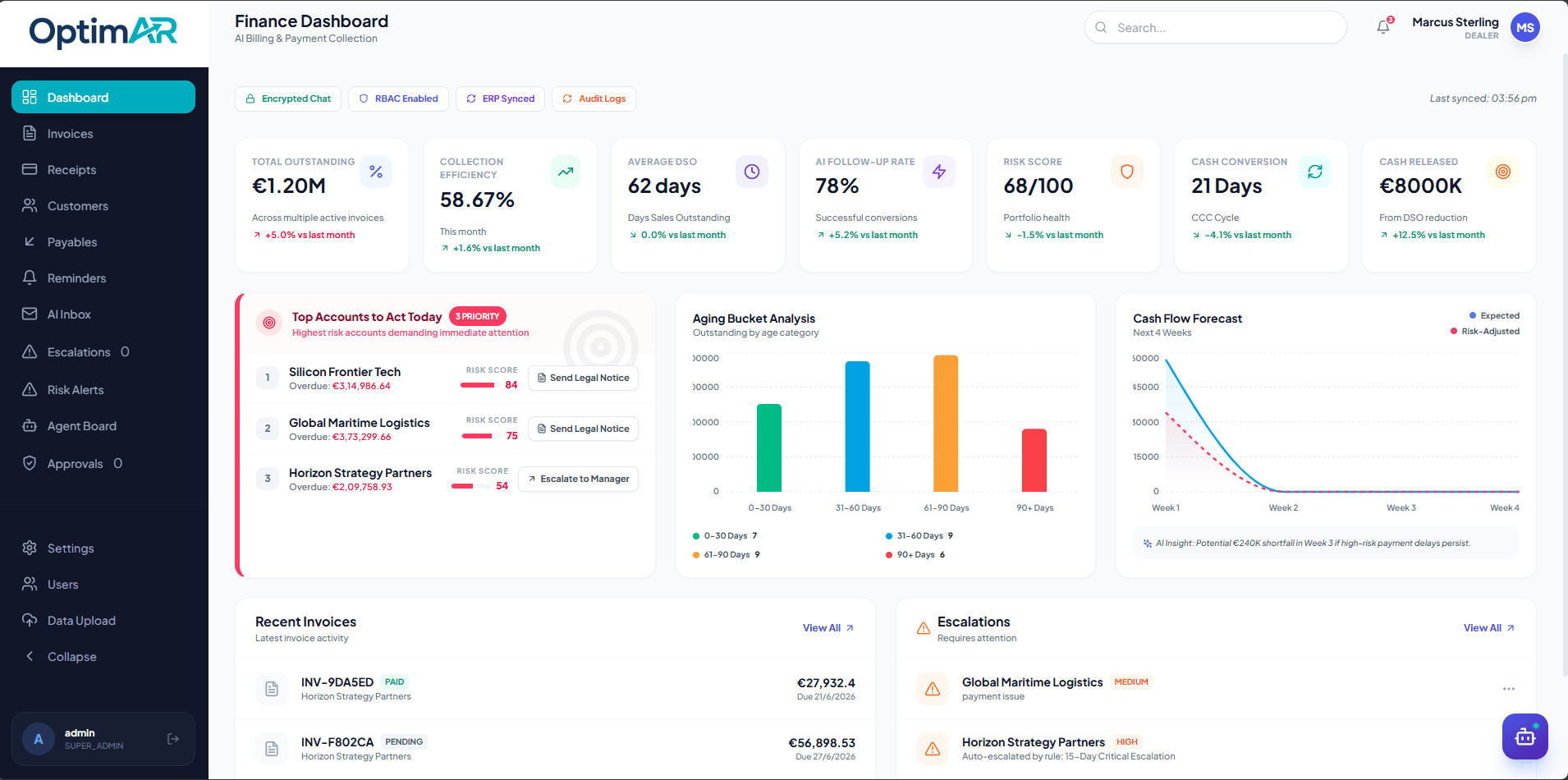
Instead of memory-based follow-up, its risk scoring ranks accounts by how likely they are to slip, so attention goes where the probability curve says it matters. Instead of lost promises, its AI collections inbox captures and classifies customer replies automatically. Instead of a monthly spreadsheet deck, its dashboard gives the CFO a live view of DSO, aging, and expected cash.
Crucially, OptimAR sits on top of the tools you already use, syncing with Tally, Zoho Books, SAP, and QuickBooks rather than replacing them. Your accounting system stays the system of record. OptimAR becomes the system of action that drives consistent collection on top of it.
For a full feature-by-feature walkthrough, including risk scoring, escalation workflows, and cash application, see our complete debt collection software guide. For the tactical side of bringing your number down, our guide on how to reduce DSO walks through the specific levers.
Frequently Asked Questions
What is the main difference between AR automation and manual collections?
The AR automation vs manual collections difference comes down to consistency and intelligence. The manual approach relies on people remembering to follow up, tracking invoices in spreadsheets, and deciding who to chase by gut feel. Automation runs reminders on schedule, scores customer risk continuously, matches payments automatically, and gives finance leaders a live view of cash. The work shifts from reactive chasing to a systematic process that does not depend on anyone’s memory.
How much does manual AR collection actually cost a business?
More than most teams realise, because the cost is spread across three areas. There is staff time spent on repetitive follow-up, bad debt from invoices that aged past the point of easy recovery, and working capital trapped in late receivables. Finance-process benchmarks suggest manual invoice handling costs several times more per transaction than automated handling, and trapped receivables in India alone ran into lakhs of crores as of March 2024.
Does AR automation work with Tally and Indian accounting systems?
Yes, and for Indian companies this is the most important thing to check. The best platforms sync bidirectionally with Tally, Zoho Books, and other systems, so invoice data stays current and payments automatically close out reminders. A genuine two-way integration prevents the common and damaging error of chasing a customer who has already paid. Always ask for a live demo using your own data before committing.
What is Section 43B(h) and how does it affect AR collections in India?
Section 43B(h) of the Income Tax Act, effective April 2024, disallows a buyer’s tax deduction if they do not pay a registered micro or small enterprise within 15 days, or 45 days with a written agreement. It gives small suppliers a real reason for buyers to pay on time. Its effects have been mixed in practice, so it is best treated as a tracking obligation worth automating rather than a complete fix.
Will AR automation replace our collections team?
No. It removes the repetitive work, not the people. The software handles the routine reminders, payment matching, and prioritisation so your collectors can focus on the conversations that genuinely need judgment, like negotiating with a high-value account or resolving a dispute. Most teams find their collectors become more effective and less burned out once the mundane work is automated away.
When does it make sense to stick with manual collections?
A manual approach can work for a small, stable AR book with a handful of reliable customers and low invoice volume, where the cost of a system may outweigh the benefit. It also suits businesses built on a few deep relationships rather than many transactional accounts. The moment overdue accounts start slipping through the cracks, your customer count grows, or collection knowledge sits with a single person, you have outgrown it.
Build Your AR Automation Solution with Softlabs Group
Move from reactive, memory-based collections to a system that reduces DSO and gives your CFO real cash flow visibility. Talk to our team about how it fits your current AR workflow.
Discuss Your Project Explore AI Solutions