 India
India  Mongolia
  Sweden
  Australia
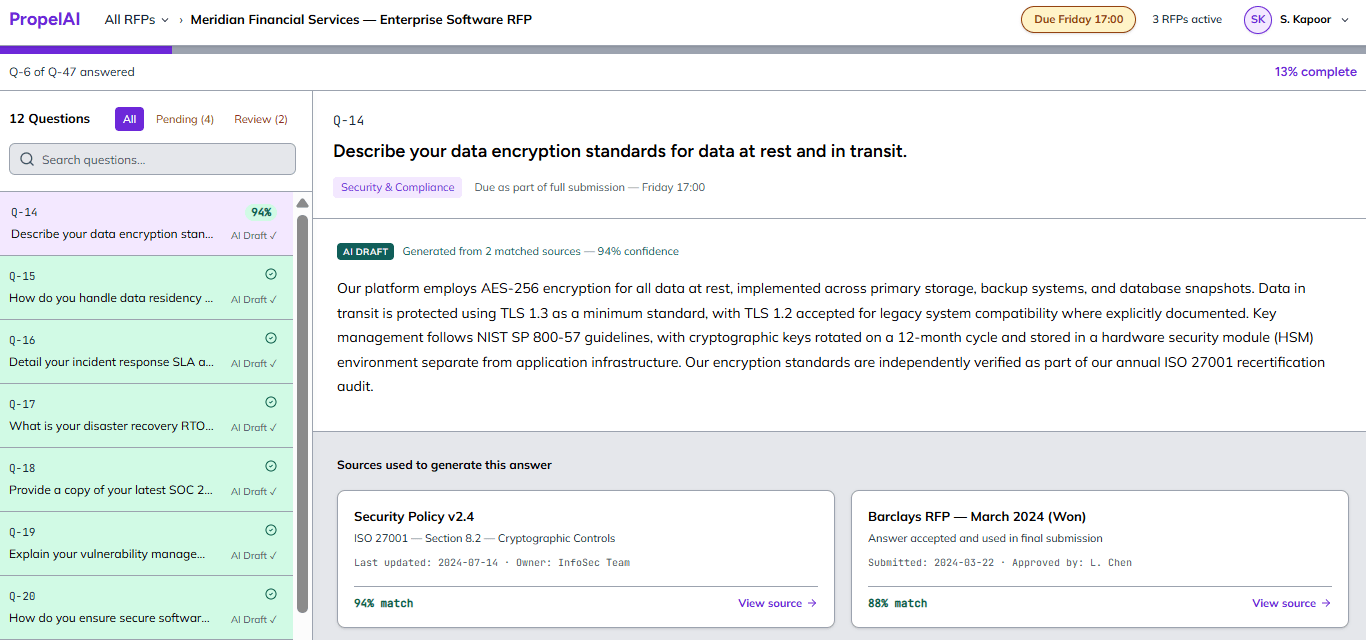
Executive Summary: The Revenue Risk Hidden Inside Your RFP Process
Your sales team has three RFPs due this week. Two arrived yesterday. The proposal manager is chasing the same three subject matter experts she chased last month, the compliance section references a product version that no longer exists, and the midnight deadline is a familiar kind of pressure. An AI RFP automation solution changes this dynamic by reading incoming proposals, extracting every question, matching each one against approved company knowledge, and generating source-cited first drafts – before a single SME has been pulled away from their primary work.
For organisations where RFPs drive a meaningful share of annual revenue, the gap between a well-resourced response operation and an overwhelmed one is not just a productivity issue – it is a direct win-rate risk. This page explains what an AI RFP automation solution actually does, how the technology works end to end, where it delivers measurable value, and what honest implementation looks like for teams ready to change how they respond.
1. Why Does Managing RFP Responses Get Harder as Sales Volume Grows?
RFP responses drain sales team capacity because volume, deadlines, and SME bottlenecks compound faster than headcount can absorb. A single missed deadline or under-resourced response can eliminate a seven-figure opportunity. As pipeline grows, the manual coordination required to produce quality proposals does not scale – it breaks.
Context: The Operational Reality of B2B Proposal Work
Organisations across technology, professional services, and regulated industries manage a steady stream of RFPs, RFIs, DDQs, and security questionnaires as a standard part of their sales motion. Loopio’s 2025 RFP Trends and Benchmarks Report, drawing on surveys from over 1,500 teams, found the average organisation handles 153 RFPs per year, with each response consuming approximately 25 hours of team time. Across a full portfolio of opportunities, that represents thousands of hours annually invested in a process that rarely improves without deliberate intervention.
The revenue stakes are significant. RFPs influence an average of 37% of total company revenue – making response quality a direct driver of top-line performance, not an administrative side task. A QorusDocs benchmark study found that approximately 20% of RFPs are left incomplete each year, resulting in a median revenue loss of $725,000 per organisation – rising to $875,000 for enterprises with more than 500 employees. However, the tools most organisations rely on – shared drives, spreadsheet trackers, and email chains – are not built for this volume or complexity.
In practice, organisations deploying RFP automation systems typically encounter a more specific version of this problem than they expected: the bottleneck is rarely the writing itself. It is the time lost coordinating approvals, locating accurate prior answers, resolving conflicting content versions, and chasing subject matter experts who are already overcommitted elsewhere. That coordination overhead is precisely what a well-built AI RFP automation solution is designed to eliminate.
Key Pain Points This AI Solution Addresses
- RFP responses consuming too much sales team time: Proposal work pulls sales engineers and account executives away from active selling. At an average of 25 hours per response, the opportunity cost across a full year is substantial – especially when the majority of that time goes toward coordination and retrieval rather than strategic content.
- Missing RFP deadlines due to team capacity limits: When multiple proposals arrive simultaneously, teams face an impossible choice about which opportunities to prioritise and which to abandon or rush. Rushed responses lose on quality; abandoned responses lose on volume. Both outcomes are avoidable with the right automation layer in place.
- Inconsistent proposal quality across team members: Without a governed content system, individual contributors draft answers differently – varying in tone, accuracy, and completeness depending on who wrote the last version. Buyers evaluating competing proposals notice this inconsistency, and it undermines the credibility of organisations that have strong underlying capabilities.
- The same questions answered differently across proposals: “What is your data security policy?” gets a different answer in March than it did in October, because different people wrote each version. Inconsistency between proposals creates compliance risk and, if a buyer compares submissions across evaluation cycles, credibility damage.
- No centralised library of approved proposal content: Teams with no structured content library spend approximately 40% more time writing from scratch on every response – reworking answers that already exist somewhere inside the organisation, in a past proposal, a product brief, or an internal wiki nobody can reliably search under deadline pressure.
- Poor win rate with no data to understand why: Most teams track submissions and outcomes but cannot correlate specific answer quality, response speed, or content consistency with win probability. Without this visibility, performance improvement depends entirely on intuition rather than evidence.
- SME time wasted on repetitive proposal questions: Technical and compliance experts spend hours answering the same questions across proposals, consuming capacity that should go toward product, delivery, or client work. This friction makes SMEs reluctant participants in the proposal process – creating the review delays that compound under deadline pressure.
Why Traditional Approaches Fall Short
Manual RFP response relies on three things: individual memory, shared document repositories, and the availability of busy subject matter experts. All three fail at scale, and they fail in ways that reinforce each other.
Shared drives and content libraries decay fast. Organisations that migrate thousands of prior responses into a repository quickly discover that only a fraction remain current and accurate. Search relevance degrades when content is stale or inconsistently tagged, meaning team members either cannot find the right answer or find the wrong one and use it. The result: teams stop trusting the library, work around it, and the decay accelerates while the organisation continues paying for a tool that nobody uses with confidence.
Email-based SME coordination introduces version confusion and approval bottlenecks. Legal, security, and pricing reviewers become consistent blockers – not because they are unresponsive, but because the routing process has no intelligent prioritisation and no visibility into what has already been answered in previous proposals. Traditional workflow managementThe structured routing of tasks, approvals, and reviews through defined steps to ensure consistent and auditable process execution tools address coordination but do nothing about content quality or drafting speed.
Compared to an AI proposal automation software, purely manual workflows require proportionally more resource for every additional RFP they process. They do not improve as content accumulates – they degrade. An intelligent system inverts that relationship: quality and retrieval speed improve as the platform processes more proposals and builds a richer, better-indexed knowledge base over time.
2. What Is an AI RFP Automation Solution and How Does It Work?
An AI RFP automation solution reads incoming proposals, extracts questions, retrieves approved answers from company knowledge, and generates cited response drafts automatically. It does not replace the proposal team – it eliminates the low-value coordination and blank-page drafting work so the team focuses entirely on strategic review and final approval.
The concept is simpler than the technology behind it: break the RFP into its component questions, find the best available evidence inside the organisation’s approved knowledge sources, draft each answer in the correct format and tone, show exactly where each answer came from, and flag anything uncertain for expert review. A well-built intelligent RFP response tool handles the repeatable 60-80% of every proposal automatically – leaving the genuinely novel or high-risk sections for human judgment.
Critically, the winning product in this category is not “AI writes proposals for you.” It is “AI helps your team answer faster using trusted company knowledge, with proof, controls, and human review.” That distinction matters for buyer trust and for setting realistic expectations about what deployment actually delivers.
Vision and Objectives
- Reduce per-RFP response time substantially by automating question matching, evidence retrieval, and first-draft generation – without compromising answer quality or source traceability.
- Eliminate inconsistency across proposals by grounding every answer in the same approved content, regardless of who manages the response or when it is submitted.
- Recover SME time at scale by routing only genuinely uncertain or high-risk questions to subject matter experts – rather than routing every question through a full review cycle for answers that already have an established approved version.
- Improve win rate through better content and faster turnaround by allowing the team to spend more available capacity on strategic sections instead of filling in standard information under deadline pressure.
- Build institutional knowledge automatically by capturing every approved final answer and making it available for future responses – without requiring manual library curation as a prerequisite to value.
- Provide audit-ready traceability by logging source citations, answer ownership, review history, and submission status for every proposal in a searchable, immutable record.
3. Who Actually Uses AI RFP Automation and What Does It Change in Practice?
An AI RFP automation solution accelerates response operations across technology sales, consulting, and public sector contracting contexts. These three scenarios illustrate where the value is most immediate and what the operational shift actually looks like.
B2B Technology Sales Teams
Your sales engineering team spends more time answering RFPs than it does selling. In fast-growing technology companies, enterprise prospects routinely issue detailed RFPs, DDQs, and security questionnaires before a contract can advance – and the answers required are technical, specific, and carry compliance implications. Without a centralised system, the same security architecture questions get re-answered from memory each time, creating version inconsistencies that surface during procurement reviews.
An AI RFP automation platform routes incoming questionnaires through automated question extraction, matches each item against approved product and security documentation, and generates a cited first draft within hours rather than days. The sales engineer reviews flagged sections – not the full document. Outcome: faster response cycles, consistent technical answers, and sales engineers back in front of buyers instead of buried in questionnaire backlogs.
Management Consulting Firms
Each proposal your firm submits reads slightly differently, depending on who wrote it last. Consulting firms compete on credibility, and proposal inconsistency – varying methodology descriptions, mismatched consultant bios, or outdated case study references – undermines the expertise the proposal is meant to demonstrate. When senior consultants draft from scratch under deadline, quality depends entirely on who is available, not on what the firm actually knows.
An AI proposal automation software draws on approved methodology frameworks, past engagement summaries, consultant profiles, and client reference materials to generate a consistent, citation-backed first draft. Proposal managers review and tailor the strategic narrative rather than building the response from the ground up. Result: faster turnaround on competitive tenders, consistent quality across the team, and senior consultants contributing judgment rather than administrative effort.
Government and Public Sector Contractors
Your bid team faces a 200-page federal solicitation, a 10-day response window, and a compliance matrix nobody has touched since last quarter. Government and public sector bids operate under strict evaluation frameworks where non-compliance on a single requirement can disqualify an otherwise strong submission. The combination of tight deadlines, mandatory compliance sections, and high document volume overwhelms teams relying on manual processes.
A bid automation AI solution extracts every explicit and implicit requirement from the solicitation document, maps requirements to a compliance matrix, retrieves relevant past performance narratives and certification evidence from approved repositories, and routes unresolved items to the right domain expert. Teams direct their capacity toward competitive differentiation rather than requirement tracking and content retrieval. Outcome: higher compliance accuracy, fewer missed requirements, and a more defensible submission record.
Ready to explore what this solution looks like for your organisation?
Talk to Our AI Team4. How Does AI RFP Automation Technology Process a Live Proposal?
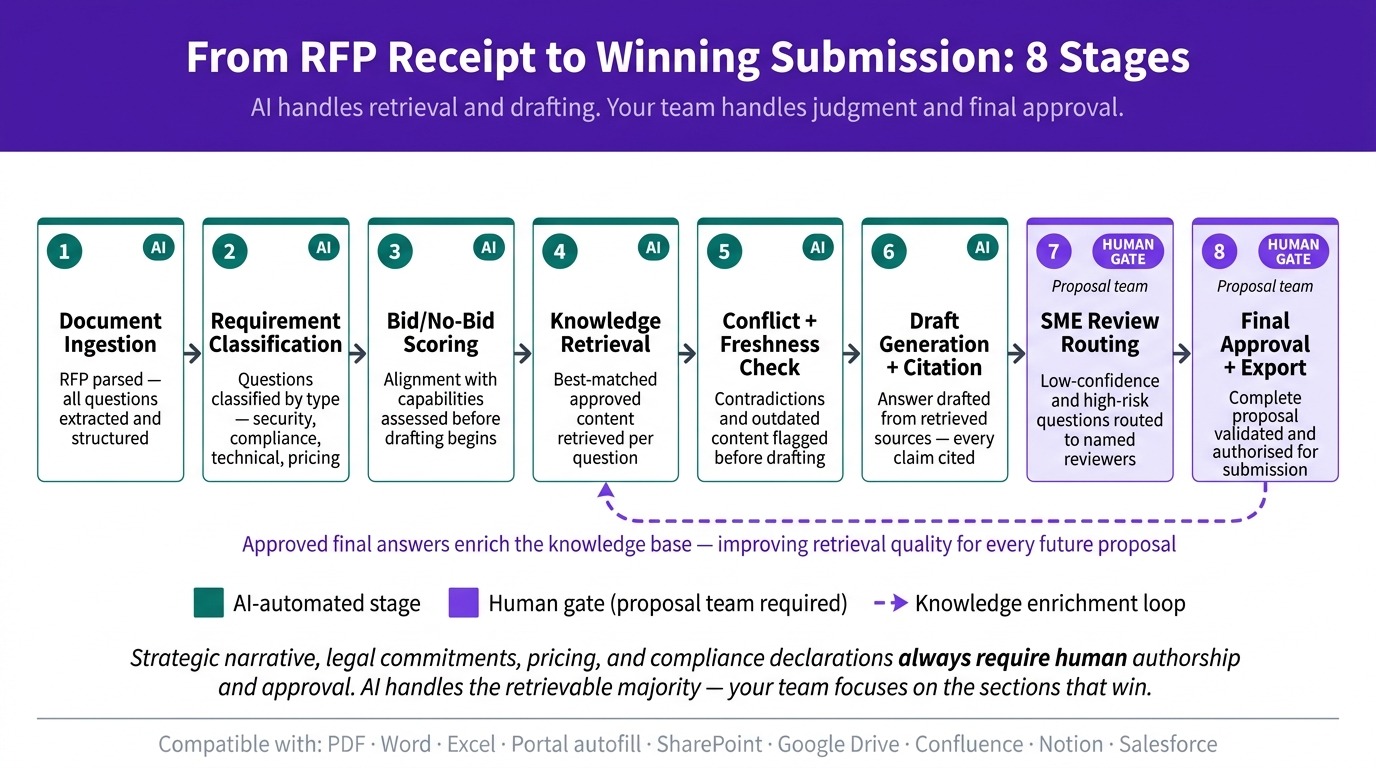
The system processes RFP documents through eight distinct stages, from initial ingestion to final formatted export. Understanding each stage clarifies what the technology actually automates, where human review occurs, and why a properly architected pipeline performs fundamentally differently from a simple AI writing assistant.
Data Acquisition: Input Sources and Knowledge Connections
The system ingests the RFP from multiple entry points: uploaded PDFs, Word documents, Excel questionnaires, and web-based procurement portals accessed via browser integration. Simultaneously, it connects to the organisation’s approved knowledge sources – document management platforms, internal wikis, product documentation, prior winning proposals, compliance certificates, and security policies. Access controls inherited from connected source systems ensure the retrieval layer only surfaces content the requesting user is authorised to access.
The AI Processing Pipeline
- Document Ingestion and Parsing. First, the system ingests the RFP document and runs optical character recognition (OCR)Technology that converts scanned or image-based document content into machine-readable, searchable text and structural parsing to identify sections, tables, requirement blocks, and submission instructions. It extracts metadata including response deadline, evaluator contact details, and required submission format – making these parameters available throughout the downstream workflow. Formatted Word documents, multi-table Excel questionnaires, scanned PDFs, and portal-rendered pages all pass through this stage.
- Requirement Extraction and Classification. Next, a natural language processing (NLP)The AI discipline enabling computers to understand, interpret, and respond to human language in context, including nuance, intent, and implicit meaning model identifies every distinct question and implicit requirement within the document. Each item is classified by type – product capability, pricing, security, legal, compliance, past performance, or implementation methodology. This classification determines which knowledge sources to search and which SME roles to route to if the system detects a content gap.
- Bid/No-Bid Scoring. Once requirements are mapped, the system generates a bid/no-bid score by evaluating alignment between the RFP requirements and the organisation’s demonstrated capabilities, pricing range, past performance record, and geographic or regulatory eligibility. This step runs before significant drafting effort begins. Low-probability opportunities are flagged for review, allowing teams to make informed resource allocation decisions before investing hours in a response.
- Knowledge Retrieval and Evidence Matching. The system performs hybrid retrievalA search approach combining dense vector-based semantic similarity matching with sparse keyword search, capturing both conceptually similar and exactly matching passages from a knowledge base across all connected knowledge sources – combining semantic similarity search with keyword matching to surface the most relevant approved content for each classified question. Retrieval respects document-level permissions throughout, ensuring content from restricted sources never appears in responses without authorised access.
- Conflict and Freshness Detection. Before drafting begins, the system flags retrieved content containing conflicting statements across sources – for example, different data retention periods cited in two different policy documents. It also checks content freshness against configurable expiry rules, preventing outdated product specifications or retired certifications from appearing in new responses without explicit reviewer confirmation. This step directly addresses the content decay problem that undermines most static library systems.
- AI Draft Generation with Source Citations. At this stage, a retrieval-augmented generation (RAG)An AI architecture that grounds large language model outputs in retrieved company-specific content, ensuring generated responses are factually anchored rather than invented from general training data pipeline generates a draft answer for each classified question, citing the specific source passage used. Every generated answer carries a confidence score. High-confidence answers proceed directly to assembly; low-confidence answers and those with conflicting or missing source evidence are queued for SME review. The model’s role here is synthesis and formatting – not knowledge creation.
- SME Review Routing. The system routes flagged items directly to the appropriate subject matter expert via integrated collaboration channels. Routing logic maps question types to named reviewers or role groups – security questions route to the information security team, pricing questions route to finance, compliance questions route to legal. Reviewers see the draft answer, the source citation, the confidence score, and the original question simultaneously, enabling efficient review without context-switching between tools. More advanced deployments leverage AI agent development patterns to automate routing logic, reminder escalations, and dependency sequencing across complex multi-reviewer workflows.
- Final Assembly, Validation, and Export. Once all sections reach approved status, the system assembles the complete response in the buyer’s required format. A final validation pass checks for missing answers, unsupported claims, inconsistent terminology, and expired evidence references. The export layer outputs into Word, Excel, PDF, or portal-specific formats with formatting preserved and submission instructions addressed. Every answer, source citation, reviewer, and approval timestamp is recorded in an immutable audit log for post-submission reference.
Human-in-the-Loop: Where Human Judgment Still Matters
What implementation experience reveals that theoretical explanations often miss is this: the value of AI in this workflow comes primarily from its ability to surface the right exceptions quickly – not from eliminating human review altogether. A well-built system automates the retrievable, repeatable majority and routes the genuinely uncertain minority to the right expert immediately, rather than letting it stall in an email queue for days.
- Strategic narrative and competitive differentiation sections always require human authorship. AI retrieves supporting evidence and reference material; human writers shape the argument for why this specific organisation is the right choice for this specific buyer.
- Legal, pricing, and contractual commitments require mandatory human approval before inclusion in any submission. The system flags these automatically and blocks export until an authorised reviewer signs off on every item in this category.
- Security and compliance declarations route to named owners in the information security or legal team for every proposal – regardless of confidence score – because inaccurate declarations carry direct liability risk that cannot be delegated to an automated system.
- Novel or highly customised requirements with no close match in the knowledge base are escalated immediately, allowing SMEs to draft and approve new canonical answers. Those approved answers then enrich the knowledge base, improving retrieval quality for all future proposals that contain similar requirements.
- Final submission decision rests with a human approver in every configured workflow. The system supports the decision; it does not make it.
Output and Interaction: How Results Are Delivered
Proposal managers interact with the system through a web-based review interface that displays each question alongside its draft answer, confidence score, and source citations. Inline editing allows direct revision without switching between tools. The SME routing dashboard shows all outstanding review items, assignees, and response deadlines in a single view – replacing the email chains and status-check meetings that characterise unmanaged workflows.
Exports cover all standard buyer-facing formats: Word documents with preserved heading structure, Excel questionnaires with pre-filled cells, formatted PDFs for formal submission, and automated form-fill for web-based procurement portals via browser integration. The system also maintains a running proposal library where approved final answers are automatically indexed, improving retrieval quality on every subsequent RFP processed.
5. What Technologies Power an AI RFP Automation Platform?
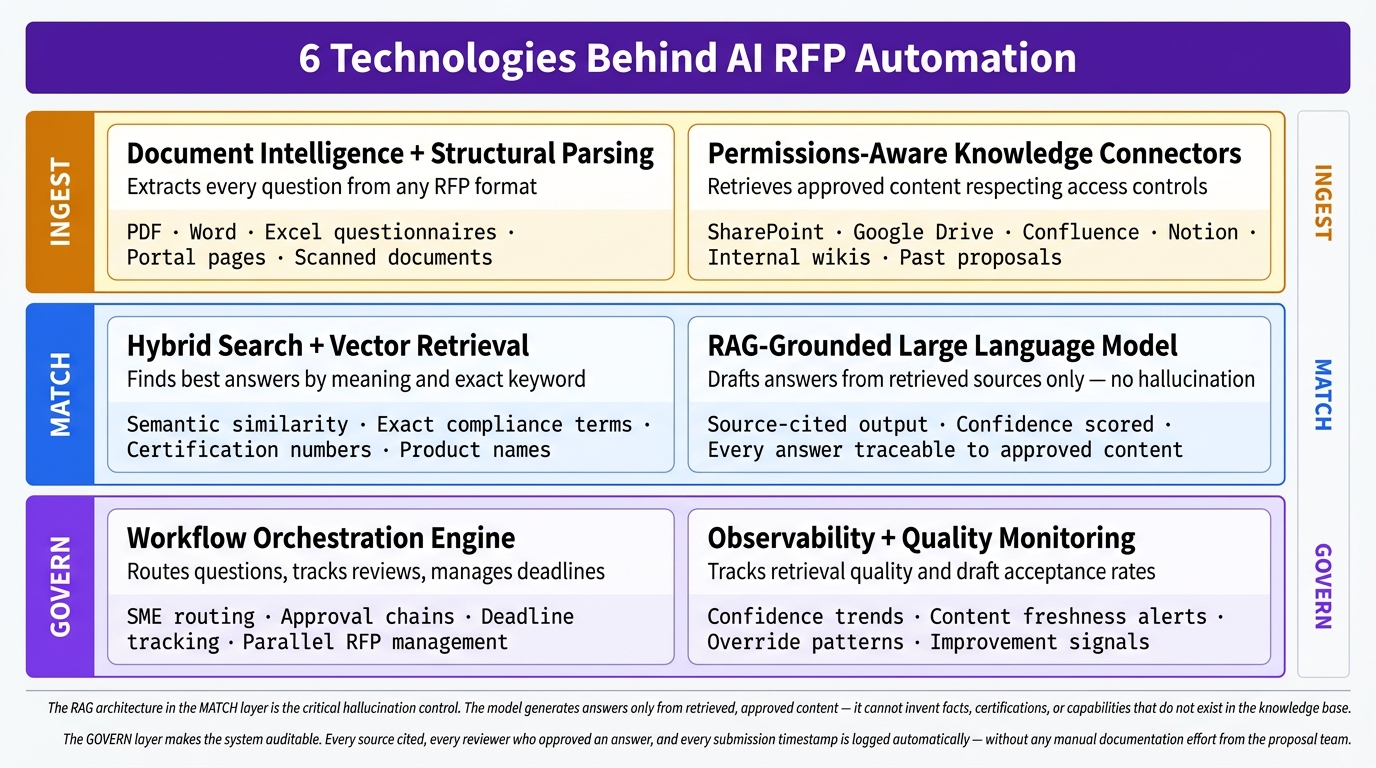
Five core technology layers combine to make an AI RFP automation platform work reliably at production scale. Each layer addresses a specific failure mode that simpler approaches – basic AI writing assistants or static content libraries – cannot handle.
- Document Intelligence and Structural ParsingAI-powered technology that extracts structured content, tables, requirement blocks, and metadata from PDFs, Word documents, Excel files, and portal-rendered HTML: Handles the full range of RFP formats – formatted Word documents, multi-table Excel questionnaires, scanned PDFs, and browser-rendered procurement portal pages – converting each into structured, searchable question sets. Without robust document intelligence, the upstream retrieval and drafting stages receive incomplete input and produce unreliable output regardless of the model quality used downstream.
- Hybrid Search and Vector RetrievalA retrieval architecture that combines dense embedding-based semantic search with sparse keyword matching, capturing both conceptually similar and precisely matching passages from large knowledge bases: Drives knowledge matching across both precise keyword queries – exact product names, certification numbers, regulatory codes – and conceptually similar but differently worded questions. Keyword-only search misses paraphrased matches; semantic-only search misses exact compliance terms. The hybrid approach is foundational to a reliable intelligent RFP response tool operating across varied buyer phrasings and question types.
- Large Language Models (LLMs)Large-scale AI models trained on extensive text data, capable of generating coherent, contextually appropriate natural language responses from retrieved source content: Generate draft answers grounded in retrieved evidence rather than free-form invention. In a well-architected AI proposal writing platform, the model’s role is synthesis and formatting – not knowledge creation. A system that drafts answers without grounding them in retrieved approved content is not an RFP automation tool; it is a hallucination risk with a proposal-shaped interface.
- Workflow Orchestration EngineA backend system managing multi-step, long-running processes including task routing, parallel execution, retry logic, and status tracking – ensuring complex proposal workflows complete reliably under concurrent load: Manages the end-to-end proposal lifecycle across multiple parallel RFPs, SME reviewers, and submission deadlines simultaneously. Without reliable orchestration, long-running proposal jobs fail silently and routing logic breaks under concurrent workload – a common failure mode in lightweight AI bid management software that lacks a proper workflow execution layer beneath the AI components.
- Permissions-Aware Knowledge Connectors: Integrate with document platforms – SharePoint, Google Drive, Confluence, Notion, internal product wikis – while inheriting each source system’s existing access control rules. This architecture ensures that content from restricted repositories – unreleased roadmap items, commercial pricing structures, confidential legal positions – never surfaces in a proposal response without explicit authorisation from the owning team.
- Observability and Quality Monitoring Layer: Tracks retrieval relevance scores, draft acceptance rates, SME override patterns, and answer freshness metrics across every proposal processed. This layer enables continuous improvement without manual quality audits – identifying which question types generate low-confidence drafts, which knowledge areas are decaying fastest, and where retrieval tuning would deliver the greatest gain in first-draft acceptance rates.
6. What Results Does an AI RFP Automation Solution Actually Deliver?
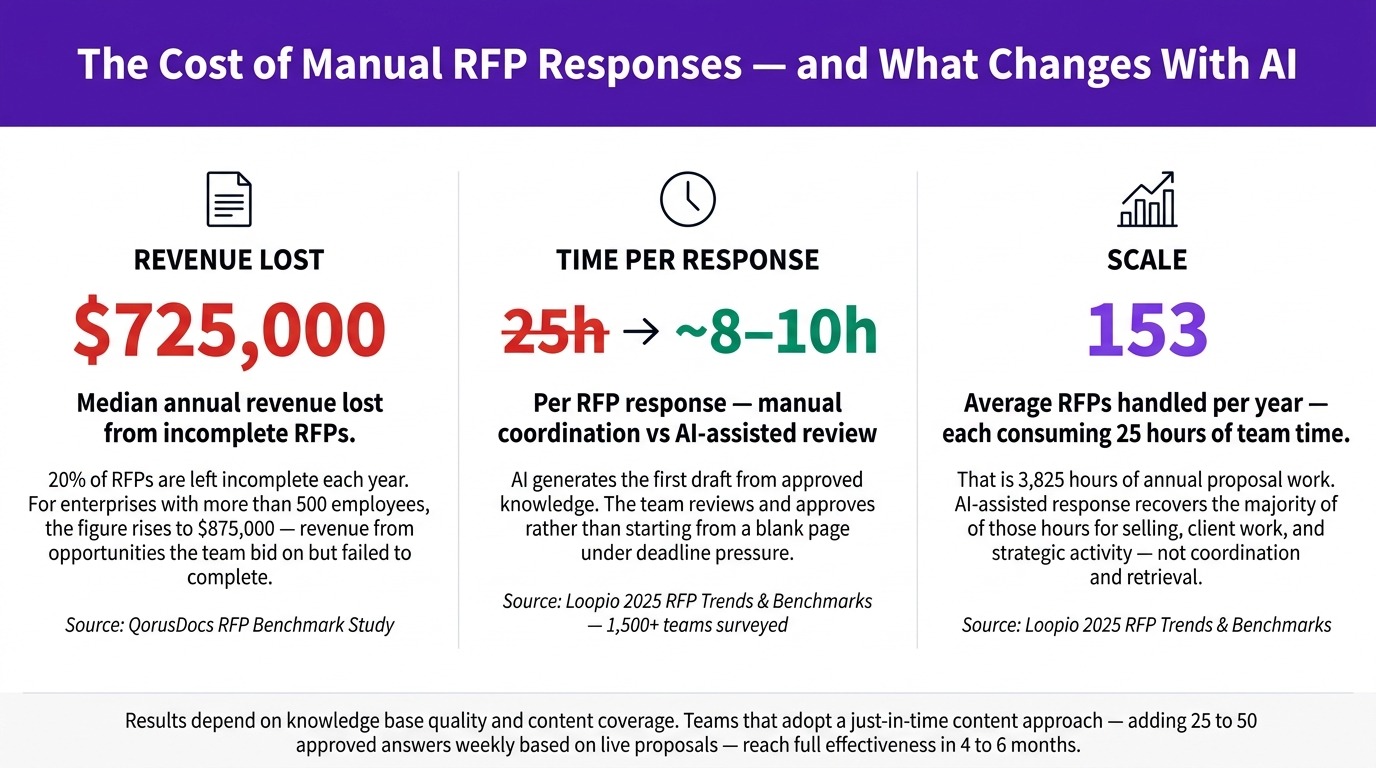
An AI RFP automation solution directly reduces the four operational costs that proposal teams feel most acutely: time per response, quality inconsistency, SME burden, and missed pipeline opportunities. Each benefit below connects to a specific pain point identified in the challenge section – not to general AI capability claims.
- Substantially faster first-draft generation: A RFP response AI tool generates an initial response draft in hours rather than days for the retrievable majority of standard questions. Teams consistently report that this shifts the proposal process from “starting from a blank page under deadline pressure” to “reviewing and refining a structured draft” – a fundamentally different and more manageable workload profile.
- Consistent answer quality across all proposals: Because every answer is grounded in the same approved knowledge sources, responses produced by a junior coordinator and a senior proposal manager draw on identical vetted content. Inconsistencies driven by individual writing style, memory gaps, or outdated personal reference files no longer appear as credibility risks or compliance concerns during buyer evaluation.
- Significant SME time recovery: Routing only genuinely uncertain or high-risk questions to subject matter experts – rather than every question – reduces SME review burden dramatically. Technical and compliance experts receive fewer, better-scoped review requests, making them more responsive and more willing participants in the proposal process rather than consistent bottlenecks.
- Reduced risk of missed deadlines: Automated question extraction, parallel knowledge retrieval, and SME routing all begin simultaneously from the moment an RFP enters the system. The bottleneck shifts from “waiting for people to start” to “reviewing completed sections” – compressing the effective timeline available between RFP receipt and the submission deadline.
- Improved win rate through better content use: Teams that deploy a bid automation AI solution and recover review capacity consistently report spending more of their available time on the strategic narrative and differentiating sections – the parts of a proposal that evaluators weight most heavily. Better allocation of existing capacity, not just faster execution, is the primary driver of the win rate improvement.
- A self-improving institutional knowledge base: Every approved final answer adds to the organisation’s knowledge repository automatically. Unlike a static content library requiring dedicated curation effort, the system accumulates knowledge as a by-product of normal proposal work – meaning quality improves with use rather than degrading through neglect and organisational turnover.
- Audit-ready compliance documentation: A complete record of every source cited, every SME reviewer, every approval timestamp, and every submitted version is maintained without manual documentation effort. For regulated industries and government contracting environments, this traceability record directly addresses post-submission audit requirements and contractual compliance verification needs.
7. Is AI RFP Automation Worth the Investment?
AI RFP automation pays for itself when proposal volume exceeds what the team can manage without quality compromises. For most mid-size B2B organisations handling 50 or more proposals annually, the time savings alone justify the investment – but the full business case extends across at least four measurable dimensions.
Key Business Metrics to Measure Before and After Deployment
- Per-proposal response time: Measure average elapsed hours from RFP receipt to submission-ready draft before and after deployment. Reduction in this figure translates directly to either higher proposal volume capacity from the same team size, or lower cost per proposal – depending on how the recovered time is reinvested. Track this per proposal type – security questionnaires, standard RFPs, and complex government solicitations typically show different improvement curves.
- SME hours consumed per proposal: Track how many hours of subject matter expert time each proposal consumes before and after. Recovery of SME time from repetitive, low-judgment review work represents a measurable financial return because that expertise has an identifiable cost rate and a clearly higher-value alternative application.
- Proposal win rate by category: Measure win rate across a comparable set of competitive proposals before and after implementation, segmented by proposal type and deal size. Improvements attributable to faster turnaround, higher consistency, and more time available for strategic content represent the most commercially significant return in the entire business case.
- Abandoned and declined RFP rate: Track how many viable opportunities the team declines or abandons due to capacity constraints. Recovering even a portion of that pipeline by processing proposals that previously had to be declined directly offsets implementation and running costs.
Realistic Implementation and Payback Timeline
A common pattern across real implementations of this solution is that the full productivity benefit arrives in phases rather than immediately after go-live. A mid-size organisation connecting an AI proposal writing platform to existing knowledge sources typically sees partial time savings within the first few weeks – covering questions where high-quality approved content already exists. The broader gain, where 70-80% of incoming questions generate accepted first drafts without SME intervention, generally arrives four to six months into operation as the knowledge base matures through regular use.
The payback timeline accelerates significantly when teams adopt a just-in-time content approach – adding 25 to 50 approved answers weekly based on questions actually received in live proposals – rather than attempting to migrate an entire historical archive upfront. This method achieves higher content coverage faster and avoids the trap of importing outdated content that degrades retrieval quality and erodes user trust before value is established.
The business case for acting now rather than waiting rests on a straightforward cost observation: every proposal processed manually while an AI system remains undeployed represents a recurring fixed cost in SME hours and coordinator time that compounds across every subsequent RFP cycle. The baseline cost does not decrease with time – only with deliberate process change.
8. What Does Implementing an AI RFP Automation Solution Actually Require?
Successful deployment of an AI RFP automation solution depends more on content quality than on the AI itself. The technology processes whatever knowledge it is given – clean, current, well-attributed content produces reliable drafts; stale, contradictory, or ungoverned content produces unreliable ones. This is the most frequently underestimated factor in live deployments of this type, and it deserves honest acknowledgment before implementation begins.
Where This Solution Has Real Limits
- Fully autonomous submission is not achievable with current technology. The system accelerates and supports the proposal process; it does not replace human judgment on strategic, legal, pricing, or compliance-sensitive sections. Any solution claiming otherwise warrants rigorous scrutiny during evaluation.
- Performance degrades with poor source content. Content that is outdated, contradictory across sources, or inconsistently attributed produces low-confidence drafts that increase rather than reduce review workload. The AI surfaces what exists in the knowledge base – it does not detect or correct what is factually wrong in the source material.
- Complex portal-based submissions add integration challenges. Web-based procurement portals vary significantly in structure and technical accessibility. Browser-based autofill handles many standard portal formats reliably, but novel portal architectures or heavily dynamic JavaScript-rendered forms may require additional custom integration work that extends the initial deployment timeline.
- Highly bespoke or strategic proposals still require significant human input. For responses requiring original thought, novel competitive positioning, or deep customisation to a specific buyer’s unique situation, the AI provides reference material, structural scaffolding, and supporting evidence – not a finished strategic argument. The team’s judgment remains the differentiating factor in high-value competitive bids.
Practical Implementation Factors
- Content governance as a prerequisite: Teams that have worked through this integration consistently find that a lightweight content governance policy – naming who owns each knowledge category, how frequently content is reviewed, and what event triggers an update – delivers more return on investment than additional AI capability alone. Without clear ownership, content decays silently and retrieval quality erodes over time without any visible warning signal until teams stop trusting the output.
- Integration with existing knowledge systems: Connecting the platform to SharePoint, Google Drive, Confluence, or internal product documentation requires access credential setup and permission mapping. For most organisations this is a one-time effort measured in days rather than weeks, but it requires IT involvement and access to the relevant system administrators from the outset of the project.
- Data privacy and compliance obligations: For organisations in regulated industries – financial services, healthcare, or defence – proposal content may include commercially sensitive information, personally identifiable data, or controlled technical specifications. Deployment options should include private LLM deployment configurations that keep all data processing within the organisation’s controlled infrastructure environment.
- Change management for proposal teams: Adopting a new workflow requires a behavioural shift – specifically the move from drafting to reviewing. Teams that receive early training on how to evaluate AI-generated drafts efficiently, and clearly understand which sections require careful scrutiny versus which can be approved quickly, realise productivity value faster and sustain higher adoption rates over the first year.
- Realistic timeline expectations: Expect two to four weeks for initial integration and knowledge source connection, followed by four to six months of progressive maturation before the system reaches sustained high-coverage performance. Setting this expectation clearly within the organisation prevents early-stage underperformance from being misread as product failure and derailing adoption before the system reaches full effectiveness.
9. Which Teams and Industries Get the Most Value from AI RFP Automation?
This solution delivers the highest value for teams handling high volumes of competitive proposals under consistent deadline pressure. The return scales with proposal volume, content complexity, and the number of SMEs involved in the review process – making the impact most significant for organisations where all three factors are present simultaneously.
Ideal organisations include B2B technology companies running active enterprise sales cycles with frequent security and procurement questionnaires, management consulting and professional services firms competing for project-based contracts on tight timelines, government and public sector contractors navigating complex federal or public procurement requirements, and financial services or healthcare organisations managing high volumes of vendor due diligence requests alongside standard RFP submissions.
An enterprise AI development approach is particularly appropriate for large organisations where proposals cross multiple business units, require multi-tier approval chains, or operate under strict data governance obligations that preclude shared cloud-based deployment. For these environments, a custom-built AI bid management software with on-premise or private cloud deployment addresses both the performance and the compliance requirement simultaneously.
This solution is particularly valuable if:
- Your team handles 30 or more proposals annually and response quality varies noticeably based on who is available to manage each one.
- Subject matter experts consistently report proposal requests as a top source of unplanned workload that conflicts with their primary responsibilities.
- Your win rate has stagnated and you lack the data visibility to determine whether response quality, turnaround speed, or content consistency is the primary contributing factor.
- Your organisation competes in regulated or compliance-heavy sectors where answer accuracy carries contractual, legal, or reputational weight beyond the individual proposal.
- Valuable institutional knowledge exists inside historical proposals, product documentation, or internal wikis – but the team cannot reliably find and reuse it under the time constraints of a live RFP response cycle.
10. Frequently Asked Questions About AI RFP Automation
How does AI RFP automation software actually work for technology sales teams?
For technology sales teams, an AI RFP automation solution connects to the organisation’s product documentation, security policies, compliance certifications, and past winning proposals. When a new RFP or security questionnaire arrives, the system extracts every question, classifies it by type – product capability, security architecture, pricing, implementation methodology – and retrieves the best matching approved content for each. It generates a source-cited first draft that the sales engineer or proposal manager reviews rather than writes from scratch. The key benefit for technology teams specifically is that the same technical and security questions – which appear across almost every enterprise procurement process – get answered consistently and quickly, without pulling solutions engineers into every full review cycle for content that already has an approved version.
How much time can an automated RFP response platform actually save?
The time saving depends on two factors: how many incoming questions match the organisation’s existing approved content, and how mature the knowledge base is at the time of each proposal. For organisations with well-maintained and current knowledge sources, an intelligent RFP software reducing response time by 50-70% on standard question types is a realistic expectation after the first few months of operation. The most meaningful saving is not raw drafting speed – it is the elimination of coordination overhead: the email chains, status meetings, and SME chasing that account for a disproportionate share of every response cycle. Teams most commonly report that the biggest change is shifting from “will this be done in time” pressure to “reviewing and approving completed sections” confidence.
Can an AI proposal tool actually reuse content from past winning bids reliably?
Yes, but the reliability depends more on content quality and governance than on the AI itself. An AI proposal tool reusing content from past winning bids works best when those bids have been reviewed, approved, and indexed with clear ownership and freshness dates attached. The most common failure mode is migrating a large historical archive without filtering for accuracy and currency – teams that import thousands of old responses often discover that only a fraction remain usable, which degrades retrieval quality and undermines user trust early in adoption. A more effective approach starts with a smaller set of recent high-quality answers and expands steadily. The system builds knowledge continuously from every approved final response, so the library improves through normal proposal work rather than requiring a large upfront migration effort as a prerequisite to value.
Is AI RFP automation software reliable enough for government and public sector bids?
An AI RFP tool for government and public sector bids is most valuable for automating the retrievable, compliance-demonstrable portions of a federal or public procurement response – past performance narratives, certifications, standard capability statements, and compliance matrix population. Strategic sections, pricing structures, and contractual commitments always require human authorship and approval before submission, regardless of AI assistance. For regulated and security-sensitive government contracting contexts, private or sovereign cloud deployment is typically required to meet data handling and classification obligations. When implemented with appropriate governance controls and mandatory human sign-off on high-risk sections, AI-assisted proposal generation measurably improves compliance accuracy and response speed without removing the bid team’s decision-making authority.
How does an AI RFP automation solution improve proposal quality and consistency over time?
An AI RFP software improving proposal quality and consistency does so through two reinforcing mechanisms. First, every answer is grounded in the same approved content – so the response to “describe your data encryption approach” is identical across every proposal, regardless of who managed the response or when it was submitted. Second, the system learns progressively from approved final answers: each time an SME edits a draft and approves the revised version, that improved answer updates the knowledge base and becomes the new canonical response for similar future questions. The cumulative effect is a self-improving knowledge library that reflects the organisation’s most current, accurate, and competition-tested language – rather than the institutional knowledge of whoever happened to write the last version of that particular answer.
Build This Solution With Softlabs Group
Softlabs Group develops custom AI RFP automation solutions built around each client’s specific knowledge architecture, proposal workflow, and compliance requirements – not off-the-shelf platforms configured around a generic use case. That means designing the retrieval layer to connect to the knowledge sources your team actually uses, building the review workflow to match how approvals genuinely flow in your organisation, and configuring the drafting layer against your industry’s evaluation criteria and language conventions. The result is an intelligent RFP response tool that reflects your institutional knowledge and improves as a natural by-product of every proposal your team processes.
Whether your team is currently managing proposal volume manually, evaluating commercial platforms that do not fit your data governance requirements, or looking to build a proprietary AI bid management software capability that integrates tightly with your existing systems, we can scope a solution that fits your operational reality – including private deployment configurations for data-sensitive or regulated environments. The starting point is a direct conversation about your proposal volume, knowledge sources, and what a realistic first deployment looks like for your team.