 India
India  Mongolia
  Sweden
  Australia
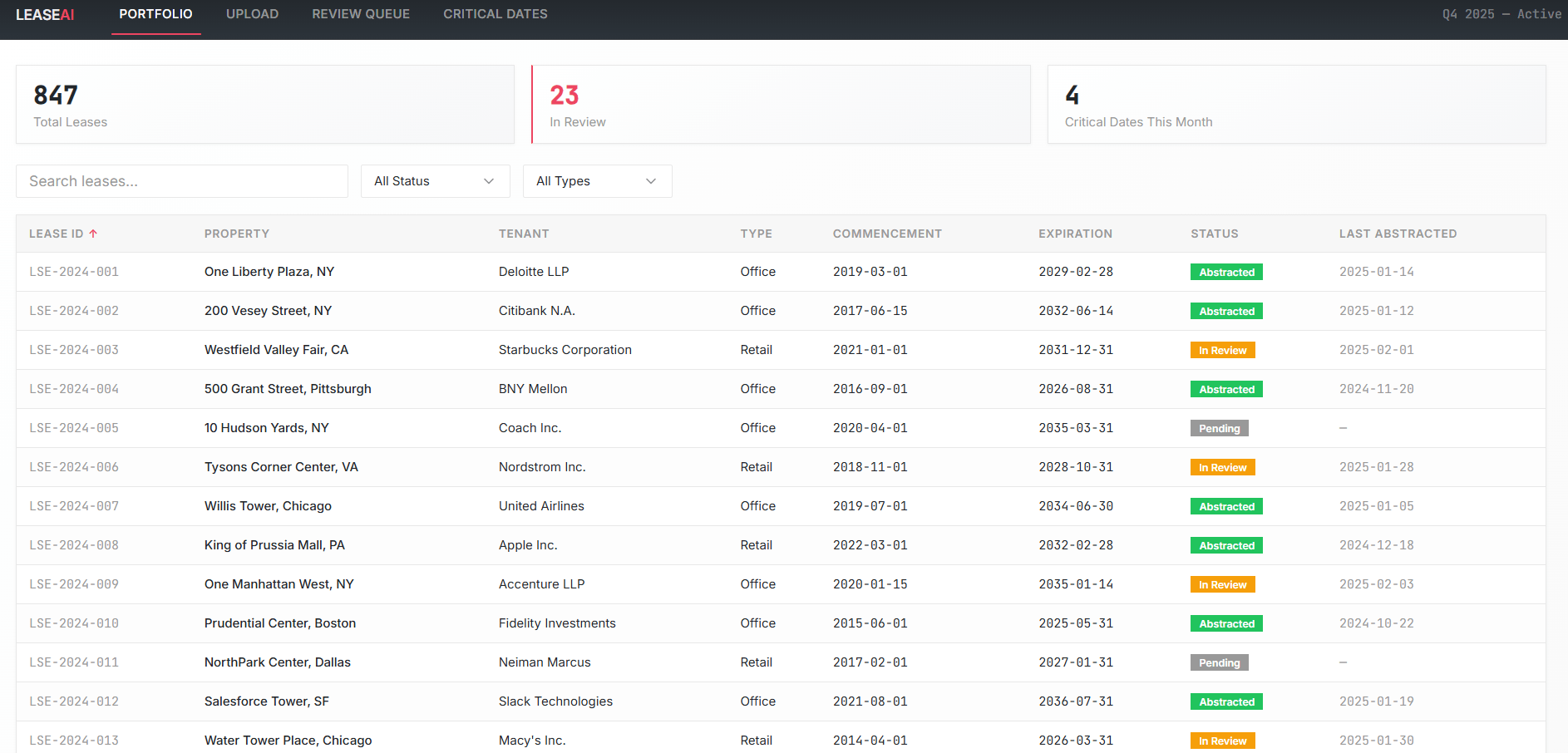
Executive Summary: How AI Is Solving a $878,000 Portfolio Problem
47 leases in the review queue. Three require amendments that modify already-abstracted provisions. Two are scanned 1998 originals with handwritten annotations. Quarter-end FASB ASC 842 reporting is eleven days out. An AI-Powered Lease Abstraction Solution exists for exactly this – the point where volume, complexity, and deadline pressure converge faster than any team can manually process them.
Commercial real estate organisations managing significant lease portfolios face a structural problem: the process of extracting rent obligations, renewal deadlines, Common Area Maintenance (CAM)The shared operating costs tenants pay proportionally under most commercial lease structures provisions, and operational restrictions from raw legal documents consumes more professional capacity than volume allows. This approach applies Optical Character Recognition (OCR)Technology that converts scanned document images into machine-readable text, Natural Language Processing (NLP)The AI discipline enabling computers to read and interpret human language in context, and Large Language Models (LLMs)Advanced AI systems capable of understanding nuanced legal language and complex conditional structures to handle routine extraction automatically – freeing Lease Administrators, Asset Managers, and legal teams for the analysis and advisory work that requires human judgment.
1. What Makes Manual Lease Abstraction Unsustainable at Portfolio Scale?
Context: The Commercial Real Estate Data Environment
Manual lease abstraction requires 4–8 hours per document at a labour cost of $120–240 each – unsustainable at portfolio scale. Commercial real estate organisations manage portfolios containing hundreds – sometimes thousands – of active lease agreements. Each document carries rent obligations, renewal deadlines, Common Area Maintenance (CAM) charge provisions, and operational restrictions with direct financial consequences. Lease Administrators, Asset Managers, Paralegals, and accounting teams all depend on accurate lease data. Yet the process of extracting that data from raw legal documents remains, in most organisations, fundamentally manual. The volume of documents involved, combined with the legal complexity of each agreement, makes this one of the most resource-intensive recurring tasks in property operations.
Key Pain Points This AI Solution Addresses
- Lease abstraction taking too long – individual documents demand 4–8 hours of Paralegal or Lease Administrator time. At portfolio scale, this creates permanent backlogs and delays decision-making.
- Manual lease review errors – human reviewers working under volume pressure introduce inaccuracies into financial data, renewal tracking, and compliance records. Human error produces material mistakes in approximately 10 percent of completed abstracts.
- Missed lease renewal deadlines – manually maintained spreadsheets and calendar reminders fail. A single missed option exercise window can forfeit millions in lease value.
- Lease data scattered across systems – spreadsheets, email attachments, document management platforms, and physical files hold different parts of the same lease record. No single source of truth exists.
- Too many leases to review manually – portfolio growth through acquisition compounds an already strained process. Manual abstraction cannot scale.
- Inconsistent lease data across portfolio entries – different reviewers apply different standards. The resulting data lacks comparability and cannot support reliable portfolio-wide reporting.
- Lease administration team overwhelmed with volume – skilled professionals spend the majority of their working hours on data entry. Higher-value analytical and advisory work goes undone.
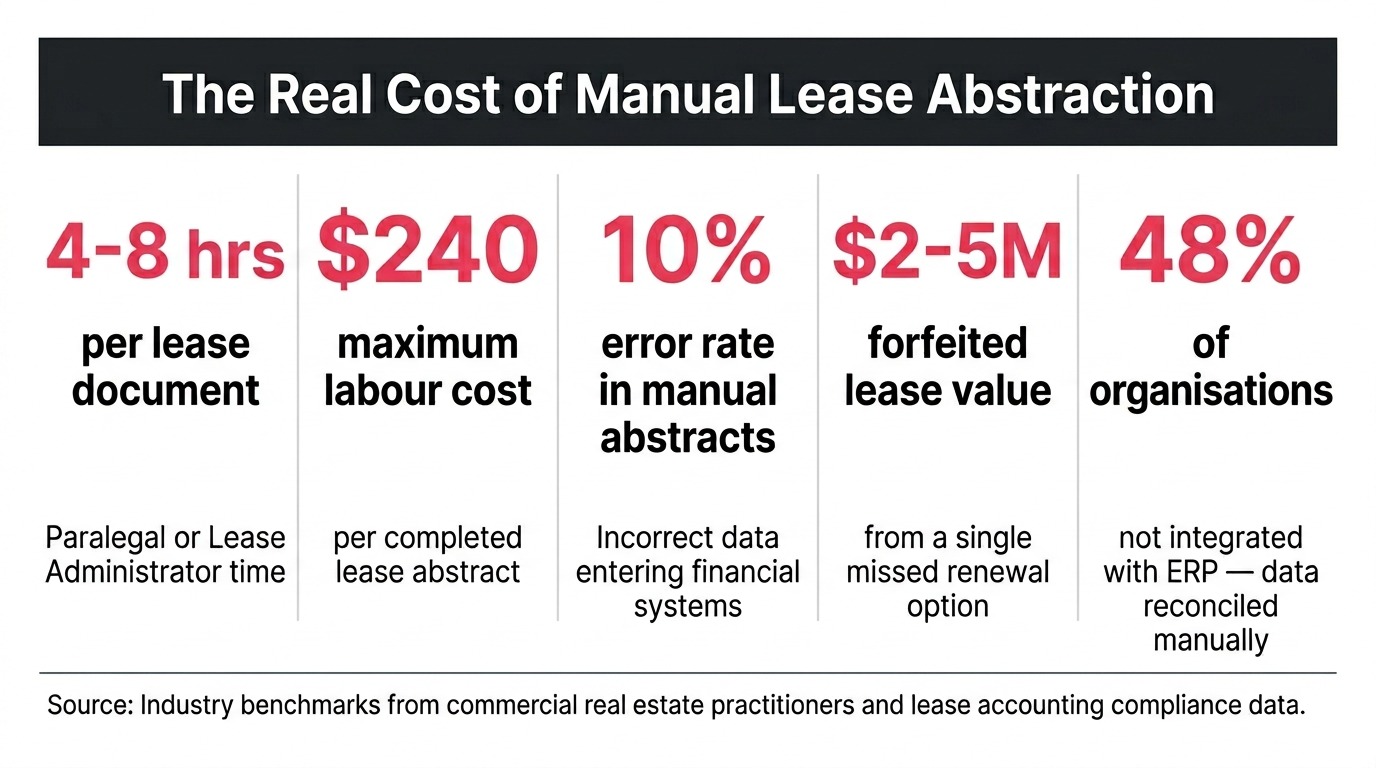
The real cost of manual lease abstraction across labour, errors, and missed critical dates
Why Traditional Approaches Fall Short
Manual abstraction cannot scale. Even experienced professionals make errors under volume pressure. Review fatigue, non-standard lease formats, and multi-document amendment stacks compound the problem over time.
Spreadsheet-based tracking creates a secondary set of failures. Data lives in silos – one system tracks critical dates, another holds financial terms, a third stores amendment records. Reconciling these silos during a portfolio acquisition takes weeks. Version control breaks down. Audit trails disappear.
Financial Accounting Standards Board Accounting Standards Codification 842 (FASB ASC 842) and International Financial Reporting Standard 16 (IFRS 16) require organisations to bring nearly all operating leases onto the balance sheet. FASB ASC 842 and IFRS 16 compliance requires structured lease data at portfolio scale – a requirement manual extraction cannot consistently satisfy. The result is that regulatory deadlines, not just operational efficiency, now force the question of whether manual abstraction remains a viable approach.
2. What Is an AI-Powered Lease Abstraction Solution?
An AI-Powered Lease Abstraction Solution converts unstructured legal documents into structured, queryable portfolio data automatically – without replacing professional judgment. Rather than eliminating the expertise of legal and real estate professionals, it eliminates the low-value data entry that currently consumes most of their time. The AI handles routine extraction at speed and scale. Human reviewers apply their expertise to complex provisions and high-stakes decisions where it actually matters.
The system applies OCR, NLP, and LLMs in sequence – reading, interpreting, and extracting information from lease documents in formats ranging from clean digital PDFs to decades-old scanned agreements with handwritten annotations. Modern AI lease abstraction platforms support 40-plus file types and extract 200-plus data fields per document. The result is a standardised, portfolio-wide data asset that Property Management, Accounting, and Legal teams can actually use for reporting, compliance, and strategic decision-making.
A realistic implementation has two components – not one. Before the AI pipeline runs, a pre-deployment readiness engagement prepares the document set, aligns the field template across legal, finance, and asset management stakeholders, and maps amendment chains to their base leases. Every AI lease abstraction implementation that fails does so because the documents were not ready, the field template was not agreed, or the amendments were not mapped – not because the AI was not good enough. The readiness engagement solves those three things first. The extraction pipeline then runs on prepared input – which is why accuracy holds on real portfolios, not just clean demo documents.
Vision & Objectives
- Reduce individual lease abstraction time from hours to minutes per document
- Achieve consistently structured output across all lease types, formats, and jurisdictions
- Eliminate critical date tracking failures and missed renewal option windows
- Create a single, auditable data source covering the full lease portfolio
- Enable FASB ASC 842 and IFRS 16 compliance reporting at portfolio scale
- Free legal, administrative, and asset management teams for higher-value analytical and advisory work
3. How Are Real Estate and Legal Teams Using AI Lease Abstraction in Practice?
AI lease abstraction delivers measurable value across three distinct operational contexts – portfolio management, transaction due diligence, and compliance reporting. In practice, organisations deploying this type of system encounter the same underlying problem in different forms: volume that exceeds manual capacity, accuracy that erodes under deadline pressure, and data that never quite reaches the system where decisions get made. The following scenarios show how the AI-Powered Lease Abstraction Solution addresses each version of that problem.
Real Estate Investment Trusts and Institutional Asset Managers: AI Lease Abstraction for Large Property Portfolios
Your Lease Administration team spends more time entering data into spreadsheets than they spend managing the portfolio those spreadsheets describe. At 300 or more active leases, every abstraction cycle creates a backlog. Amendment tracking compounds it – each modification requires cross-referencing multiple documents to update a single record. The team capable of doing this work well is perpetually occupied doing it, leaving no capacity for the analysis that drives portfolio decisions.
The system ingests the full document set simultaneously – PDFs, Word files, scanned originals – extracting financial terms, rent escalation schedules, option dates, and CAM charge provisions across the entire portfolio in parallel. It links amendments to parent leases automatically. High-confidence extractions populate the asset management platform directly; lower-confidence fields route to a focused review queue. Portfolio Managers gain reliable, current visibility across the full inventory. Automated lease abstraction for large property portfolios converts a permanent bottleneck into a managed, exception-based review process.
Mergers and Acquisitions Advisory and Acquisition Teams: AI Lease Abstraction for Due Diligence
Your deal team has ten business days to assess 400 leases – and the clock started yesterday. Sequential, Paralegal-led review cannot keep pace with transaction timelines at this volume. Reviewers working under deadline pressure miss provisions. Co-tenancy clauses, assignment restrictions, and termination rights – the provisions that most affect deal pricing – require careful contextual reading that fatigue compromises.
AI lease abstraction for due diligence and acquisitions processes the complete lease package simultaneously rather than sequentially. The system extracts co-tenancy clauses, early termination rights, assignment provisions, rent guarantees, and exclusivity clauses across the full target portfolio in hours rather than days. Legal and advisory teams receive structured summaries sorted by provision type – material risks surface early rather than buried in sequential review. The commercial lease abstraction platform compresses weeks of review into days, improving deal velocity without reducing the quality of lease-level data entering the pricing model.
Property Management Companies: Lease Data Automation for Compliance and Reporting
Every time a new lease or amendment arrives, your Accounting team manually re-enters data that already exists in a signed legal document – because the lease repository and the financial reporting system have never been connected. Each quarter-end, the team reconciles lease terms against balance sheet entries by hand, accumulating errors across amendment stacks. The FASB ASC 842 balance sheet recognition requirement demands structured, reproducible data – and manually maintained spreadsheets cannot satisfy auditors reliably at scale.
The automated lease abstraction software processes each new document on arrival, extracting commencement dates, lease terms, renewal options, and variable payment structures in a consistent, standardised format. Structured outputs enter financial reporting systems directly – no manual re-entry, no reformatting. The lease data extraction software pipeline links every extracted field back to its source clause, giving auditors a complete, reproducible trail. Quarter-end preparation time decreases substantially. Errors from inconsistent manual entry stop accumulating.
4. How Does AI-Powered Lease Abstraction Actually Work?
An AI-Powered Lease Abstraction Solution processes each document through seven sequential stages – from OCR to human-in-the-loop validation. In practice, organisations deploying this type of system encounter document quality variation as the first real constraint: clean digital originals process differently from degraded 1990s scans with handwritten annotations, and the pipeline must handle both. Understanding each stage helps legal, technology, and real estate teams set accurate expectations for accuracy, speed, and review burden before committing to an implementation.
Data Acquisition: Document Sources and Formats
The system consumes lease documents in their native formats. Input sources include searchable PDFs, scanned document images, Word files, and – in some deployments – email attachments and document management system exports. Input document types include original lease agreements, amendments, assignments, subleases, lease guarantees, and estoppel certificates. Clean digital originals from recent transactions sit alongside decades-old scanned agreements with poor image quality, handwritten margin annotations, and non-standard formatting. The pipeline must handle this entire range reliably – document type classification occurs as the first processing step, before any extraction begins.
Stage 0: Pre-Deployment Readiness
Before the AI pipeline runs, three preparation steps determine whether extraction produces reliable output on a real portfolio – or accurate results only on clean demo documents. This stage is what separates implementations that hold up under audit from those that deliver impressive demos and disappointing production performance.
- Document quality audit and tiering – Every document in the portfolio is assessed and assigned a quality tier: clean digital original, degraded scan requiring preprocessing, or handwritten and mixed-format requiring manual preparation. Tier 2 and Tier 3 documents route through image enhancement and OCR optimisation before entering the main pipeline. This prevents OCR errors from propagating silently through every downstream stage.
- Field template agreement – Legal, Finance, and Asset Management stakeholders agree on the required extraction field set before a single document is processed. This step is a structured working session, not a technical task. Without it, Stage 6 normalisation maps to a template that no stakeholder group fully owns – and the output satisfies none of them. The signed-off field template becomes the extraction specification for the entire engagement.
- Amendment chain mapping – For each base lease with a history of modifications, amendments are catalogued in sequence and mapped to the provisions they affect. This structured record tells the pipeline which terms have been superseded, which remain live, and which require human reconciliation because amendments overlap on the same provision. Without this map, amendment interplay is invisible to the system until it surfaces as an error in the output.
The AI Processing Pipeline
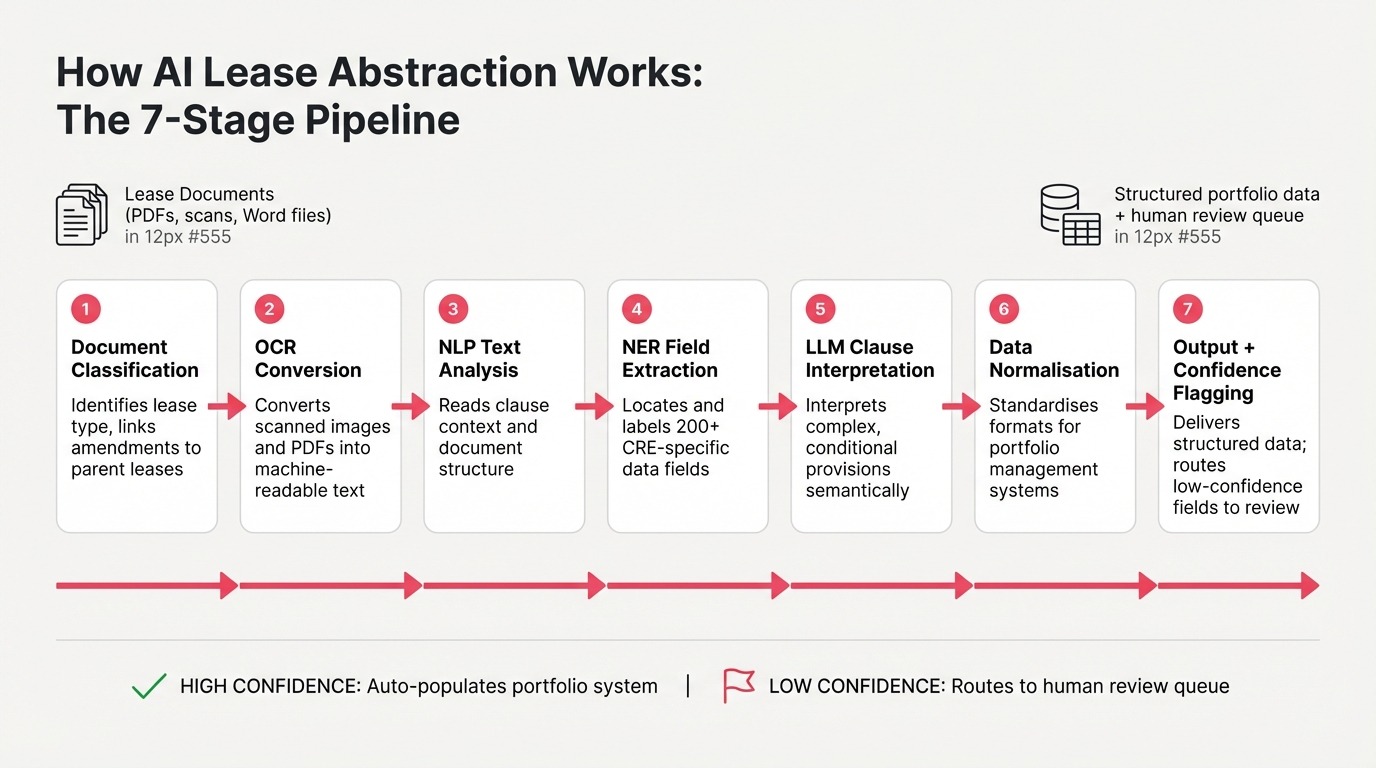
The 7-stage AI processing pipeline: from raw document input to structured, audit-ready lease data
- Document Ingestion and Classification – First, the system receives each uploaded document and determines its type. It identifies whether the file is a new lease, an amendment, a sublease, or an ancillary agreement. Where multi-document lease packages arrive together, the system links related files before extraction begins. This step prevents amendments from being processed as standalone agreements – a common error in manual workflows.
- OCR Conversion – Next, OCR processes each document page, converting scanned images and non-searchable PDFs into machine-readable text. Modern OCR achieves high accuracy on clean digital originals. Heavily degraded scans, unusual typefaces, and handwritten annotations remain challenging. Legacy documents from older archives frequently require quality-control attention during implementation – and OCR accuracy sets the ceiling for everything downstream.
- NLP Text Analysis – Once the document contains machine-readable text, NLP analyses the full document structure. The system identifies clause boundaries, section headings, and logical document organisation. NLP moves beyond keyword matching – it reads each clause in context to understand its function within the broader agreement.
- Named Entity Recognition (NER) and Field Extraction – The system then applies Named Entity Recognition (NER)A technique that identifies and classifies specific data entities – dates, monetary values, party names, and locations – within unstructured text to locate and label specific data points. Base rent figures, commencement dates, expiration dates, rent escalation schedules, renewal option windows, CAM charge provisions, and hundreds of other Commercial Real Estate–specific fields are extracted and labelled at this stage. NER classifies 200-plus CRE-specific data fields across each document.
- LLM-Based Clause Interpretation – The system then applies LLMs to provisions requiring deeper semantic reasoning. Co-tenancy clauses with multi-condition triggers, percentage rent formulas, and amendment interplay across multiple documents fall into this category. LLMs interpret what a clause means – not just what it literally says. This stage represents the most significant capability advance in AI lease abstraction since 2023.
- Data Normalisation – Once processed, the system standardises all extracted values. Dates convert to a uniform format. Currency figures align to consistent units. Field names map to the organisation’s template structure. This stage ensures that data extracted from hundreds of differently formatted lease documents loads cleanly into a single portfolio management system without manual reformatting.
- Output Generation and Confidence Flagging – At this stage, the system assembles the structured lease abstract and assigns a confidence score to each extracted field. Fields below the confidence threshold route automatically to the human review queue. High-confidence fields populate the output template directly. The system generates the final deliverable – structured data, exportable abstracts, or direct integration feeds – and creates an audit trail linking each extracted field back to its source clause in the original document.
Product Walkthrough
See the AI lease abstraction platform in action – document ingestion, field extraction, confidence scoring, and structured output delivery.
Human-in-the-Loop: Where Human Judgment Still Matters
Approximately 80 percent of standard lease provisions extract automatically at high confidence; the remaining 20 percent require qualified human review. Treating AI as a complete replacement for professional review creates real risk – and no current system eliminates that 20 percent.
- Complex interdependent clauses – Co-tenancy provisions with multi-condition triggers, percentage rent formulas with variable calculation bases, and radius restriction clauses require Attorney or experienced Lease Administrator review before finalisation.
- Amendment interplay – When multiple amendments modify overlapping provisions in a lease, the system flags the interaction for human reconciliation. Auto-resolving conflicting amendments introduces material risk.
- Degraded or non-standard legacy documents – Handwritten annotations, poor image quality, and non-standard formatting produce lower OCR and NLP confidence scores. These documents receive targeted human review.
- High-stakes legal provisions – Early termination rights, assignment restrictions, exclusivity clauses, and subordination provisions carry significant financial and legal consequences. These merit professional review regardless of system confidence score.
- Low-confidence extractions – Every field below the system’s confidence threshold routes to the review queue automatically. No field enters the portfolio database without appropriate oversight.
Vendors sometimes cite field-level accuracy figures of 95–99 percent. These typically reflect performance on clean documents where a field is present – not completeness across all provision types in a real, mixed-quality portfolio. The 80/20 benchmark reflects practitioner experience across real deployments.
Output & Interaction: How Results Are Delivered
Users interact with abstracted data through several delivery formats. Standard outputs include exportable abstract documents in standardised templates, structured data feeds for direct import into Property Management and accounting platforms, configurable critical date alerts with advance notification windows for renewals and option exercise deadlines, and portfolio-wide dashboards displaying lease data across the full inventory. Each extracted field maintains a hyperlink back to its source clause in the original document – providing a complete, auditable record of data provenance for legal and compliance purposes.
5. What Technologies Power an AI Lease Abstraction Platform?
Six core technologies combine to make this solution reliable at scale – each one handles a distinct stage of the extraction pipeline, and failure at any stage limits everything downstream.
- Optical Character Recognition (OCR): Converts scanned lease images into machine-readable text. Advanced OCR handles multi-column layouts, degraded documents, and mixed typefaces. OCR quality directly determines the accuracy ceiling for all downstream NLP and NER extraction.
- Natural Language Processing (NLP): Enables the system to read lease language in context rather than matching keywords. NLP identifies clause structure, paragraph intent, and inter-provision relationships – the foundation of accurate field extraction across diverse lease formats and jurisdictions.
- Named Entity Recognition (NER): Classifies specific data entities – parties, dates, monetary amounts, locations – within unstructured text. NER accuracy determines how reliably the system extracts field-level data from non-standardised commercial lease language.
- Large Language Models (LLMs): Post-2023 advances in LLMs substantially improved interpretation of complex, ambiguous commercial lease provisions. LLMs handle co-tenancy structures, conditional renewal options, and multi-document amendment interplay that rule-based systems and earlier NLP models could not process accurately.
- Machine Learning Classification Models: Trained on large corpora of commercial lease documents, these models learn document structure and field-location patterns across diverse lease types, formats, and jurisdictions. Larger, more diverse training sets produce models that generalise better across atypical agreements.
- Data Normalisation and Transformation Engines: Structure extracted values into consistent, queryable formats for import into Property Management Systems, Enterprise Resource Planning (ERP)Integrated software platforms managing financial, operational, and administrative data across an organisation systems, and accounting tools. This is where a lease data extraction software implementation either succeeds or fails in practice – clean extraction means nothing if the output cannot integrate cleanly downstream.
6. What Measurable Benefits Does AI Lease Abstraction Deliver?
AI lease abstraction reduces per-document processing time from hours to minutes, at a fraction of manual labour cost – with the highest financial value coming from error prevention, not speed. An AI-Powered Lease Abstraction Solution addresses each of the seven pain points from Section 1 in a direct, measurable way. The following benefits each connect directly to a specific operational cost or risk from that list.
- Dramatically reduced processing time per document – This lease abstraction AI solution compresses individual document processing from 4–8 hours to minutes. Teams clear large document backlogs that manual methods could not address within operational timelines.
- Lower direct labour costs at portfolio scale – The system handles routine extraction across the full portfolio automatically. Cost per abstracted document decreases substantially. Staff previously tied to data entry reallocate time to portfolio analysis and advisory work.
- Significant reduction in manual lease review errors – Systematic extraction eliminates inconsistencies and omissions that arise from Paralegal fatigue and non-standard document formatting. Human error produces material mistakes in approximately 10 percent of manual abstracts – a rate that compounds materially at portfolio scale.
- Elimination of missed lease renewal deadlines – Automated critical date extraction replaces manually maintained spreadsheets. Option exercise windows and notice period deadlines enter the alert system as a byproduct of abstraction. A single missed renewal option on a prime retail or office location can forfeit $2–5 million in lease value.
- Consistent, audit-ready data across the full portfolio – Every lease follows the same extraction template. Reporting becomes reliable and comparable across the entire inventory. External audit preparation time decreases significantly when lease data traces back to source clauses automatically.
- FASB ASC 842 and IFRS 16 compliance at scale – Accounting teams receive structured lease data in the formats required for balance sheet recognition. The recurring quarterly compliance burden decreases as lease data enters financial systems directly from the extraction pipeline.
- Accelerated Mergers and Acquisitions due diligence – Real estate transaction teams process complete lease packages in days rather than weeks. Commercial lease data extraction with AI improves deal velocity without reducing data quality or increasing risk exposure.
- Scalability through portfolio growth – When portfolios expand through acquisition, the system scales without proportional headcount increases. The constraint of too many leases to review manually dissolves as a limit on growth.
7. What Is the ROI of an AI-Powered Lease Abstraction Solution?
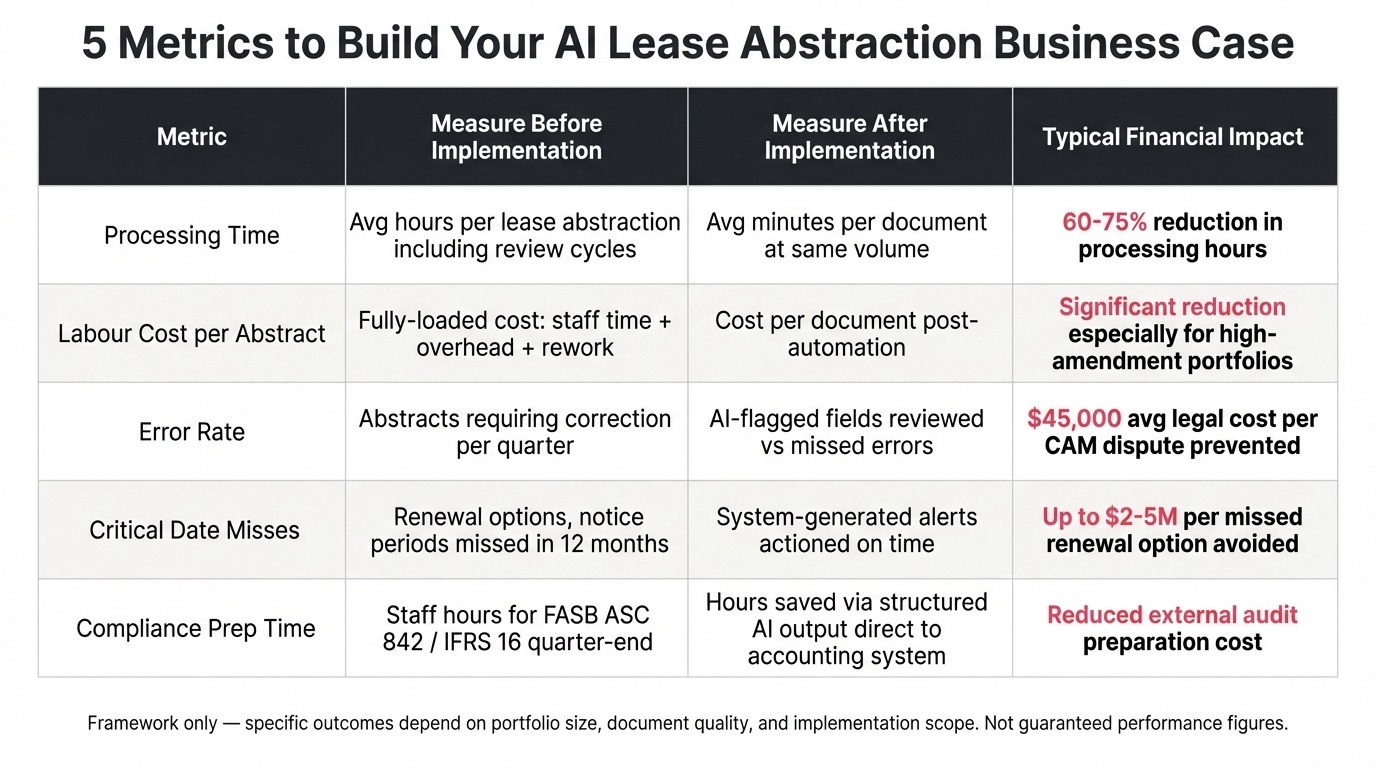
Key metrics to measure before and after AI lease abstraction implementation – the business case framework
AI lease abstraction ROI flows from three measurable sources: labour hour savings, error prevention, and critical date miss elimination. A common pattern in real implementations is that organisations focus the business case on processing speed – then discover the error-prevention savings exceed the labour savings, particularly where incorrect Common Area Maintenance reconciliations have historically generated tenant disputes. The following framework provides the structure for building a credible internal case. These are measurement inputs, not promised outcomes.
Processing Time per Lease
Measure the average hours spent per lease abstraction – including review cycles – before implementation. Measure again after deployment. The reduction translates directly into labour hour savings. At 1,000 leases annually, five hours saved per document at $30 per hour produces $150,000 in minimum annual labour savings before factoring in amendment processing.
Labour Cost per Abstract
Calculate the fully-loaded cost of a completed lease abstract before implementation – include Paralegal time, overhead, and rework cost for corrections. Compare this to post-implementation cost at the same volume. Automated lease abstraction software typically shifts this cost structure significantly, particularly for portfolios with high amendment volumes where rework is a recurring hidden expense.
Error Rate and Rework Cost
Track the number of abstracts requiring correction due to extraction errors in a given period. Assign a cost to each correction – staff time plus any downstream financial consequences. Incorrect Common Area Maintenance (CAM) charge reconciliations generate tenant disputes averaging $45,000 per case in legal fees. Error prevention often delivers more financial value than processing speed improvement alone.
Critical Date Miss Rate
Track the number of renewal options, notice periods, and option exercise windows missed in a twelve-month period. Assign a conservative financial value to each miss. A single missed renewal option exercise on a prime commercial property can forfeit $2–5 million in lease value. For portfolios where this has occurred previously, the cost justification for this automated lease abstraction software may be self-evident.
Compliance Preparation Time
Measure the staff hours spent preparing lease data for FASB ASC 842 or IFRS 16 balance sheet reporting per reporting period. Structured AI output reduces this time – particularly at quarter-end – by delivering data in formats that accounting platforms ingest directly without manual reformatting.
Implementation and Payback Timeline
A mid-size organisation typically completes initial setup, template configuration, and team onboarding within four to eight weeks. Parallel processing of historical document backlogs runs concurrently with initial deployment. Full integration with Property Management Systems and ERP systems adds time depending on technical complexity. The most frequently underestimated cost is legacy document preparation – scanning, quality-control, and organisation of older paper agreements that may span decades.
The business case for acting now rests on a straightforward observation: every lease processed manually while the evaluation continues represents a real, ongoing cost – in labour, in error risk, and in the compounding problem of inconsistent portfolio data entering FASB ASC 842 and IFRS 16 financial reporting.
8. What Should You Know Before Implementing AI Lease Abstraction?
The seven factors below are the most common reasons AI lease abstraction implementations underperform – across all vendors, not just this one. Every item on this list is addressed during the pre-deployment readiness engagement before the extraction pipeline begins. They are included here not as warnings, but as the checklist against which any implementation partner should be held accountable. If a vendor skips these steps and goes straight to extraction, the problems listed below are where the project will fail.
- Document quality and readiness – Legacy document quality varies significantly across real portfolios. Degraded scans from older archives require pre-processing before OCR produces reliable text. The readiness engagement assesses every document in the portfolio, tiers it by quality, and routes Tier 2 and Tier 3 documents through enhancement preprocessing before the pipeline begins. No document enters Stage 1 without a quality assessment.
- Field template agreement across stakeholders – Legal, Finance, and Asset Management teams each need different things from abstracted lease data – and they rarely agree without a structured session. The readiness engagement produces a signed-off field template before extraction begins. This is the single most frequently skipped step in failed implementations.
- Amendment chain mapping – Leases with 10 to 15 years of amendment history require explicit mapping before extraction. The readiness engagement produces a structured amendment catalogue for complex lease stacks – identifying which provisions have been superseded and which require human reconciliation. The pipeline then runs against a known amendment structure, not a guessed one.
- System integration complexity – Connecting the platform to existing Property Management Systems, ERP systems, and accounting platforms requires Application Programming Interface (API) configuration or custom integration development. 48 percent of organisations have not yet fully integrated lease management with existing ERP systems. Integration scope and timeline are scoped during the readiness engagement, not discovered mid-deployment.
- Data privacy and document security – Commercial lease documents contain sensitive financial information and confidential counterparty terms. Deployment architecture – cloud-hosted, on-premise, or hybrid – is confirmed during the readiness engagement based on the organisation’s data governance policies and any contractual confidentiality obligations in the lease agreements themselves.
- Accuracy expectations across stakeholders – Legal, Compliance, and Finance stakeholders need accurate expectations before results arrive. The readiness engagement sets these expectations explicitly: standard provisions at high confidence, complex and legacy documents to human review, high-value leases to mandatory QA regardless of confidence score. Expectation gaps are the fastest way to lose internal confidence in a system that is actually performing correctly.
- Staff adoption and workflow integration – Lease Administrators, Paralegals, and Accounting teams need to understand the review queue, how to action flagged provisions, and how extracted outputs connect to the systems they use. Onboarding and workflow integration are planned during the readiness engagement and delivered at go-live, not after the first complaints arrive.
9. Which Teams Get the Most Value from AI Lease Abstraction Software?
The AI-Powered Lease Abstraction Solution delivers maximum value where lease volume, data accuracy requirements, and compliance obligations converge – typically at 30-plus active leases with ongoing amendment tracking. Real Estate Investment Trusts (REITs) managing diversified commercial portfolios represent the clearest beneficiary – volume, complexity, and FASB ASC 842 and IFRS 16 reporting requirements all point to the same need. Institutional Asset Managers, large Property Management firms, and corporate real estate teams overseeing multi-site occupier portfolios benefit directly from the speed and consistency the system delivers.
Legal and advisory teams conducting Mergers and Acquisitions (M&A) due diligence gain deal velocity through the AI lease abstraction tool’s ability to compress weeks of review into days. Accounting and Finance teams responsible for FASB ASC 842 or IFRS 16 reporting benefit from structured, audit-ready outputs delivered directly from the extraction pipeline.
The commercial lease abstraction platform also serves law firms and real estate advisory practices handling large transaction volumes. For any team where lease abstraction software for legal and compliance teams is a recurring workload, this solution restructures how that work gets done.
This Solution Is Particularly Valuable If:
- Your organisation manages 30 or more active leases with ongoing amendment tracking and renewal deadline obligations
- Your team has experienced financial or operational consequences from missed renewal deadlines or incorrect CAM charge calculations
- You face recurring compliance reporting obligations under FASB ASC 842, IFRS 16, or equivalent lease accounting standards requiring structured, auditable lease data
- Your portfolio is growing through Mergers and Acquisitions activity and manual abstraction cannot keep pace with incoming document volume
- Your Lease Administration or Legal team currently spends the majority of their time on data entry and manual tracking rather than analysis and advisory work
10. Frequently Asked Questions
How does AI-powered lease abstraction for commercial real estate actually work?
An AI-Powered Lease Abstraction Solution processes lease documents through a sequential technical pipeline. Optical character recognition converts scanned documents into machine-readable text. Natural language processing and named entity recognition then identify and extract specific data fields – dates, financial terms, and key clauses – from that text. Large language models interpret complex provisions requiring contextual understanding. The system outputs structured data into standardised templates and routes lower-confidence extractions to a human review queue for verification before they enter the portfolio database.
Can automated lease abstraction handle large property portfolios accurately?
Automated lease abstraction for large property portfolios handles standard provisions – base rent, commencement dates, escalation schedules, renewal options – with high accuracy at volume. Complex, non-standard clauses require human review to reach the accuracy standards that financial and legal teams require. A realistic benchmark from industry practitioners: AI handles approximately 80% of standard provisions automatically, with human oversight covering the remainder. For large portfolios, this represents a substantial reduction in total review hours even when factoring in the human review component.
What should property managers look for in the best AI lease abstraction tool?
The best AI lease abstraction tool for property managers supports the full range of document types in their portfolio – PDFs, scanned originals, Word files – and extracts the specific field set their reporting workflows require. Direct integration with property management and accounting platforms eliminates manual data transfer between systems. Configurable critical date alerts and audit trails linking extracted data back to source clauses are essential for compliance and dispute resolution. Accuracy on non-standard and legacy documents is the key differentiator between platforms at similar price points – test this specifically during evaluation.
How does AI lease abstraction for due diligence and acquisitions speed up deal timelines?
AI lease abstraction for due diligence and acquisitions compresses a process that traditionally spans weeks into days. During a transaction, the acquisition team uploads the full lease package and the system extracts material terms – assignment provisions, co-tenancy clauses, early termination rights, and rent guarantees – across the entire portfolio simultaneously. Legal and advisory teams receive structured summaries that surface material risks rapidly rather than through sequential manual review. This acceleration reduces both due diligence costs and the risk of closing a transaction before all material lease provisions have been assessed.
Is AI lease abstraction software reliable enough for legal and compliance teams?
AI lease abstraction software reliably handles routine data extraction across standard commercial lease formats. Legal and compliance teams should maintain human review for provisions with material legal or financial consequences – termination rights, exclusivity clauses, and complex multi-condition renewal structures. The appropriate deployment model treats AI as a high-speed, first-pass extraction layer with qualified professionals reviewing flagged and high-stakes provisions. This approach preserves professional accountability while eliminating the manual effort that currently consumes the majority of lease abstraction time. Automated lease term extraction for accounting teams follows the same principle – AI structures the data, humans verify the material items.
11. Build This Solution With Softlabs Group
Softlabs Group builds custom AI-Powered Lease Abstraction Solutions designed around your document types, portfolio structure, and existing technology infrastructure. Our team designs the full extraction pipeline – from document ingestion and OCR through NLP-based clause interpretation, data normalisation, and direct integration with your property management, ERP, and accounting platforms. Every implementation reflects the specific field set, accuracy thresholds, compliance requirements, and review workflow your organisation operates under. We build for your data and your processes – not a generic template applied to your organisation’s lease portfolio. The lease abstraction AI solution we deliver functions as a production system, not a demonstration.
If your team manages a significant lease portfolio and the cost of manual abstraction – in staff hours, error risk, and missed opportunities – has reached the point where the business case is clear, the next step is a direct conversation. We assess your document inventory, map your integration requirements, and propose a solution architecture grounded in what your organisation actually needs. AI lease abstraction reducing manual review time is achievable. The right implementation partner makes the difference between a system that works in a demo and one that works in production.