 India
India  Mongolia
  Sweden
  Australia
Executive Summary: The Hidden Liability Inside Every Vendor Network
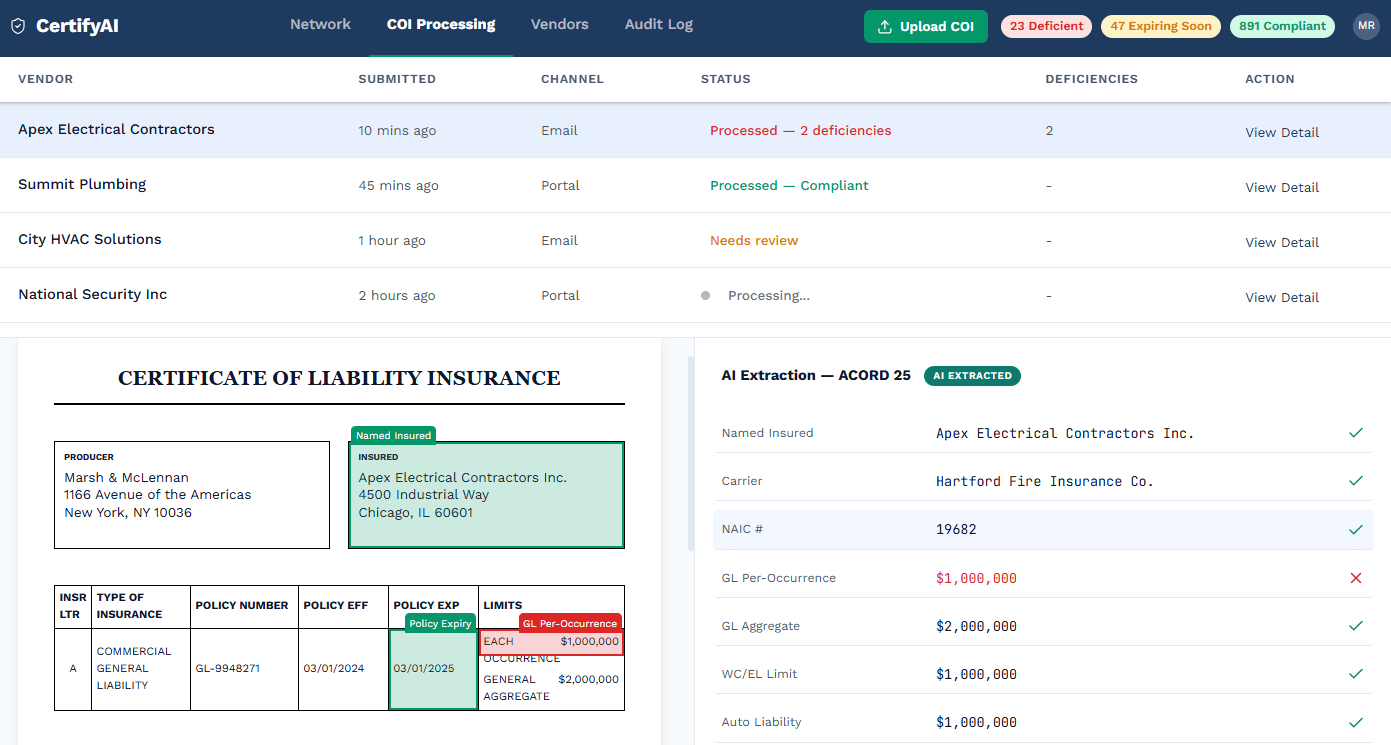
Your procurement team approved a subcontractor three months ago. The certificate of insurance looked clean. But the policy expired six weeks later, nobody caught it, and now there is an uninsured incident on your job site. This is not a rare edge case – it is the default outcome when large vendor networks are tracked manually. An AI-powered COI verification solution changes this equation by replacing periodic, error-prone manual reviews with continuous, rule-based compliance monitoring across every vendor in your network.
At its core, the solution reads certificates of insurance and endorsement documents automatically, extracts every material field, checks those fields against your contract requirements, and flags gaps or expirations before they create exposure. However, the most capable implementations go further – connecting to live policy data to detect mid-term cancellations, coverage reductions, and schedule changes that a static document will never reveal. For organisations managing hundreds or thousands of vendor relationships, this is the difference between compliance confidence and a liability crisis that is invisible until it becomes a claim.
Why Does Manual Certificate of Insurance Tracking Keep Creating Liability Exposure?
Manual COI tracking fails at scale because the volume of certificates, the complexity of contract requirements, and the speed of policy changes all compound faster than any team can absorb. A single compliance gap – one expired policy, one missing endorsement – can expose an organisation to losses that dwarf the cost of an entire compliance programme.
Context: Where This Problem Lives
General contractors, property managers, real estate operators, and enterprise procurement teams all share a common operational reality: their business depends on a rotating cast of vendors, subcontractors, and service providers, each carrying insurance that must meet specific contractual standards. A general contractor managing a large commercial project may need to verify and track certificates for dozens of subcontractors simultaneously. A property management firm with a multi-site portfolio manages hundreds of vendor relationships across maintenance, security, landscaping, and construction trades.
In practice, organisations commonly encounter around 60-70% average compliance rates with traditional manual tracking methods – meaning a meaningful proportion of any large vendor network may be non-compliant at any given moment. The administrative machinery required to close that gap manually is both expensive and structurally unreliable.
Key Pain Points This AI Solution Addresses
- Thousands of vendor certificates impossible to track manually: Organisations managing large vendor networks process tens of thousands of certificates annually. Manual review of each document is not a sustainable workflow at this volume.
- Expired certificates creating liability exposure: A certificate that was compliant on approval day may expire weeks or months later. Without automated monitoring, that expiry goes unnoticed until an incident occurs.
- Inconsistent certificate requirements across contracts: Different projects, sites, and contract types carry different insurance requirements – varying limits, required endorsements, and additional insured designations. Applying inconsistent rules manually creates gaps that are difficult to audit.
- No automated alert for expiring vendor insurance: Most manual systems lack proactive renewal reminders. Teams discover expired coverage reactively, often after work has already resumed under an uninsured vendor.
- Manual COI review too slow for procurement timelines: When vendor approval depends on a human manually reviewing a certificate, procurement timelines stretch. Work gets held, invoices get delayed, and relationships strain – all because of an administrative bottleneck.
- Staff time wasted on certificate collection and chasing: Following up with vendors, agents, and brokers to obtain or renew certificates consumes significant staff time that produces no strategic value.
- COI data entry errors creating compliance gaps: Manual data entry from certificates into tracking spreadsheets introduces transcription errors. A single transposed policy number or misread expiry date can create a false sense of compliance.
Why Traditional Approaches Fall Short
In practice, organisations deploying manual COI workflows typically encounter a specific and predictable failure pattern: the process works adequately when vendor counts are low and requirements are uniform, then breaks down sharply as either dimension scales. Spreadsheets and shared folders cannot enforce rules, cannot alert proactively, and cannot catch what they were never designed to check.
- Spreadsheets capture data but enforce nothing: A cell showing a future expiry date does not prevent work from proceeding after that date passes. Enforcement requires active monitoring that static documents cannot provide.
- Manual review misses hidden coverage gaps: Height restrictions, XCU hazard exclusions, geographic limitations, and primary/non-contributory wording requirements are buried in endorsements that a quick visual review will frequently overlook. A certificate that appears clean on its face may carry exclusions that void coverage for the exact work being performed.
- Static documents cannot detect post-issuance changes: A certificate is a snapshot of policy status at the moment of issue. Mid-term cancellations, coverage reductions, and policy modifications happen after the document is filed. Without live monitoring, those changes are invisible.
- Fake certificates are easy to produce and hard to detect manually: Standard ACORD 25 templates are freely available. A convincing fraudulent certificate requires only basic PDF editing software. Manual review by non-insurance staff provides limited protection against deliberate forgery.
- No scalable escalation path: When a manual reviewer identifies a deficiency, the follow-up process – contacting the vendor, specifying the gap, tracking resubmission – is informal and often undocumented. The same issue frequently recurs across renewal cycles.
What Is an AI-Powered COI Verification Solution, and How Does It Work?
An AI-powered COI verification solution is a compliance operations system – not simply a document reader. It combines document AI for extraction, a deterministic rules engine for compliance checking, automated communication for deficiency resolution, and ongoing monitoring for renewals and coverage changes. Together, these layers convert a reactive, manual process into a continuous, auditable compliance programme.
The key conceptual shift is treating vendor insurance compliance as an operational state to maintain over time, not a one-time gate to pass at onboarding. A vendor’s coverage status can change the day after their certificate is filed. A serious AI COI management platform monitors that status continuously – not just at submission. This distinction separates platforms that reduce paperwork from platforms that genuinely reduce risk.
Vision and Objectives
- Continuous compliance visibility across the full vendor network: Every vendor’s current insurance status is visible in real time – not just at the moment of certificate submission.
- Automated deficiency detection and vendor notification: The system identifies specific gaps and communicates them to vendors with precise instructions, eliminating manual follow-up.
- Consistent rule application across all contracts and sites: Requirements defined per project, site, or contract type are applied uniformly without reliance on individual reviewer judgment.
- Proactive renewal management: Expiration alerts trigger at defined intervals before policy end dates, giving vendors adequate time to renew before coverage lapses.
- Defensible audit trail for every compliance decision: Every extracted field, rule check, approval, and deficiency notice is logged with timestamps and document evidence, supporting legal and regulatory review.
- Reduced vendor approval lead time: Automated extraction and rule checking eliminate the queue of certificates waiting for human review, accelerating vendor onboarding and invoice release.
Real-World Application Scenarios: Where This AI Solution Delivers Measurable Value
General Contractor Managing a Multi-Trade Commercial Build
Your project engineer is holding a COI packet from a new electrical subcontractor, but the certificate is missing the CG 20 37 additional insured endorsement your contract requires – and the sub needs to mobilise tomorrow. Manually confirming this gap, communicating the exact requirement, tracking the resubmission, and re-reviewing the corrected document consumes hours that the project schedule does not have.
An automated COI verification solution for general contractors ingests the submitted documents immediately, extracts all coverage data and endorsement indicators, and checks them against the project’s contract requirements automatically. The system identifies the missing endorsement, generates a precise deficiency notice to the subcontractor’s broker, and flags the record for human confirmation once the corrected endorsement arrives. Vendor approval time drops from days to hours, and the compliance decision carries a full audit trail if a dispute arises later.
Property Management Company with a Multi-Site Vendor Network
You manage forty commercial properties across three states, each with its own service vendors for HVAC, electrical, landscaping, and cleaning. Every vendor carries insurance. Half of those policies renew at different times throughout the year, and your team has no reliable way to know when any specific certificate is about to expire.
An AI COI tracking tool for property management monitors every vendor’s policy status continuously, triggers renewal reminders at 60, 30, 14, and 7 days before expiration, and holds vendor invoice approval when coverage has lapsed. The platform applies site-specific insurance requirements automatically – a vendor cleared for routine maintenance work may not meet the higher limits required for structural work at the same property. Compliance gaps that previously surfaced only after an incident now surface before any work begins.
Enterprise Procurement Team Managing a National Vendor Network
Your procurement function approves hundreds of new vendors annually, each requiring insurance verification before onboarding. The current process routes every certificate to an analyst who checks it manually – a bottleneck that creates a multi-day approval queue and delays purchase order release across the business.
An AI vendor insurance certificate management tool processes submitted certificates automatically: extracting fields, checking them against the organisation’s standard insurance schedule, and routing only the exceptions – low-confidence extractions, unusual endorsement structures, or high-risk vendor categories – to a human reviewer. Straightforward certificates that meet all requirements move through without touching a queue. The practical result is a significant reduction in average vendor approval time and a compliance record that holds up under audit, without adding headcount to the compliance function.
Ready to explore what this solution looks like for your organisation?
Talk to Our AI TeamHow Does an AI COI Verification Solution Actually Work?
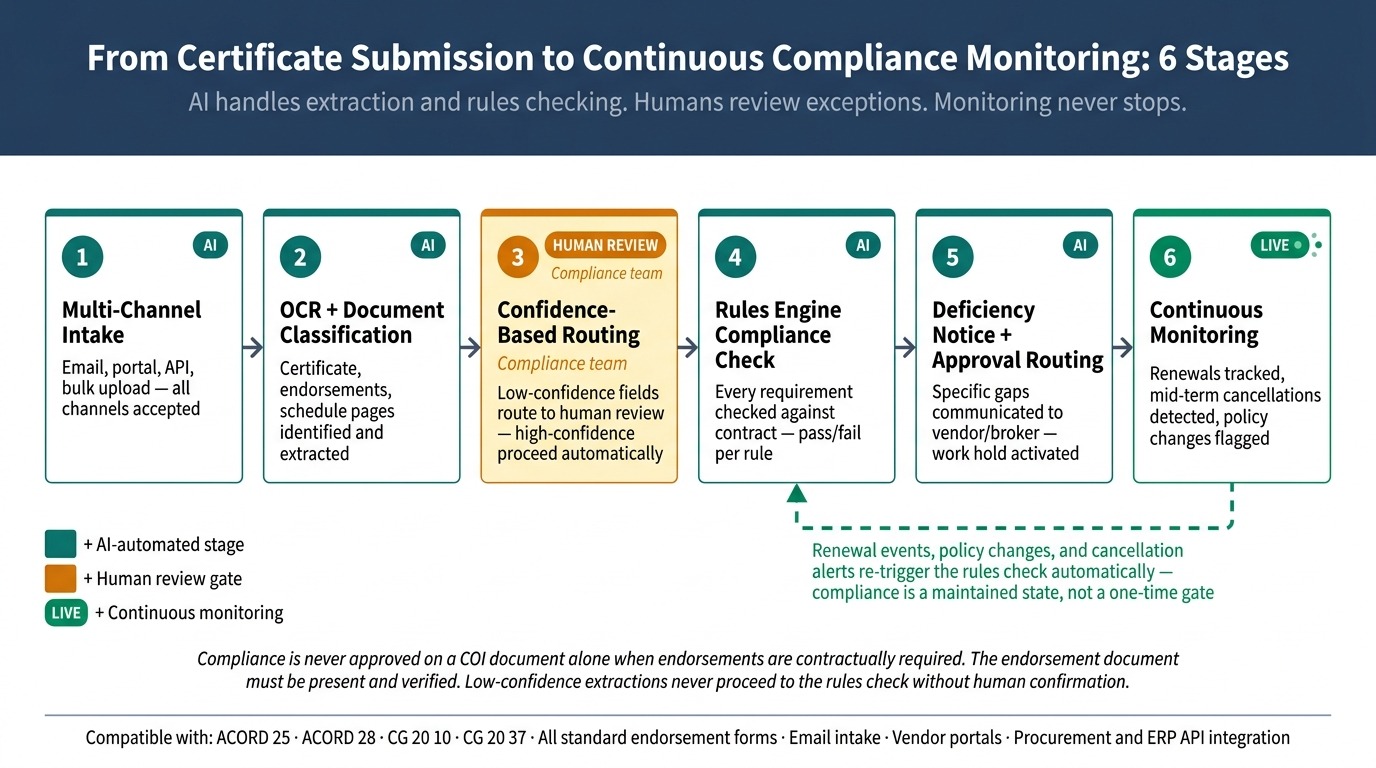
A common pattern across real implementations of this solution is a six-layer architecture where each layer handles a distinct function – and where failing to build even one layer correctly produces the same compliance gaps that manual tracking produces. The layers are: Intake (accepting documents through all channels vendors actually use), Understanding (OCR, classification, and extraction from COIs, endorsements, schedules, and contracts), Decision (a deterministic rules engine that checks extracted data against contract requirements), Action (deficiency notices, reminders, approval routing, and renewal chasing), Truth (carrier or broker-connected re-verification for live policy status beyond what the document shows), and Guardrail (confidence thresholds, human review queues, immutable audit logs, and policy-change alerts). This distinction matters: a tool that only covers the first two layers reads PDFs efficiently. A tool that covers all six manages insurance compliance reliably. Below is how each layer operates in practice.
Data Acquisition: What the System Ingests
The system accepts certificate documents through multiple intake channels to accommodate the different ways vendors, brokers, and agents actually submit. Primary channels include direct email ingestion – where certificates sent to a monitored address are captured automatically – vendor self-service portals with upload functionality, API connections for organisations that want to automate submission from existing procurement or project management systems, and bulk import for onboarding large existing vendor networks.
Document types include the standard ACORD 25The industry-standard Certificate of Liability Insurance form issued by the Association for Cooperative Operations Research and Development, used to evidence commercial general liability, auto, workers compensation, and umbrella coverage certificate of liability insurance, ACORD 28 evidence of commercial property insurance, endorsement pages, policy schedules, and supplemental documentation such as additional insured endorsement riders. The system classifies what arrived before processing begins, so a packet containing a certificate and two endorsements is handled differently from a standalone certificate.
The AI Processing Pipeline
- Document Classification and Pre-processing: First, the system classifies every incoming document – determining whether it is a standard ACORD form, an endorsement rider, a policy schedule page, or an unrelated file. Optical Character Recognition (OCR)Technology that converts printed or handwritten text in images and PDFs into machine-readable digital text then extracts the raw text, applying enhanced processing for low-quality scans, handwritten annotations, and mixed-format PDFs. This stage handles the wide variance in document quality that real vendor submissions produce – from clean digital PDFs to faxed copies photographed on a phone.
- Field Extraction and Structuring: Next, the Natural Language Processing (NLP)A branch of AI that enables computers to read, interpret, and extract structured meaning from human-written text layer extracts every material field: named insured, carrier name and NAIC number, policy number, effective and expiry dates, coverage types, per-occurrence and aggregate limits, additional insured designations, waiver of subrogation status, primary and non-contributory indicators, and endorsement form numbers such as CG 20 10 and CG 20 37. The extraction model assigns a confidence score to each field, flagging low-confidence extractions for human review before any compliance decision is made.
- Rules Engine Compliance Check: Once extracted fields are structured, the rules engineA deterministic software component that applies explicit, configurable if-then logic to compare data against defined requirements – producing pass, fail, or exception outcomes without probabilistic AI inference compares them against the applicable insurance requirements for that vendor, project, or contract type. Requirements can vary by site, trade, contract value, or work category. The engine checks every requirement independently – minimum limits, required endorsement forms, carrier rating thresholds, geographic applicability, and date validity – and records a pass, fail, or exception status for each.
- Deficiency Identification and Notification: The system then generates a precise deficiency notice for any certificate that fails one or more checks. Notices specify exactly which requirement failed and what documentation is needed to resolve it – rather than generic “certificate does not meet requirements” language. Automated notifications go to the vendor, broker, or agent through the configured channel. The record status updates to “deficient” and blocks downstream approvals until the deficiency is resolved and re-verified.
- Approval Routing and Audit Logging: Certificates that meet all requirements at adequate extraction confidence move to approved status automatically. Those with low-confidence extractions, unusual structures, or high-risk flags route to a human reviewer queue with an AI-generated explanation of the specific concern. Every decision – automated or human – is logged with the document evidence, rule results, confidence scores, and timestamps that constitute a defensible audit trail.
- Ongoing Monitoring and Renewal Management: After approval, the system continues to monitor each vendor’s compliance status. Renewal reminders trigger at configurable intervals before expiry. Where live carrier or broker connections are available, the system monitors for mid-term cancellations, coverage reductions, and policy changes between renewal cycles – not just at the next certificate submission. Vendors whose coverage lapses after approval are flagged immediately, and downstream work holds or invoice approvals can be paused automatically.
Human-in-the-Loop: Where Human Judgment Still Matters
An automated COI verification solution does not eliminate the need for human judgment – it focuses it. Humans review only the cases where it genuinely matters, rather than every document regardless of complexity. Specifically, human reviewers handle:
- Low-confidence extractions: When the AI extraction model cannot read a field with sufficient certainty – due to document quality, unusual formatting, or handwritten entries – the record routes to human review before any compliance decision is made.
- Complex endorsement structures: Non-standard or manuscripted endorsements, unusual policy wording, and borderline compliance cases involving legal interpretation require experienced human review.
- High-risk vendor categories: Organisations can configure certain vendor types, trade categories, or contract values to always include a human review step regardless of AI confidence – ensuring oversight where the consequence of error is highest.
- Disputed deficiencies: When a vendor or broker contests a deficiency finding, a human reviewer evaluates the specific dispute with the AI-generated evidence summary as context.
- Exception approvals: In cases where a vendor cannot meet a specific requirement but a business reason exists to proceed, a human administrator records the exception decision with documented justification – maintaining the audit trail for the override.
Guardrail Architecture: What Prevents This from Failing
The most common failure mode of weaker COI automation tools is approving a certificate that appears compliant but is not – because the extraction was wrong, an endorsement was missing, or the policy changed after the document was filed. A well-built AI COI verification solution prevents this through explicit design guardrails, not assumptions about AI accuracy.
- Never approve on a COI alone when endorsements are contractually required. The endorsement document must be present, extracted, and checked – a COI that references an endorsement without the endorsement page attached does not constitute compliance.
- Never auto-approve low-confidence extractions. Any field the AI cannot read with sufficient certainty routes to human review before a compliance decision is recorded. Confidence scoring is not optional; it is the primary mechanism that keeps the system honest about what it actually knows.
- Keep deterministic rules separate from LLM judgment. The rules engine decides pass/fail outcomes. The LLM reads, extracts, and explains – but it does not make the compliance call. This separation is what makes outcomes auditable and legally defensible.
- Store every decision with its document evidence and timestamp. Every approval, rejection, deficiency notice, and exception override is logged with the specific evidence that supported it. Compliance decisions need to survive legal scrutiny, not just operational review.
- Re-run all checks on renewal, resubmission, and policy-change events. Compliance is a continuously maintained state, not a one-time gate. A vendor who was compliant at onboarding may not be compliant six months later. The system re-verifies at every trigger point, not just at initial submission.
- Show every user exactly what was checked, what passed, what failed, and what still needs a human. Transparency into the decision logic is what builds trust with compliance teams who understand the legal stakes – and what makes exception reviews meaningful rather than arbitrary.
Output and Interaction: What Users Actually See
The user-facing experience is designed around a simple status workflow: Received, Reviewing, Deficient, Approved, and Reverify Soon. Each vendor record shows its current status, the specific requirements checked, which passed or failed, and what action is needed next. The complexity of the AI and rules processing stays behind the interface – what the user sees is a clear, actionable compliance dashboard.
Operations teams access compliance dashboards showing portfolio-wide status, upcoming expirations, and vendors with open deficiencies. Vendors receive email or portal notifications with clear instructions. Procurement and finance systems receive status updates via API – enabling automated holds on purchase orders or invoice releases when vendor compliance has lapsed. Compliance managers access the full audit log for any vendor record, including every document version, rule check result, and decision timestamp.
What Technologies Power an AI COI Verification Platform?
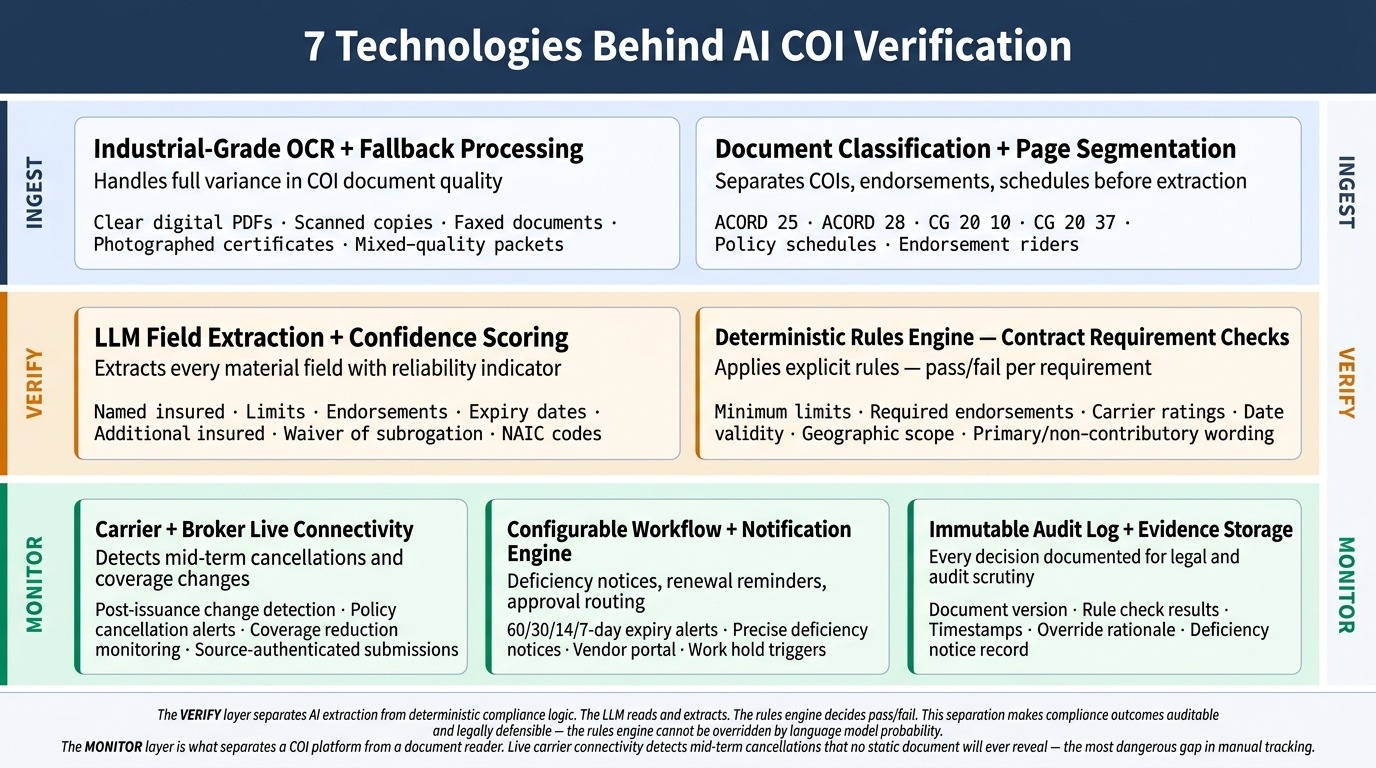
The technology stack behind a production-grade AI COI verification platform combines several distinct capabilities. Each layer addresses a specific failure mode that simpler approaches leave unresolved.
- Industrial-grade OCR with fallback processingOptical Character Recognition technology capable of extracting text from low-quality scans, mixed-format PDFs, and handwritten documents, with secondary processing pipelines for documents that fail initial extraction – COI documents arrive in inconsistent quality: clear digital PDFs, faxed copies, scanned images, and photographed documents. Industrial OCR engines handle the full variance, with fallback pipelines for documents that fail primary extraction. This prevents document quality from becoming a compliance gap.
- Large Language Model (LLM) reasoning layerA large-scale AI model trained on text data, capable of reading unstructured documents and reasoning about their content – used here for field extraction, endorsement interpretation, and generating plain-English deficiency explanations – Used selectively for extraction and interpretation tasks where understanding context matters: reading non-standard endorsement wording, inferring missing fields from surrounding text, and generating clear deficiency explanations. The LLM layer is kept narrow and its outputs validated by the deterministic rules engine before any compliance decision is recorded.
- Deterministic rules engineA rules-based software component that applies explicit, configurable logic to evaluate extracted data against defined compliance requirements, producing consistent pass/fail outcomes without probabilistic inference – Compliance decisions are not left to AI judgment. A dedicated rules engine applies explicit, configurable logic to every extracted field – checking limits, dates, endorsement codes, and carrier ratings against the requirements defined for each contract. This separation of AI extraction from deterministic compliance logic is what makes the system auditable and legally defensible.
- Document classification and page segmentationThe capability to identify what type of document has been submitted and separate a multi-page PDF into its component documents before extraction begins – Multi-page submissions containing a certificate, multiple endorsements, and a schedule page require accurate classification before extraction. Misclassifying an endorsement as the main certificate produces incorrect compliance results, so this capability is a prerequisite for reliable extraction downstream.
- Carrier and broker connectivity layerDirect data connections to insurance carriers, agents, and management systems that enable real-time verification of current policy status, bypassing reliance on a static certificate document – The most critical differentiator between document-reading tools and genuine compliance platforms. Live connections to carrier or agent systems enable real-time monitoring of policy status, mid-term cancellation detection, and source-authenticated submissions that eliminate the most dangerous fraud vector.
- Configurable workflow and notification engineThe component that manages automated deficiency notices, renewal reminders, human review routing, approval escalations, and status updates – orchestrating the operational workflow around compliance decisions – Extracts operational value from accurate compliance data by automating follow-up, routing exceptions, and triggering reminders at the right moments. Without this layer, even accurate extraction data requires manual action to resolve deficiencies.
- Immutable audit log and evidence storageA tamper-resistant record of every document received, field extracted, rule checked, and decision made – with timestamps and document evidence retained in permanent storage for legal and regulatory review – Every compliance decision must survive legal scrutiny. Immutable logging captures the complete record of what was submitted, what was checked, what passed or failed, and who made any manual override – providing the defensible audit trail that enterprise and regulated-industry buyers require.
What Results Does an AI-Powered COI Verification Solution Deliver?
The benefits of deploying an automated COI verification solution map directly to the failure modes of manual tracking. Each improvement addresses a specific operational or financial risk that manual processes leave unresolved.
- Significantly higher compliance rates across the vendor network: Continuous monitoring and proactive renewal chasing push compliance rates well above the 60-70% industry average typical of manual tracking – reducing the proportion of the vendor network operating with expired or non-compliant coverage at any given time.
- Dramatically faster vendor approval and onboarding: Automated extraction and rules checking processes compliant certificates without human queue time. Vendor approval timelines that previously stretched across several days or longer with manual review compress to hours for straightforward submissions, removing a consistent procurement bottleneck.
- Reduced liability exposure from undetected coverage gaps: Proactive identification of missing endorsements, expired policies, and post-issuance cancellations closes the window during which uninsured or underinsured vendors can perform work without detection – directly reducing the financial exposure from uninsured incidents.
- Staff time redirected from certificate chasing to strategic work: Most of the 15-20 hours per week that compliance staff spend collecting, chasing, and manually reviewing certificates converts to system-managed workflow. Human effort concentrates on genuine exceptions, legal disputes, and process improvement rather than administrative data entry.
- Consistent rule application across all projects and sites: Requirements configured per contract, site, or vendor category are applied identically to every submission – eliminating the inconsistency that occurs when different team members apply rules differently or rely on memory rather than documented standards.
- Fraud and forgery risk substantially reduced: Automated extraction detects inconsistencies that manual review misses, and platforms with source authentication or direct carrier connectivity eliminate vendor-submitted forgeries at the intake layer rather than relying on visual inspection.
- Defensible compliance record for claims and audits: Every vendor approval, deficiency notice, and exception decision is logged with full documentation. When a claim occurs or a contract dispute arises, the organisation has a complete, timestamped record of every compliance check performed – rather than relying on email chains and spreadsheet versions.
- Scalable compliance operations without proportional headcount growth: Organisations can grow their vendor network without growing their compliance team at the same rate. The system handles volume growth through automation; only genuine exceptions require additional human attention.
Is an AI COI Verification Solution Worth the Investment?
Yes – for organisations managing more than a few dozen active vendor relationships, the business case is typically clear within the first year of deployment. The ROI calculation rests on three categories of value: cost reduction, risk avoidance, and operational acceleration.
Key Metrics to Measure Before and After Implementation
- Compliance rate across the active vendor network: Measure the percentage of vendors with current, fully compliant certificates at any given point in time. This is the primary indicator of risk reduction. Pre-implementation baselines at many organisations fall well below best-in-class targets – the gap between your current baseline and a target above 90% quantifies your residual risk.
- Average vendor approval lead time: Track the time from certificate submission to approval or deficiency notice. Reducing this metric directly accelerates procurement timelines, faster onboarding, and earlier invoice release cycles. The productivity value of compressing approval time from days to hours scales with vendor volume.
- Staff hours consumed by certificate management: Measure how many hours per week your team currently spends collecting, chasing, reviewing, and filing certificates. These hours carry a fully loaded cost. An automated COI compliance platform recovers a significant portion of that time and redirects it to higher-value work.
- Open deficiency resolution time: Track how long deficiencies remain open from identification to resolution. Automated, precise deficiency notices with specific instructions typically close faster than informal follow-up – reducing the window during which non-compliant vendors remain active.
- Uninsured incident frequency and associated cost: This is the most significant value driver, and the hardest to predict in advance. A single uninsured incident involving a subcontractor can generate costs far exceeding annual software investment. The business case for risk avoidance is probabilistic but real.
Realistic Implementation and Payback Timeline
Teams that have worked through this integration consistently find that the implementation timeline for a mid-size organisation – one managing several hundred to a few thousand active vendors – runs approximately eight to sixteen weeks for a production-ready deployment. This covers data migration of existing vendor records, configuration of contract-specific insurance requirements, integration with existing project management or procurement systems, and vendor portal onboarding.
Positive ROI within twelve months is realistic for most organisations above a certain vendor volume threshold, driven primarily by staff time recovery and the elimination of manual follow-up workflows. The risk avoidance component – the value of incidents that do not occur because coverage gaps are caught proactively – is harder to put a precise number on but represents the largest potential value driver for organisations with high-risk vendor activities.
The Business Case for Acting Now Rather Than Waiting
Every quarter an organisation continues with manual tracking is a quarter in which the compliance rate stays depressed and the liability exposure from undetected coverage gaps accumulates. The gap between the current state and a best-in-class compliance posture represents real, quantifiable risk that does not diminish on its own.
What Does Implementing an AI COI Verification Solution Actually Require?
What implementation experience reveals that theoretical explanations often miss is that the technical AI and extraction components are rarely the hard part. The genuinely difficult work is operational: migrating existing vendor data, configuring contract-specific rules accurately, integrating with existing procurement and project systems, and getting vendors and brokers to cooperate with new submission workflows. Each of these is manageable with the right expertise, but none should be underestimated.
- Data quality and existing record migration: Most organisations have an existing vendor database and historical certificate files in some form – spreadsheets, folders, project management systems. Migrating and cleaning this data before go-live is a prerequisite. Records with incomplete or inconsistent fields need remediation before the rules engine can check them accurately.
- Contract and site-specific rules configuration: The rules engine is only as accurate as the requirements configured into it. This means translating the insurance requirements from every active contract type, project category, or site-specific schedule into structured rules – a task that requires both insurance knowledge and access to the actual contracts. Under-configured rules produce false approvals; over-configured rules produce unnecessary deficiencies. Getting this right is the most critical configuration step.
- Integration complexity with existing systems: High-value deployments connect the COI platform to existing procurement, project management, ERP, or accounts payable systems – enabling automated holds on purchase orders or invoice release when compliance lapses. The complexity of these integrations depends on what systems are in place and their API capabilities. Custom integration work is sometimes required.
- Vendor and broker onboarding: The system only works when vendors and brokers submit through it. Onboarding resistance – vendors who prefer to email PDFs directly, brokers unfamiliar with the submission portal – is a genuine adoption challenge. Clear communication, easy submission pathways, and where necessary a parallel processing period help manage this transition.
- Data privacy and document security requirements: Certificates of insurance contain policy numbers, carrier details, and named insured information. Regulated industries and enterprise buyers will require confirmation of SOC 2 controls, encryption standards, field-level access controls, and data retention policies before deployment.
- Model maintenance and rules evolution over time: Insurance requirements change as contracts are renewed and new project types are added. The rules engine needs ongoing maintenance to stay current. Extraction models may need retraining if document formats change. Treating the platform as a static deployment rather than a maintained system leads to accuracy degradation over time.
Where This Solution Has Real Limits
Honest assessment of where an AI-powered COI verification solution does not perform perfectly is important for setting accurate expectations:
- A COI document does not guarantee ongoing coverage. Unless the platform has live carrier or broker connections, document-based verification tells you what coverage looked like at the moment of issue – not what it looks like today. Static document processing alone leaves the post-issuance change gap open.
- Heavily manuscripted endorsements resist automated extraction. Standard ACORD endorsement forms extract reliably. Non-standard, carrier-specific, or heavily customised endorsement language is harder for AI to interpret with high confidence and will route to human review more frequently.
- Vendor adoption is never guaranteed. A technically capable platform delivers limited value if vendors and brokers do not cooperate with the submission process. Operational adoption work is as important as technical deployment.
- AI cannot replace legal judgment on borderline compliance questions. Questions about whether a specific exclusion voids coverage for a specific activity, or whether a particular endorsement wording meets a contract requirement, are legal interpretation questions – not extraction questions. The platform surfaces the relevant data; a qualified person makes the legal determination.
Who Benefits Most from an AI COI Compliance Platform?
An AI-powered COI verification solution delivers the highest value to organisations where vendor volume, compliance complexity, or liability exposure exceeds the capacity of manual tracking. The solution scales with the size and complexity of the vendor network – the larger and more demanding the network, the stronger the case for automation.
- General contractors and construction firms managing subcontractor networks across multiple active projects, each with its own endorsement and limit requirements.
- Property management companies operating multi-site portfolios with large, rotating vendor networks across maintenance trades, security, and capital improvement contractors.
- Enterprise procurement and risk teams responsible for insurance compliance across national or global vendor networks – where manual tracking at scale is structurally unsustainable.
- Real estate developers and operators managing construction, renovation, and ongoing property operations with complex subcontractor insurance requirements across multiple asset classes.
- Facilities management and outsourcing firms that deploy third-party service providers across client sites and carry contractual obligations to maintain vendor compliance on their clients’ behalf.
This solution is particularly valuable if:
- Your organisation manages more than 50 active vendor relationships with ongoing insurance requirements.
- Different projects, sites, or contract types carry different insurance requirements that must be applied consistently.
- You have experienced a compliance gap, an uninsured incident, or a failed audit related to vendor insurance in the past three years.
- Your compliance team spends significant time on certificate collection and follow-up rather than risk management strategy.
Frequently Asked Questions About AI COI Verification
Can AI certificate of insurance tracking software handle large enterprise vendor networks reliably?
Yes – automated processing scales in ways that manual review cannot. An AI-powered COI verification solution processes certificates through a rules engine that applies the same checks consistently regardless of volume. For enterprise vendor networks with thousands of active vendors across multiple sites and contract types, the platform maintains continuous compliance monitoring and renewal reminders without the bottlenecks that limit manual teams. The key requirement is thorough initial rules configuration, since the platform’s accuracy depends on how well your contract requirements are translated into the rules engine.
What is the difference between an AI COI verification solution and just using a spreadsheet or project management tool?
A spreadsheet captures data but enforces nothing. It cannot alert you when a policy expires, cannot check for missing endorsements, cannot send a deficiency notice to a vendor’s broker, and cannot detect a mid-term cancellation. An AI COI compliance platform actively monitors every vendor’s status, applies contract-specific rules automatically, and manages the follow-up workflow that manual systems leave to individual staff judgment. The practical difference is that a spreadsheet-based process is reactive – you discover compliance gaps after the fact. An automated platform is proactive, catching gaps before work proceeds under uninsured or underinsured vendors.
How does an automated COI verification tool for property management handle different insurance requirements across different sites?
The rules engine in a well-designed platform supports site-specific and contract-specific requirement sets. You configure the minimum limits, required endorsement forms, carrier rating thresholds, and any site-specific requirements for each property or contract type. When a vendor submits a certificate, the system checks it against the requirements applicable to that specific site or engagement – not a single global standard. This means a landscaping vendor cleared for routine grounds maintenance at one property may not automatically meet the higher limits required for structural work at another, and the system catches that distinction automatically.
Can an AI vendor insurance verification tool detect fake or fraudulent certificates?
Automated extraction and rules checking catches many of the inconsistencies and errors that appear in fraudulent certificates – mismatched policy numbers, invalid NAIC carrier codes, impossible coverage dates, and limits that do not align with stated policy types. Platforms with source authentication or direct carrier connectivity provide the strongest fraud protection, because they verify coverage against the actual policy record rather than relying on the document alone. However, no document-based AI system provides a 100% guarantee against a sophisticated forgery. The combination of AI extraction, carrier connectivity where available, and human review of high-risk submissions provides the most defensible protection.
What does an AI COI tracking solution for procurement and risk teams cost to implement, and how long does it take?
Implementation scope and cost depend on vendor network size, the complexity of contract-specific requirements, and the depth of integration needed with existing systems. A mid-size deployment covering several hundred vendors with standard procurement system integration typically reaches production readiness in eight to sixteen weeks. The business case for most organisations managing a significant vendor network becomes positive within twelve months, driven primarily by staff time recovery and the elimination of manual follow-up workflows. The risk avoidance value – incidents that do not occur because coverage gaps are caught proactively – represents the largest potential value driver but is harder to predict in advance.
Build This Solution With Softlabs Group
Softlabs Group designs and builds custom AI-powered COI verification solutions tailored to your specific vendor network, contract requirements, and existing systems. We do not offer off-the-shelf software. Every engagement starts with your data, your rules, and your operational workflow – then we engineer the extraction, compliance logic, monitoring, and integration layers to match. Whether you need a focused automated certificate of insurance monitoring platform to handle a specific vendor category or a full enterprise AI development engagement covering your entire vendor compliance operation, our team has the technical depth and domain knowledge to build it correctly – including the rules engine rigour that separates reliable compliance tools from document readers that create false confidence.
If your organisation manages a vendor network where insurance compliance genuinely matters – and where the cost of getting it wrong is measured in liability exposure, not just administrative inconvenience – the right starting point is a conversation about your specific requirements. Our team will assess whether a custom build, a configured deployment, or a hybrid approach best fits your context, and give you an honest view of what implementation actually involves.