 India
India  Mongolia
  Sweden
  Australia
Executive Summary: The Race Between Drawing Revisions and Tender Deadlines
Your tender deadline is in four days. The architect issued revision three last night. Two of your estimators are already committed to another bid. The bill of quantities from the previous version still has twenty open items needing re-measurement, and the subcontractor pricing hasn’t even started. This is the operational reality quantity surveyors and preconstruction teams live with on nearly every project – not as an occasional crisis, but as a routine condition of the job.
An AI BOQ automation solution changes the structure of that problem. Instead of a human estimator spending 40 to 80 hours measuring drawings from scratch, AI performs the first-pass quantity extraction – detecting, measuring, and classifying building elements automatically – and hands the estimator a reviewed draft takeoff rather than a blank sheet. The same logic applies when tenders arrive not as drawings but as structured BOQ documents or digital tender schedules: AI processes the line items, matches them against known calculation logic, and surfaces only the uncertain or novel items for estimator attention. Either way, the result is faster tender turnaround, fewer missed items, and a repeatable process that doesn’t depend on who is available that week.
This page explains what an AI BOQ automation solution actually does, how the technology works in practice, where it performs reliably, and where it still requires professional judgment. If your team is evaluating whether this category of technology is right for your projects, the following sections give you the detail you need to decide.
Why Does Manual BOQ Production Keep Failing Construction Teams at Scale?
Context: The Preconstruction Environment Where BOQ Problems Compound
Bills of quantities sit at the intersection of design, cost, and contract – which makes errors expensive in ways that don’t always surface until a project is well underway. A medium commercial project typically demands 40 to 80 hours of dedicated measurement and compilation work per the industry’s own documented benchmarks. Large projects run into weeks. Yet tender windows are compressing, design teams issue revisions through the bid period, and the number of experienced quantity surveyors entering the profession is shrinking. According to the RICS 2025 Surveying Skills Report, nine in ten surveyors report skills shortages in their organisations, with nearly one-third describing the shortfall as critical. That structural gap – growing project volume against shrinking specialist capacity – is the environment where manual BOQ processes break down.
In practice, organisations operating under these pressures typically see the same failure patterns repeat: rushed measurements, inconsistent standards between team members, and BOQs that need partial rework every time a design changes. In practice, these are not occasional setbacks – they are the background condition against which every tender bid is prepared.
Key Pain Points This AI Solution Addresses
- Quantity surveyors spending too long on manual measurement: Counting and tracing building elements from PDFs and CAD drawings consumes a disproportionate share of a QS’s working hours – hours that cost the same whether they’re spent on measurement or on higher-value professional judgment.
- BOQ errors leading to pricing disputes with clients: Missed items, miscounted elements, and misclassified materials all produce BOQs that don’t match the actual scope – creating disputes at tender adjudication and variations during construction.
- Tender deadlines missed because estimation takes too long: When the measurement phase alone consumes most of the bid window, teams either submit undercooked estimates or decline to bid – both outcomes representing lost revenue or increased risk.
- No automated way to update BOQ when designs change: Every design revision forces a manual re-measurement cycle. Without version comparison, identifying exactly what changed between revision two and revision three takes hours of cross-referencing.
- Inconsistent measurement standards across the team: Different estimators apply different interpretations of NRM2 or CESMM4 categories, producing BOQs that vary in structure even on similar project types – making aggregation and benchmarking unreliable.
- High cost of outsourcing quantity surveying work: Sending takeoff work to external QS consultants or offshore services adds cost, introduces coordination overhead, and creates dependency on third parties during the most time-pressured phase of preconstruction.
- BOQ rework every time the design is revised: Without a system that tracks which quantities link to which drawing elements, every revision triggers a full manual update rather than a targeted correction – multiplying the cost of change.
Why Traditional Approaches Fall Short
Manual spreadsheet-based estimation – still the dominant approach, with an industry survey finding 85% of the sector still creates estimates in Excel – fails at scale for reasons that compound rather than simply adding together.
- Volume doesn’t scale with headcount: Adding a second estimator doesn’t halve the time because coordination, quality checking, and section handoffs eat into the saved hours. Manual processes scale poorly against growing project pipelines.
- Revisions break traceability: When quantities are hand-traced, there’s no programmatic link between a BOQ line item and its source drawing element. A design revision requires finding every affected item manually – there’s no automated change detection.
- Human consistency erodes under deadline pressure: Estimators working fast under deadline make classification decisions they’d reconsider under normal conditions. The same room type might be categorised differently across two bids prepared by the same person in different weeks.
- Standard document tools weren’t built for construction logic: PDF viewers and spreadsheets handle numbers well, but they have no understanding of building elements, trade categories, or measurement conventions like NRM2. Every piece of construction intelligence has to live in the estimator’s head.
- AI BOQ automation versus manual workflow: The core difference isn’t just speed – it’s the removal of the blank-sheet starting condition. AI produces a structured draft that humans review and correct. Manual processes require humans to produce and check the same output sequentially, with no parallel processing.
What Is an AI BOQ Automation Solution and How Does It Change the Estimation Process?
An AI BOQ automation solution is a technology system that reads construction drawings, specifications, structured BOQ files, and tender documents to extract, measure, and classify building elements – or match incoming line items to known calculation logic – and produces a draft bill of quantities that a qualified professional then reviews and finalises. It is not a replacement for quantity surveying expertise. It is a first-pass generation engine that eliminates the blank-sheet starting condition and removes the most repetitive measurement and interpretation tasks from the professional’s workload.
The distinction matters for setting accurate expectations. Current AI quantity takeoff tools operate as hybrid systems: AI handles object detection, measurement, and initial classification; the estimator handles pricing judgment, scope interpretation, method-related charges, and final sign-off. The best implementations make this division of labour explicit – surfacing AI confidence levels, flagging uncertain items for review, and maintaining traceability so the professional can verify every quantity back to its source sheet. Teams that understand this architecture adopt the technology successfully. Teams expecting a fully autonomous output without review tend to encounter the limitations first.
Vision and Objectives
- Reduce per-project takeoff time from 40-80 hours toward 8-20 hours of professional review and validation work
- Eliminate the manual re-measurement cycle when designs change by detecting drawing revisions automatically and flagging affected quantities
- Handle structured BOQ and tender document inputs – matching incoming line items semantically against historical calculation templates and flagging wording variations for review – covering the document-first reality of specialist subcontractor and trade estimating workflows
- Standardise measurement output against recognised frameworks such as NRM2 or CESMM4, producing consistent BOQ structures across the team regardless of which individual prepared the first draft
- Increase bid volume by reducing the per-tender resource commitment, allowing teams to evaluate and respond to more opportunities within the same capacity
- Provide full traceability from every BOQ line item back to the source drawing, sheet reference, or tender document line – creating an audit trail that supports dispute resolution and value engineering
- Enable earlier cost planning input by producing indicative quantity data from early design stages, giving project teams cost feedback before drawings reach tender-ready status
How Does AI BOQ Automation Work in Practice Across Different Construction Contexts?
Commercial General Contractor: Bid Volume Constrained by Estimating Capacity
Your estimating team turns down two out of every five tender invitations because the measurement phase alone consumes the full bid window for the projects already in progress. A mid-size commercial fit-out project arrives with 140 drawing sheets and a 12-day tender window. Manually, one estimator needs four to five days just to complete the takeoff before pricing can begin. With an AI BOQ automation platform, the system processes the drawing set, detects and measures wall types, floor areas, door and window schedules, and ceiling zones, then outputs a structured draft quantity set within hours. The estimator spends one and a half days reviewing flagged items, correcting edge cases on non-standard junctions, and confirming scope against the specification. The remaining time goes to pricing, subcontractor enquiries, and bid strategy. The team submits a better-prepared tender and has capacity to pick up the next opportunity.
Specialist Trade Subcontractor: High-Volume Repetitive BOQ Tenders Arriving as Structured Documents
You receive twenty-plus structured BOQ tender packages each month from main contractors – each one a spreadsheet or digital schedule with hundreds of line items describing HVAC, plumbing, or fire protection scope. The wording shifts slightly between clients and projects, but 60 to 70 percent of items map to scope your team has priced before. Manually, a senior estimator reads every line, decides which historical calculation applies, and rebuilds the logic from scratch when the wording is close but not identical. An AI BOQ automation platform trained on your historical estimates reads the incoming BOQ, matches each line item semantically against your library of past calculations, scores the confidence of each match, and outputs a draft calculation set. High-confidence matches need only a quick scan. Low-confidence items – novel scope, changed specifications, wording that diverges from historical patterns – route to a short review queue where estimator attention is genuinely needed. The team covers more tenders in the same time without cutting corners on the items that carry real commercial risk.
Cost Consultancy Practice: Design-Stage Cost Planning Ahead of Tender
Your client wants a cost plan at RIBA Stage 3 – before the drawings are tender-ready, before the specification is complete, and before anyone would normally begin a BOQ. Manually, producing indicative quantities from partly-developed drawings requires significant professional time and involves documented assumptions at every line item. An AI construction cost estimation system processes the Stage 3 drawings, extracts measurable elements, and generates a structured quantity schedule with confidence indicators showing which items are supported by clear drawing information and which derive from assumptions. The cost consultant reviews the output, applies elemental cost rates, documents the assumption basis, and delivers the cost plan in a fraction of the time a manual approach would require. When Stage 4 drawings arrive, the AI system compares them against the Stage 3 set and highlights the quantity changes – making cost plan updates targeted rather than wholesale re-measurements.
Ready to explore what this solution looks like for your organisation?
Talk to Our AI TeamHow Does an AI BOQ Automation Solution Actually Work From Drawing to Output?
The technical architecture of an AI BOQ automation solution combines document processing, computer vision, structured reasoning, and human review workflows into a sequential pipeline. Understanding each stage clarifies both what the technology can reliably do and where professional judgment remains essential. What implementation experience reveals that theoretical explanations often miss is how much the output quality depends on the preprocessing and calibration steps – not just the AI detection layer. Clean inputs and correct scale calibration have an outsized effect on downstream accuracy.
Data Acquisition: What the System Reads and From Where
The system ingests three primary input categories. The first is 2D drawing packages – architectural, structural, and services drawings supplied as PDF or DWG files, including floor plans, elevations, sections, details, and schedules. The second is BIM (Building Information Modelling)A digital process in which 3D building models carry embedded data about every element – geometry, materials, quantities, and properties – enabling automated extraction and analysis models in IFC or proprietary format, which carry richer geometric and property data. Alongside drawings, the system accepts specification documents, schedule tables, legends, and addenda packages.
The third input category is structured BOQ and tender documents – spreadsheet-format bill of quantities schedules, XML tender filesDigitally structured tender documents in machine-readable XML format, common in markets with standardised digital procurement workflows, where BOQ line items carry codes, descriptions, units, and quantities in a consistent parseable structure, prior estimate templates, and text-based specifications with line-item codes. These inputs power a document-based processing path that complements the drawing pipeline – particularly valuable for specialist trade subcontractors who receive tender scope primarily as priced BOQ schedules rather than drawing sets. Each file is tagged with version and project metadata on upload, so the system organises documents by revision history and identifies which version supersedes earlier ones.
The AI Processing Pipeline
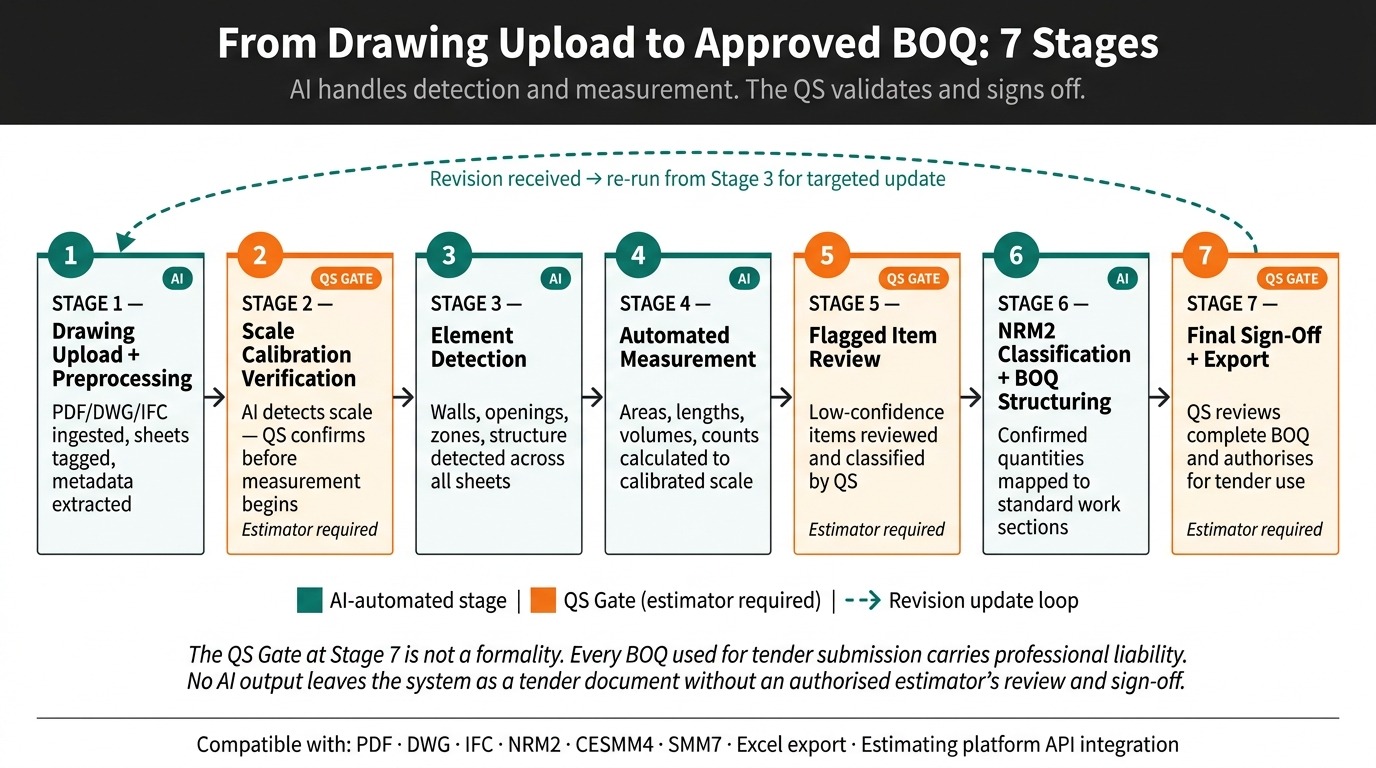
- Document Preprocessing and Scale Calibration: First, the system reads each uploaded file to extract sheet metadata, identify drawing type and discipline, and detect scale references from title blocks and bar scales. OCR (Optical Character Recognition)Technology that reads and converts printed or handwritten text in images and PDFs into machine-readable characters, used here to extract dimensions, notes, and annotation text from drawings runs across all sheets to capture dimension annotations, room labels, and specification notes. Accurate scale detection at this stage is foundational – errors here propagate through every subsequent measurement.
- Element Detection via Computer Vision: Next, a computer visionThe AI capability that enables machines to identify, classify, and measure objects within images and technical drawings by recognising visual patterns, shapes, and symbols layer analyses each drawing sheet, detecting building elements through pattern recognition trained on large datasets of construction drawings. For architectural plans, this includes walls, doors, windows, rooms, stairs, and floor zones. For structural drawings, it includes columns, beams, slabs, and foundations. For MEP drawings, trade-specific symbol recognition identifies pipe runs, ductwork, fittings, fixtures, and equipment. The system assigns a confidence score to each detected element, flagging items where the detection certainty falls below a defined threshold.
- Measurement and Quantity Extraction: Once detected, each element undergoes automated measurement against the calibrated scale. The system calculates areas for floor zones and wall faces, linear lengths for pipework and steel members, volumes for concrete and earthwork elements, and unit counts for fixtures, fittings, and openings. For BIM inputs, IFC (Industry Foundation Classes)An open, vendor-neutral file format standard for BIM data exchange that embeds geometry, material properties, and classification data within each building element parsing extracts geometry and embedded property data directly, yielding higher precision than 2D drawing interpretation.
- Classification and BOQ Structuring: The system then maps measured quantities to standard measurement frameworks. For UK construction, this means classification against NRM2 (New Rules of Measurement 2)The RICS measurement standard governing the detailed measurement and description of construction work for bill of quantities production in the UK or CESMM4 for civil engineering. Each detected element resolves to a work section, description category, and unit of measurement consistent with the chosen standard. The output at this stage is a structured, line-item quantity schedule rather than a raw detection list.
- Revision Comparison and Change Detection: When a new drawing revision arrives, the system compares it against the previous version at element level – identifying added, removed, and modified items. Affected BOQ line items are flagged automatically, showing exactly which quantities have changed and by how much. This targeted update process replaces the manual cross-referencing that a full re-measurement would require.
- Human Review Queue Generation: At this stage, the system compiles a prioritised review queue for the estimator – separating high-confidence items that warrant a quick scan from low-confidence flags that need professional judgment. Items involving non-standard details, conflicting drawing information, or elements that fall outside the system’s training coverage appear as explicit review tasks rather than silently entering the quantity schedule.
- Export and Integration: Finally, the approved quantity schedule exports to the estimator’s working format – structured Excel workbooks matching their BOQ template, PDF for tender submission, JSON for integration with estimating software, or a shareable cloud link for team collaboration. Every exported line item retains a link to its source sheet reference and detected element, maintaining the full audit trail.
Alternative Input Path: When the Tender Arrives as a Structured BOQ Document
Not every project starts from drawings. Specialist subcontractors and trade estimators often receive tender packages as structured BOQ schedules, XML files, or spreadsheet-format bill-of-quantities documents – particularly in markets with standardised digital procurement formats. When the input is structured text rather than drawings, the processing path changes but the core logic stays the same.
The system parses incoming BOQ line items and applies semantic matching against a library of historical estimates and trade calculation templates. Each line item receives a confidence score based on how closely the current wording maps to a known prior calculation. High-confidence matches – where the description aligns clearly with historical scope – populate the draft output with minimal review needed. Low-confidence items – novel scope, changed specifications, wording that diverges significantly from the team’s historical patterns – route directly to the estimator’s review queue. This path is most effective where BOQ wording is repetitive across tenders but not identical, which is the standard condition for specialist subcontractors in MEP, structural, fit-out, and technical building services trades. The estimator’s time concentrates on genuine exceptions rather than rebuilding every calculation from scratch.
Human-in-the-Loop: Where Professional Judgment Remains Essential
A responsible implementation of an AI BOQ automation solution is explicit about which decisions stay with the professional. The following areas require human oversight in every production deployment:
- Method-related charges and programme-specific items: AI measures physical quantities from drawings. It does not assess the construction method, access constraints, phasing requirements, or site conditions that generate method-related costs. These remain entirely the estimator’s judgment.
- Rate application and market pricing: The system produces quantities, not prices. Current labour rates, material market conditions, subcontractor quotes, and project-specific risk allowances all require the estimator’s input and professional knowledge.
- Non-standard elements and design intent: Where drawings show atypical details, bespoke elements, or scope that falls outside standard measurement categories, the AI flags these items rather than making assumptions. The professional determines the appropriate treatment.
- Scope boundary decisions: What’s included and excluded in a particular trade package – particularly at interfaces between disciplines – involves contractual and commercial judgment that AI systems are not equipped to make.
- Final sign-off before bid submission: No responsible implementation skips professional review before quantities are used for a commercial bid. The estimator reviews the AI-generated draft, corrects it where needed, and takes professional responsibility for the output.
Output and Interaction: What the User Actually Receives
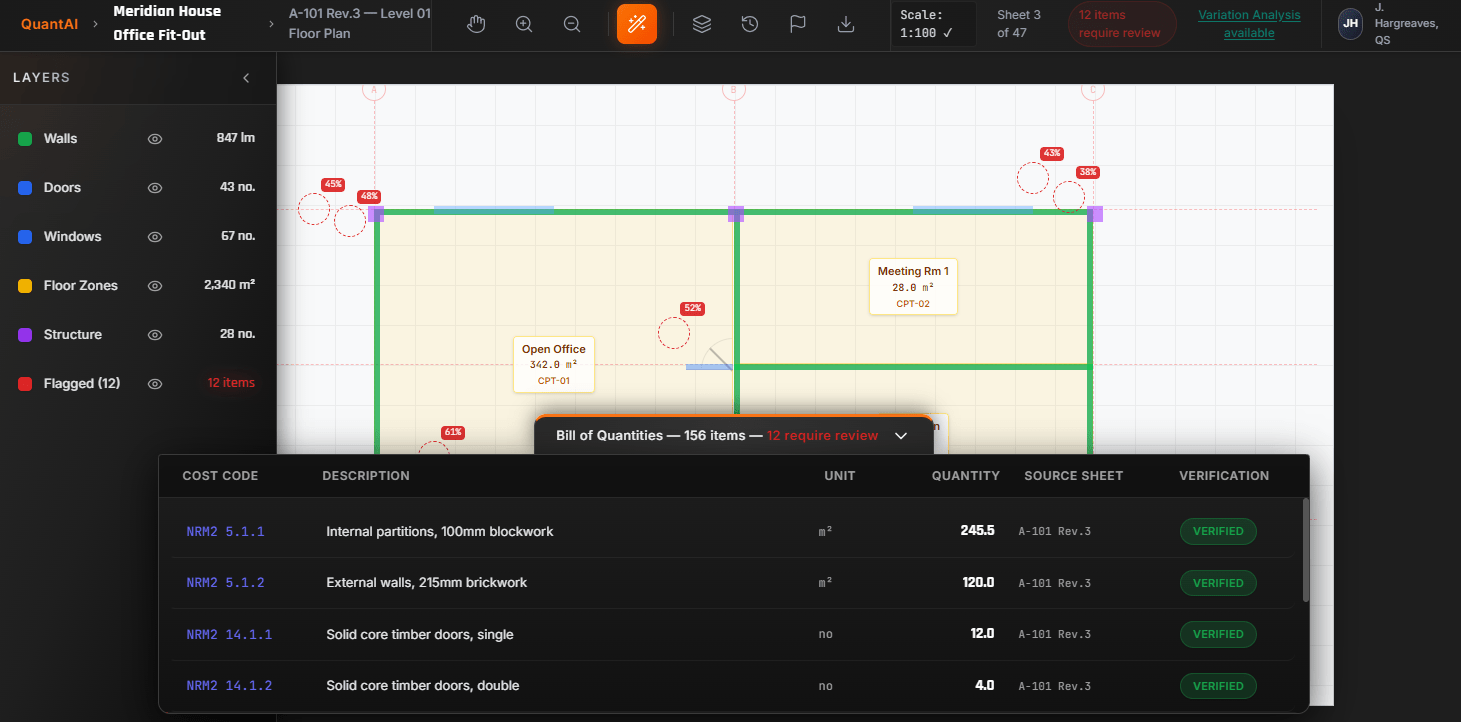
The user-facing experience centres on an interactive drawing workspace where detected elements are visually overlaid on the source drawing sheets. Each detected item is colour-coded by confidence level, allowing the estimator to immediately identify which areas need attention. The quantity schedule appears alongside the drawing view, with live links between line items and their detected source elements – clicking a BOQ line highlights the corresponding element on the drawing.
The review queue surfaces prioritised items requiring professional input, with context showing why each item was flagged. Revision comparison mode highlights changed areas between drawing versions with a visual overlay. Export options produce structured Excel workbooks pre-formatted to the team’s BOQ template, PDF schedules for tender packages, and API delivery of quantity data for integration with estimating platforms or cost management systems.
What Technologies Power an AI BOQ Automation Solution?
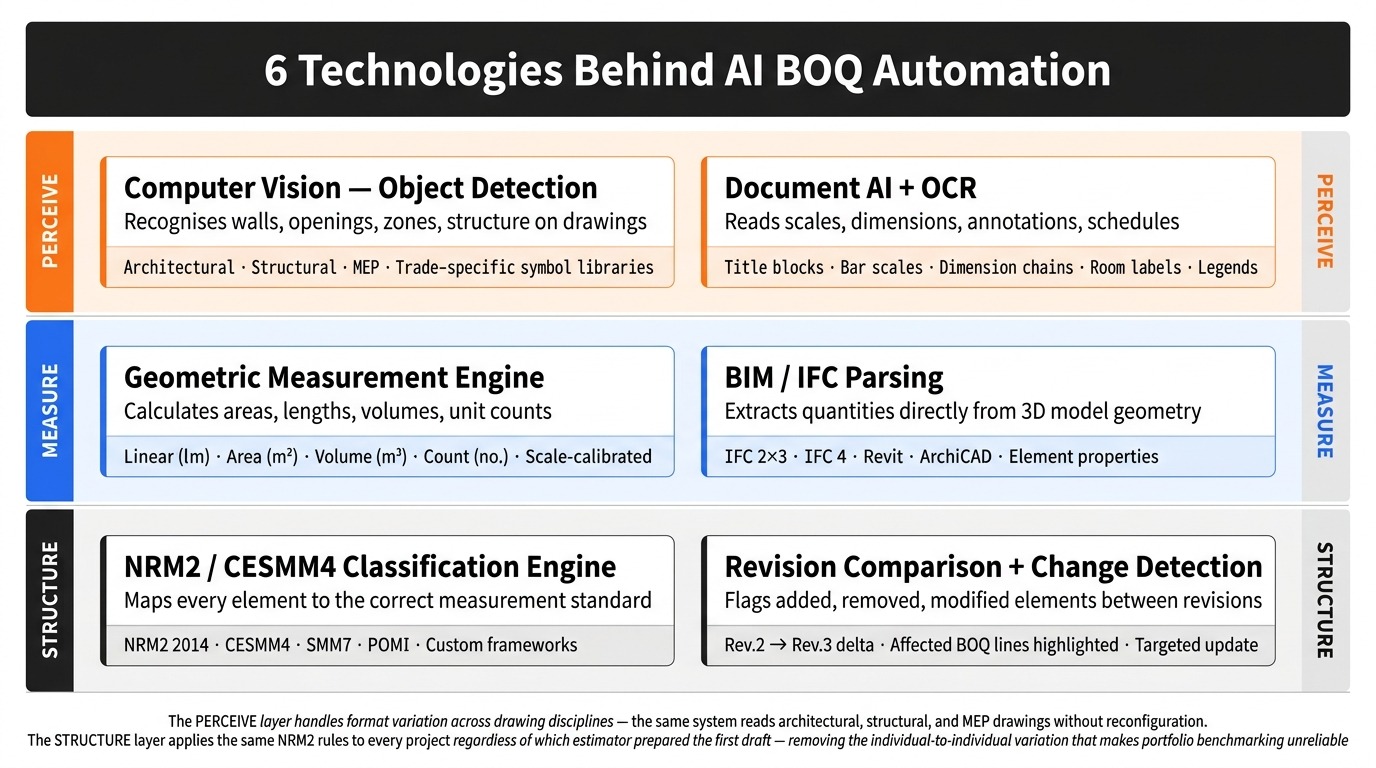
- Multimodal AI ModelsAI systems capable of processing and reasoning across multiple input types simultaneously – including images, text, tables, and structured data – enabling analysis of drawing geometry alongside specification text in a single processing step: Next-generation AI models combine visual drawing understanding with text comprehension, allowing the system to correlate a detected symbol on a plan with its definition in the legend and its specification clause in the same processing pass. This capability is what separates modern AI BOQ platforms from earlier single-modality tools.
- Object Detection ModelsComputer vision models trained to identify and locate specific objects or elements within images, here applied to construction drawings to find walls, fixtures, ductwork, structural members, and other measurable building elements: Trained specifically on construction drawing datasets, these models recognise building elements across architectural, structural, and MEP drawings. Trade-specific model variants handle the symbol conventions and drawing styles of different disciplines more accurately than generic detection models.
- Document Understanding and OCRTechnology combining text recognition with structural understanding to extract not just characters but meaning from complex documents – reading tables, schedules, dimensions, notes, and legends in construction drawings and specifications: Beyond reading text, document understanding layers interpret the structure and meaning of construction documents – identifying title blocks, parsing schedules, reading dimension chains, and extracting annotation notes that modify or override what the geometry appears to show.
- BIM Parsing and IFC ProcessingSoftware capability to read and interpret Building Information Model files in the IFC open standard format, extracting element geometry, material classifications, embedded property sets, and spatial relationships directly from the digital model: For projects with BIM deliverables, IFC parsing extracts richer data than 2D drawing interpretation can provide – including element volumes, material assignments, and spatial relationships that simplify quantity calculation and reduce reliance on manual scale measurement.
- Rules-Based Validation EngineA deterministic software layer that applies defined logic checks to AI outputs – verifying unit consistency, scale plausibility, duplicate detection, and measurement standard compliance – providing a safety net on top of probabilistic AI outputs: Deterministic validation rules run across AI outputs to catch implausible results – quantities that exceed physical constraints, scale inconsistencies, duplicate detections, and unit mismatches. This layer provides the guardrail that makes AI outputs trustworthy enough to base professional review on, rather than requiring complete re-verification.
- Vector Retrieval for Specification MatchingA search technology that represents text as numerical vectors to find semantically similar content – used here to match BOQ line item descriptions against specification clauses and standards definitions even when exact wording differs: For linking detected quantities to specification requirements, vector-based semantic search finds relevant clauses across long specification documents faster and more accurately than keyword matching, even when project-specific terminology differs from standard descriptions.
- Semantic Line-Item Matching and Historical Estimate MemoryAn AI layer that compares incoming BOQ line item descriptions against a library of historical estimates using semantic similarity – finding the correct prior calculation even when wording differs across clients, projects, or procurement formats: For document-based BOQ inputs, this matching layer identifies the closest historical calculation for each incoming line item even when wording varies between tenders. The system builds accuracy over time as the library of past estimates grows – turning the team’s accumulated quoting history into a searchable knowledge base. This technology is what makes the document-first workflow viable: it converts wording variation from a blocker into a managed exception.
- Structured Data Export and API IntegrationSoftware interfaces that output quantity data in structured formats (Excel, JSON, CSV, PDF) and allow programmatic connection to external estimating platforms, cost management systems, and collaboration tools: Interoperability with existing estimating workflows is a critical capability, not an afterthought. Export engines that produce output in the team’s existing BOQ template format – rather than requiring adoption of a new tool for the complete workflow – drive adoption by reducing the friction of switching.
What Results Does an AI BOQ Automation Solution Deliver for Construction Teams?
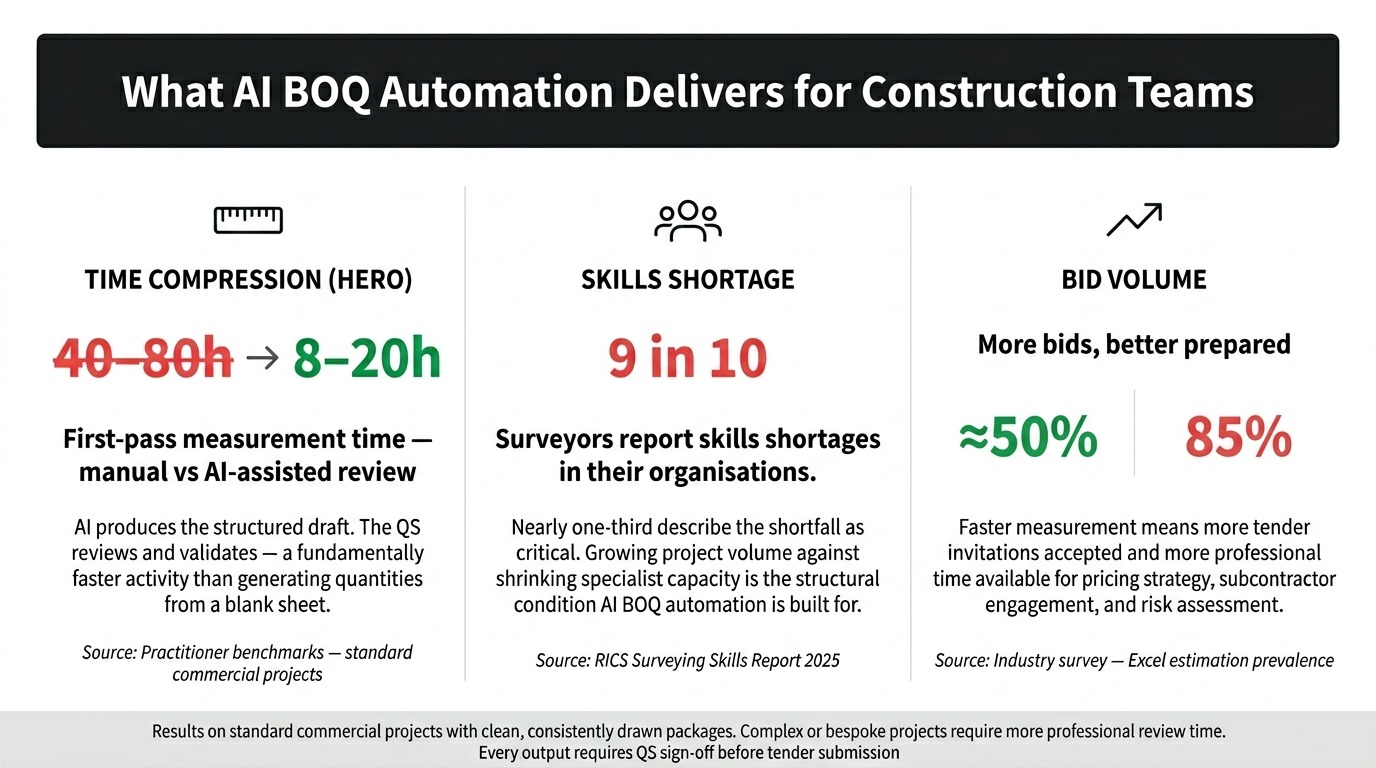
- Significant reduction in first-pass measurement time: Addressing the core pain point of quantity surveyors spending too long on manual measurement, AI-assisted takeoff shifts the professional’s role from generating quantities to reviewing and validating them – a fundamentally faster activity. Practitioner accounts consistently describe first-pass takeoff time being cut by roughly half on standard commercial projects when AI handles the initial measurement pass and the estimator focuses on review rather than generation.
- Fewer missed items and reduced BOQ errors: Systematic AI detection across entire drawing sets – rather than human attention that naturally tires across long measurement sessions – reduces the rate of missed elements. Particularly on large drawing packages where human consistency erodes under time pressure, automated first-pass detection catches items that a fatigued estimator might overlook.
- Faster tender turnaround and higher bid volume: Directly addressing the problem of tender deadlines missed because estimation takes too long, faster BOQ production means teams can bid on more opportunities within the same resource envelope – or submit better-prepared bids on the same number of projects.
- Targeted revision handling instead of full re-measurement: Automated change detection between drawing revisions replaces the manual cross-referencing currently required every time a design changes. Teams that previously needed to re-measure significant portions of a BOQ after every design update can now receive a targeted list of affected quantities within hours of a new revision arriving.
- Consistent measurement standards across the team: AI classification against NRM2 or CESMM4 applies the same rules to every project, removing the estimator-to-estimator variation that makes portfolio-level cost benchmarking unreliable. Newer team members working from AI-generated drafts also benefit from implicit training in how elements should be classified.
- Reduced dependency on external QS outsourcing: For firms that currently use external consultants or offshore services for volume takeoff work, an AI quantity surveying tool brings that capacity in-house – reducing cost, eliminating coordination overhead, and keeping commercially sensitive project information within the organisation.
- Earlier and more frequent cost plan updates: Because AI-assisted quantity extraction is faster, cost consultants can produce indicative BOQ data from earlier design stages and update it more frequently as designs develop – giving clients better cost visibility through the design process rather than only at tender stage.
- Full quantity traceability for dispute resolution: Every AI-generated line item links back to its source drawing sheet and detected element. That audit trail supports dispute resolution, value engineering reviews, and post-contract reconciliation far more efficiently than a spreadsheet where measurement decisions are implicit rather than documented.
Is an AI BOQ Automation Solution Worth the Investment? A Business Case Framework
An AI BOQ automation solution generates measurable return when the cost of estimator time saved exceeds the platform investment – and for most QS practices and construction teams with active tender pipelines, that threshold is reached quickly. Teams that have worked through this investment decision consistently find that the ROI calculation is straightforward once you quantify current costs honestly, but the non-financial benefits – bid volume, staff retention, and consistency – often matter as much as the direct cost saving.
Key Business Metrics to Measure Before and After Implementation
- Hours per BOQ takeoff: Measure current first-pass measurement hours by project size category. Post-implementation, measure total professional hours including AI-assisted review. The gap is your primary efficiency metric. For a team processing 20 medium commercial projects per year, a 40-hour saving per project represents 800 estimator-hours recovered annually.
- Cost per tender prepared: Calculate current fully-loaded cost per tender (estimator hours multiplied by blended hourly rate plus any external QS fees). Compare against post-implementation cost including platform subscription. This is the metric that justifies the investment to finance and senior leadership.
- Tender hit rate and bid volume: Track how many tender invitations the team currently declines due to capacity constraints. Post-implementation, measure whether additional tenders are attempted and whether overall win rate changes with better-prepared bids. Revenue uplift from additional won tenders often exceeds the direct cost savings.
- Revision cycle cost: Count the average number of design revisions per project and current hours spent re-measuring per revision. Post-implementation, measure time spent on targeted revision updates using automated change detection. For projects with high revision frequency, this metric alone can justify the platform.
- Error rate and variation costs: Track BOQ-related pricing disputes, variations attributable to measurement errors, and post-contract reconciliation time. Reducing these costs represents a financial benefit that doesn’t appear in the estimating function’s budget but directly affects project profitability.
Realistic Implementation and Payback Timeline
For a mid-size quantity surveying practice or contractor estimating team, implementation of a configured AI BOQ automation platform typically follows a three-to-six month adoption curve. The first month covers system setup, drawing template configuration, and trade model tuning to the organisation’s project types. Months two and three involve parallel running – using AI-assisted output alongside existing manual processes on live projects, building team confidence and measuring accuracy. By months four to six, the team operates primarily from AI-generated drafts with professional review, and the productivity gains are measurable against the pre-implementation baseline.
Payback period depends primarily on project volume and current estimator hourly costs. For teams running ten or more medium commercial projects annually, payback periods of three to nine months are realistic based on published efficiency benchmarks – though every organisation should calculate this against its own project mix and cost structure rather than relying on vendor-quoted averages.
The strongest business case for acting now rather than waiting rests on competitive dynamics: as AI quantity takeoff adoption grows across the contractor and QS market, teams still operating manually will face a structural bid-preparation speed disadvantage against competitors who’ve integrated AI-assisted workflows.
What Does Implementing an AI BOQ Automation Solution Actually Require?
A common pattern across real implementations of this solution is that the technical deployment is rarely the hard part – drawing quality, workflow integration, and change management within the estimating team require more attention than the platform setup itself. Understanding these factors before procurement prevents the disappointment that comes from expecting results that the actual deployment conditions don’t support.
- Drawing quality is the primary accuracy determinant: AI BOQ tools perform best on clean, consistently drawn plans with readable legends, clear scales, and well-structured annotations. Complex projects with hand-marked revisions, inconsistent symbol usage, or very large sheet sets (above 1,500 to 2,000 sheets) challenge current systems more than straightforward commercial projects. Organisations primarily working with messy or incomplete drawing packages should set accuracy expectations accordingly.
- Trade-specific configuration requires upfront investment: Generic detection models don’t match the accuracy of models tuned to your project types. Configuring trade templates, symbol libraries, and BOQ output formats to match your existing estimating structure takes setup time – typically two to four weeks of collaboration between your team and the implementation partner. Skipping this step produces generic outputs that still require significant manual reformatting.
- Integration with existing estimating workflows is critical: The tool needs to export in the formats your team actually uses – whether that’s a specific Excel template structure, a BOQ format matching your standard document, or an API connection to your estimating platform. Implementations that require estimators to adopt an entirely new workflow to extract value face adoption resistance that undermines the productivity gain.
- Data privacy and document security need explicit attention: Construction drawings contain commercially sensitive and sometimes contractually confidential project information. Firms handling documents under NDA, government projects with security classifications, or data subject to client confidentiality requirements need to assess whether cloud-based processing meets their obligations – and should explore private deployment options where on-premise or private cloud processing is required.
- Model maintenance as project types evolve: Detection accuracy on new project types or unusual building systems may be lower than on well-represented categories. An implementation that works well on standard commercial office fit-out may need retraining to achieve the same accuracy on, say, healthcare facilities or industrial buildings with different drawing conventions. Build ongoing model maintenance into operational planning.
- Team expertise and change management: Estimators who’ve worked with manual takeoff for years sometimes resist AI-generated drafts, particularly if early results include visible errors. Managing this transition requires demonstrating accuracy on real projects the team knows well, building trust incrementally rather than switching entirely at once, and being honest that the tool works best as a professional copilot rather than an autonomous system.
Where This Solution Has Real Limits
- Complex, non-standard, or bespoke architectural details – particularly custom junctions, specialist facade systems, and unique structural solutions – often fall below AI detection confidence thresholds and require manual measurement. The system flags these; it doesn’t quietly produce a wrong answer, but it does require human input.
- Very large drawing sets with thousands of sheets, multiple addendum packages, and complex cross-reference dependencies push the limits of current change detection reliability. The system becomes more useful as a search and organisation tool on these projects than as a fully automated quantity generator.
- Scope interpretation – deciding what is and isn’t included in a particular trade package, identifying ambiguous scope boundaries, and understanding the commercial intent behind certain design decisions – remains outside what AI can currently handle reliably. These decisions require professional construction knowledge that no current model consistently demonstrates.
- The output should never go to tender without professional review. That constraint is not a temporary limitation waiting to be engineered away – it reflects the reality that construction bids carry commercial liability, and the professional placing their name on a bill of quantities needs to have actually reviewed it.
- Drawing-based AI and document-based AI are not the same problem, and treating them identically leads to miscalibrated expectations. The system performs most reliably on structured inputs – clean drawings with consistent conventions, or digital BOQ files with standardised formats. Ambiguous inputs – messy hand-marked drawings, inconsistent BOQ wording across large document sets, or scope requiring deep contextual construction knowledge – are where both paths still require the most human involvement.
Which Construction Teams and Organisations Benefit Most from an AI BOQ Automation Platform?
An AI BOQ automation solution delivers the highest value to organisations where tender volume is high, estimating resource is constrained, and input quality is reasonably consistent – whether that input is drawings or structured tender documents. It performs best where the competitive advantage of faster, more accurate takeoffs directly translates to more bids submitted, better-prepared tenders, or freed-up professional time for higher-value work. Cost consultancies, general contractors, specialist subcontractors handling significant bid volumes, and QS practices supporting active development pipelines are the primary beneficiaries.
This solution is particularly valuable if:
- Your team declines tender invitations because the measurement phase alone would consume the available bid window
- Design revisions during the tender period force costly re-measurement cycles that compress the time available for pricing and bid strategy
- You handle multiple concurrent tenders and consistency of BOQ output across estimators is a visible quality challenge
- You currently outsource takeoff work to external QS consultants or offshore services and want to bring that capacity in-house
- Your project types are commercially standardised enough that AI detection models can be trained to reliable accuracy on your typical drawing packages
- You are a specialist trade subcontractor – in MEP, structural, fit-out, or technical building services – who prices high volumes of repetitive BOQ tenders and currently rebuilds calculation logic manually every time wording shifts slightly between clients or procurement formats
Specific roles that interact directly with an enterprise AI construction solution of this type include: Quantity Surveyors, Senior Estimators, Preconstruction Managers, Cost Managers, Project Directors overseeing bid pipelines, and Commercial Directors responsible for bid-to-win ratios and estimating department capacity.
Frequently Asked Questions About AI BOQ Automation
Can AI BOQ automation software handle complex drawings, not just simple floor plans?
Current AI BOQ automation platforms handle standard commercial drawings with high accuracy, but complex projects present genuine challenges. Systems trained on large datasets of construction drawings perform well on architectural plans, structural layouts, and common MEP symbol libraries. Where accuracy drops is on unusual bespoke details, very large sheet sets with thousands of drawing sheets, and projects where key scope information is buried in engineer’s notes or non-standard symbols. The honest answer is that AI handles the majority of a standard drawing set reliably, flags the complex items for professional review, and should never be used without that review step. For genuinely complex projects, the tool’s value shifts from autonomous quantity generation toward acceleration of the professional’s review process – still significant, but different from what simpler projects deliver.
How does AI quantity takeoff software compare to traditional manual measurement?
The core difference between AI quantity takeoff and manual measurement isn’t just speed – it’s the starting condition. Manual measurement requires the estimator to begin from a blank sheet and produce the complete quantity set. AI-assisted takeoff produces a draft quantity set that the estimator reviews, corrects, and validates. That shift from generation to review is faster even accounting for the review time, particularly on large drawing packages where a single estimator would take multiple days to complete a manual takeoff. The trade-off is that AI output requires active professional oversight – items the system misses or misclassifies need to be caught in the review process. When that review is done properly, the combination outperforms pure manual measurement on speed while maintaining professional accuracy standards.
How long does it take to implement an AI BOQ automation platform for a construction team?
A realistic implementation timeline for a mid-size construction estimating team runs three to six months from platform setup to confident everyday use. The first month focuses on configuration – aligning the system’s output format with your existing BOQ templates, tuning trade detection models to your common project types, and setting up drawing upload and export workflows. Months two and three typically involve parallel running on live projects, building team familiarity and validating accuracy before full adoption. By month four to six, most teams are operating primarily from AI-generated drafts with professional review, and measurable productivity gains are visible. The timeline is longer if significant custom development is required for specific workflow integrations, shorter if the team’s project types are straightforward and the implementation is well-supported.
What types of construction projects is an AI BOQ automation tool best suited for?
AI BOQ tools perform best on commercial construction projects with clean, well-structured drawing packages – commercial office fit-outs, residential developments, retail, hospitality, and standard industrial buildings where drawing conventions are consistent and building elements follow recognisable patterns. MEP-specialist tools add strong value on services-heavy projects where symbol recognition across large duct and pipework drawing sets would otherwise require significant manual effort. Civil and earthwork projects use different AI approaches centred on volume calculation from survey data. Where the tools perform less predictably is on highly bespoke architectural projects, heritage restoration, and complex infrastructure works with non-standard scope packaging – these remain areas where manual QS expertise carries more weight than AI assistance currently can.
Is AI BOQ software reliable enough to use for actual tender submissions?
AI BOQ software is reliable enough to be the starting point for tender submissions – but not the ending point without professional review. Current systems achieve high accuracy on standard drawing types, and leading implementations include confidence scoring and flagging systems specifically designed to surface items where the AI is less certain. That means a qualified estimator reviewing an AI-generated BOQ can focus attention on the flagged items rather than checking everything from scratch. However, professional sign-off before submission is non-negotiable – both for accuracy reasons and because the contractor or QS firm carries the commercial liability for a submitted bill of quantities, regardless of how it was produced. The best implementations build this human review step into the workflow explicitly rather than treating it as optional.
Build This Solution With Softlabs Group
Softlabs Group develops custom AI BOQ automation solutions built around your organisation’s specific project types, drawing standards, estimating workflow, and output format requirements. That means a system trained on your drawing datasets, producing quantity outputs in your BOQ template structure, and integrating with the estimating tools your team already uses – not a generic platform that requires your team to change how they work. We build the AI processing pipeline, the human review interface, the revision comparison engine, and the export layer as a coherent, production-grade system rather than a collection of stitched-together tools.
If you’re evaluating whether AI BOQ automation is right for your team – or if you already know what you need and want to talk through the build – the right starting point is a focused conversation about your current estimating volume, project types, and the specific workflow gaps you need to solve. From there, we can define a realistic scope, timeline, and approach that fits your situation.