 India
 Mongolia
 Sweden
 Australia

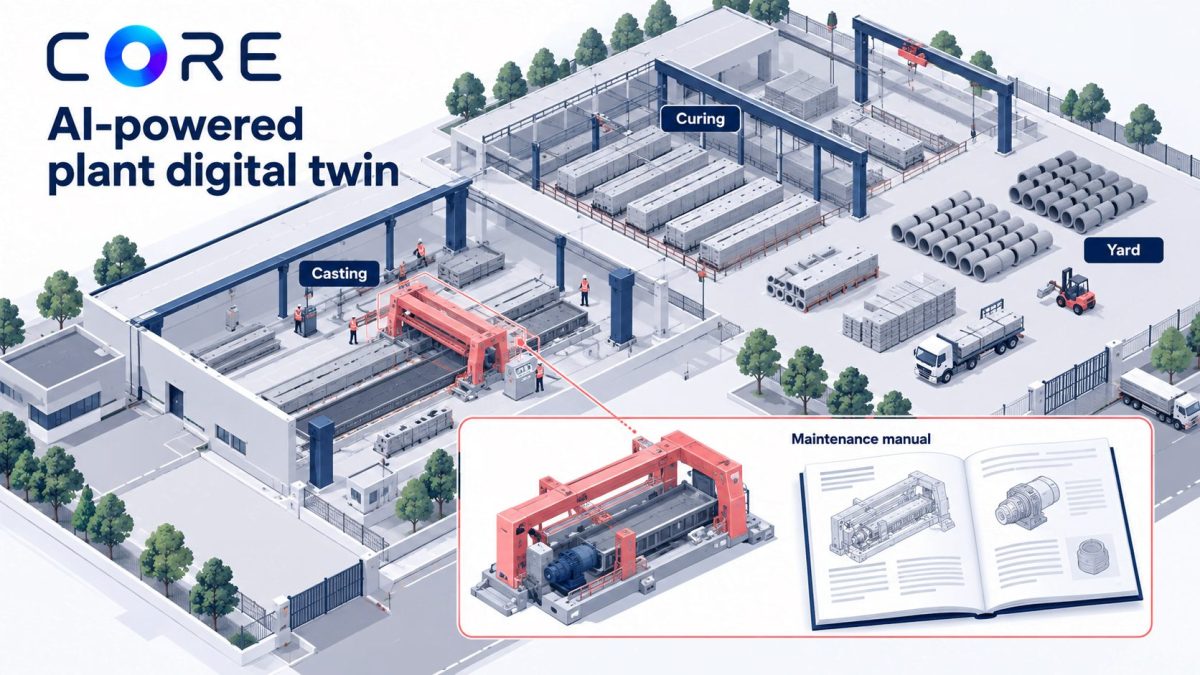
Executive summary: How can plant teams bring readings and manuals into one investigation?
An AI-powered Digital Twin for Manufacturing Plant can bring plant views, machine readings and maintenance documents into one investigation workflow. Softlabs can scope a custom CORE-based build around your layout, available data and the questions your plant team needs to answer.
The proposed scope is read-only monitoring and investigation. Operators keep equipment, safety and maintenance decisions. A connected implementation needs its own data feeds and tests; a plant model alone is not a live monitoring system.
Discuss your plant use case1. The challenge: Why does a plant investigation still cross several systems?
When a press slows down, a maintenance lead may need its recent readings, the production context and the relevant manual page. Those records can sit in different systems, leaving someone to match the machine, time period and document before deciding what to inspect.
Plant dashboards, alarms and historians may already provide analysis. The gap to check is whether staff still have to gather information across those tools and the document store to investigate a specific question. A historian stores past readings; a manual explains the equipment, but staff need to connect both to the same asset.
That gathering and cross-checking can delay the investigation. The proposed solution focuses on bringing the evidence together, not taking equipment decisions away from the people responsible.
2. The solution concept: What can an AI-powered Digital Twin for Manufacturing Plant bring together?
Softlabs can scope plant digital twin software that links a checked plant model to permitted readings and maintenance documents. CORE, an AI knowledge and workflow platform, would support information retrieval and draft answers with references for staff to inspect.
An AI-powered Digital Twin for Manufacturing Plant gives the investigation a physical context: which area, machine or part does the question concern? This digital twin for manufacturing focuses on monitoring and evidence review, not physics simulation, automatic optimisation or proven failure prediction.
3. Where can a digital twin support production and maintenance teams?
An AI-powered Digital Twin for Manufacturing Plant could support these investigations. The proposed AI assistant for manufacturing would prepare the available evidence for a plant or maintenance lead, not decide the cause or action.
Review a possible production bottleneck
Production bottleneck analysis can begin with counts and operating context for an agreed line and time period. If OEE monitoring software supplies the data, the view could include overall equipment effectiveness and its availability, performance and quality factors. A production lead would check the definitions and sources. The benefit sought is a comparison in context rather than another manual collection of readings.
Investigate a machine reading alongside its manual
Machine condition monitoring can supply trends for the asset under review. The workflow could bring those readings and relevant manual passages together, so maintenance staff can inspect the evidence before choosing their next check. A rising temperature or lower count does not, by itself, prove a fault or its cause.
Locate the equipment behind a question
A factory digital twin could help staff move from a line to the machine or component being discussed, then open its information. This would give the team a common reference for the investigation. Staff still need to confirm that the model and documents refer to the actual equipment.
Example: investigate where output is being held up on one line
Suppose a plant lead asks where output is being held up. An AI-powered Digital Twin for Manufacturing Plant could prepare an evidence review as follows:
- Identify the line, assets and time period in the question.
- Collect the permitted counts and readings, with their timestamps.
- Show differences and any gaps in the available data.
- Add relevant document passages where equipment context is needed.
- Present the evidence and open questions for the plant lead to check.
The lead receives material for an investigation, not a confirmed diagnosis. Staff decide what to inspect and what action is safe. The assistant would not change a production plan or approve maintenance.
4. How does the plant investigation workflow work?
- Choose one line and a question. Check the model against the physical layout and identify the machines and components included.
- Map each model asset to its identifier in the source systems. Link the permitted readings and relevant manuals to that same asset, so a value for one machine is not shown against another.
- Read the agreed data feeds without sending equipment commands. Keep timestamps and units with the readings, and make gaps or old values visible.
- Use the asset and time period in the question to gather the available readings and retrieve relevant document passages.
- Prepare an evidence view or draft answer with its sources and open questions. The plant or maintenance lead checks it before deciding what to inspect.
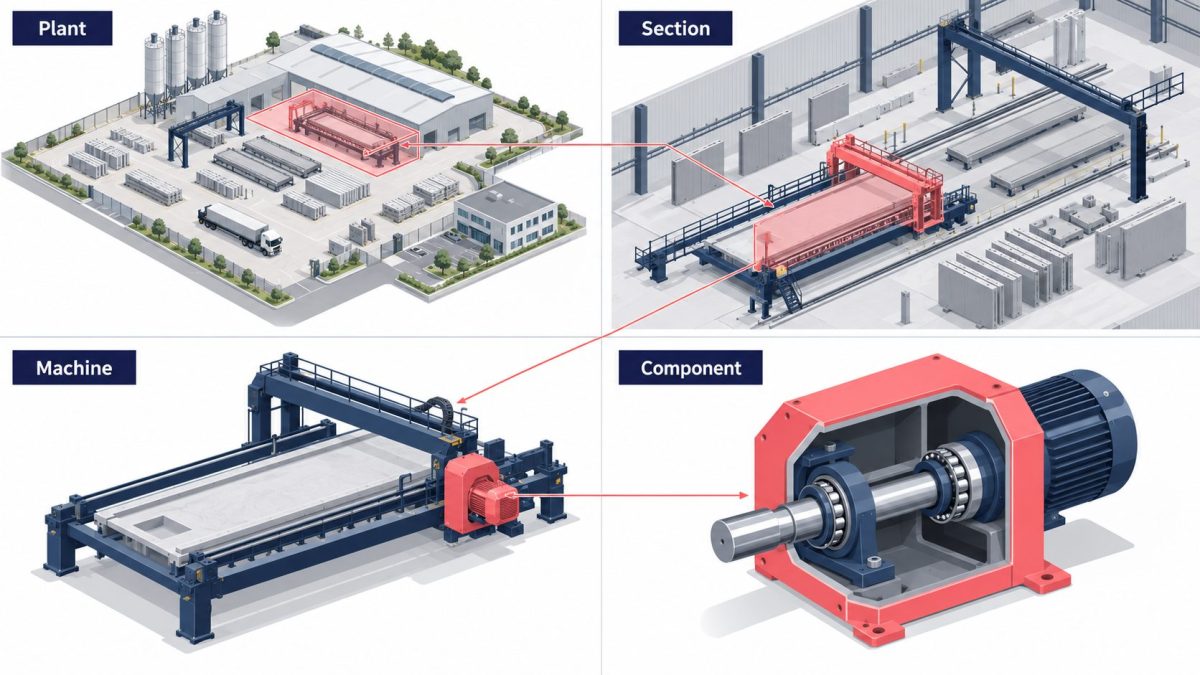
Move through four levels of the plant
- Plant: locate the main production areas and material flow.
- Section: narrow the view to the line or stage under review.
- Machine: match the asset to its available readings.
- Component: identify the part and relevant maintenance information.
For 3D factory monitoring, those views must match the physical equipment and the identifiers in the source data. The precast illustration shows the levels of detail; a customer layout needs its own checks.
5. What technologies support the plant view and evidence search?
The proposed customer build joins a plant model, read-only data access and CORE information retrieval. Each part needs to match the actual plant.
- The 3D model gives readings and documents a physical location. Its plant, section, machine and component views depend on checked asset identifiers.
- Read-only connections bring in agreed records from plant systems or sensors. The source, update rate, units and timestamps determine what a displayed value can tell the reviewer.
- Document search locates relevant maintenance information for the asset. Source references let staff check the manual passage and version.
- The question-and-answer workflow brings the selected readings and document context into a draft response. Staff need to see where evidence is missing rather than receive a confident explanation without support.
- Access rules limit the data available to each user. Testing must cover both answer quality and the absence of an equipment-command path.
A model display, data connection and AI response are separate parts to test. A useful view of the equipment does not by itself establish a working live feed.
6. What benefits can plant teams expect?
The intended benefit is less time gathering evidence before an investigation. A production lead can compare readings for an agreed period in the context of the line. A maintenance lead can look at an asset’s trend alongside the relevant manual. The model can give both people a common reference for the equipment they are discussing.
Keeping timestamps, sources and gaps visible can also make the handover clearer: staff can see what information is available and what still needs checking. These are benefits to test on the chosen line, not promises of higher output, lower downtime or a confirmed fault diagnosis.
7. How should a plant team measure its value?
Evaluate an AI-powered Digital Twin for Manufacturing Plant against the current process for one investigation question. Use the same assets, time period and available records, and include the reviewer’s correction effort in the comparison.
- Check the model against the actual machines and components.
- Compare displayed values and update intervals with the source system.
- Have plant staff check answers and document references.
- Test missing data, old readings and unsupported questions.
- Verify the read-only boundary and compare investigation effort with the current process.
Record wrong asset matches separately from missing readings or irrelevant manual passages. Check whether the assembled evidence helps staff decide what to inspect, without treating their eventual diagnosis as something the assistant proved.
A precast model is a starting point for discussing the views, not evidence of connected performance at your factory. Cost, timing and further extensions depend on the layout, data access and what the evaluation shows.
8. What should plant teams check before implementation?
An AI-powered Digital Twin for Manufacturing Plant needs a defined read-only connection scope. SCADA digital twin integration starts with the actual system, available interfaces and permitted records. Softlabs can assess IoT integration where sensor or device connections are needed; compatibility must be checked for your setup.
Real-time production monitoring needs an agreed update rate, consistent units and timestamps, and a visible warning when readings are old or missing. The design also needs matched asset identifiers, current manual versions and user access rules.
Softlabs can assess private AI deployment across model requests, search stores, logs, backups and external services. The chosen setup determines where data is processed. The build must test that its connections cannot issue equipment commands; it is not a safety or control system.
For a first build, Softlabs can assess one line and one investigation question. Our manufacturing software development scope can cover the required layout work, read-only data connections, document retrieval and review output.
Agree who checks the layout, who owns each data feed and who reviews the evidence. The first-build deliverables should identify the included assets, source-to-model mapping, data connections and investigation output. Test them with plant staff before adding more sections or tasks.
9. Who can use the plant investigation workflow?
- Plant managers can review production context for a line and identify questions that need closer investigation.
- Production and operations teams can compare available counts and operating information for the same time period.
- Maintenance leads can review asset readings alongside manuals before choosing the next inspection.
- Plant engineers can check the layout, component references and mapping between model assets and data identifiers.
- IT and operational technology owners can assess interfaces, access and the read-only boundary. Operators retain equipment control and follow the plant’s safety procedures.
10. Frequently asked questions
Do we need to replace our SCADA system or historian?
The proposed approach works alongside existing plant systems. It needs a review of the interfaces, permitted readings and update rates those systems provide. A connection is scoped for your setup; it is not a promise of compatibility with every SCADA product.
Would the twin control machines or safety systems?
No equipment control is included in the proposed scope. The implementation must use and test read-only connections. Operators remain responsible for equipment commands, safety procedures and maintenance decisions.
Can our plant data stay on our own infrastructure?
That can be assessed during the hosting review. The design must account for model requests, data stores, logs and connected services, not only where the main application runs. Local model and infrastructure choices need to match the agreed data rules.
What should happen when data is missing or too old?
The design should make that limit visible rather than present an old reading as current. Answers should identify gaps and give staff a way to inspect the available sources. These behaviours need testing on the chosen data feeds.
Can we start with one line instead of the whole factory?
Yes. One line and one investigation question can define a focused evaluation. The scope needs the relevant layout, permitted readings, manuals and a plant reviewer. It does not require a promise about factory-wide performance before that work is tested.
Discuss one production line and one question
Tell us which plant question is difficult to answer today. Softlabs can scope an AI-powered Digital Twin for Manufacturing Plant around the readings, documents and views needed to investigate it.
Start with the plant systems involved and the person who will review the evidence. You do not need to share live production credentials in the first enquiry.
Discuss your plant use case