 India
India  Mongolia
  Sweden
  Australia
Executive Summary: Airlines Have Fixed the Operations Side – the Passenger Last Mile Remains Broken
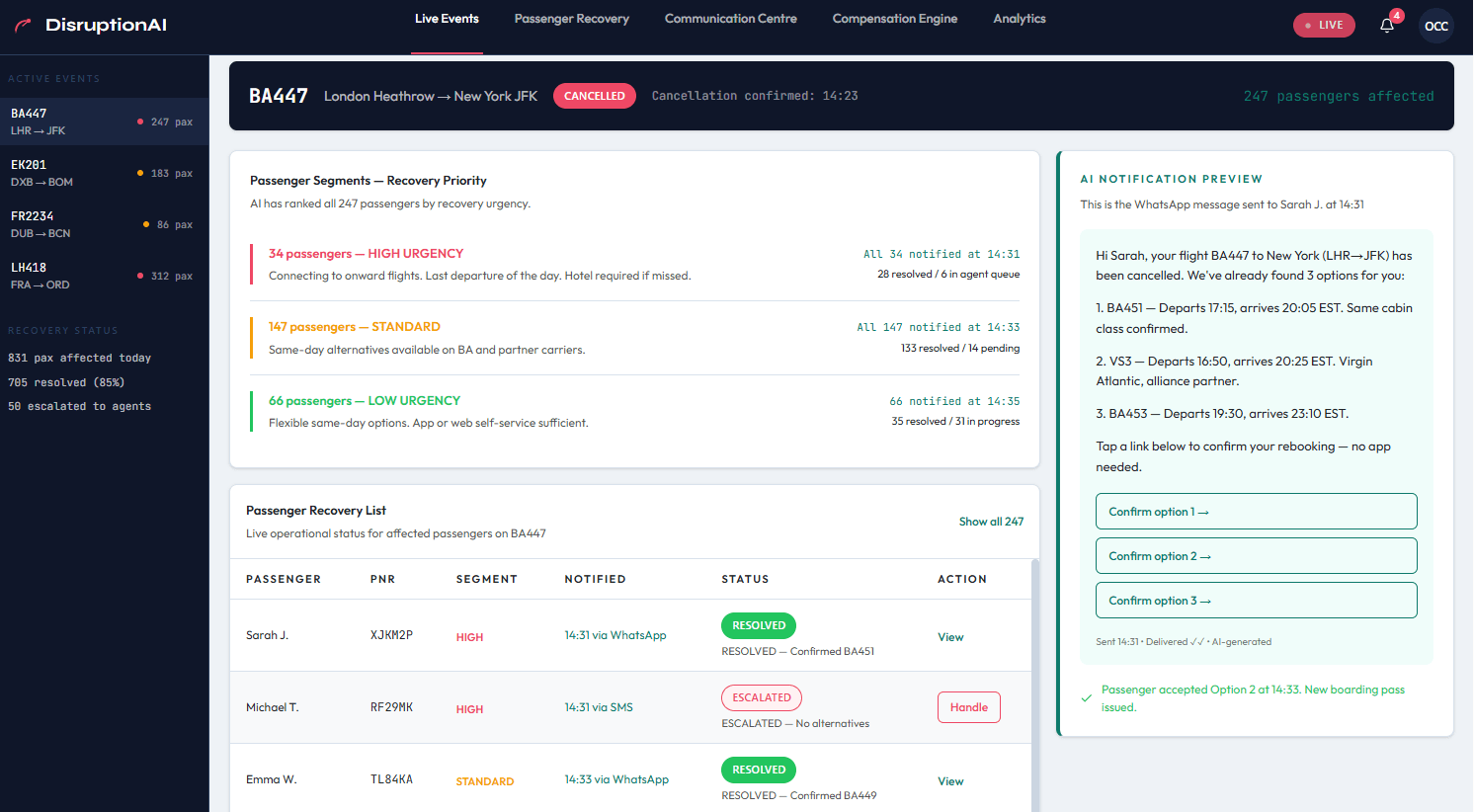
Your operations control centre activates the moment a flight cancels. Recovery itineraries queue, internal dashboards refresh, and agents get notified. Meanwhile, your passenger stands at a gate with a connecting flight in 40 minutes, still watching a departure board that has not changed. That gap – between what your systems already know and what passengers actually experience – is the layer every serious airline disruption management solution must close.
Airlines have spent years investing in operations-side recovery technology. Yet passengers continue to find out about cancellations through a vague SMS, wait 45 minutes on hold, and discover they have been rebooked onto a flight they would never have chosen. An AI-powered airline disruption management solution targets this exact failure point: real-time disruption detection, personalised proactive communication, self-service rebooking, and automated compensation – delivered before the passenger reaches the gate.
This page explains what that solution involves technically, what genuine implementation requires, and where the real limits are – so operations directors, digital transformation leads, and airline technology teams can make a grounded evaluation.
1. Why Do Passenger Experiences Keep Failing During Airline Disruptions, Despite Technology Investment?
Most disruption technology investment targets the operations centre, not the passenger. That asymmetry explains why passengers keep having bad experiences even as airline ops teams get more capable tools.
Context: The Operational Environment Where Disruptions Cascade
Globally, a significant share of flights face some form of disruption on any given day – weather events causing cascading flight delays, IROPSIrregular Operations – the aviation industry term for any unplanned event that disrupts normal flight operations, including weather, crew issues, mechanical faults, or ATC delays events triggered by mechanical faults, or sudden crew unavailability at hubs. When a single high-traffic flight cancels, the disruption rarely stays isolated. The aircraft is removed from later rotations. Crew hit legal duty-hour limits or land in the wrong city. Connecting passengers miss onwards flights across multiple carriers.
Operations control centre teams face this multi-layer crisis simultaneously – managing aircraft recovery, crew rescheduling, passenger reaccommodation, and gate reassignment at the same time, under time pressure, using tools built for calmer conditions. In practice, airlines that have deployed passenger-facing recovery automation consistently find that their operations team handles the flight recovery reasonably well – but the passenger communication loop runs hours behind, and that is where the damage compounds.
The result is a predictable pattern: passengers hear nothing until they are already at the gate, reach a call centre with a 40-minute wait, and feel abandoned at exactly the moment that airline loyalty is most vulnerable. An effective airline disruption management solution must address this communication lag directly – not as a secondary feature, but as its primary design objective.
Key Pain Points This AI Solution Addresses
- Passengers missing connections with no proactive help: Affected travellers learn about cancellations at the gate rather than hours earlier, eliminating any window for self-service recovery.
- Operations centres overwhelmed during major disruptions: When a weather event or IT outage affects hundreds of flights simultaneously, manual workflows break down entirely – call volumes spike and agent capacity collapses.
- Manual crew rescheduling taking hours: Crew tracking becomes impossible during large disruptions when legal duty-hour rules, location data, and qualification requirements must be cross-referenced manually across a disrupted network.
- High compensation costs from poor disruption recovery: Slow or inaccurate reaccommodation triggers regulatory compensation obligations under rules such as EU261/2004European Union Regulation 261/2004 – establishes passenger rights to compensation, re-routing, and care when flights are cancelled, significantly delayed, or subject to denied boarding, plus goodwill costs from loyalty erosion on top of direct payouts.
- No way to predict disruptions before they escalate: Most airlines react to disruptions after the event rather than identifying high-risk flights early enough to pre-position recovery options.
- Airline disruption handling passenger experience failure: Even when rebooking succeeds operationally, passengers experience the outcome as arbitrary – being placed on a 6am flight they did not request, with no explanation and no alternative offered.
- How to reduce airline passenger complaints during disruptions: Post-event complaint volume and social media criticism create reputational costs that outlast the disruption itself, particularly when the communication experience was avoidable.
Why Traditional Approaches Fall Short
Legacy PSSPassenger Service System – the core reservation and inventory management platform airlines use to manage bookings, check-in, and passenger data; most are decades old and not designed for real-time AI integration platforms were designed for transaction processing, not real-time disruption reasoning. When an IROPS event triggers, agents query these systems manually and construct recovery options through a combination of screen-based lookups and phone calls – a process that scales poorly once more than a handful of flights are affected.
Furthermore, most existing airline disruption management software separates the operations layer from the passenger communication layer. The ops team may have a capable rebooking tool, but the system that contacts passengers either runs separately, runs later, or depends on a manual trigger from an already-overwhelmed agent. The result: passengers receive a generic notification hours after the airline’s internal systems have already identified the disruption and generated options.
When demand on passenger-facing apps and contact centres spikes during mass disruptions, the very systems passengers need most are often the first to degrade under load. That is not a fringe edge case – it is the consistent pattern practitioners report across high-profile disruption events. Traditional approaches fail not because the technology is absent, but because the passenger communication layer was never designed to operate at IROPS scale and speed.
2. What Is an AI-Powered Airline Disruption Management Solution?
An AI-powered airline disruption management solution automates the passenger-facing recovery layer – detecting disruptions in real time, communicating proactively, and enabling self-service resolution before passengers reach the gate or the phone queue.
The concept is best understood as a specialised software layer that sits between an airline’s operational systems and its passengers. When a disruption event is detected, the solution immediately identifies every affected passenger, segments them by impact severity and passenger profile, generates personalised recovery options, and delivers those options via the passenger’s preferred channel – all without requiring an agent to initiate the process.
This is not a replacement for operations-side recovery platforms that handle aircraft routing and crew reassignment. Instead, it closes the gap that those platforms consistently leave open: the passenger experience during the recovery window. A well-designed flight disruption recovery tool in this category does five things reliably – detects early, communicates proactively, offers real choices, resolves digitally, and compensates automatically where rules require it.
Vision and Objectives
- Eliminate the information gap: Every affected passenger receives accurate, personalised disruption information via their preferred channel within minutes of the event triggering – not hours.
- Reduce call centre volume at peak: Self-service resolution handles the majority of standard rebooking and refund requests without agent involvement, keeping contact centre load manageable during IROPS events.
- Increase passenger-preferred reaccommodation: AI-generated options ranked by passenger preference history, loyalty tier, and availability replace arbitrary system assignments, improving acceptance rates and loyalty protection.
- Automate regulatory compliance across jurisdictions: Compensation entitlements under EU Regulation 261/2004 and India’s DGCA Civil Aviation Requirements are calculated and issued automatically – removing the claim friction that drives complaint volume and, for Indian carriers, the direct regulatory enforcement exposure that comes with non-compliance.
- Surface real-time operational intelligence: An analytics layer gives operations and customer experience teams visibility into disruption patterns, communication effectiveness, and recovery cost by route and event type.
- Enable scalable agentic recovery: As the solution matures, AI agent workflows handle end-to-end passenger recovery for standard disruption scenarios autonomously, escalating only genuine edge cases to human agents.
3. What Does This AI Solution Look Like Across Real Airline Operations?
The passenger communication gap appears across airline types and disruption categories – but the specific pain and the value delivered varies significantly by context. These three scenarios illustrate where this solution creates the most immediate impact.
Low-Cost Carrier: Summer Weather Event at a Congested Hub
Your hub airport closes for three hours due to a thunderstorm cell, and 22 departures are now stacking. Every affected passenger is about to find out at the gate at the same time.
For a low-cost carrier operating thin margins and no legacy reservation buffer, manual rebooking across 22 flights simultaneously is operationally impossible without hours of agent time and significant cost leakage. The airline delay notification system has no segmentation logic – it sends the same generic delay message to every passenger regardless of connection sensitivity or loyalty status.
With an AI-driven flight disruption communication platform in place, the system detects the weather trigger, immediately identifies passengers with same-day connecting flights, generates rebooking options from available inventory, and pushes personalised WhatsApp or SMS messages with three ranked alternatives before the first passenger reaches a gate agent. The passengers who need an agent are the exception rather than the rule – not the entire queue.
Full-Service International Carrier: EU261 Compliance Under Mass Cancellation
Your legal team flags that compensation claims from last month’s wave cancellation event are running higher than projected – and a growing share are coming through third-party claim aggregators rather than direct passenger contact.
That shift matters financially in a specific way. EU261 compensation amounts are fixed by law regardless of how the claim arrives. But aggregators actively identify and file claims that passengers would never have made themselves, expanding total claim volume significantly. They also pursue disputed cases aggressively through national enforcement bodies and courts, adding legal and administrative costs on top of the standard compensation. EU Regulation 261/2004 requires defined compensation based on flight distance and delay duration – the rules are clear, which means automation is fully achievable.
An automated passenger compensation EU261 software layer calculates each passenger’s entitlement automatically at the moment of confirmed cancellation, issues vouchers or initiates bank transfers through the airline’s payment system, and sends confirmation – all within the disruption event window. Third-party claim volume drops sharply when passengers receive proactive compensation before they consider making a claim.
Regional Carrier: IT Outage During Peak Travel Period
Your core booking system goes offline for six hours during a public holiday peak, and your passenger-facing app becomes unreachable at the exact moment thousands of affected travellers try to access it.
This is the failure mode that most airline disruption management software is not designed to survive. When the PSS goes down, the AI layer built on top of it often goes with it – because both depend on the same database queries. The airline reverts to manual processes at the worst possible time.
A resilient airline disruption management solution decouples the passenger communication layer from the core reservation system, using event-driven architecture with an independent message queue. When the PSS goes offline, the notification engine continues operating on the last known passenger state, pushing confirmed disruption information through WhatsApp and SMS while the core system recovers. Passengers receive acknowledgement and a timeline rather than silence – which meaningfully reduces call volume even in the absence of a full booking system.
Ready to explore what this solution looks like for your organisation?
Talk to Our AI Team4. How Does an Airline Disruption Management Solution Work, Step by Step?
The solution operates as a real-time event-driven pipeline that moves from disruption detection to passenger resolution without requiring manual triggers at each stage. Understanding this flow is essential for evaluating where AI adds genuine value versus where human oversight remains necessary.
Data Acquisition: What the System Consumes
The pipeline ingests data from several real-time and reference sources simultaneously. Flight status feeds provide live departure, arrival, and gate change data from airport operational databases and airline scheduling systems. Passenger reservation data – booking records, seat preferences, loyalty tier, meal and assistance requirements – flows from the PSS. Weather and ATCAir Traffic Control – the service that manages aircraft movements in controlled airspace and at airports; ATC ground stops and slot restrictions are a major source of airline disruption triggers data from third-party aviation data providers gives early warning of developing disruptions before they formally trigger. Additionally, historical disruption and recovery data feeds the predictive models that flag high-risk flights in advance.
The AI Processing Pipeline
A common pattern across real implementations of this solution is that the most value comes not from the AI reasoning layer alone, but from the quality of the event detection trigger and the accuracy of the passenger preference model feeding it. Both require careful data preparation before the pipeline delivers reliable results.
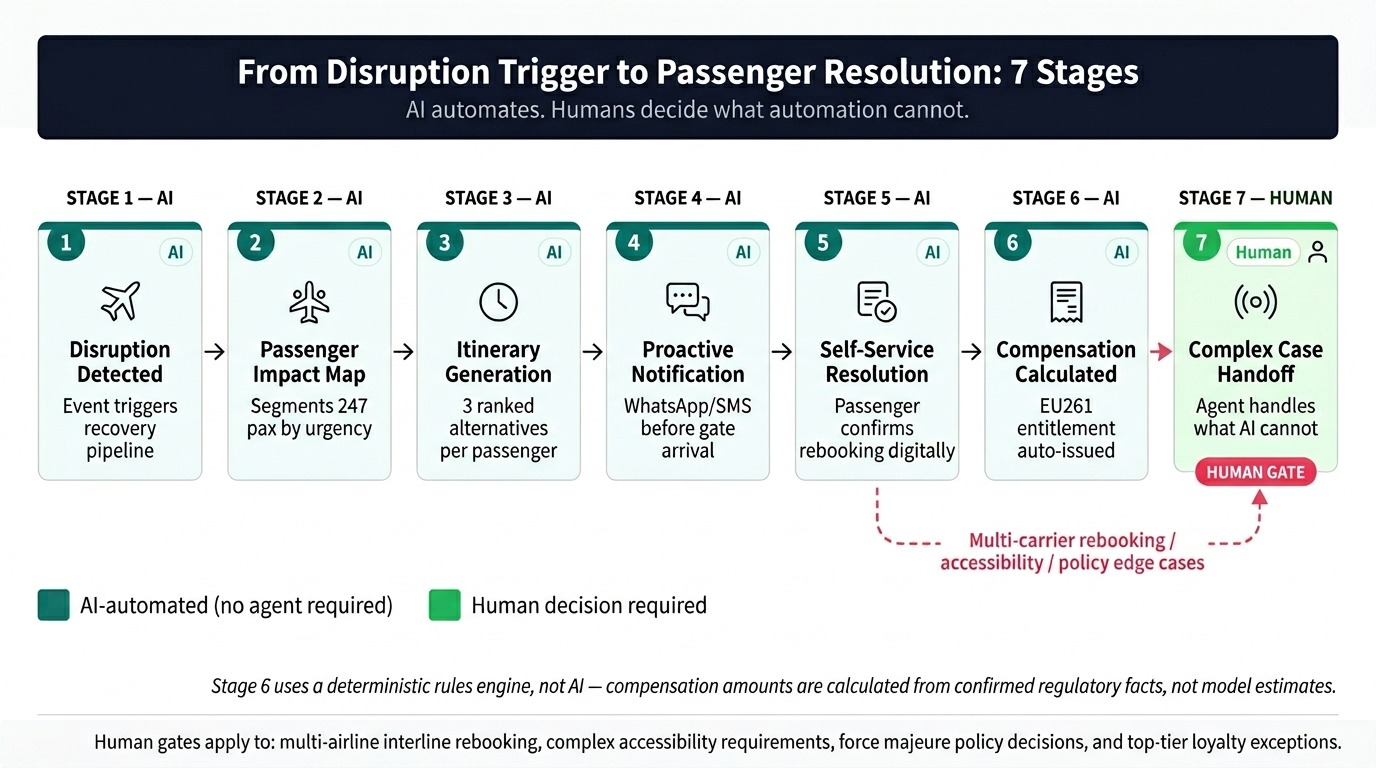
- Disruption Event Detection: First, the system monitors incoming flight status streams and weather feeds using event streamingA data architecture pattern where events – such as flight status changes – are published to a central message queue the moment they occur, allowing downstream systems to react in near-real time without polling a database infrastructure. When a threshold is crossed – a departure delayed beyond a defined window, a cancellation confirmed, or a predicted disruption probability exceeding the model’s threshold – the pipeline activates immediately. This is the trigger point that begins the recovery workflow.
- Passenger Impact Mapping: Next, the system queries the passenger manifest for all flights in the disruption scope. It identifies each passenger’s onward connections, loyalty tier, special service requirements, and communication preferences. The system then scores each passenger by impact severity – a traveller on the last connection of the day to a small regional airport rates higher urgency than a traveller with a same-day alternative on a high-frequency route. This segmentation determines notification priority and the complexity of recovery options generated.
- Alternative Itinerary Generation: Once the impact map is complete, the system queries available inventory – either through direct NDCNew Distribution Capability – an IATA-defined XML standard that allows airlines to distribute rich content and dynamic offers through modern APIs, replacing the older EDIFACT-based GDS pipeline API connections or through integration with the airline’s own inventory system. A large language model (LLM)A deep learning model trained on large volumes of text that can understand context, generate natural language, and reason across complex inputs – used here to produce personalised rebooking recommendations and conversational responses layer then ranks alternatives by passenger preference signals, minimising overnight stays and matching preferred departure windows, alliances, and cabin class where possible. The system generates three ranked options per passenger rather than a single assignment.
- Proactive Multi-Channel Notification: The system then pushes personalised alerts through the passenger’s registered communication channel – WhatsApp, SMS, email, or push notification via the airline’s app. Each message is generated by the LLM using the passenger’s name, confirmed disruption details, and their three ranked rebooking options with direct action links. Critically, this notification goes out before the passenger arrives at the gate – the defining characteristic of a passenger-first airline delay notification system. The message is not a generic delay alert; it is a personal recovery offer.
- Self-Service Resolution Interface: At this stage, the passenger accesses a lightweight web interface or conversational chat – no app download required. They review their options, select a preference, and confirm the rebooking. For straightforward cases on a single airline, the system writes the new booking back to the PSS and issues a new boarding confirmation within seconds. An AI chatbot powered by RAGRetrieval-Augmented Generation – an AI technique that combines an LLM with a retrieval system so the model’s responses are grounded in a specific knowledge base, such as the airline’s fare rules, rebooking policies, and compensation entitlements architecture handles follow-up questions – baggage status, lounge access, meal vouchers – without escalating to an agent.
- Automated Compensation Calculation: Simultaneously, a rules engine calculates each passenger’s regulatory entitlement based on the applicable jurisdiction, confirmed delay duration, flight distance, and disruption cause. Where the compensation obligation is confirmed, the system initiates the payment or voucher issuance automatically. This step removes the claim process entirely for straightforward cases, reducing both the administrative cost to the airline and the incentive for passengers to route through third-party aggregators.
- Escalation and Human Handoff: Finally, cases that fall outside the automated resolution paths – interline rebooking requiring commercial agreements with partner carriers, passengers with complex accessibility requirements, or situations where all alternative inventory is exhausted – are flagged with full context and routed to a human agent queue. The agent receives the passenger’s full disruption history, all options already considered, and the specific reason for escalation, so the conversation begins at resolution rather than at diagnosis.
Human-in-the-Loop: Where Human Judgment Still Matters
- Multi-carrier rebooking decisions: Placing a passenger on a competing or partner carrier’s flight requires commercial agreements and fare-rule logic that automated systems cannot resolve independently. A human agent must own these decisions.
- Complex accessibility and medical requirements: Passengers requiring specific on-ground assistance, medical clearance, or specialised seating need human confirmation before any rebooking is confirmed as viable.
- High-value loyalty exceptions: Top-tier frequent flyer escalations – where a passenger’s lifetime value warrants exceptional handling beyond standard rebooking rules – are flagged for senior agent review with all context pre-loaded.
- Policy edge cases: Disruptions involving unusual circumstances – force majeure declarations, security events, third-party strikes – may trigger non-standard compensation rules that require legal or compliance team review before the automated engine issues entitlements.
- Quality review and model oversight: The AI recommendations engine requires periodic review by operations and CX teams to ensure its ranking logic aligns with current inventory strategy, seasonal route changes, and evolving passenger preference data.
Output and Interaction: What Users See
Passengers receive a personalised disruption notification through their preferred channel, containing their three ranked alternatives with estimated journey time and confirmed availability. Selecting an option opens a lightweight confirmation flow – no login required if the booking reference authenticates the session. A conversational chat interface handles ancillary queries. On confirmation, a new boarding document arrives immediately.
Airline operations and CX teams interact with a real-time analytics dashboard showing active disruption events, resolution rates by channel, compensation issued, and escalation queue volume. This dashboard gives operations leadership live visibility into how the recovery is progressing – not just on the flight side, but on the passenger side – enabling dynamic response decisions during a developing IROPS event.
5. What Technologies Power an AI Airline Disruption Management Platform?
The technical architecture of an effective airline disruption management platform combines several distinct AI and data engineering components. Understanding what each one does – and why it matters specifically for IROPS recovery – clarifies where the real engineering complexity sits.
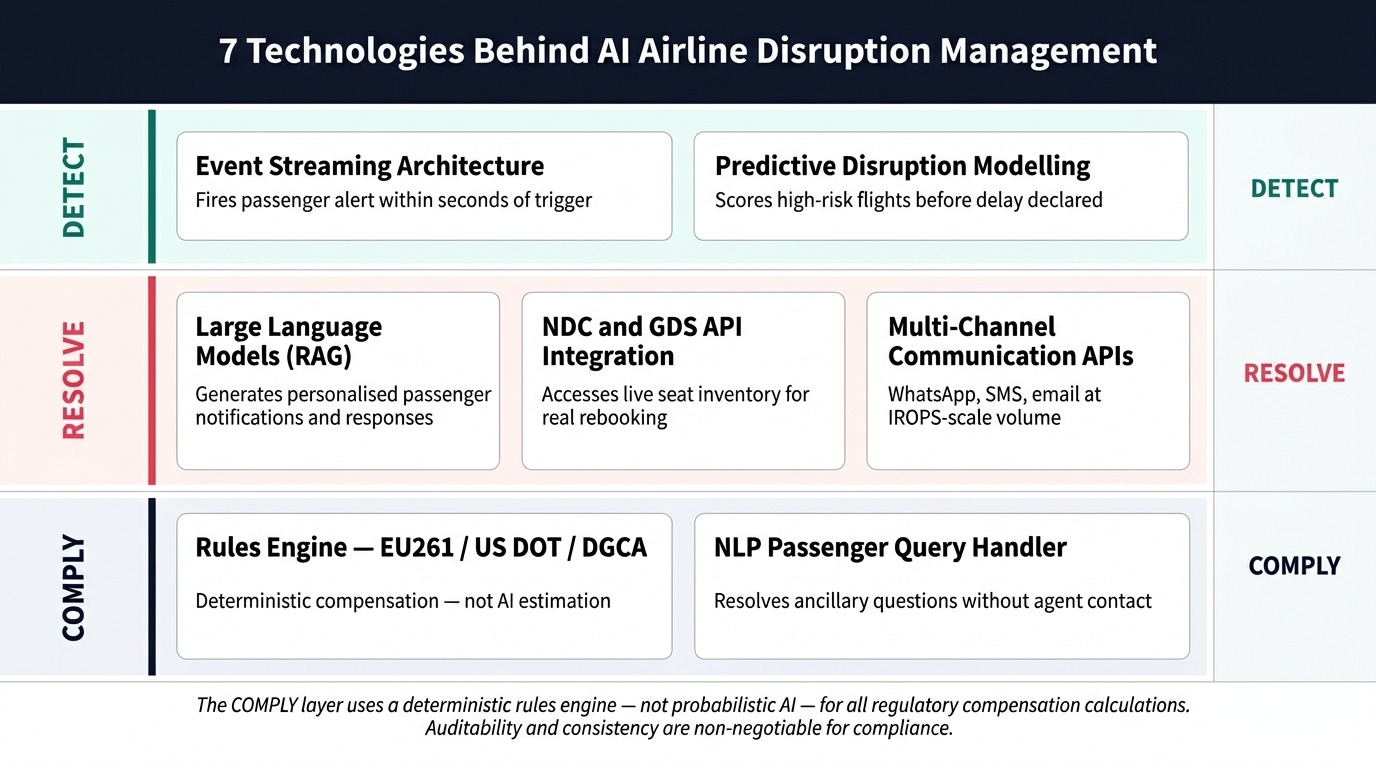
- Natural Language Processing (NLP)The AI discipline that enables computers to understand, interpret, and generate human language – used here to produce personalised passenger messages and interpret free-text queries in the disruption chat interface: Enables the system to generate contextually appropriate, personalised passenger notifications and handle unstructured follow-up queries through the chat interface. NLP quality directly determines whether a passenger feels addressed as an individual or processed as a booking reference.
- Large Language Models (LLMs): Power the conversational recovery interface and the itinerary ranking reasoning layer. LLMs applied to this domain require grounding through RAG architecture against the airline’s fare rules, partner agreements, and compensation policy documents – without grounding, they produce plausible but inaccurate responses about fare conditions and eligibility.
- Event Streaming Architecture: The real-time backbone of the pipeline – typically using a distributed message queue system to process flight status events as they occur. This architecture ensures the passenger notification fires within seconds of a disruption triggering, rather than minutes or hours. It also provides the resilience needed to continue operating if upstream systems experience partial outages.
- NDC and GDS API Integration: Connects the rebooking engine to live seat inventory. GDSGlobal Distribution System – the intermediary technology platforms that aggregate airline inventory and allow travel agents and booking systems to query and book seats across multiple carriers from a single interface access provides broad multi-airline inventory reach; direct NDC connectivity with the airline’s own system enables richer, faster rebooking without intermediary cost. The scope of rebooking automation depends directly on which inventory APIs the system can access.
- Rules Engine for Compensation Logic: A deterministic layer – not a probabilistic AI model – that applies regulatory compensation calculations based on confirmed facts: delay duration, flight distance, cause classification, and applicable jurisdiction. Rules engines are preferable to LLMs for compliance-critical calculations where auditability and consistency are non-negotiable.
- Predictive Disruption Modelling: Machine learning models trained on historical flight, weather, and maintenance data to assign delay probability scores to future departures. These scores enable pre-emptive recovery planning and early passenger communication on high-risk flights before a disruption is formally declared.
- Multi-Channel Communication APIs: Integration with WhatsApp Business API, SMS gateway providers, push notification services, and email infrastructure to reach passengers through their verified preferred channel. Communication reliability at peak IROPS volume requires dedicated API throughput separate from standard marketing communication pipelines.
6. What Results Does an AI Airline Disruption Management Solution Deliver?
The benefits are most visible in two places: agent contact volume during peak events, and compensation costs on high-exposure routes. Both move in the same direction when the passenger communication gap is closed.
- Reduction in agent-handled rebooking volume during IROPS events: Self-service resolution through the airline passenger rebooking automation layer handles standard reaccommodation requests without agent involvement, freeing contact centre capacity for genuinely complex cases. The more passengers who self-resolve before reaching the phone queue, the more manageable the peak load becomes – and that is where the direct cost saving sits.
- Earlier passenger notification – measured in hours, not minutes: Proactive communication triggered by the real-time flight cancellation notification system reaches affected passengers hours before gate departure in many cases, opening a genuine recovery window for self-managed rebooking.
- Lower compensation payouts through faster resolution: Prompt, airline-initiated compensation handling reduces the share of claims routed through third-party aggregators, which command a per-claim premium. Automation also ensures consistent application of entitlement rules, preventing both under-payment and over-payment errors.
- Improved reaccommodation acceptance rates: AI-ranked alternatives that match passenger preferences – rather than system-assigned options based purely on availability – produce higher acceptance rates and fewer secondary contacts requesting changes.
- Reduced social and reputational damage from disruptions: Proactive, personalised communication during a disruption significantly reduces the likelihood that passengers resort to social media to report their experience in real time – a pattern consistently visible across major disruption events where communication was absent.
- Real-time operational visibility for CX and revenue teams: The analytics dashboard gives operations leadership a live view of passenger recovery status during an active IROPS event, enabling faster resource deployment decisions and more accurate post-event cost modelling.
- Foundation for agentic disruption recovery: A well-implemented passenger communication and self-service layer provides the data and integration infrastructure needed to progressively automate a higher proportion of recovery scenarios, moving towards the agentic AI for airline operations recovery model where AI handles standard disruptions end-to-end without human initiation.
7. Is an AI Airline Disruption Management Solution Worth the Investment?
For airlines with frequent IROPS exposure, the cost avoidance case is real – but the ROI depends almost entirely on how much of the disruption contact volume currently reaches a human agent, and how significant the regulatory compensation exposure is on the airline’s route network.
Teams that have worked through the full integration cycle consistently report that the business case is most compelling when it accounts for all four cost drivers simultaneously: agent handling cost, compensation claim volume, loyalty erosion, and the administrative overhead of managing disputed claims through enforcement channels. Evaluating any one of these in isolation understates the total exposure.
Key Business Metrics to Measure Before and After Deployment
- Call centre contact rate per disrupted passenger: Measure how many passengers currently contact an agent per disruption event versus the self-service resolution rate after deployment. This is the clearest before/after metric – every passenger who resolves digitally is a handled contact that did not reach the phone queue.
- Third-party compensation claim volume: Track the share of EU261 or equivalent claims arriving through aggregator services versus direct passenger contact. Aggregators do not cost more per individual claim – EU261 amounts are fixed by law. The real exposure is that aggregators proactively identify and file claims that passengers would not have filed independently, expanding total claim volume, and they pursue disputed cases through enforcement bodies at additional administrative and legal cost. Automated proactive compensation issuance, delivered before passengers consider making a claim, directly reduces this volume.
- Average time from disruption trigger to first passenger notification: This metric captures the core communication gap. The baseline for most airlines using legacy notification systems is measured in hours. An AI flight disruption communication platform targeting sub-10-minute notification for the highest-impact passenger segments is a meaningful operational improvement with a direct loyalty effect.
- NPS and satisfaction scores at disruption touchpoints: Post-disruption NPS data – available from most airline customer surveys – provides a before/after signal on whether the communication experience has improved in passenger perception, beyond the operational metrics.
- Disruption cost per affected passenger: A composite metric combining rebooking cost, compensation issued, vouchers issued, and hotel accommodation arranged. This provides a total cost-per-event baseline against which the solution’s impact can be tracked over time.
The DGCA Enforcement Dimension for Indian Carriers
For airlines operating domestic Indian routes, the compliance cost driver is structurally different from the EU261 aggregator dynamic. India does not yet have a mature third-party claim aggregator market. The enforcement pressure comes directly from the regulator – DGCA can and does fine airlines for non-compliance with CAR Section 3, Series M, Part IV, the governing framework for denied boarding, cancellation, and delay facilities. DGCA also receives passenger escalations through the AirSewa portal, a government grievance platform that creates a formal record of unresolved complaints against specific airlines.
The DGCA framework mandates specific passenger entitlements under defined conditions. Meals and refreshments are required after a two-hour delay. An alternate flight within six hours or a full refund is required when a domestic flight is delayed beyond six hours. For cancellations with less than 24 hours’ notice, or where a connecting flight on the same ticket is missed due to cancellation, cash compensation of ₹5,000 to ₹10,000 applies – or the one-way basic fare plus fuel charge, whichever is lower. There is one architecture-relevant condition: compensation is void if the passenger did not provide verified contact details at booking. That single rule makes a proactive notification system – which depends on accurate contact data – directly relevant to whether the airline can legally avoid compensation liability in some scenarios.
In practice, organisations deploying this type of solution for Indian carriers typically find that the contact-data quality issue surfaces immediately during scoping. A large share of bookings made through travel agents or offline channels may carry incomplete mobile numbers or unverified email addresses – which means the notification engine cannot reach those passengers, and the airline simultaneously loses its regulatory exemption defence. Fixing contact data capture at the booking stage becomes a project prerequisite, not an afterthought.
Realistic Implementation and Payback Timeline
For a mid-size airline operating a defined single-carrier network, a phased implementation typically unfolds over three to six months. The first phase – notification engine and self-service rebooking UI for same-carrier inventory – is deliverable in 8-12 weeks with appropriate API access in place. The compensation rules engine layer adds 4-6 weeks. Full LLM-powered chat integration with RAG grounding on airline policy documents follows. The complete agentic recovery loop, where the system handles standard disruptions end-to-end, represents a later-phase maturity milestone rather than a launch deliverable.
The business case for acting now rather than waiting is straightforward: every major disruption event that occurs before the solution is in place generates the same preventable costs – agent volume spike, third-party compensation claims, and social media incidents. Each of those events has a documented cost that a deployed flight disruption recovery tool would have reduced. The compounding cost of delay is visible and measurable in post-event analysis.
8. What Does Implementing an Airline Disruption Management Solution Actually Require?
Implementing this type of solution involves more than deploying an AI model. The following factors determine realistic timeline and success rate.
Core Implementation Requirements
- PSS API access and data agreements: The passenger communication and rebooking layers both require read and write access to passenger reservation data. Negotiating and establishing secure API access to the airline’s core PSS is the single most time-sensitive integration dependency. Airlines with legacy PSS platforms running COBOL-era core systems may need an intermediary API layer before modern AI components can connect reliably.
- Live flight data feed partnership: Predictive disruption modelling and real-time notification triggering require a reliable flight status data feed from a reputable aviation data provider. This is a commercial data partnership – not a purely technical dependency – and must be established as part of project scoping.
- Inventory API access scope: The depth of rebooking automation the system can achieve depends directly on which inventory APIs are available. Same-carrier rebooking through a direct NDC connection is fully automatable. Multi-carrier reaccommodation involving interline agreements requires additional commercial and technical access that is often outside the scope of an initial deployment.
- Regulatory mapping and legal review – EU261: For routes touching EU airports, the compensation rules engine must correctly apply EU Regulation 261/2004 – including distance thresholds (€250 for flights under 1,500km, €400 up to 3,500km, €600 beyond), the three-hour arrival delay trigger, and the extraordinary circumstances exemption. Legal review of the automated issuance logic is required before live deployment. Particular care is needed for codeshare and interline itineraries where operating carrier liability differs from marketing carrier.
- Regulatory mapping and legal review – DGCA (Indian domestic routes): For airlines operating under DGCA’s CAR Section 3, Series M, Part IV, the rules engine must handle a different structure: cash compensation of ₹5,000-₹10,000 (or one-way basic fare plus fuel charge, whichever is lower) triggered by cancellations with less than 24 hours’ notice or missed connections on the same ticket. Critically, the regulation explicitly exempts airlines from compensation where the passenger did not provide verified contact details at booking. This makes accurate contact data capture a compliance dependency, not just an operational preference – the notification system and the compensation eligibility determination are directly linked.
- Communication channel verification: Multi-channel notification relies on verified passenger contact data – WhatsApp opt-in status, validated mobile numbers, and email deliverability. Airlines with incomplete or stale contact records will see lower proactive notification reach until data quality is improved at the booking stage.
- Load testing at IROPS scale: The passenger communication layer must be stress-tested at mass disruption volumes – not just typical daily throughput. Systems that perform well for 200 affected passengers may degrade under 2,000. Load testing against peak historical disruption event sizes is a mandatory pre-launch requirement.
- Model maintenance and policy document updates: The RAG layer grounding the LLM on airline fare rules and compensation policies requires ongoing maintenance as policies change seasonally. A defined process for updating the knowledge base must be part of the operational support model from day one.
Where This Solution Has Real Limits
What implementation experience reveals that theoretical explanations often miss is how frequently the bottleneck is not the AI layer at all – it is the data infrastructure the AI layer depends on. A well-built disruption notification engine sitting on top of incomplete passenger contact records or a PSS that cannot handle concurrent API queries at scale will underdeliver against expectations regardless of the AI’s quality.
- Multi-airline coordination remains unsolved: Placing a passenger on a partner carrier’s flight requires commercial interline agreements and revenue settlement mechanisms that no software layer can substitute. Disruptions involving connections across two or more separate airlines still require human resolution for the rebooking decision itself, even if the communication around that decision can be automated.
- App and API degradation during mass events: Passenger-facing interfaces and notification APIs face peak load at exactly the moment of mass disruption. Infrastructure must be independently scaled and tested to maintain performance when thousands of passengers attempt to access the self-service interface simultaneously – this is a known and recurring failure mode across the industry.
- Compensation automation scope is limited by data quality: Automated compensation issuance for complex itineraries – especially those involving codeshare flights, alliance partner segments, or mixed fare classes – requires accurate journey data that is not always present in a single system. Fully automated compensation on complex interline tickets remains a partial-automation scenario in most real deployments today.
- Predictive models require clean historical data: Disruption prediction accuracy depends on years of clean, labelled historical flight, weather, and maintenance data. Airlines with fragmented or inconsistently recorded operational history will see lower prediction accuracy in the first deployment phase while the model learns from live data.
9. Which Airlines and Operations Teams Benefit Most from This Solution?
The highest immediate return from an AI-powered airline disruption management solution occurs where disruption frequency is high, passenger communication infrastructure is weak, and regulatory compensation exposure is significant. This combination typically describes mid-size to large carriers operating hub-and-spoke networks with meaningful weather or congestion exposure.
Airline disruption management software for low cost carriers represents a particularly strong fit. As a proven IROPS management solution for budget operations, it helps carriers with lean contact centre teams, high passenger volumes, and strong incentive to deflect disruption contacts to digital self-service. Their passengers tend to be price-sensitive but digitally engaged – well-suited to WhatsApp and web-based self-service resolution rather than agent calls.
- Low-cost carriers with high disruption frequency and lean ops teams: The cost benefit of replacing agent-handled rebooking with digital self-service is largest where agent headcount is tightest and disruption volume is highest.
- Full-service carriers with significant EU or US route exposure: Regulatory compensation obligations under EU261 or US DOT rules create a direct financial incentive for automated issuance that prevents third-party aggregator claims.
- Regional carriers undergoing digital transformation: Airlines moving away from phone-first passenger service models benefit from a passenger-facing AI layer that gives their digital transformation initiative a visible, passenger-experienced outcome.
- Airlines operating hub airports with high weather or ATC disruption rates: The predictive disruption modelling layer creates the highest incremental value where weather events are frequent and complex – Caribbean, Northern European winter routes, US Northeast hub operations.
This solution is particularly valuable if: your post-disruption NPS scores are measurably lower than non-disruption scores; your contact centre experiences peak load beyond normal staffing capacity during IROPS events; your compensation claim rate through third-party aggregators is growing; or your airline has invested in operations-side recovery tools but not yet addressed the passenger communication layer. In each of these cases, a properly deployed airline disruption management solution functions as both an IROPS management solution and a customer experience protection tool simultaneously.
10. Frequently Asked Questions About Airline Disruption Management
How can airlines automate passenger rebooking during flight disruptions?
Airline passenger rebooking automation works through an event-driven pipeline that detects a disruption trigger – a cancellation, a delay beyond a threshold, or a predicted high-risk event – and immediately queries available inventory to generate ranked alternative itineraries for each affected passenger. The system pushes those options to the passenger via WhatsApp, SMS, or app notification, and the passenger confirms their selection through a lightweight self-service interface. The confirmed booking writes back to the airline’s inventory system automatically. The key dependencies are live inventory API access, accurate passenger contact data, and a self-service interface that works reliably at peak load. Rebooking on the same carrier can be fully automated; rebooking onto a partner or competing carrier still requires human commercial decisions in most deployments today.
How does an AI solution for airline irregular operations passenger communication actually reduce call centre volume?
The call centre volume spike during IROPS events is driven almost entirely by passengers who have not received usable information and cannot self-resolve. An AI solution for airline irregular operations passenger communication addresses this at the root – by notifying passengers proactively, before they attempt to call, and giving them a direct resolution path through a self-service channel. When a passenger receives a personalised WhatsApp message with three rebooking options and a one-tap confirmation, they have no reason to call. Airlines that have deployed proactive notification and self-service resolution layers report that digital self-service handles a large share of standard disruption contacts, with agent involvement limited to genuinely complex cases. The reduction in inbound contact volume is most significant during large-scale events when call centre capacity is most constrained.
Can automated software handle EU261 and DGCA passenger compensation without human agents?
Yes – for straightforward cases under both frameworks, a rules engine can handle the full calculation and issuance without agent involvement. Under EU261, the engine calculates entitlement based on confirmed delay duration at the final destination, flight distance, and whether the disruption cause qualifies as extraordinary circumstances – and issues €250, €400, or €600 accordingly. Under India’s DGCA framework (CAR Section 3, Series M, Part IV), the engine calculates whether the cancellation notice period or missed connection triggers the ₹5,000-₹10,000 cash compensation obligation, cross-referencing the one-way basic fare plus fuel charge to apply whichever is lower. The two frameworks differ in one architecturally important way: DGCA explicitly voids the compensation obligation if the passenger did not provide verified contact details at booking. This means the notification system and the compensation eligibility check share the same contact-data dependency – a passenger who cannot be reached proactively may also be ineligible for compensation, which changes how the system must handle incomplete contact records. Human review remains necessary for extraordinary circumstances disputes, complex codeshare itineraries, and cases where the data is incomplete.
What does self-service flight rebooking during disruption actually look like from the passenger’s perspective?
From the passenger’s perspective, self-service flight rebooking during disruption should require no more than three interactions: receive a notification, review the alternatives, and confirm a choice. The notification arrives via their preferred channel – WhatsApp or SMS for most passengers – and contains their name, the disruption details, and three ranked alternative itineraries with departure times and journey durations clearly stated. Selecting an option opens a mobile-friendly confirmation page, authenticated by booking reference rather than a password login. After confirming, a new boarding document arrives immediately. A chat interface handles ancillary questions – baggage status, seat assignment, meal vouchers – without requiring an agent. The entire flow is designed to complete in under two minutes on a mobile device. That is the user experience benchmark a well-built flight disruption recovery tool should meet.
How mature is agentic AI for airline operations recovery, and is it deployable today?
Agentic AI for airline operations recovery is genuinely emerging but not yet fully mature for end-to-end autonomous deployment across complex disruption scenarios. The current state in 2026 is a hybrid model: AI agents handle standard single-carrier disruptions autonomously – notification, self-service rebooking, and automated compensation – while human agents retain ownership of complex cases involving interline rebooking, accessibility requirements, and regulatory edge cases. The technology to close the standard disruption loop autonomously exists today. What limits broader agentic deployment is not the AI capability itself but the underlying data infrastructure: PSS API reliability, passenger contact data quality, and load resilience at mass disruption scale. Airlines pursuing agentic disruption recovery should plan for a phased maturity path – building the passenger communication and self-service layer first, then progressively expanding the automation scope as data quality and integration depth improve.
Build This Solution With Softlabs Group
Softlabs Group builds custom AI-powered passenger recovery systems tailored to the airline’s specific PSS environment, route network, and regulatory exposure. Our work in this domain covers the full passenger-facing recovery stack: real-time disruption detection, personalised multi-channel notification, self-service rebooking interfaces, LLM-powered chat for IROPS queries, and automated compensation rules engines for EU261, US DOT, and DGCA compliance. We do not sell off-the-shelf products – every engagement is a custom build connected to the airline’s own data, designed for the airline’s specific network and operational context. For airlines pursuing the broader enterprise AI development path, the passenger disruption layer integrates naturally with wider operational intelligence and customer experience programmes.
If your airline has invested in operations-side recovery technology but still sees passenger experience failures during disruptions, that is precisely the problem we are built to address. The right starting point is a scoped conversation about your current PSS environment, your highest-frequency disruption scenarios, and what passenger communication infrastructure you have in place today. From there, we can scope a realistic first build that delivers demonstrable impact within a single disruption season.