 India
India  Mongolia
  Sweden
  Australia
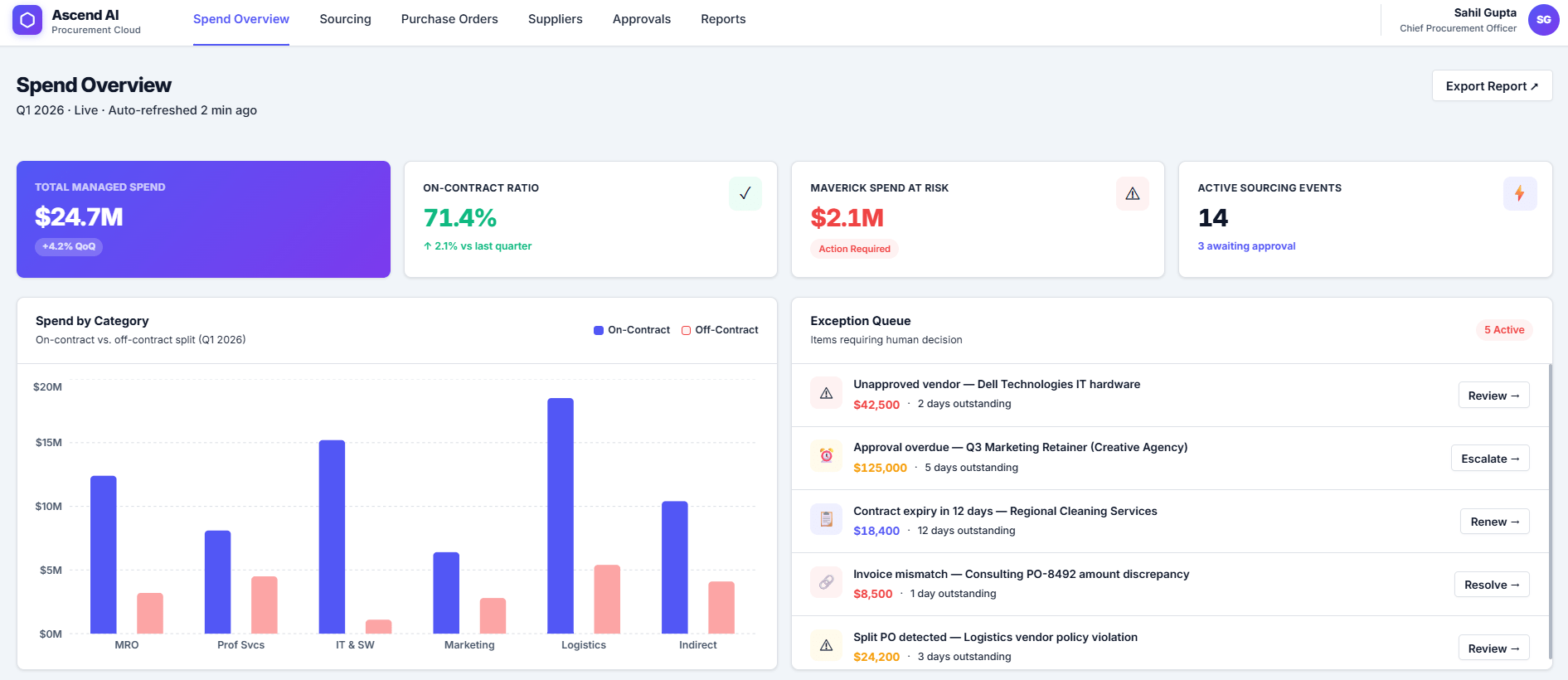
Executive Summary: Why AI Is Redefining How Enterprises Buy
Your procurement team runs on a process built for a simpler era. Requisitions sit in queues. Purchase approvals cycle through three inboxes. Buyers spend hours gathering quotes for routine items that cost more to process than they cost to purchase. An AI autonomous procurement solution changes this equation – automating the decision-intensive work across the full source-to-pay cycle so procurement teams move from operational firefighting to strategic supplier management.
The core shift is from human-executed to AI-executed procurement decisions across defined spend categories. Autonomous sourcing agents, intelligent spend classification, predictive demand signals, and data-driven supplier matching work together to reduce cycle times, close visibility gaps, and bring unmanaged spending back under governance. The result is a procurement function that handles significantly higher transaction volumes with the same headcount – and makes consistently better buying decisions in the process.
1. Why Does Procurement Spend Keep Leaking Without an AI Autonomous Procurement Solution?
Enterprise procurement fails at scale not because buyers lack capability – but because the process itself creates friction that bypasses controls. The more complex the organisation, the more spend flows outside approved channels.
Context: The Modern Enterprise Procurement Environment
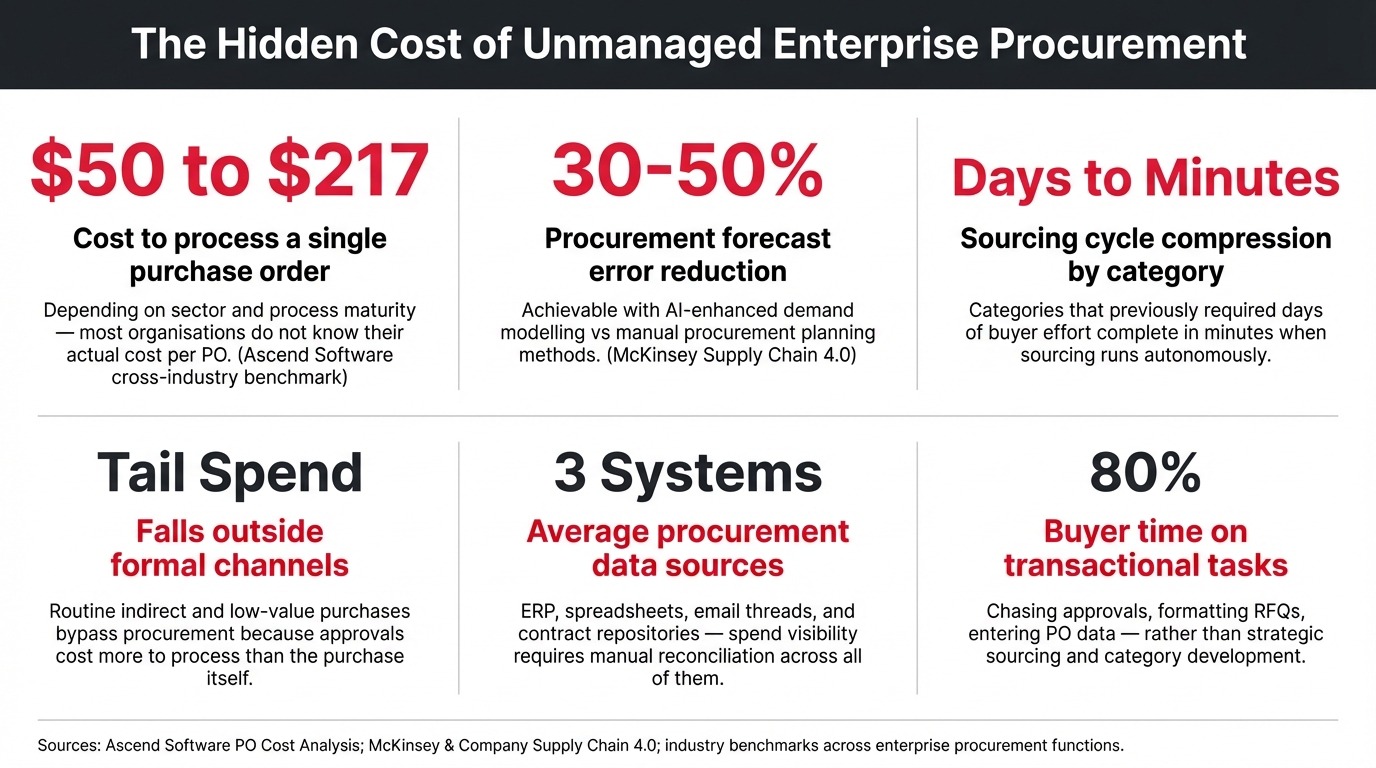
Large organisations typically manage thousands of active suppliers, multiple procurement systems, and buying activity across dozens of cost centres and geographies. Procurement teams operate with fragmented data spread across ERP systems, spreadsheets, email threads, and legacy contract repositories.
Category managers focus on strategic spend, while routine indirect and tail spend – the long tail of smaller, frequent purchases – goes largely unmanaged. This operational fragmentation creates the exact conditions where spending leaks and compliance breaks down consistently.
Key Pain Points This AI Solution Addresses
- Tail spend going unmanaged: Low-value, high-frequency purchases fall outside formal procurement channels because the approval process costs more to execute than the purchase itself is worth.
- Procurement team buried in manual work: Buyers spend the majority of their hours on transactional tasks – chasing approvals, formatting RFQs, entering PO data – rather than strategic sourcing and category development.
- Maverick spending bypassing the approval process: Employees purchase from unapproved suppliers to avoid slow procurement workflows, eroding negotiated savings and creating compliance exposure across the business.
- No visibility into supplier performance: Spend data lives in disconnected systems, making it practically impossible to track supplier delivery rates, quality trends, or contract compliance in real time.
- Long procurement cycle times: The average PO cycle spans from hours to multiple days depending on the organisation – creating operational delays that departments learn to work around rather than wait through.
- Supplier onboarding taking too long: Manual onboarding processes – collecting documentation, running compliance checks, establishing payment terms – delay new supplier activation by weeks and stall category expansion.
- Compliance failures in the purchasing process: Without automated policy enforcement at the point of purchase, approvers miss requirements and audit trails remain incomplete – creating regulatory and financial exposure.
Why Traditional Approaches Fall Short
Traditional procurement automation – e-procurement portals, approval workflow tools, and ERP purchasing modules – was built to enforce process, not to make decisions. These systems digitise the manual steps without eliminating them. A buyer still selects suppliers manually, compiles quotes, and judges bids based on experience and relationships rather than real-time performance data.
In practice, organisations deploying this type of system typically encounter a critical structural gap: legacy tools handle well-catalogued direct spend reasonably well, but they collapse under the weight of indirect, services, and tail spend categories where requirements vary and supplier options are wide. Procurement teams end up maintaining two parallel tracks – a formal ERP-based process for strategic spend, and an informal, largely uncontrolled process for everything else.
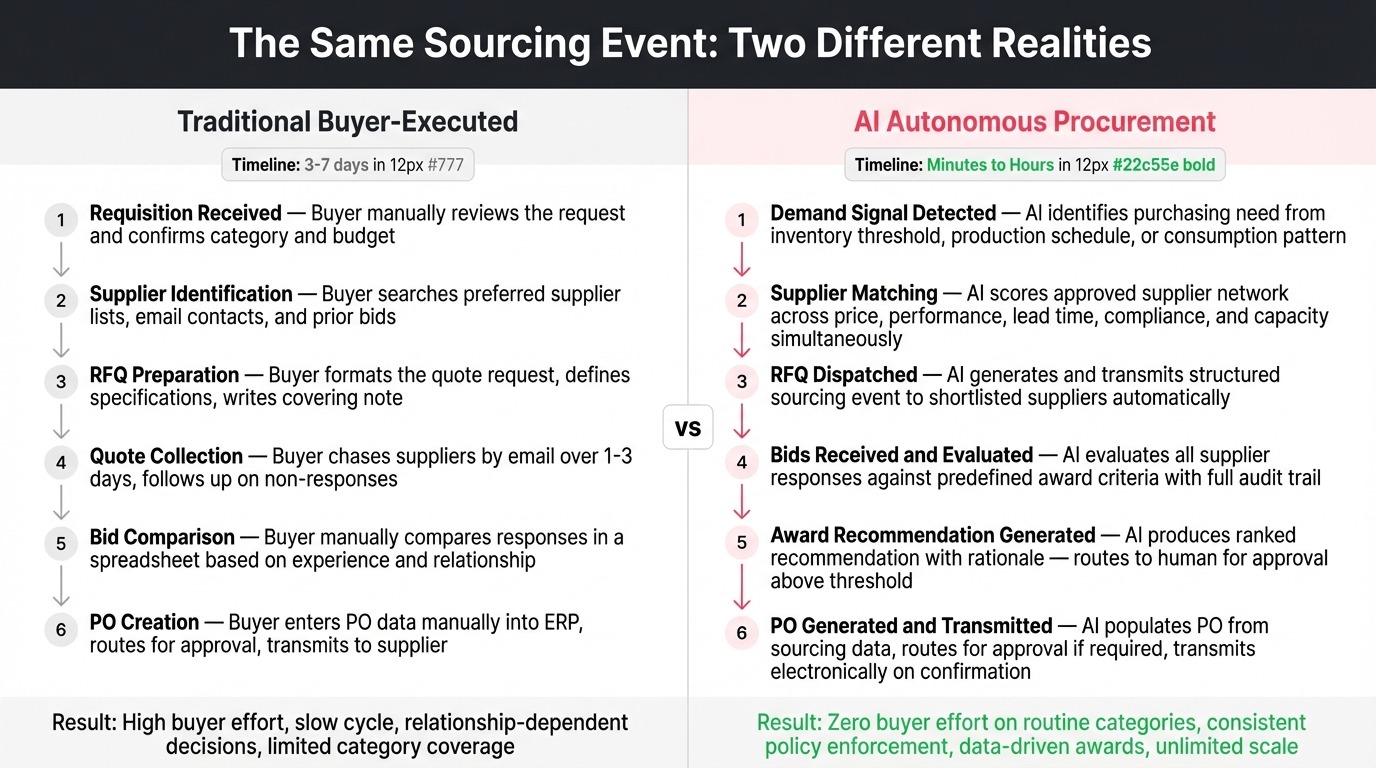
The AI-versus-manual contrast here is concrete and measurable. A manual procurement process requires a buyer to identify potential suppliers, request quotes, compare responses, and make an award recommendation – a sequence that consumes hours to days per sourcing event. An autonomous procurement AI tool completes the equivalent cycle in minutes for categories where decision rules are well-defined, without the buyer touching it. That gap in throughput is not marginal. It is structural.
2. What Is an AI Autonomous Procurement Solution and What Does It Actually Do?
Most procurement teams are not slow because their people are slow. They are slow because the process forces every transaction through the same human touchpoints regardless of value, risk, or complexity. A $180 MRO purchase and a $180,000 services contract both wait in the same approval queue. Both require a buyer to source manually. Both consume the same calendar time. An AI autonomous procurement solution breaks that structural constraint – applying human attention only where it changes the outcome, and routing everything else through automated execution.
The operational shift is from a buyer-executed model to a policy-executed model. Procurement leaders define which categories run autonomously, set the approval thresholds, configure the supplier eligibility criteria, and establish the award logic. From that point, the system handles execution: classifying spend, forecasting demand before requisitions are raised, matching requirements to qualified suppliers, running competitive sourcing events, evaluating bids, generating purchase orders, and reconciling invoices – without a buyer touching the transaction. The team stops processing and starts governing. That distinction sounds simple. The operational difference at scale is substantial.
Vision and Objectives
- Eliminate manual transaction processing across routine spend categories, redirecting buyer capacity from operational tasks to strategic supplier development and category management.
- Close the maverick spending gap by making the automated, policy-compliant buying path faster and more convenient than informal workarounds.
- Achieve real-time spend visibility across all categories, suppliers, and business units through continuous automated classification and data aggregation.
- Reduce procurement cycle times from days to minutes for defined categories, removing the delay that currently drives departments to bypass procurement entirely.
- Improve supplier selection quality by replacing availability-biased choices with data-driven matching against performance, cost, compliance, and capacity criteria simultaneously.
- Scale procurement capacity without proportional headcount growth – enabling the same team to govern significantly higher spend volumes as the organisation grows.
Product Walkthrough
Watch: AI Autonomous Procurement Solution in Action
3. What Does an AI Autonomous Procurement Solution Look Like in Practice?
Industrial Manufacturing – Controlling Tail Spend at the Point of Need
When your maintenance team waits three days for a PO approval on a $200 replacement part, that is your tail spend problem in its most visible form. In manufacturing, thousands of routine purchases – MRO supplies, safety consumables, facilities services – flow through informal channels because formal procurement moves too slowly for operational urgency.
Without an autonomous procurement tool for manufacturing companies, buyers spend significant hours on these low-value requests while plant managers bypass procurement to keep production moving. The AI autonomous procurement solution applies policy rules and approved supplier lists automatically at the point of need – raising, routing, and closing routine POs without buyer intervention. Tail spend drops to near-zero unmanaged levels. Buyer hours redirect to strategic contracts worth exponentially more.
Global Enterprise – Recapturing Negotiated Savings Lost to Maverick Spending
Your procurement team negotiated preferred supplier contracts at meaningful discounts – yet department heads keep buying from whoever answers their email first. This is the maverick spending reality across distributed global enterprises: policy exists on paper, but enforcement breaks down the moment purchasing activity is decentralised across regions and business units.
AI-powered guided buying changes the enforcement model entirely. The intelligent procurement software presents only policy-approved supplier options at the point of need – delivering a consumer-grade shopping experience within procurement guardrails. Purchasing outside approved channels becomes the path of more resistance, not less. Maverick spend falls measurably as compliance shifts from an audit function to a purchase-time control embedded in the buying experience.
Financial and Professional Services – Compressing Complex Services Sourcing Cycles
Every major consulting, legal, or agency engagement your organisation runs involves weeks of market scanning, brief writing, RFP preparation, and vendor shortlisting – before evaluation even begins. For services procurement leaders, the sourcing process itself routinely consumes a significant portion of the project timeline available.
An AI sourcing and purchasing tool reframes this entirely. The system translates a project brief into a structured sourcing event, matches it against qualified providers in the approved network, and solicits competitive responses without manual coordination. What previously required a category manager to spend weeks building an RFP and managing responses now completes in hours. The team focuses on evaluating outcomes – not logistics. Sourcing cycles compress dramatically, and supplier pool quality improves as the AI surfaces objectively qualified providers beyond familiar relationships.
Ready to explore what an AI autonomous procurement solution looks like for your organisation?
Talk to Our AI Team4. How Does an AI Autonomous Procurement Solution Process Data and Execute Decisions?
The architecture of an AI autonomous procurement solution operates as a continuous closed loop – ingesting spend data, classifying it, generating sourcing actions, executing transactions, and feeding outcomes back into supplier and category intelligence. Each stage adds information that sharpens the next decision.
Data Acquisition: What the System Consumes
The system draws from multiple structured and unstructured data sources across the organisation. Core inputs include purchase order history, invoice records, supplier master data, contract repositories, and product or service catalogues from existing systems.
The system also ingests demand signals – production schedules, inventory levels, project plans, and consumption trends – to anticipate purchasing needs before requisitions arrive. External data feeds supplement internal sources with supplier financial health indicators, market pricing benchmarks, and third-party risk intelligence. Integration with the organisation’s ERP, finance, and project management platforms ensures data flows automatically rather than requiring manual exports from each system.
The AI Processing Pipeline
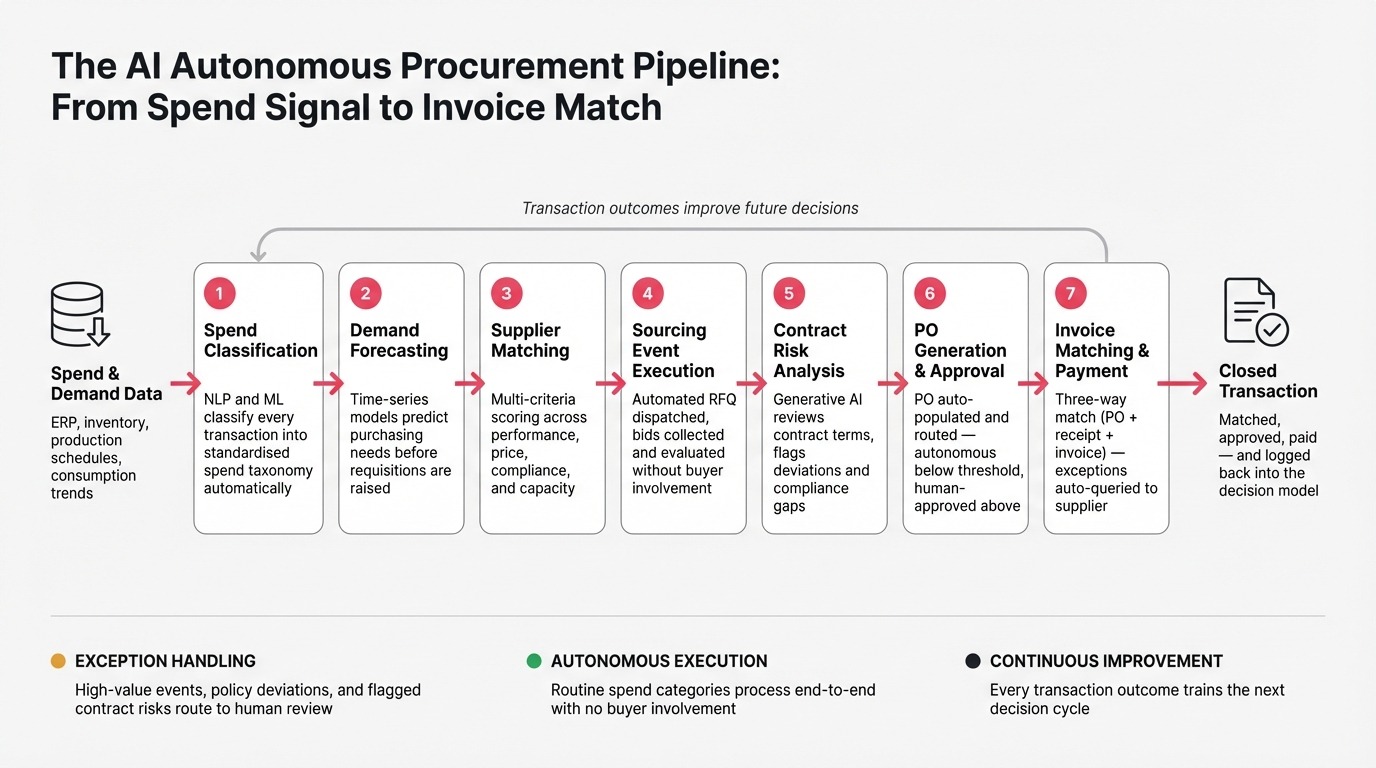
- Spend Classification and Taxonomy Mapping: First, the system ingests raw transaction data from ERP and financial systems. It applies NLPNatural Language Processing – an AI discipline enabling computers to read, interpret, and categorise text written in human language and machine learning classifiersAlgorithms trained on historical data to automatically assign spend categories to new transactions based on learned patterns to assign each item to a standardised spend taxonomy such as UNSPSC. This creates the foundational visibility layer – every dollar of spend now carries a category, supplier, and business unit tag. The classification model refines its accuracy continuously as it processes more transactions.
- Demand Signal Processing and Forecasting: Next, the system analyses historical purchasing patterns alongside live operational data – production schedules, project pipelines, inventory thresholds. Time-series forecasting modelsAI models that predict future values by analysing patterns in historical sequential data, such as monthly purchase volumes by category identify cyclical demand, seasonal variation, and consumption trends by category. The output is a rolling procurement forecast the sourcing engine uses to initiate purchasing actions proactively – before requisitions are formally raised by users.
- Autonomous Supplier Matching: Once the system identifies a demand signal, it activates the supplier matching layer. This component evaluates the approved supplier network against multi-dimensional criteria: historical delivery performance, quality record, pricing competitiveness, geographic proximity, diversity certification status, and current confirmed capacity. The system ranks eligible suppliers for each requirement and selects the optimal shortlist for the sourcing event, applying category-specific weighting rules that the procurement team configures.
- Sourcing Event Execution: The system then translates the procurement requirement into a structured sourcing event – an automated RFQRequest for Quotation – a formal document sent to suppliers requesting pricing and availability details for a defined set of goods or services or mini-tender – dispatched to the matched supplier shortlist without buyer involvement. Suppliers submit bids through a structured digital interface, and the AI evaluates each response against predefined award criteria: total landed cost, delivery lead time, compliance certificates, and past performance scores. The system generates a ranked award recommendation with a complete audit trail supporting every decision point.
- Contract Analysis and Risk Flagging: Before award confirmation, the system applies generative AIA class of AI models capable of reading, summarising, and generating text – enabling document analysis, clause extraction, and contract risk identification at scale to review supplier contract terms against the organisation’s compliance requirements. It flags deviations, missing clauses, unusual payment terms, and liability gaps for human review before any award proceeds. This applies to both framework agreements and transaction-level terms, ensuring no commitment carries unreviewed contractual risk.
- Purchase Order Generation and Approval Routing: Once an award is confirmed, the system generates a structured purchase order automatically – populating all required fields from the sourcing event data and routing it through the organisation’s defined approval hierarchy. Low-value orders within pre-approved parameters process without manual sign-off. Higher-value or policy-exception orders route to the designated approver with full context, supporting data, and a one-click approval interface. The PO transmits electronically to the supplier upon approval.
- Invoice Matching and Payment Triggering: Finally, the system applies three-way matchingAn automated reconciliation process that compares the purchase order, goods receipt confirmation, and supplier invoice to verify accuracy before authorising payment to each incoming invoice – comparing PO, goods receipt, and invoice data to identify discrepancies before payment authorisation. Matched invoices route to accounts payable within agreed terms automatically. Exceptions trigger an automated supplier query identifying the specific discrepancy, reducing manual resolution effort significantly.
Human-in-the-Loop: Where Human Judgment Still Matters
A common pattern across real implementations of this solution is that human oversight delivers the most value at strategy-setting and exception-handling stages – not at the transaction level, where AI handles routine execution reliably and consistently.
- Policy and threshold configuration: Procurement leaders define which categories run autonomously, what approval thresholds apply, and which supplier criteria carry the most weight. This is a recurring governance activity, not a one-time setup.
- Strategic supplier relationship management: Partnership development, supplier development programmes, and strategic contract negotiations remain human-led. The AI informs these conversations with performance data; it does not replace the relationship.
- High-value and novel sourcing events: Sourcing events above defined value thresholds, or for categories without sufficient historical data, route to human category managers for review and approval before the system proceeds.
- Contract deviation review: Any flagged deviation or compliance risk identified during contract analysis requires human legal or procurement review before award confirmation – the AI surfaces the issue, the human resolves it.
- Ongoing model governance: Procurement leaders review AI decision quality periodically, correcting classification errors, adjusting supplier scoring weights, and validating forecast accuracy across categories over time.
Output and Interaction: How Results Reach the User
Requestors interact with the system through a guided buying interface – a consumer-grade catalogue experience that surfaces policy-approved options and handles sourcing automatically in the background. Category managers access a procurement intelligence dashboard showing real-time spend by category, supplier, and business unit alongside an exception queue of items requiring review.
Alerts reach the relevant stakeholder when the system identifies risk: a supplier missing a delivery milestone, an invoice discrepancy above threshold, or a contract approaching expiry. Approvers receive notification-linked requests with full context and a single-action approval interface. Finance teams access automated spend reports and accrual feeds. All transaction outcomes return to the central data layer, continuously enriching the AI’s decision models for the next cycle.
5. What Technologies Power an AI Autonomous Procurement Solution?
- Natural Language Processing (NLP)AI technology enabling systems to read, classify, and extract meaning from unstructured text such as invoices, contracts, and free-text purchase descriptions – enables automatic spend classification across millions of transactions, contract clause extraction, and the natural language interaction layer in guided buying interfaces. Without NLP, unstructured procurement data remains unclassifiable and invisible to spend analytics.
- Machine Learning Classification ModelsAlgorithms that learn to categorise data by identifying patterns in historical labelled examples, improving in accuracy as more data is processed over time – power spend taxonomy assignment, supplier performance scoring, anomaly detection in invoice data, and demand pattern recognition. These models improve continuously as the organisation accumulates procurement history through normal operations.
- Large Language Models (LLMs)Advanced AI models trained on large text datasets capable of reading and generating coherent human-like text – enabling contract analysis, RFQ content generation, and conversational procurement interfaces – enable contract risk analysis at scale, automated sourcing document generation, and the conversational guided buying experience. LLMs convert unstructured requirement descriptions into structured sourcing events without manual formatting by a buyer.
- Sourcing Optimisation AlgorithmsMathematical optimisation models that evaluate thousands of supplier and quantity combinations simultaneously to find the award allocation that best satisfies defined cost, risk, and service objectives – solve multi-supplier award allocation problems across complex categories, identifying optimal split awards that balance cost savings, supply risk, and supplier diversification goals simultaneously rather than sequentially.
- Retrieval-Augmented Generation (RAG)An AI architecture combining document retrieval with language model generation – grounding AI outputs in the organisation’s actual documents rather than generic training data alone – enables contract analysis and policy compliance checking by grounding LLM outputs in the organisation’s actual contract database and procurement policy library, producing accurate, document-specific responses rather than generic ones.
- API Integration and iPaaS MiddlewareApplication Programming Interfaces and Integration Platform-as-a-Service tools that connect disparate enterprise systems, enabling automated bidirectional data exchange without manual exports – connects the AI procurement layer to existing ERP, accounts payable, and supplier management systems. Reliable bidirectional data flow is the infrastructure requirement that makes autonomous execution possible across the full transaction lifecycle.
- Predictive Analytics and Time-Series ModellingStatistical and machine learning techniques that analyse historical patterns over time to forecast future values such as demand volumes, price movements, and supplier lead times – drives proactive purchasing by forecasting demand before requisitions are raised, reducing emergency buying, and enabling better volume-based commitments in supplier negotiations.
6. What Business Results Does an AI Autonomous Procurement Solution Deliver?
The results below are framed against real procurement performance benchmarks – not aspirational ranges. If your organisation sits in the bottom half of these benchmarks today, the gap to the top is where the financial case for an AI autonomous procurement solution lives.
- PO cost drops toward the top-performer floor: Cross-industry benchmark data tracked by Ascend Software’s detailed analysis of purchase order processing costs places average PO processing costs between $50 and $217 depending on sector and process maturity – with the widest variation sitting in indirect and tail spend categories where manual handling is heaviest. Autonomous processing of routine POs removes the labour cost that drives organisations toward the top of that range. The buyer time freed does not disappear – it redirects to sourcing events where human judgment changes the commercial outcome.
- Cycle times move from 48 hours toward 5: Top-performing procurement teams complete PO cycles in approximately 5 hours. Bottom-quartile teams take close to 48 hours for the same transaction. That 43-hour gap is almost entirely human-touch time – queued approvals, manual supplier outreach, email-based quote collection, and data re-entry between systems. Autonomous procurement eliminates most of that gap for defined categories. Departments stop bypassing procurement not because policy changed, but because the automated path is now faster than the workaround.
- Maverick spend recovery produces the largest year-one return: Industry research consistently places maverick spending – purchases made outside approved channels – at up to 80% of all invoices in organisations without automated buying controls. For a $500M annual spend organisation, that represents $25M to $80M in negotiated savings that never materialise because buying happens outside contract. The autonomous procurement software makes the compliant path the fast path. Maverick spend does not require policing – it requires removing the friction that makes non-compliant buying feel rational to the person doing it.
- Sourcing event throughput increases dramatically per buyer: A procurement buyer running manual sourcing events can realistically manage a fixed number of competitive events per month – constrained by the time required to prepare RFQs, chase supplier responses, and evaluate bids. Autonomous sourcing removes that ceiling. Buyers in automated environments manage multiples of their previous event volumes with the same working hours – because the AI handles event preparation, supplier communication, and bid evaluation, while the buyer reviews the recommendation and confirms the award. The same team covers significantly more spend categories actively, rather than leaving tail spend uncontested.
- Demand forecasting errors reduce by 30 to 50 percent: McKinsey’s Supply Chain 4.0 analysis indicates AI-enhanced forecasting reduces errors by 30 to 50 percent in studied supply chain implementations. In procurement terms, that improvement translates directly into better volume commitment conversations with suppliers – and volume commitments are one of the few levers that move pricing beyond what competitive tendering alone achieves. Organisations currently buying reactively on spot pricing in high-frequency categories leave consistent savings on the table that better demand visibility would recover.
- Supplier selection shifts from familiar to optimal: Relationship-driven supplier selection is not inherently wrong – but it is inherently limited. Buyers default to known suppliers because the cost of evaluating new ones under time pressure exceeds the perceived benefit. Autonomous supplier matching removes that cost. The system evaluates approved suppliers against current delivery performance, pricing, capacity, and compliance status on every event – not just the ones where the buyer has time to run a proper process. Categories that have operated with a de facto single supplier for years begin to see genuine competition, and pricing responds accordingly.
- Spend visibility shifts from monthly reports to live intelligence: Most procurement leaders currently understand their spend position through reports generated weeks after the transactions occurred. By the time the data surfaces, the pattern that needed intervention has already repeated several times. Automated spend classification processes every transaction in near real-time – giving finance and procurement a live view of category spend, supplier concentration, and budget trajectory. The decisions that view enables – rebalancing supplier mix, flagging a category running over commitment, identifying a new maverick spend pattern early – are decisions the monthly report cycle makes impossible.
- Audit defensibility improves without additional effort: Every autonomous sourcing decision generates a structured record: which suppliers were invited, what they bid, how the evaluation criteria applied, and what the award rationale was. This audit trail exists by default – not because someone remembered to document it. For organisations in regulated industries or subject to supplier diversity reporting requirements, this removes a significant compliance overhead and produces more complete records than manual processes typically generate under time pressure.
7. Is an AI Autonomous Procurement Solution Worth the Investment?
Yes – but the return is not uniform, and the variance between good and poor implementations is wide enough that “it depends on your situation” is not a hedge. It is the accurate answer. What follows is what the financial case actually looks like at different stages, and what separates the deployments that pay back quickly from those that stall.
What implementation experience reveals that theoretical evaluations often miss is the sequencing of value. The financial return does not arrive as one number at the end of year one. It arrives in three distinct waves – and organisations that understand this structure make better deployment decisions than those chasing a single headline ROI figure.
Wave 1 – Months 1 to 3: Visibility Returns First
The first thing an AI spend management solution delivers is not savings – it is a complete picture of where money is actually going. Most organisations deploying for the first time discover that their actual managed spend ratio is materially lower than their internal estimates suggested. Spend that was categorised as “managed” turns out to have a significant off-contract component that the manual classification process never surfaced. This visibility is not itself a financial return. But it defines the size of the opportunity the system will work against in waves two and three. Organisations that skip this measurement step typically understate their ROI at the 12-month mark because they had no accurate baseline to compare against.
Wave 2 – Months 3 to 9: Maverick Spend Recovery Delivers the Largest Single Return
For a $500M-spend organisation where a meaningful share of invoices flows outside approved channels – a common profile in organisations without automated buying controls – recovering even a fraction of that to contracted pricing produces returns that dwarf the processing efficiency gains. The financial mechanism is straightforward: off-contract purchases typically carry a price premium over negotiated rates, and they forfeit volume rebates and early payment discounts built into preferred supplier agreements. Closing that gap on even 20 to 30 percent of previously maverick categories generates a return that is visible in category spend data within a single quarter.
This is the wave where organisations with accurate pre-deployment baseline data make the strongest internal case. If you cannot measure your current managed spend ratio, you cannot demonstrate wave two returns to your CFO with confidence.
Wave 3 – Months 6 to 18: Throughput and Supplier Quality Improvements Compound
The longer-tail financial return comes from two compounding sources: increased sourcing event volume and improved supplier competition quality. Buyers running autonomous sourcing across previously uncontested tail spend categories introduce competitive tension where none previously existed. Suppliers who have held informal preferred status without competing for it respond to structured events with sharper pricing. Over 12 to 18 months, this improved competition quality across a growing number of active categories produces savings that accrue quietly but consistently – and unlike one-time negotiation wins, they reset with each sourcing cycle rather than eroding as the contract ages.
What Separates Fast Payback From Stalled Deployments
The critical implementation reality is this: only a small fraction of organisations have achieved large-scale AI procurement deployment despite many more running pilots. The gap between piloting and scaling is where most value disappears. Pilots typically run in one category, with clean data, with enthusiastic users, and with implementation team support. Scaling requires all of the above to hold across dozens of categories, messier data, resistant users, and no dedicated support resource. Organisations that plan for the scaling requirements before they start the pilot – data remediation, change management, supplier enablement, governance model – reach payback measurably faster than those that treat these as problems to solve later.
Realistic payback for AI-native solutions targeting specific spend categories runs 3 to 12 months from go-live. Full source-to-pay suite implementations carry longer payback horizons of 12 to 18 months. The right comparison is not payback period alone – it is payback period relative to the scale of the addressable opportunity. A 12-month payback on a solution recovering $40M in annual maverick spend leakage is a materially different decision than a 3-month payback on a solution saving $2M in PO processing costs.
8. What Does Implementing an AI Autonomous Procurement Solution Actually Require?
Successful deployment of a procurement automation platform requires more than technology installation. It demands data readiness, policy formalisation, change management, and realistic expectation-setting across every level of the organisation involved in buying activity.
- Data quality and historical spend readiness: Spend classification accuracy depends directly on the cleanliness and consistency of historical transaction data. Organisations with inconsistent supplier naming, missing category codes, or fragmented purchase history in their ERP need a data remediation phase before AI models can reach reliable performance. This is consistently the most underestimated preparation requirement in deployment programmes.
- ERP and systems integration scope: The procurement automation platform must connect bidirectionally to the organisation’s ERP, accounts payable system, and contract management repository. Integration complexity varies by ERP version, customisation level, and API availability. Cloud-native ERP environments integrate faster than heavily customised legacy systems – understanding your technical landscape early determines timeline realism.
- Policy documentation and threshold formalisation: The AI system enforces only procurement policies that are clearly documented and translatable into digital decision rules. Organisations with informal or inconsistently applied procurement policies must formalise these rules as part of the implementation process – not after go-live. Undocumented policy becomes an unenforceable gap in the autonomous workflow.
- Supplier onboarding and portal adoption: Autonomous sourcing requires suppliers to submit bids and documentation through a structured digital interface. Supplier onboarding to the platform is a deployment workstream that frequently takes longer than anticipated – particularly for smaller, less digitally mature suppliers who need active enablement support rather than a portal link.
- Change management for buying teams and requestors: Teams that have worked through this integration consistently find that user adoption is the primary risk to value realisation – not the technology itself. Buyers accustomed to personal supplier relationships may resist systems that remove them from routine transactions. Demonstrating time savings early, providing clear role clarity for the higher-value work automation enables, and involving procurement teams in configuration decisions are the levers that drive genuine adoption.
- Model governance and ongoing recalibration: AI classification models and supplier scoring algorithms require periodic review as procurement categories evolve, new suppliers enter the market, and organisational priorities shift. This is a recurring operational requirement. Treating it as a one-time setup task leads to model drift and degrading decision quality over time.
- Compliance and data privacy obligations: For organisations operating across multiple jurisdictions, procurement data handling must comply with applicable data protection regulations. Supplier pricing intelligence, contract terms, and spend data represent sensitive commercial information requiring appropriate access controls, data residency consideration, and legal review of cross-border data flows before deployment.
Where This Solution Has Real Limits
An honest assessment of autonomous procurement capability includes the following specific constraints that practitioners encounter in live deployments:
- Autonomous procurement performs best in spend categories with well-defined specifications, measurable quality criteria, and multiple qualified suppliers. Highly bespoke, creative, or relationship-intensive services – where supplier selection involves nuanced judgment beyond scoreable criteria – still require significant human category manager involvement at evaluation and award stages.
- Demand forecasting accuracy depends on the volume and consistency of historical purchasing data in that category. New spend categories, rapidly changing market conditions, or low-frequency purchases with irregular demand patterns produce less reliable forward projections and require more conservative automation parameters initially.
- The AI does not replace commercial negotiation capability in strategic supplier relationships. It provides better information for those negotiations and frees buyers from transactional work – but the negotiation itself remains a distinctly human function that the system informs rather than executes.
- Supplier qualification at onboarding requires human validation of physical documents, legal certifications, site visits, and reference checks that AI can organise, flag, and track – but cannot independently verify to the standard required for regulated or high-risk supplier categories.
9. Which Organisations Get the Most Value From an AI Autonomous Procurement Solution?
An AI autonomous procurement solution delivers its highest return in organisations where procurement transaction volume is high, spend is fragmented across categories and geographies, and the cost of manual processing has become a structural inefficiency – not a temporary growth phase. The solution fits both large enterprises and mid-market organisations scaling faster than their procurement teams can absorb.
Primary beneficiaries include Chief Procurement Officers and procurement transformation leads responsible for spend governance at scale; CFOs and Finance Directors who need real-time spend visibility to support accurate budgeting; Operations and Supply Chain Directors in manufacturing, logistics, and infrastructure where procurement must match operational speed; and Shared Services leaders managing high-volume transactional procurement across multiple business units simultaneously.
This solution is particularly valuable if:
- Your organisation spends more than $50M annually and a meaningful portion of that spend flows outside formal procurement channels or with unapproved suppliers.
- Your procurement team processes more purchase transactions per month than it can handle within operational service level commitments – creating backlogs that departments learn to work around rather than engage with.
- You operate across multiple geographies or business units where consistent policy enforcement is practically impossible through manual controls and approval hierarchies alone.
- Your current ERP or procurement system produces historical spend reports but cannot generate actionable intelligence in real time or execute any part of the sourcing and purchasing process autonomously.
Organisations pursuing a custom-built approach to procurement transformation – rather than deploying off-the-shelf software – typically do so because their spend data complexity, category breadth, or integration environment exceeds what standard platforms support without significant configuration compromise. Softlabs Group’s enterprise AI development capability addresses precisely these situations.
10. Frequently Asked Questions About AI Autonomous Procurement
What is an autonomous procurement solution for enterprise companies and how does it differ from standard e-procurement software?
Standard e-procurement software digitises the manual procurement process – it gives buyers a digital portal for requests and managers an online inbox for approvals, but humans still make every decision and execute every step. An autonomous procurement solution for enterprise companies goes further: it uses AI to make and execute procurement decisions automatically across defined spend categories, with the procurement team setting policy parameters rather than touching each transaction. The practical difference is throughput and coverage. Autonomous systems handle tail spend and indirect categories at transaction volumes that manual teams cannot sustain. Procurement teams consequently shift from processing routine transactions to managing category strategy and supplier relationships at a higher level.
Can an AI procurement platform for tail spend management really operate without constant human oversight?
Yes – for well-defined spend categories with clear specifications, measurable quality criteria, and a pool of pre-approved suppliers, an AI procurement platform for tail spend management operates autonomously with only periodic human review of decision quality and model performance. The system applies procurement policy rules at the point of purchase, selects from approved suppliers, executes competitive sourcing events, evaluates bids, and generates purchase orders without a buyer touching the transaction. Human oversight remains important at the governance level – setting parameters, reviewing exception queues, and auditing AI decision quality over time – but not at the transaction level for routine spend. Categories with unusual specifications, high strategic value, or novel requirements continue to route to human buyers as designed.
How does an AI procurement tool integrate with existing ERP systems?
An AI procurement tool integrating with ERP systems typically connects through published APIs or integration middleware platforms that sit between the AI layer and the ERP. The AI system reads purchase history, supplier master data, and inventory records from the ERP, and writes back purchase orders, goods receipts, and invoice matching results in real time. Most modern cloud-based ERP environments offer well-documented API connectivity that makes this integration achievable within a structured implementation programme. Legacy on-premise ERP systems with heavy customisation may require additional middleware or adapter development to enable the same bidirectional data flow. The completeness and consistency of ERP data is a key determinant of how quickly the AI system reaches reliable performance after integration is established.
What savings can an AI spend management solution for procurement teams realistically deliver?
An AI spend management solution for procurement teams delivers savings across two distinct mechanisms: efficiency savings from reducing PO processing costs and buyer time on routine transactions, and commercial savings from recovering maverick spend, increasing supplier competition, and improving buying decisions with better real-time data. The magnitude of savings depends entirely on your organisation’s current baseline – specifically how much spend flows outside managed channels today, what your current cost per PO is, and how many categories currently receive minimal buyer attention. Organisations should quantify these baseline metrics before implementation to set realistic return expectations and measure actual outcomes. A business case built on your own spend data is meaningfully more accurate than any generic industry benchmark figure applied to your situation.
Is an intelligent procurement platform for global enterprises also suitable for mid-size organisations?
The primary target market for intelligent procurement software is large organisations with high spend volumes, but mid-size organisations with high procurement complexity relative to team size are increasingly strong candidates – particularly in manufacturing, distribution, healthcare, and professional services where transaction frequency is high but headcount is constrained. The qualifying factor is not revenue or employee count alone, but spend volume and procurement transaction frequency relative to team capacity. A mid-size manufacturer spending $30M annually across hundreds of suppliers and thousands of transactions per year may have a stronger automation case than a larger organisation where spend concentrates in a few strategic relationships managed by senior buyers. Cloud-based deployment models have also reduced the infrastructure investment previously required, making autonomous procurement accessible beyond the largest enterprises.
Build This Solution With Softlabs Group
Softlabs Group builds custom AI autonomous procurement solutions tailored to your organisation’s specific spend categories, ERP environment, supplier base, and procurement policy framework – not pre-packaged software configured to approximate your requirements. Our AI agent development capability underpins the autonomous sourcing execution, supplier matching, and decision-routing components that make real procurement automation possible. Our integration team handles the connectivity architecture to your existing procurement, finance, and supplier management systems. We work across the full technical stack – from spend data architecture and classification model training through to the guided buying interface your procurement team and internal requestors interact with daily.
If you are evaluating whether an AI autonomous procurement solution fits your organisation’s current challenges, spend profile, and infrastructure, the most productive next step is a structured conversation with our procurement AI team. We will review your spend data profile, current process gaps, and systems environment – and give you an honest, specific assessment of what autonomous procurement can and cannot achieve for your situation.